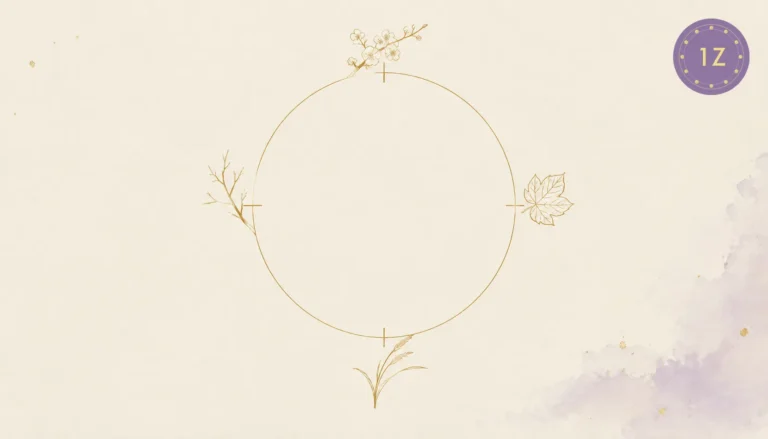
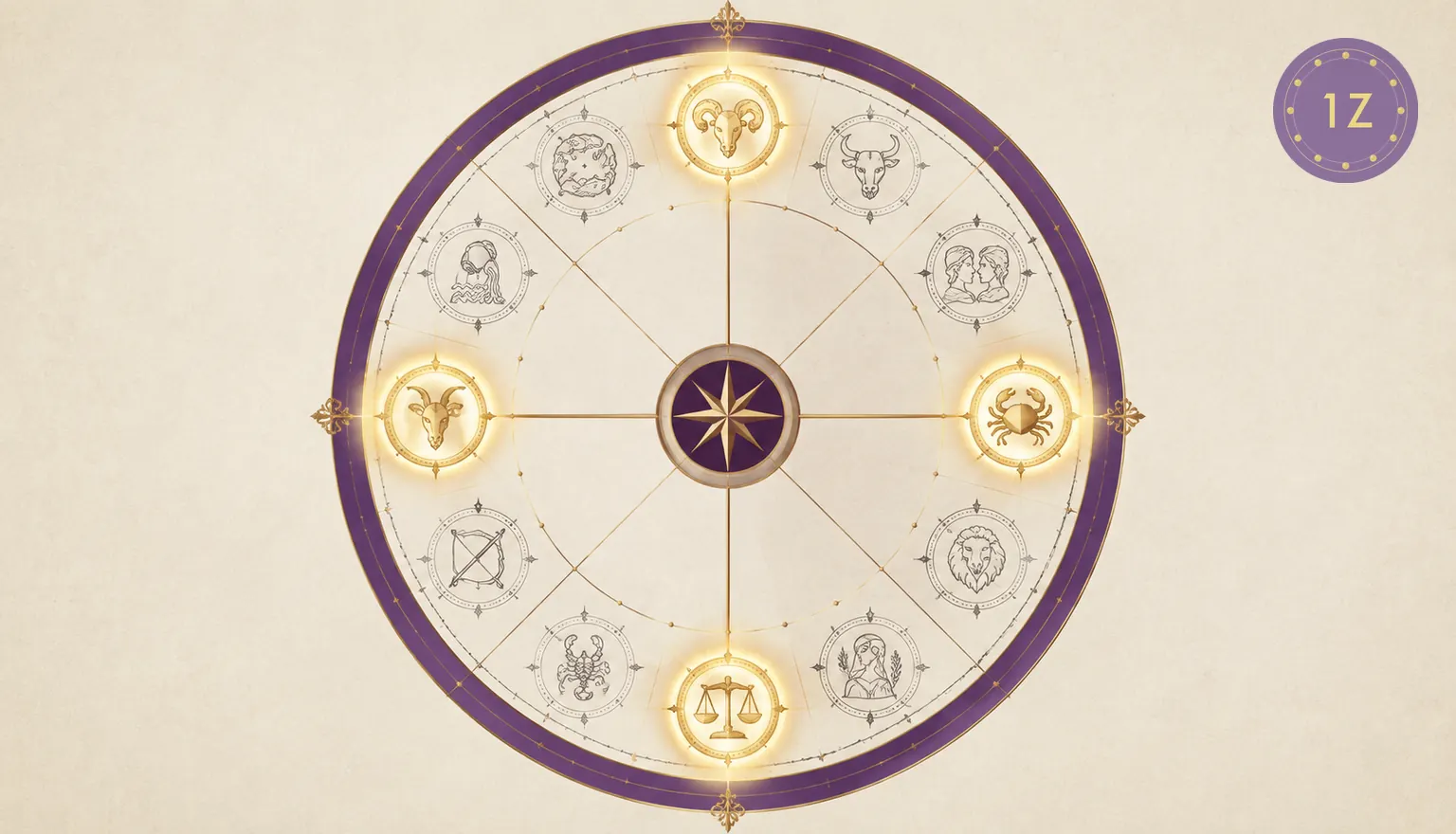

A Chinese zodiac wheel is the twelve animal seats arranged in cycle order (Rat first, Pig last), and each seat carries three fixed layers: an earthly branch, an element, and a direction; read it clockwise and you are reading year order, read it across and you are reading partnerships, because the wheel’s hidden structure is its clash lines, harmony pairs, and trine triangles. Most people only use the wheel to find their animal; the other 90% of the wheel is the useful part.

Key Takeaways
- The wheel’s cycle order is fixed: Rat, Ox, Tiger, Rabbit, Dragon, Snake, Horse, Goat, Monkey, Rooster, Dog, Pig, then back to Rat.
- Each seat carries an earthly branch (Rat is Zi, 子), and the branches are where the real interactions live.
- Six clash lines run straight across the wheel (diameter pairs, six years apart); three trine triangles connect every fourth seat.
- Across our 78-pair dataset, 48 pairs (62%) share no classical interaction at all, so most pairings read as neutral, not dramatic.
- A wheel reading without the interaction layer is a birth-year lookup, not an analysis.
The Wheel’s First Layer: Order and Why the Rat Leads
The cycle order never changes, and the order itself is data. The founding legend says the Jade Emperor ranked the animals by a river-crossing race, and the Rat won it by riding the Ox and jumping off at the bank. Strip the legend and the order still encodes something real: the twelve branches map onto the wheel’s positions the way clock numbers map onto a clock face, with the Rat’s Zi (子) seated at the top in classical charts, pointing north and holding the first hour of the day (23:00 to 01:00).
If you were born in a Rat year (1996 for example gives the pillar Bing Zi), your seat is the wheel’s anchor position. In my experience teaching wheel readings, students memorize the animals first and the branches never, which is like memorizing a clock’s decoration instead of the numbers. When I teach it the other way around, branch first, animal as mnemonic, students stop losing their place within a week.
Learn the branches first, then, and use the animals as mnemonics.
The Wheel’s Second Layer: Elements and Directions
Each seat carries a fixed element and a direction, and this layer is what makes two wheels look identical but read differently. The Rat’s Zi is Water pointing north; the Horse’s Wu is Fire pointing south; the Rabbit’s Mao is Wood pointing east; the Rooster’s You is Metal pointing west. The four cardinal branches (Zi, Mao, Wu, You) sit at the four compass points, and three of them (Zi, Mao, You) are single-qi: one element each, no hidden stems mixed in. The Horse’s Wu is the classical exception: it holds cardinal south and pure Fire in character, but structurally it carries two stems (Ding Fire plus Ji Earth), as the table below shows. The remaining eight seats hold compound qi: a primary stem plus one or two hidden stems, like drawers inside a cabinet.
| Seat | Branch | Element | Direction | Qi structure |
|---|---|---|---|---|
| Rat | Zi (子) | Water | North | Single (Gui only) |
| Rabbit | Mao (卯) | Wood | East | Single (Yi only) |
| Horse | Wu (午) | South | Fire | Ding + Ji |
| Rooster | You (酉) | West | Metal | Single (Xin only) |
The cardinal four are the wheel’s load-bearing columns. Every serious clash line and every trine triangle in the third layer runs through or between these seats, which is why classical charting starts from them. In practice, when I read a chart for a client, the first question is not “what animal are you” but “which cardinal seat do you touch,” because the answer determines which interactions can even fire.
The cardinal four seats anchor every interaction on the wheel.
The Wheel’s Third Layer: Clash Lines and Trine Triangles
The interaction layer is where a wheel becomes a reading instrument. Two structures matter most, summarized below and unpacked after.
| Structure | Geometry | Members | Dataset score (method) |
|---|---|---|---|
| Six Harmony | 6 mirror folds (method) | Rat-Ox 94, Tiger-Pig 95, Rabbit-Dog 94 | 94-95 |
| Six Clash | 6 diameters (opposite seats) | Rat-Horse, Ox-Goat, Tiger-Monkey | all exactly 38 |
| Four Trines | 4 triangles (every 4th seat) | Rat-Dragon-Monkey, Ox-Snake-Rooster, Tiger-Horse-Dog | intra-trine 88-89 |
First, the Six Clash lines: six straight diameters across the wheel, each connecting seats exactly six positions apart. Second, the Four Trines: four triangles, each connecting every fourth seat.
These are not decorations. Under our scoring framework, all six clash-pair diameters score exactly 38 points, the only relationship group with zero variance across all 78 pairs, while every intra-trine pairing scores 88-89, one tier below the 94-95 of the Six Harmony couples (full methodology here). The wheel’s geometry literally is the compatibility map: diameter equals friction, triangle equals alliance, and the Six Harmony pairs (like Rat-Ox, mirror seats that fold together across the wheel) equal the deepest bonds.
The pattern we see in practice: clients who learn the three layers stop asking “are we compatible” and start asking “which line connects us,” which is the right question, because the line type is the answer’s mechanism. In my experience, the trine triangle is the easiest structure to internalize first: four triangles, each covering a temperament family, and once you see them you cannot unsee them.
Diameters clash, triangles ally, mirror folds harmonize.
Reading a Real Wheel Step by Step
Here is the full procedure, compressed. Find your birth year’s animal and branch (the wheel’s outer ring). Check the element of your seat (second ring). Trace your clash line straight across the wheel: that seat’s natives share your friction axis, and the years that activate it come six-year cycles apart. Trace your trine triangle: the two other seats are your temperament allies. Finally, check whether your seat folds into a Six Harmony with its mirror seat across the wheel (Rat-Ox, Tiger-Pig, and four more): those are your secret-friend pairs.
A worked example: a 1996 Rat sits on Zi, Water, north. The Rat’s clash line runs straight to the Horse; its trine triangle connects Dragon and Monkey; its Six Harmony folds to the mirror partner Ox. That single seat now has its full partnership map: friction with Horse-year natives, alliance with Dragon and Monkey years, deepest bond with Ox years. Every other seat on the wheel, seven of them, reads as neutral toward the Rat, which matches the dataset’s arithmetic: 62% of the 78 pairs carry no classical bond at all, a figure our analysis of the full pairing set confirms every year.
One seat, four relationships, and everything else on the wheel is neutral.
Conclusion
Spin through the full pairing map on our compatibility hub and see which lines and triangles connect your seat to everyone you know.
What does the zodiac wheel actually mean, beyond finding your animal?
It is a relationship and timing instrument, not just a birth-year lookup. The outer ring gives your seat, but the working layers are the ones most wheels print faintly or omit: the branch interactions. Six diameter lines carry the clashes, four triangles carry the trine alliances, and six mirror folds carry the Six Harmony bonds. Read with those layers, the wheel answers mechanism questions (“why does this pairing feel frictional”) that a simple animal lookup cannot. Read without them, it is trivia.
How is the Chinese zodiac wheel different from the Western zodiac wheel?
The two wheels share the circular form and almost nothing else. The Western wheel divides the ecliptic into twelve star-sign sectors by month of birth; the Chinese wheel divides a twelve-year cycle by year of birth, and its seats are earthly branches rather than constellations. The Chinese wheel’s interactions are structural (branch-to-branch clash lines and trine triangles), not angular aspects. And the Chinese cycle is sexagenary: sixty distinct year pillars (stem plus branch) before the cycle repeats, so two Rats born twelve years apart share an animal but differ in stem.
Can a zodiac wheel reading override the birth chart?
No, and it was never designed to. A wheel reading is the compatibility-and-cycle layer of Chinese astrology, built from year branches; a full BaZi birth chart is the four-pillar analysis (year, month, day, hour) that the wheel’s single ring cannot reach. The wheel tells you which seats interact and when; the chart tells you what your own structure can hold. Used correctly, the wheel is the chart’s front door: a fast, visual triage that tells you which deeper questions are worth asking. Anyone promising wheel-level certainty about your life is reading the door as if it were the house.
Why do some zodiac wheels show different animals in the same seat?
Almost always it is the Vietnamese variant: the Vietnamese zodiac keeps the Chinese cycle’s twelve positions but seats the Cat in the fourth position where the Chinese wheel seats the Rabbit, a substitution traceable to a sound shift between the Chinese word for the Rabbit’s branch and a Vietnamese word for cat. Everything else on the wheel, including the branch positions and the interaction geometry, stays identical, so a reading transfers cleanly once you know which variant you are holding. I keep a Vietnamese wheel on my own desk precisely because it reminds me which system I am reading, and if a wheel shows any other animal substitution, it is an artist’s error, not a tradition.
Sources
- Chinese zodiac – Wikipedia: cycle order, branch assignments, sexagenary structure
- Chinese astrology – Britannica: directions, hours, and element associations per branch
- Cat (zodiac) – Wikipedia: the Vietnamese Cat-for-Rabbit substitution