
The Creek-Water Rabbit
乙卯 (Yi-Mao) · 大溪水 (Creek-Water) · Wood Stem
The Creek-Water Rabbit defines those born in 1915 and 1975 under the Yi-Mao (乙卯) pillar. While mainstream astrology often classifies this year as the Wood Rabbit based on its Heavenly Stem (乙 = Wood), its deeper NaYin (纳音) resonance is Creek-Water (大溪水) — blending wood’s core energy with water’s expressive quality. This grants supreme wisdom and exceptional adaptability, allowing them to find opportunity in change, yet also fosters volatility and indecisiveness. They embody the paradox of a placid surface concealing a powerful, ceaseless current.
A quick map: this is a Wood year by its Heavenly Stem (乙 / Yi), while its NaYin is Creek-Water (大溪水), a Water archetype — two parallel systems describing the same pillar, not a contradiction.
Quick Facts
| Years | 1915, 1975 |
| GanZhi | 乙卯 (Yi-Mao) |
| NaYin | Creek-Water (大溪水 Da-Xi-Shui) |
| Stem Element | Wood (乙) |
| NaYin Element | Water (大溪水) |
| Base Element | Wood |
| Lucky Numbers | 1, 6, 13, 49 |
| Lucky Colors | Blue, Black, Silver |
| Lucky Direction | North |
| NaYin Season | Winter |
| Trine Group | Fourth Trine (Rabbit, Goat, Pig) |
| Sexagenary Position | #52 of 60 in the Jia-Zi cycle |
| Lunar Year Dates | 1915: 1915-02-14 to 1916-02-03 1975: 1975-02-11 to 1976-01-31 |
| Six Harmony (六合) | Dog — Secret Friend |
| Three Harmony (三合) | Rabbit · Goat · Pig (Wood Trine) |
| Six Clash (六冲) | Rooster — Opposing Force |
| Five Element Cycle | Generated by Metal → Water generates Wood → Controlled by Earth |
Rabbit Element Variants Compared
| NaYin Variant | Stem Name | GanZhi | Years | Stem Element |
|---|---|---|---|---|
| Hearth-Fire Rabbit | Fire Rabbit | 丁卯 | 1927, 1987 | Fire |
| Wall-Earth Rabbit | Earth Rabbit | 己卯 | 1939, 1999 | Earth |
| Pine-Wood Rabbit | Metal Rabbit | 辛卯 | 1951, 2011 | Metal |
| Gold-Leaf-Metal Rabbit | Water Rabbit | 癸卯 | 1903, 1963, 2023 | Water |
| Creek-Water Rabbit | Wood Rabbit | 乙卯 | 1915, 1975 | Wood |
The rushing creek of their NaYin gives the Rabbit an unexpected current of momentum beneath a calm surface. They excel at diplomatic mediation where hidden tensions run deep, reading the room like a river reads its banks. This combination thrives in roles like conflict resolution or community organizing, where gentle persistence carves lasting change. Their edge comes from moving with steady force, not by pushing but by flowing around obstacles until the path opens naturally.
When the creek’s current turns inward, this Rabbit can become paralyzed by overthinking every ripple. The same sensitivity that reads others well may amplify self-doubt, making them hesitate at thresholds where a decisive leap is needed. Their desire for harmony can erode boundaries, letting others’ expectations wear them down like water on soft stone. The shadow side is retreating into safe shallows rather than risking the rapids of confrontation.
The NaYin: Creek-Water (大溪水 Da-Xi-Shui)
In classical Chinese astrology, each of the 60 year-stem combinations carries a specific NaYin (纳音, “assigned tone”) — a poetic elemental melody refining the Five Elements into 30 archetypes. The Creek-Water (大溪水) NaYin represents a unique expression of the water element.
Classical Sources
《三命通会》(Comprehensive Treatise on the Three Fates)
By 万民英 (Wan Minying), Ming Dynasty, 1587 — Volume 30, “On NaYin Elements”:
“大溪水者,惊涛拍石,奔流到海,不可以寻常水论。”
“乙卯,自死之水,虽处死地,却为雷,能发生万物,又乙庚合化,故皆主吉。”
Born in January or February?
There are two systems for determining your zodiac year. Folk tradition uses Lunar New Year (late Jan / early Feb). BaZi astrology uses Lichun (立春, Start of Spring, ~Feb 3–5). If your birthday falls in this boundary period, you might belong to the previous sign (Tiger) under one system but the Creek-Water Rabbit under another. Use our BaZi Calculator to determine your exact pillar based on Lichun.
Personality
In contemporary terms, the Creek-Water Rabbit embodies a paradox: they are simultaneously gentle and unstoppable. Their strength is not in dominating the stream but in choosing where to channel its flow. This is the quiet leader who transforms organizations not by demanding change but by making it the path of least resistance, carving new channels through persistent, undramatic effort.
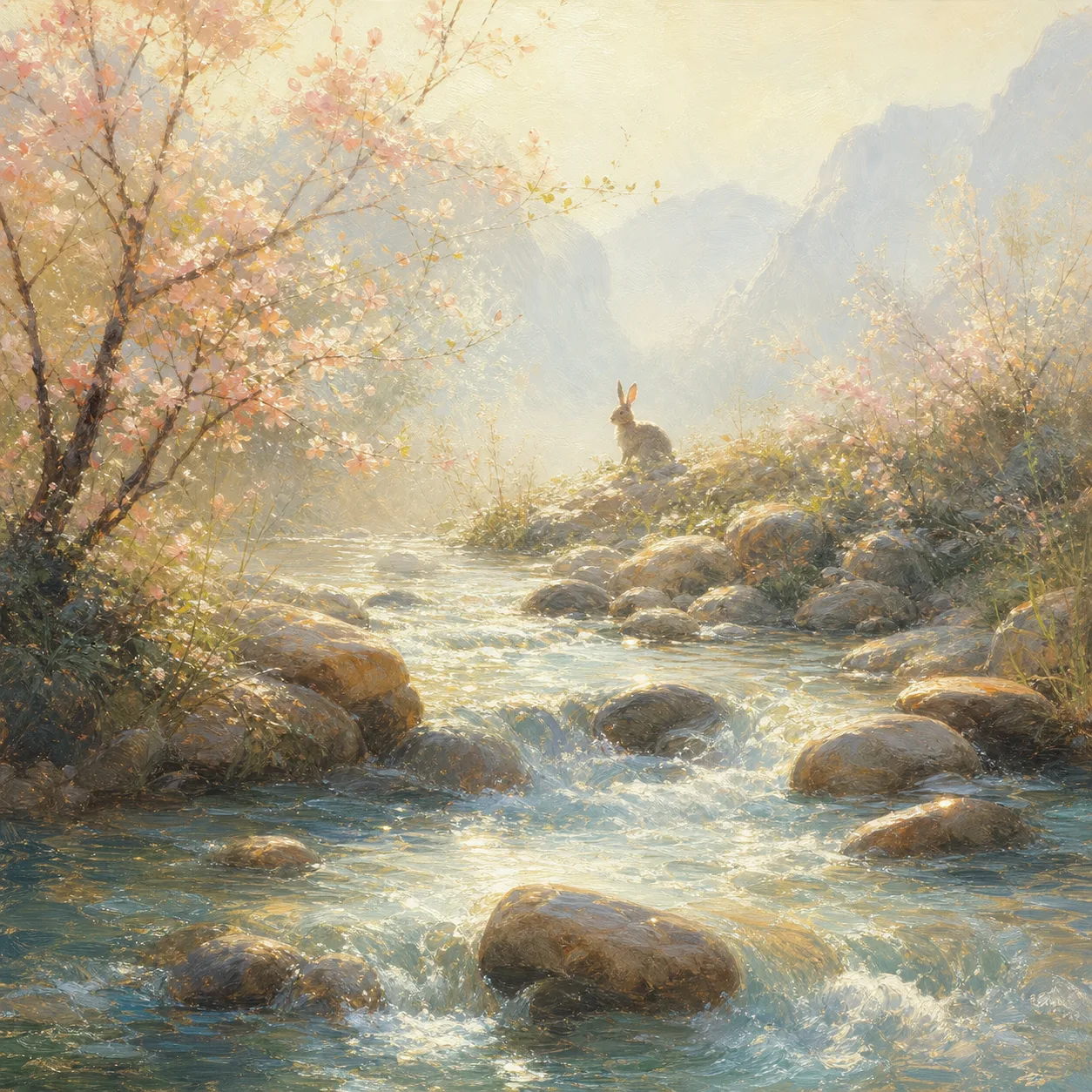
Imagine a mountain stream that has just emerged from a narrow gorge—crystal clear, yet carrying the memory of the cliffs it has tumbled through. This is the Creek-Water Rabbit (乙卯, 大溪水 (Da-Xi-Shui)). The Rabbit’s natural grace and diplomacy flow here not as a gentle brook but as a current with hidden depth, a quiet force that can reshape the landscape. The NaYin of 大溪水, ‘Water of a great stream,’ gives this Rabbit a resilience that is not flashy but persistent, like water wearing down stone over centuries.
As the Sanming Tonghui (三命通会) notes, this water is ‘self-dead water’ (自死之水), yet it is also thunder—capable of awakening all things. This paradox lies at the heart of the Creek-Water Rabbit: outwardly calm and refined, inwardly charged with creative potential. The heavenly stem 乙 (Wood) and the earthly branch 卯 (Rabbit) are both Wood, creating a double-wood foundation that amplifies the Rabbit’s natural sensitivity and intuition. But the water of the NaYin softens this Wood, making it flexible rather than rigid. This Rabbit bends, but does not break; they adapt, but never lose their essential nature.
The classical text further tells us that 乙庚合化 (the combination of乙 and Geng) brings good fortune. This is key: the Creek-Water Rabbit’s destiny is tied to synthesis and partnership. They are not meant to stand alone but to merge their energies with others, like a stream joining a river. Their wisdom is social, their power relational. Yet this very strength can become a vulnerability—they may lose themselves in the currents of others’ expectations, their own voice drowned by the roar of the stream.
The paradox of the Creek-Water Rabbit is that their greatest asset—their fluid adaptability—can also be their greatest challenge. They are masters of soft power, but must guard against becoming so yielding that they forget their own direction. Like water, they can nourish or erode; the choice is theirs.
Love & relationships
In love, the Creek-Water Rabbit does not rush. They approach romance as a stream approaches a valley—with patience, seeking the path of least resistance, yet with an inexorable certainty. Their love language is one of quiet attentiveness: a cup of tea brewed just so, a listening ear that never interrupts, a presence that is felt rather than declared. The 大溪水 (Da-Xi-Shui) quality adds depth to their emotions; they feel profoundly but express subtly, like underwater currents invisible from the surface.
Their ideal partner is someone who can match their depth without drowning them. The Dog (戌), as their Liuhe (六合) match, is a natural complement—loyal, grounding, and able to appreciate the Rabbit’s quiet intensity. Together, they form a union of water and earth, where the Dog’s stability contains the Rabbit’s flow. The Wood trine (Rabbit, Goat, Pig) also offers harmonious partnerships, especially with the Goat, whose creativity mirrors the Rabbit’s own, and the Pig, whose generosity soothes the Rabbit’s occasional melancholy.
But the Creek-Water Rabbit must beware of their own indecisiveness in love. They can become so attuned to their partner’s needs that they lose sight of their own. The same water that nourishes can also erode boundaries. They need a partner who not only receives their care but also reminds them to care for themselves. The Rabbit’s challenge is to love without losing themselves in the stream.
Career & professional path
The Creek-Water Rabbit’s career path is one of slow, steady accumulation—like a stream carving a canyon over millennia. They are not suited to fields that demand rapid, aggressive growth; their genius lies in long-term cultivation. Education, environmental science, publishing, and the arts are natural homes for their talents. The Wood stem gives them a nurturing quality, making them exceptional teachers and mentors, while the water NaYin endows them with strategic depth—they see the long game where others see only the immediate.
In the workplace, they are the quiet force that holds teams together. Their diplomacy defuses conflict, their adaptability finds solutions where others see dead ends. They excel in roles that require patience and precision: research, editing, curating, or any work that benefits from a gentle but persistent hand. The 大溪水 (Da-Xi-Shui) energy gives them a resilience that others may mistake for passivity—they do not burn out because they do not rage; they flow around obstacles.
Yet their career vulnerability is the same as their strength: they can become too accommodating, too willing to let others set the course. The Creek-Water Rabbit must learn to assert their own direction, to recognize when flowing around an obstacle means abandoning their own path. They need to find the balance between being a team player and being the architect of their own career. The Sanming Tonghui‘s mention of ‘thunder’ (雷) in the 乙卯 configuration is a reminder: within this gentle Rabbit lies the power to shake the world—if they dare to unleash it.
Health & wellness
For the Creek-Water Rabbit, health begins with the liver, the organ associated with Wood in Five Element theory. The liver governs the smooth flow of qi (energy) and emotions, and when it is out of balance, the Rabbit’s natural grace turns to frustration, their flexibility to rigidity. The water NaYin can help—water nourishes wood—but only if the Rabbit consciously maintains that flow. Stagnation is their enemy: emotional suppression, poor diet, or a sedentary lifestyle can dam up their vital energy.
Specific practices can keep their stream flowing. Regular stretching, especially of the tendons and ligaments (also ruled by Wood), is essential. Yoga, tai chi, or simply a morning routine of gentle movement can work wonders. Emotionally, they need outlets for their deep feelings—journaling, creative expression, or talking with a trusted confidant. The 大溪水 (Da-Xi-Shui) Rabbit must also guard against overindulgence in alcohol or stimulants, which can ‘flood’ the liver’s function. Sleep before 11 p.m. is non-negotiable: it is the time when the liver replenishes its energy. By tending to their inner stream, the Creek-Water Rabbit ensures that their water remains clear, their wood strong, and their life force abundant.
Wealth & finances
The Creek-Water Rabbit’s approach to wealth mirrors the 大溪水 (Da-Xi-Shui): steady, patient, and cumulative. They are not speculators; they are builders. Their financial strength lies in long-term investments, systematic savings, and assets that appreciate slowly—real estate, blue-chip stocks, or their own education. The Wood stem gives them a natural inclination to ‘grow’ their wealth, like a tree adding rings year by year. They are also generous, often finding that giving—to charity, to family, to causes—brings unexpected returns, as though the universe rewards their open hand.
But the Creek-Water Rabbit must beware of one pitfall: their indecisiveness can lead to missed opportunities. They may see a promising investment but hesitate until the moment passes. Or they may be too trusting, lending money to friends without clear terms, only to find their generosity exploited. The water NaYin’s ‘stream’ quality also warns against scattering their resources too thinly—like a river that braids into many channels and loses its force. The key is focus: one clear financial channel, deepened over time, will carry them farther than many shallow streams. With discipline, their wealth, like a great river, will eventually reach the sea.
Growth & self-development
The Creek-Water Rabbit’s greatest growth edge is learning to say ‘no’—to prune the branches that drain their energy so that the trunk can grow strong. Their natural tendency is to say ‘yes’ to everyone, to flow in whatever direction the terrain suggests. But a stream that spreads too thin becomes a marsh; a tree that never prunes becomes a tangled bush. The Sanming Tonghui reminds us that this water is ‘self-dead’—it carries within it the seed of its own transformation. To grow, the Rabbit must embrace a kind of death: the death of the need to please, the death of the fear of conflict.
A specific practice: once a week, the Creek-Water Rabbit should sit with a journal and ask, ‘What am I doing out of obligation rather than desire?’ Then, they must have the courage to let one of those obligations go. This is not selfishness; it is the discipline of the stream that knows its course. When they learn to channel their energy with intention, their gentle power becomes formidable. They transform from a good Rabbit into an extraordinary one—a being whose quiet presence can move mountains, not by force, but by the patient, inexorable flow of a life lived with purpose.
Creek-Water Rabbit Years
| Year | GanZhi | Type | Details |
|---|---|---|---|
| 1915 | 乙卯 | Creek-Water Rabbit | View Profile → |
| 1975 | 乙卯 | Creek-Water Rabbit | View Profile → |
Famous Creek-Water Rabbits
Notable figures born in 1915, 1975.
Oscar winner; diplomatic grace combined with fierce compassion.
Oscar winner, Titanic, The Reader, Eternal Sunshine.
Oscar winner, Monster, Mad Max: Fury Road.
Ol' Blue Eyes, Chairman of the Board, 9 Grammys, Oscar winner.
15-time major champion; precision and patience in the most mental sport.
Football icon; style and diplomatic appeal on and off the pitch.
A Six Harmony (六合) match — the secret friend combination, naturally aligned in energy and purpose.
Frequently asked questions
What does it mean to be born a Creek-Water Rabbit?
Being born a Creek-Water Rabbit, with the Gan-Zhi 乙卯 and NaYin 大溪水, means you possess the gentle, diplomatic nature of the Rabbit amplified by the fluid, adaptable energy of Creek Water. Those born in 1915 or 1975 are known for their keen intuition, artistic sensitivity, and a calm exterior that hides deep emotional currents. The water element makes you exceptionally empathetic and persuasive, able to navigate social situations with grace. However, you may also be prone to mood swings and a tendency to withdraw when overwhelmed, needing periods of solitude to recharge.
What hidden sides of the Creek-Water Rabbit’s personality surprise others?
Beneath the Creek-Water Rabbit’s serene surface lies a surprising resilience and strategic mind. The 乙卯 combination, with its 大溪水 NaYin, grants you a quiet determination that can be mistaken for passivity. Others are often shocked by your ability to make bold, decisive moves when necessary, especially in career or financial matters. You also possess a dry, witty humor that emerges in trusted company, contrasting with your usual diplomatic demeanor. This duality—soft yet strong, calm yet sharp—makes you an intriguing and underestimated presence.
What does a Creek-Water Rabbit need from a partner?
A Creek-Water Rabbit, born under 乙卯 with 大溪水, needs a partner who offers emotional security and intellectual stimulation. You thrive with someone who respects your need for personal space and quiet reflection, yet can engage you in deep, meaningful conversations. Loyalty is paramount; you detest betrayal and superficiality. Your ideal match provides a stable home base while encouraging your creative pursuits. Compatibility is high with Goat, Pig, or Dog signs, as they complement your gentle nature and share your appreciation for harmony and affection.
How does the water element channel the Rabbit’s ambition?
The water element of 大溪水 channels the Rabbit’s ambition into a steady, flowing pursuit rather than aggressive competition. As a Creek-Water Rabbit (乙卯), you set long-term goals and work patiently towards them, adapting to obstacles like a creek finding its path. This makes you successful in careers requiring diplomacy, negotiation, or creative problem-solving. Your ambition is not for power but for security, comfort, and the ability to help others. You achieve through persistence and networking, using your natural charm to open doors without burning bridges.
How does the water element affect Rabbit’s physical vitality?
The 大溪水 NaYin bestows the Creek-Water Rabbit with a generally robust constitution, but the water element also governs the kidneys and urinary system. Those born in 乙卯 years like 1915 and 1975 should pay attention to hydration and avoid excessive salt or alcohol. You have moderate energy levels, preferring steady activity over bursts of exertion. Regular, gentle exercise like swimming or tai chi helps maintain your vitality. Emotionally, stress can manifest as fatigue or lower back issues, so managing your emotional health is key to physical well-being.
What abundance mindset benefits the Creek-Water Rabbit?
For the Creek-Water Rabbit (乙卯, 大溪水), an abundance mindset rooted in gratitude and generosity attracts prosperity. Your Creek Water nature flows best when you share resources and opportunities, trusting that more will come. Hoarding or fearing lack creates stagnation. Embrace collaboration over competition; your diplomatic skills can build networks that yield mutual benefits. Cultivate a belief in life’s richness—this opens you to creative projects, unexpected income streams, and supportive relationships. Remember, water nourishes everything it touches, so giving freely enhances your own flow.
Which life stages bring transformation for Creek-Water Rabbits?
Creek-Water Rabbits (乙卯) experience significant transformations around ages 24, 36, and 48, corresponding to cycles of the Rabbit’s twelve-year zodiac. In your mid-20s, you may shift from dependency to independence, often through education or travel. Around 36, career and family priorities realign, possibly leading to a major change in profession or location. By 48, a deep spiritual or creative awakening occurs, prompting you to pursue passions set aside earlier. These periods are marked by emotional growth and increased self-awareness, guided by the adaptable nature of 大溪水.
How can Creek-Water Rabbits harness Fire Horse momentum positively?
When a Fire Horse year arrives (e.g., 1966, 2026), the Creek-Water Rabbit (乙卯, 大溪水) can harness its dynamic energy by channeling passion into structured projects. The Fire Horse’s intense drive may overwhelm your gentle nature, but you can use your water element to temper and direct that fire. Focus on creative endeavors, networking, or starting new ventures—your adaptability turns chaos into opportunity. Avoid impulsive decisions; instead, plan carefully and use your diplomatic skills to mediate conflicts. The key is to ride the wave without losing your center, letting the Horse’s momentum carry you toward your long-term goals.
Why is 1915 called Creek-Water Rabbit instead of Wood Rabbit?
In mainstream Chinese astrology, 1915 is often called the Wood Rabbit because its Heavenly Stem 乙 (Yi) corresponds to Wood. However, the NaYin (纳音) system — a deeper layer of BaZi analysis — assigns this pillar the Creek-Water (大溪水) resonance. Both names refer to the same year: the Stem name (Wood Rabbit) describes its foundational energy, while the NaYin name (Creek-Water Rabbit) reveals its poetic-spiritual quality.
Want Your Personal Reading?
Get your complete BaZi chart with all four pillars, NaYin analysis, and life chapters.
Open Free BaZi Calculator →