
Hanlu (寒露), Cold Dew, begins in 2027 at the precise moment of 20:17 on October 8, Beijing time (UTC+8), when the sun reaches 195° celestial longitude. It is the seventeenth of the 24 solar terms: the dew that shone white at White Dew a month ago now reads cold, and the calendar enters its last autumn month.

Key Takeaways
- Hanlu 2026 arrived at 14:29 on October 8; Hanlu 2027 begins at 20:17 the same date, both computed to the minute at 195° celestial longitude
- The name is a temperature verdict: White Dew’s condensation “is about to turn to frost” at Hanlu, the classical gloss reads, one step before Frost’s Descent
- Hanlu opens the Dog month (戌月) in BaZi charts, the final Earth-dominant month of the solar year, switching at the exact solar term minute
- The term’s classic table pairing is chrysanthemum wine and climbing hills, the Double Ninth Festival’s orbit around this fortnight
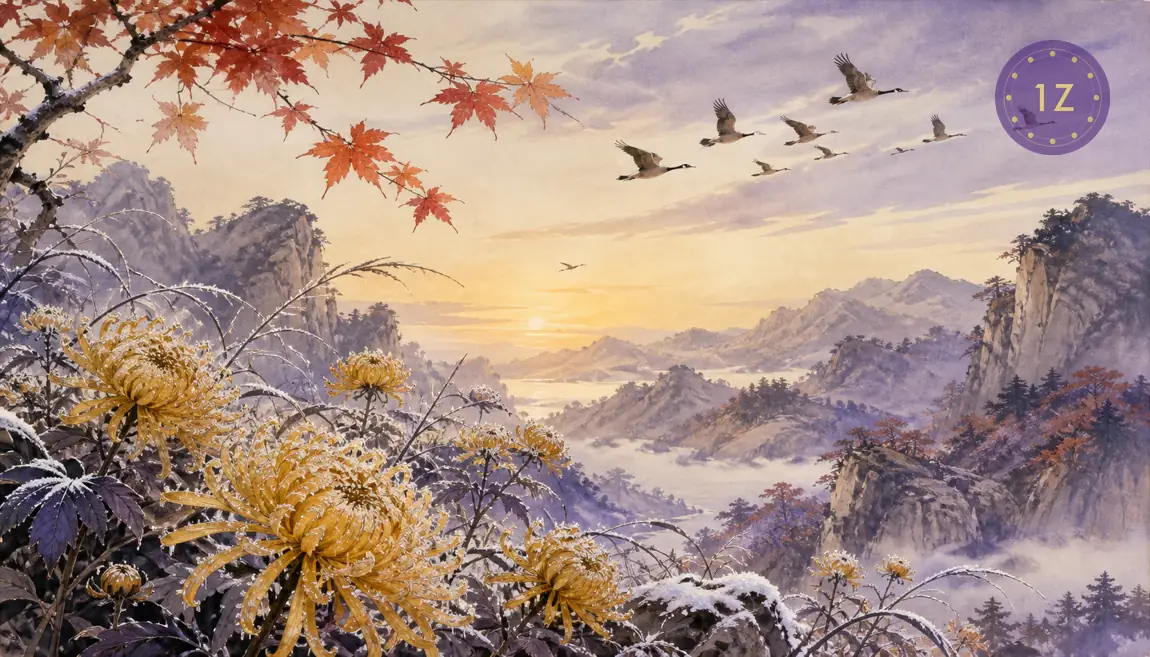
- Wild geese finish their southbound migration in the term’s phenology: the last skeins pass as resident birds vanish into quiet
What Is Hanlu, the Cold Dew Solar Term?
Hanlu is the fifth and last-but-one term of autumn, arriving after the Autumn Equinox and before Frost’s Descent. The name upgrades White Dew’s observation by one degree of severity: the Yueling Qishier Hou Jijie gloss says the dew air is now cold and about to congeal (露气寒冷,将凝结也), meaning the same morning droplets that scattered white light in early September now bite the hand, a month from hardening into frost. The farmers’ version tracks the wardrobe: “White Dew hides the body, Cold Dew adds frost to the feet” (白露身不露,寒露脚不露), the saying that retires the last sandals of the year.
The term closes the great autumn sequence. Summer’s residual heat, the tiger that almanacs call the autumn tiger, has fully surrendered by this fortnight; north China’s days run dry and clear, the sky at its highest annual ceiling, while the south dries out of its autumn rains. The calendar’s attention turns from harvest to storage, and the festivals of the season follow it uphill: the Double Ninth Festival, with its climbing and chrysanthemum rites, orbits around this window. The Wikipedia Hanlu entry holds the astronomical frame, and the term system carries UNESCO intangible cultural heritage status.
The Exact Moment Hanlu Begins in 2026 and 2027
Calendars print “October 8 or 9”; the almanac engine gives the minute, and at Hanlu the minute is the Dog-month boundary:
| Year | Exact Moment (UTC+8) | Sun’s Celestial Longitude | Month Pillar Switch |
|---|---|---|---|
| 2026 | October 8, 14:29 | 195° | Ding You (丁酉) → Wu Xu (戊戌) |
| 2027 | October 8, 20:17 | 195° | Ji You (己酉) → Geng Xu (庚戌) |
Both instants come from the 12Zodiacs almanac engine on JPL DE440s ephemeris data. The 2027 moment converts to 12:17 UTC, early morning in the Americas on the same date: another term the whole world shares by calendar day. The six-hour annual drift is the tropical year’s familiar quarter-day surplus.
In BaZi terms the switch is the Rooster month giving way to the Dog month, pure yielding Metal giving way to Earth with Metal and Fire hidden inside. Charts dated October 7, 2027 belong to the Rooster month; from October 9 onward, the Dog month applies, and the boundary day itself is decided at 20:17 to the minute. The 12Zodiacs daily almanac publishes the switch instant.
The Three Pentads: Last Geese, Clams, and Fading Birds
The Yizhoushu phenology for Hanlu reads as autumn’s closing movements:
| Pentad | Chinese | English | Phenology Type |
|---|---|---|---|
| First (days 1-5) | 鸿雁来宾 | The last wild geese arrive as guests | Animal |
| Second (days 6-10) | 雀入大水为蛤 | Sparrows vanish into the sea, transformed into clams | Animal |
| Third (days 11-15) | 菊有黄华 | Chrysanthemums show their yellow blooms | Plant |
The first pentad completes the migration ledger that Bailu opened: the geese that arrived there were the vanguard, these are the guests, the final skeins straggling south after the main wave, and the classical commentary treats the wording as precise. The second pentad is the calendar’s last transformation entry of the year: sparrows thin from the hedgerows as the shorebirds fatten on the autumn mudflats, and the old observers wrote the exchange as one creature becoming another. The third needs no explanation at all: chrysanthemums open exactly now, and every Double Ninth poem about yellow blooms is anchored to this fortnight. What stands out about the set is its valedictory tone, arrivals ending, small birds departing, one flower holding the field alone.
Chrysanthemum Wine, Climbing Hills, and the Double Ninth Orbit
Hanlu’s customs borrow the Double Ninth Festival whenever the lunar calendar drops it into the fortnight:
| Custom | Practice | Logic |
|---|---|---|
| Climbing hills (登高) | Ascending heights with family on the Double Ninth | Escape the lowland chill; the high view of stored fields |
| Chrysanthemum wine (菊花酒) | Drinking wine steeped with the term’s fresh blooms | The flower that defies frost, taken in as courage |
| Dogwood sachets (佩茱萸) | Wearing cornel sprigs | Pungent wards against the season’s first illnesses |
| Autumn fishing the edges (秋钓边) | Angling where sun-warmed shallows meet deep water | Fish retreat to the warm rim as ponds cool |
| Eating sesame (吃芝麻) | Sesame sweets and pastes | Moistening dryness, the kitchen answer to autumn’s air |
| Crab and persimmon | The season’s table | Crabs fatten, persimmons sweeten after first cold nights |
The chrysanthemum carries the term’s whole personality. It is the flower that blooms as everything else shuts down, which is why the classical tradition made it the scholar’s late-season emblem and the festival’s drink in the same stroke: the Tang poet Tao Yuanming’s chrysanthemum fence is quoted at every Double Ninth, and the wine was believed to steady the eyes and the spine against the coming winter. The custom has a practical shadow, too, in the farming calendar’s rhythm of work ending and stores holding. We recommend the climb over the wine, honestly: the view is the part that never disappoints, and the flower marks the date whether or not anyone brews it.
Hanlu in Your BaZi Chart: The Dog Month Opens
For BaZi practice, Hanlu is the boundary that opens the Dog month (戌月), the last month governed by an Earth branch this solar year. In the 2027 season the switch at 20:17 on October 8 moves the month pillar from Ji You (己酉) to Geng Xu (庚戌), and the technical contrast across the line is the season’s sharpest: the Rooster branch holds one pure hidden stem, Xin Metal, while the Dog branch hides a full storehouse, Wu (戊) Earth dominant, Xin (辛) Metal secondary, and Ding (丁) Fire residual.
The classical name for branches like Xu is the tomb or storehouse (墓库), the vault where a season’s element is banked before winter. Autumn’s Metal does not vanish at Hanlu; it is filed into the Earth, with a pilot light of Fire kept in the vault, and that structure explains why Dog-month weeks read as consolidation rather than decline: the year’s harvest logic moves from taking in to locking down. Earth Day Masters find the month stabilizing, and charts heavy in Metal read the stretch as the season paying itself out slowly. In Mei Lin Chen’s practice, the Hanlu fortnight is the last strong window of the year for closing real-estate and family-asset matters, the Earth-vault month matching the paperwork’s nature; one Metal-heavy client made it a standing rule to sign before Frost’s Descent, and the habit outlived the reasoning behind it. The Dog year pages profile the branch in full, and the auspicious dates calendar applies the boundary to planning.
What to Do Around Cold Dew
Practical guidance for the term:
- Retire the bare feet for good. The saying closes the season: after Hanlu no sandals, no light shoes, and the ankles join the neck and wrists on the covered list.
- Eat toward oil and moisture. Sesame, honey, white fungus, and pears answer the drying air; the crab and persimmon of the stall can join in rotation rather than together, the old caution about mixing them surviving as folklore.
- Take the climb while the sky holds. The term’s high clear days are the year’s best visibility in much of China; the haze of winter has not arrived and the mosquitoes are gone.
- Check October birthdays against the minute. Charts near October 8-9 straddle the Rooster-Dog boundary; the BaZi calculator resolves the side in one step.
- Start the store, not the venture. The month’s classical character is the vault: openings can wait for winter’s Water months, consolidations and filings belong to now. In practice, the difference between signed in the Dog month and signed in the Rat month is the difference between banking and borrowing.
Why do some sources call Hanlu the true start of cold while others wait for Frost’s Descent?
The two terms grade the same physical process one step apart. Hanlu records the dew turning cold, still liquid, one register above freezing; Frost’s Descent, three weeks later, records the droplet hardening into visible frost. The classical gloss is explicit about the sequence, saying Hanlu’s dew air is about to congeal, and the health traditions split their advice the same way, wardrobe warnings at Hanlu, warming therapies from Frost’s Descent. Regions calibrate differently as always, south China still runs mild at Hanlu while the north edges toward first frost, which is why national tables print both terms and let latitude choose.
How does the Dog month differ from the other Earth months?
Each season banks its element into an Earth branch at its close, but the Dog month’s vault has a distinguishing feature: it is the only autumn Earth branch, and it hides Fire in residual position. The Dragon and Ox branches hold Water and Metal connections respectively with their own mixed stems, but Xu pairs its dominant Earth with both the season’s Metal and a trace of the Fire that summer left behind. Practitioners read charts with strong Dog-month placement as natural consolidators, people whose instinct is to store, secure, and maintain rather than launch, and the classical texts give the branch the guardianship role in the zodiac family for exactly this temperament. The storehouse opens only under specific interactions, which is why Dog-month matters tend to conclude rather than generate.
Can charts born on the Hanlu boundary day change month pillars within hours?
Yes, and October 8 gives the clean demonstration: the 2027 switch lands at 20:17, so a birth at noon that day belongs to the Rooster month and one at night belongs to the Dog month, same calendar date, two different hidden-stem structures. The boundary is not the exception but the rule, every boundary term produces such evenings somewhere in its cycle, and printed almanacs that round to the day assign the wrong pillar to the entire daylight side. Families checking October birthdays should use minute-level tables, and the calculator resolves them from the engine’s exact solar term instants automatically.
Conclusion
Hanlu is autumn counting its coins: dew gone cold, geese gone south, chrysanthemums standing alone yellow in the fields, and the year’s harvest moving into the vault. The 2027 term arrives at 20:17 on October 8 Beijing time, the Dog month opens at that minute, and the hills are worth one more climb before winter haze. To see how the vault month frames your own chart, try the 12Zodiacs BaZi Calculator, and for every term boundary through the winter, follow the Tung Shing almanac.
Sources
- Hanlu, Wikipedia (term definition, dates)
- Cold Dew, China Culture, Ministry of Culture (customs, official English terminology)
- The Twenty-Four Solar Terms, UNESCO Intangible Cultural Heritage (heritage listing)
- Solar term timing data computed by the 12Zodiacs almanac engine (JPL DE440s ephemeris)