
Your Academic Star (Wen Chang, 文昌) sits at one fixed branch decided by your day stem, and the full lookup takes ten seconds once you know your day pillar. The star marks where study, certification, and clean writing flow with less friction in your chart; it is a flavor layer over the structure, not an intelligence score. Below you will find the complete ten-stem table, what the star adds to a reading, and the exact windows when it lights up, including the one day stem whose study star stays lit for all of 2026.

Key Takeaways
- The Academic Star (Wen Chang, 文昌) is one of the four symbolic star types our framework tracks in a BaZi chart, looked up from your day stem, never guessed from personality.
- All ten day stems map onto eight branch seats: Si, Wu, Shen, You, Hai, Zi, Yin, and Mao.
- The four storage branches (Chen, Wei, Xu, Chou) host no Academic Star seat at all.
- A star activates only when a flowing period carries its seat branch, so the same year lights different stars for different people.
- In 2026 (Bing Wu), Yi Wood day masters keep the star lit for the whole year; in 2027 (Ding Wei), the year branch matches nobody’s seat.
- Finding yours requires your day pillar, not your zodiac animal; our BaZi calculator gives you both in one step.
What the Academic Star (Wen Chang) Means in a Birth Chart
The Academic Star belongs to the symbolic star family (Shen Sha, 神煞), the layer of BaZi that tags specific stem-branch positions with thematic meaning. Classical tradition personified the seat as Wenchang, the patron of literature and examinations, and the Four Pillars system carries that association into chart reading today. In a modern chart, the star flags talent for study, structured learning, exams, and putting thoughts into clear writing.
What the star is not matters just as much. It does not measure raw intelligence, it does not guarantee a diploma, and it never overrides the structural reading of element balance and branch relationships. We treat it as an accent, the way a well-lit desk corner helps you work without deciding what you produce. The lookup behind it is entirely mechanical, which is the point: ten day stems, ten fixed answers, no interpretation required to place it.
In our framework the four symbolic stars split into two derivation families, trine-frame stars and day-stem stars, and the Academic Star belongs to the second family. That placement means your year animal alone cannot locate it. Your day stem can.
The Complete Day-Stem Table: All Ten Seats
The table below copies the mapping reviewed by Mei Lin Chen and reproduced by our tool for every chart. Find your day stem (the heavenly stem of your day pillar), then read across to your seat.
| Day stem | Academic Star seat | Branch animal |
|---|---|---|
| Jia (Yang Wood) | Si | Snake |
| Yi (Yin Wood) | Wu | Horse |
| Bing (Yang Fire) | Shen | Monkey |
| Ding (Yin Fire) | You | Rooster |
| Wu (Yang Earth) | Shen | Monkey |
| Ji (Yin Earth) | You | Rooster |
| Geng (Yang Metal) | Hai | Pig |
| Xin (Yin Metal) | Zi | Rat |
| Ren (Yang Water) | Yin | Tiger |
| Gui (Yin Water) | Mao | Rabbit |
Two sharing rules hold across the table, and the derivation behind every row is the same: the star marks the Lu, the official seat, of the day stem’s Eating God. Take Jia as the plain case: Jia’s Eating God is Bing, and Bing’s Lu sits at Si, hence the seat at Si. The two shared seats follow the same rule with one classical convention attached: for Bing and Wu day stems the Eating God is an earth stem, and the classical growth tables seat earth’s phases alongside water, landing the star at Shen; for Ding and Ji the tables seat earth’s phases alongside fire, landing the star at You. Everything else gets a private seat.
Counting the seats tells its own small story. Only eight of the twelve branches ever host an Academic Star: Si, Wu, Shen, You, Hai, Zi, Yin, Mao. The four storage branches (Chen, Wei, Xu, Chou) host no seat at all, and the reason is mechanical rather than poetic: no stem’s Lu seat stands in them, because the ten Lu seats occupy only eight branches. Take a Xin Metal day stem as a worked example: the table sends its seat to Zi, the Rat branch, and any chart carrying Zi in a pillar now knows where to look first.
What the Academic Star Adds to a Birth Chart Reading, Honestly Framed
A recurring pattern in our consultation files is that clients expect the Academic Star to behave like a grade, and it never does. The star adds a sensitivity: when its seat is present and especially when a period lights it, study-heavy seasons tend to run with less drag, and writing tends to organize itself faster. That is a tailwind, not a verdict, and the same logic holds across every scoring rule documented on our methodology page.
I have watched the difference play out with a 2005 Wood Rooster student in our case files. Her chart carried the detail-driven discipline of the Ox, Snake, and Rooster alliance, and she turned that discipline into anxiety-driven overachievement rather than easy marks. Her friends across the gentler Rabbit, Goat, and Pig trine were the ones who taught her pacing. The study star, wherever it sat, was never the engine; the structure was.
The pattern that emerges from cases like hers is about ordering, not strength. In practice, the star behaves like a named desk: it helps once someone actually sits at it, and it does nothing for a chart whose structure never walks over. Structure first, star second, and the star colors what the structure already carries. A chart with thin study structure gains little from a lit seat, and a chart built for scholarship barely needs the excuse. The star tells you where the desk sits, not whether you sit at it.
Activation: When the Academic Star Lights Up
The rule is mechanical across the whole symbolic star layer: a star activates only when a flowing period carries its seat branch, and it sleeps the rest of the time. A year branch persists for roughly twelve months, a day branch for its two-hour window, and a luck pillar for its ten-year run, so the same seat can glow briefly, yearly, or for a decade depending on where the match lands.
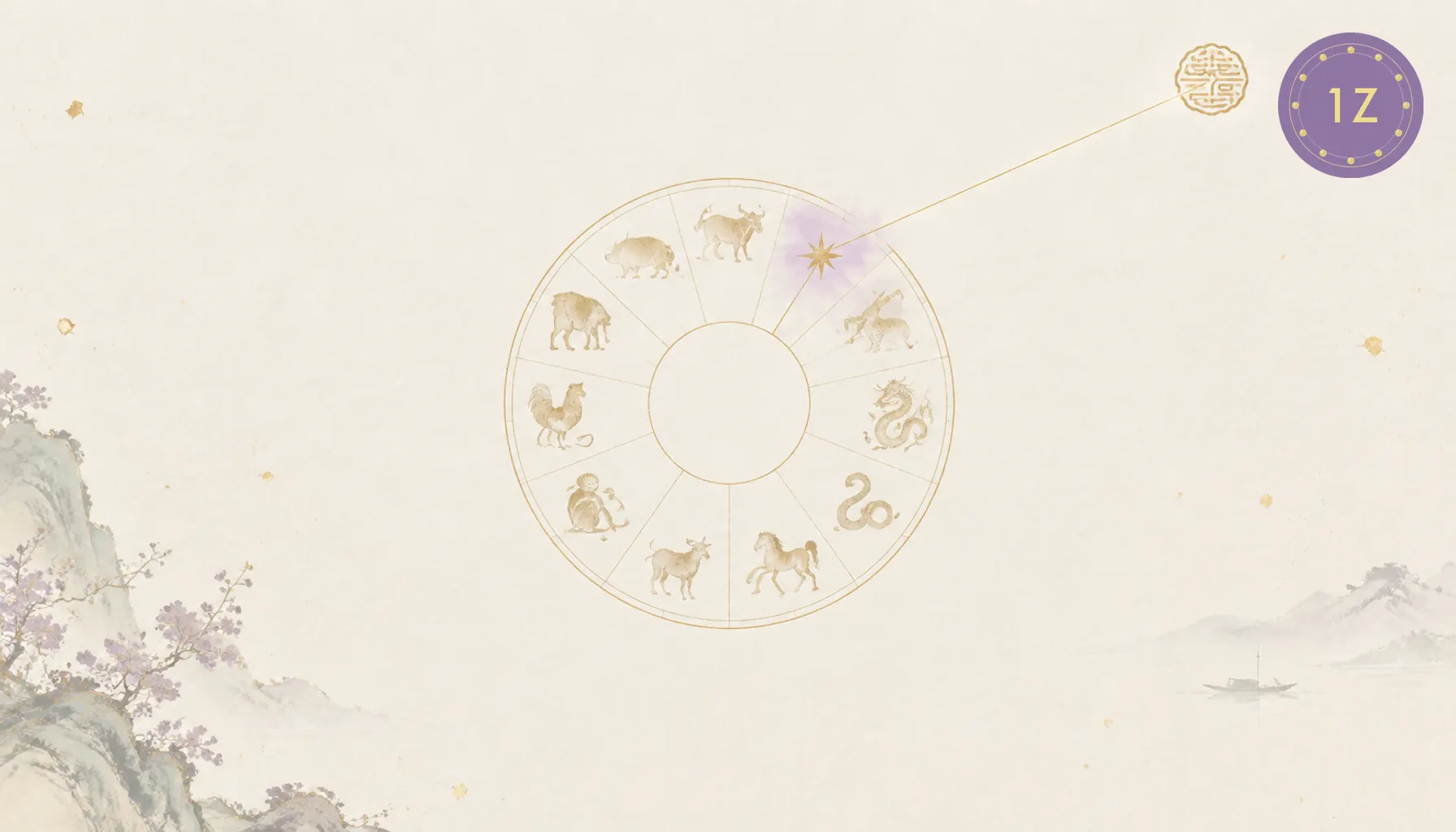
The current stretch makes the mechanics vivid. Our calendar engine pins every year pillar to the astronomical solar terms, cross-checked against Purple Mountain Observatory data, so the matches below are exact rather than approximate. 2026 runs as a Bing Wu year, and Wu happens to be the seat of exactly one day stem: Yi. For Yi Wood day masters, the Academic Star burns for the entire year. 2027 arrives as Ding Wei, and Wei belongs to the storage branches that host no seat, so the year branch matches nobody. 2028 hands the mic to Shen, which lights the shared Monkey seat for both Bing and Wu day masters.
| Year | Year pillar | Year branch | Whose star lights |
|---|---|---|---|
| 2026 | Bing Wu | Wu | Yi day masters only |
| 2027 | Ding Wei | Wei | nobody, from the year branch |
| 2028 | Wu Shen | Shen | Bing and Wu day masters |
Peach Blossom and the Travel Horse follow their own trine-frame activation calendar, which is why the same Horse year that lights one person’s desk lights another person’s social calendar. The annual stars breakdown walks that side of the ledger, and the two calendars never interfere with each other. The day-stem activation calendar is, in my reading, the most underused planning tool in the entire symbolic star layer.
A star that never meets its seat is not a broken promise. It is a room left unlit until someone walks in with a match.
How to Read the Academic Star in Your Birth Chart
- Find your day pillar. Your zodiac animal comes from your birth year, while your day stem comes from the day you were born.
- Read across the table. Match your day stem to its seat branch, then note which pillar of your chart carries that branch, because the seat’s location flavors where the study luck shows up.
- Check the current year’s branch. A year branch matching your seat means an active year for study plans, certifications, or any writing project that has been waiting for a tailwind.
Ten day stems, one fixed table, and a rule that never bends: that is the whole machinery. If the four pillars still feel new, our chart reading basics page lays the groundwork first. The Ten Gods layer adds the surrounding cast, and our Ten Gods table picks up exactly where the star lookup stops.
Is the Academic Star the same as the Intelligence Star in BaZi?
The two names usually point at the same star, but the naming noise is real and worth clearing up. English-language BaZi texts translate the same classical marker as the Academic Star, the Scholar Star, or the Intelligence Star, and a few charts also list a separately derived literacy marker tied to the month pillar. The lookup rule, day stem in, seat branch out, stays identical across the translations that follow the classical rhyme, which pairs Jia with Si, Yi with Wu, Bing and Wu with Shen, Ding and Ji with You, Geng with Hai, Xin with Zi, Ren with Yin, and Gui with Mao. That rhyme is the durable part. Names drift school by school; the ten-row table above does not, and any chart that quotes a different seat for your day stem is running a different table than the classical one. When you compare readings across sites, compare the lookup rule first and the label second, and keep month-derived markers in their own column because their derivation never mixes with the day-stem table.
Why does the Academic Star light up for only some people in the Horse year 2026?
Because activation is a matching problem, not a blessing that rains on everyone. The 2026 year pillar is Bing Wu, so the year branch is Wu, and Wu serves as the Academic Star seat for exactly one of the ten day stems: Yi. A Yi Wood day master spends the entire year with a lit study seat, while the other nine stems wait for a period that carries their own branch. The same geometry runs in reverse the next year: 2027 is a Ding Wei year, Wei is one of the four storage branches, storage branches host no Academic Star seat at all, so the year branch matches nobody and the layer goes quiet for everyone at the yearly level, while monthly, daily, and ten-year luck pillars still carry seats throughout. The window simply moves from twelve months wide to two hours or a decade deep.
I only know my zodiac animal. How do I find my Academic Star?
Your zodiac animal cannot locate your Academic Star, because the star reads off your day stem, and the day stem comes from your birth day rather than your birth year. The two systems rotate on different wheels: the year wheel makes one full turn in twelve years, while the day pillar completes its cycle of sixty stem-branch pairs in sixty days. That sixty-day rhythm is why a single zodiac-year cohort, everyone born across one year of the Horse for example, spreads across all ten day stems and the eight distinct Academic Star seats those stems map onto. Two Rat-year siblings born weeks apart can hold completely different study seats. This is also the fastest way to see why zodiac-level predictions feel generic: they describe the year’s weather, while your day stem locates your own desk inside it. Run your birth date through the BaZi calculator, read your day stem off the third pillar, and the table above does the rest in one line.
Conclusion
The Academic Star is the most mechanical corner of BaZi: ten day stems, eight seats, one activation rule, and zero guesswork once the table is in front of you. To find your day pillar and see whether 2026 lights your study seat, run your chart through our free BaZi calculator.
Sources
- Four Pillars of Destiny (Wikipedia): backs the four-pillar structure and the symbolic star layer described above.
- Wenchang (Wikipedia): backs the literary patron origin of the Wen Chang association.
- Chinese astrology (Britannica): backs the classical stem-branch framework the lookup table rests on.