
The Hearth-Fire Tiger
丙寅 (Bing-Yin) · 炉中火 (Hearth-Fire) · Fire Stem
The Fire Tiger (丙寅 Bing-Yin, Hearth-Fire 炉中火) corresponds to birth years 1926 and 1986. This combination tempers the Tiger’s natural boldness with the Hearth-Fire’s controlled, sustained energy, producing passionate charisma and natural leadership. However, the fire also fuels impatience and impulsiveness. Like a fire in a furnace, this Tiger possesses deep resilience and powerful influence when channeled, rather than seeking flashy displays of strength.
Quick Facts
| Years | 1926, 1986 |
| GanZhi | 丙寅 (Bing-Yin) |
| NaYin | Hearth-Fire (炉中火 Lu-Zhong-Huo) |
| Element | Fire (Fire Stem) |
| Base Element | Wood |
| Lucky Numbers | 2, 7, 18, 27 |
| Lucky Colors | Red, Orange, Purple |
| Lucky Direction | South |
| NaYin Season | Summer |
| Trine Group | Third Trine (Tiger, Horse, Dog) |
| Sexagenary Position | #3 of 60 in the Jia-Zi cycle |
| Lunar Year Dates | 1926: 1926-02-13 to 1927-02-02 1986: 1986-02-09 to 1987-01-29 |
| Six Harmony (六合) | Pig — Secret Friend |
| Three Harmony (三合) | Tiger · Horse · Dog (Fire Trine) |
| Six Clash (六冲) | Monkey — Opposing Force |
| Five Element Cycle | Generated by Wood → Fire generates Earth → Controlled by Water |
Tiger Element Variants Compared
| Variant | GanZhi | Years | Stem Element |
|---|---|---|---|
| Hearth-Fire Tiger ← You are here | 丙寅 | 1926, 1986 | Fire |
| Wall-Earth Tiger | 戊寅 | 1938, 1998 | Earth |
| Pine-Wood Tiger | 庚寅 | 1950, 2010 | Metal |
| Gold-Leaf-Metal Tiger | 壬寅 | 1902, 1962, 2022 | Water |
| Creek-Water Tiger | 甲寅 | 1914, 1974 | Wood |
Like a hearth fire that transforms raw fuel into steady warmth, the Hearth-Fire Tiger ignites bold visions with sustainable intensity. This combination excels at rallying teams around long-term missions—think startup founders who inspire loyalty through both charisma and consistent care. Their fire is never reckless; it’s the controlled blaze that powers a forge, turning raw ideas into tangible results. In crisis management or community organizing, they shine brightest when their passion is channeled into structures that benefit everyone nearby.
When the hearth fire burns unchecked, it consumes its own fuel source. This Tiger’s natural impatience can lead them to ignite too many projects at once, scattering their energy until the fire dims from lack of focus. They may struggle with delegating, insisting on stoking every flame themselves. The shadow side emerges when they prioritize being the center of warmth over ensuring the fire’s longevity—burnout becomes a real risk if they don’t learn to add fuel steadily rather than in desperate bursts.
The NaYin: Hearth-Fire (炉中火 Lu-Zhong-Huo)
In classical Chinese astrology, each of the 60 year-stem combinations carries a specific NaYin (纳音, “assigned tone”) — a poetic elemental melody refining the Five Elements into 30 archetypes. The Hearth-Fire (炉中火) NaYin represents a unique expression of the fire element.
Classical Sources
《三命通会》(Comprehensive Treatise on the Three Fates)
By 万民英 (Wan Minying), Ming Dynasty, 1587 — Volume 30, “On NaYin Elements”:
“炉中火者,天地为炉,阴阳为炭,颓光辉耀,力可熔金。”
“丙寅,赫曦之火,无水制之,则有燔灼炎炎之患,不可抑遏。”
Yan Dongsou (阎东叟) commented: “丙寅火,为禄元佑,发声则吉,禀赫曦之气,四时不能为害,物极必反。”
Born in January or February?
There are two systems for determining your zodiac year. Folk tradition uses Lunar New Year (late Jan / early Feb). BaZi astrology uses Lichun (立春, Start of Spring, ~Feb 3–5). If your birthday falls in this boundary period, you might belong to the previous sign (Ox) under one system but the Fire Tiger under another. Use our BaZi Calculator to determine your exact pillar based on Lichun.
Personality
The Hearth-Fire Tiger is a visionary who must learn that true power lies not in the initial spark but in the patient craft of sustaining momentum. In a world obsessed with viral moments, they thrive by building slow-burning movements—their challenge is to balance their tiger-like charge with the patience of a keeper who knows when to add coal and when to let embers glow.
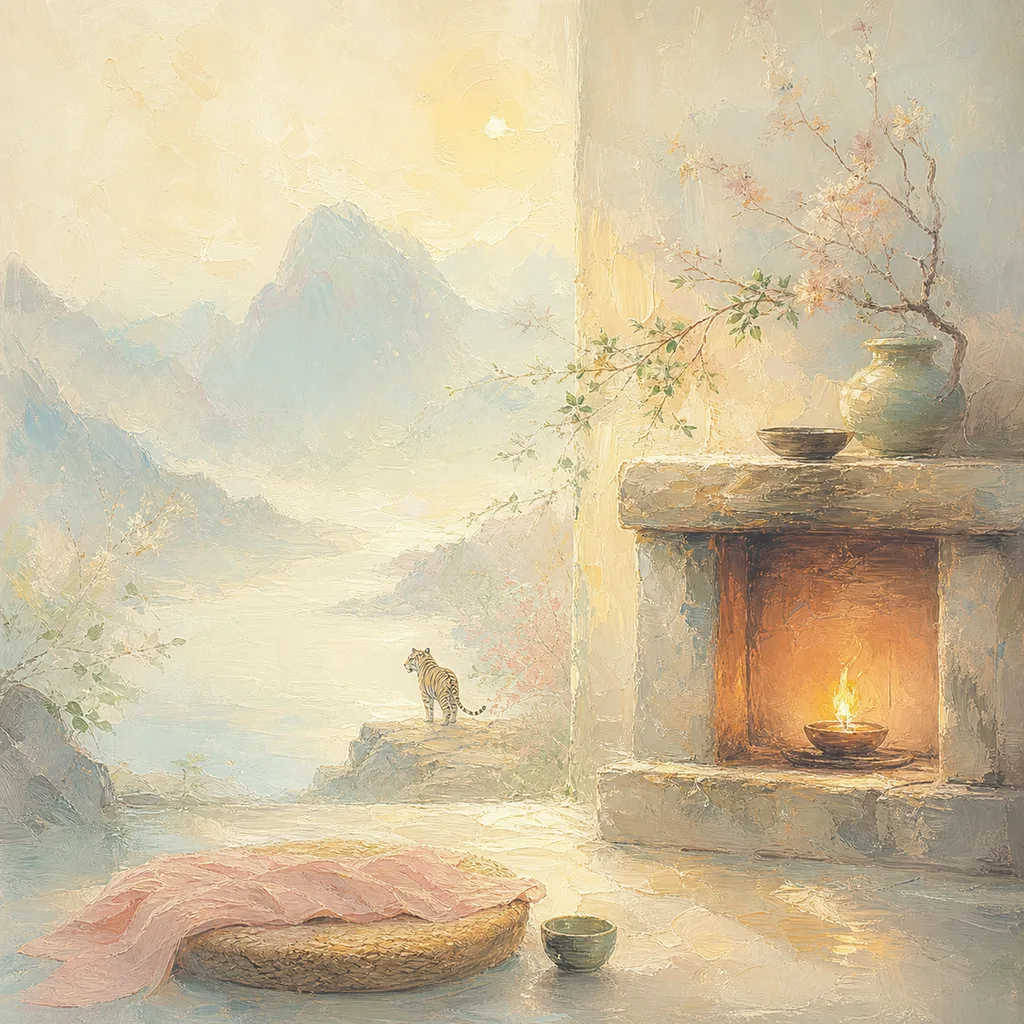
Imagine a forge in the deep of night—iron glowing within a clay furnace, smoke curling upward, sparks leaping like captive stars. That is the Hearth-Fire Tiger (丙寅): not the wildfire that ravages a forest, but the contained, transformative blaze that forges steel. The Tiger’s native wood feeds this flame, and the fire stem (丙, Bing) turns its raw courage into incandescent charisma. Where an ordinary Tiger might charge blindly, this one burns with purpose—yet the furnace’s walls remind it that unchecked heat becomes destruction.
The Sanming Tonghui (三命通会) calls this stem-branch pairing “赫曦之火” — a blazing, splendid fire that must be tempered by water. Without that cooling influence, it warns, “there is the danger of scorching and conflagration.” This is the Hearth-Fire Tiger’s eternal paradox: it is born to illuminate and transform, but its own intensity can consume what it loves. Its presence is magnetic, its laughter infectious, its anger volcanic. People are drawn to its warmth, then startled by its sudden flare.
Yet the Hearth-Fire image offers a deeper truth: this fire is not meant to burn wild. It is a domestic fire, a hearth-fire—the kind that cooks meals, heats homes, and draws families together. When the Tiger learns to contain its blaze within the furnace of discipline, it becomes a source of sustained light. The classical texts hint at this: “禀赫曦之气,四时不能为害” — endowed with the brightest of fires, it cannot be harmed by the seasons, provided it respects its own limits. This Tiger’s greatest strength is not its fierceness, but its ability to transform raw passion into enduring warmth.
Love & relationships
In love, the Hearth-Fire Tiger courts like a blacksmith at the anvil: with force, with heat, with the intent to shape something lasting. When this Tiger falls, it falls hard—grand gestures, bold declarations, a blaze that leaves no room for doubt. The fire stem makes it direct and impatient; it cannot stomach games or hesitation. It wants to possess and be possessed, and its passion is so vivid that partners often feel they have stepped into a myth.
But a hearth-fire needs fuel to keep burning. The Tiger’s enthusiasm can peak and plummet, leaving a beloved shivering in the ash. Its Liuhe (六合) match is the Pig, whose deep, accepting waters can absorb the Tiger’s heat without being scalded. The Pig teaches the Tiger that love is not a single conflagration but a banked fire, tended day by day. The Hearth-Fire Tiger must learn to stoke its flame gently—to let the other person add kindling, to allow embers to glow through silence. Otherwise, it burns out its partners, and itself.
Its love language is intense presence: a hand on the small of the back, a voice that drops to a growl, a sudden gift that says “I was thinking of you.” Yet its vulnerability is the fear that the fire will die—so it fans the flames ever higher, not realizing that a hearth-fire’s beauty lies in its steadiness. The Tiger who masters patient warmth finds a love that outlasts any wildfire.
Career & professional path
The Hearth-Fire Tiger belongs in careers where passion meets craft—where it can stoke a furnace and watch raw material turn to gold. Marketing, entertainment, design, and new media are natural arenas: they demand the Tiger’s charisma, its instinct for the dramatic, and its ability to ignite a crowd. The fire stem grants a gift for improvisation and a nose for what will catch fire next. In a boardroom or on a stage, this Tiger is electric.
Yet the NaYin image of the furnace warns: fire must be fed, but it must also be contained. The Tiger’s career vulnerability is short-lived enthusiasm. It will pour itself into a project with volcanic energy, then abandon it when the initial blaze dies down. Professions that require long, steady burns—research, enterprise-building, artistic creation—suit it only if it learns to bank its fire. The classical texts speak of this fire as “useful when controlled”; the Tiger must find the discipline to keep its furnace stoked even when no one is watching.
It thrives in roles where it can lead, inspire, and transform. Entrepreneurship, creative direction, or crisis management let the Tiger’s fire shine brightest. But it must surround itself with steady earth and water personalities—people who can feed the furnace without getting burned. The Hearth-Fire Tiger’s career arc is not a straight line; it is a series of forges, each one shaping it into something stronger.
Health & wellness
The Hearth-Fire Tiger’s vitality is immense, but its fire element (丙) governs the heart and small intestine, while the Tiger’s branch (寅) rules the liver, gallbladder, and nervous system. This is a combination that burns hot—too hot, if unchecked. Insomnia, palpitations, mouth ulcers, and a flushed complexion are signs that the furnace is overheating. The Tiger’s natural restlessness, amplified by fire, can lead to burnout if it does not learn to cool its own flames.
Wellness for this Tiger is about balance: not extinguishing the fire, but feeding it wisely. Cooling foods—mung beans, lotus seeds, lily bulb, cucumber—are its medicine. Meditation, Tai Chi, and calligraphy are its furnace doors, allowing steam to escape. The Sanming Tonghui’s warning about “无水制之” (without water to control it) applies directly to health: the Tiger must seek water activities—swimming, walks by the sea, even just a glass of cool water sipped slowly—to temper its internal blaze. Sleep is non-negotiable; a Hearth-Fire Tiger who skips rest becomes a wildfire. With care, its fire becomes not a fever, but a steady, life-giving warmth.
Wealth & finances
The Hearth-Fire Tiger makes money the way a furnace consumes fuel: fast, hot, and with a roar. The fire stem gives it a talent for spotting trends and monetizing them instantly—whether through sales, speculation, or creative ventures. Money flows to it, but it also flows away just as quickly. The NaYin image of the hearth-fire warns: a furnace that burns too bright exhausts its fuel. This Tiger must learn to bank its coals—to convert quick gains into long-term assets like property, art, or steady investments.
Its financial pitfall is impatience. It wants the payoff now, and it will take risks that make steadier signs wince. The classical wisdom of “fire burns the wealth gate” means that money earned in a blaze can vanish in a spark. The Tiger needs a financial steward—a partner or advisor with a water or earth nature—to help it build a lasting fortune. When it learns to let some of its fire cool into gold, it becomes not just wealthy, but wise.
Growth & self-development
The Hearth-Fire Tiger’s greatest lesson is contained in its own NaYin: the furnace. Fire alone is chaos; fire shaped by a vessel becomes useful. This Tiger must learn to build walls around its flame—not to smother it, but to direct it. The Sanming Tonghui’s phrase “物极必反” (things turn when they reach their extreme) is its mantra: when passion becomes rage, when confidence becomes arrogance, it has crossed the threshold. The Tiger’s growth edge is self-discipline, the discipline of tending its own fire.
A specific practice: every morning, the Tiger should light a single candle and watch it for five minutes—not to meditate on flame, but to study its stillness. This is the furnace’s wisdom: a fire that stays in one place can heat an entire home. The Tiger who masters this practice transforms from a wildfire into a hearth—a source of warmth that draws others in, that cooks meals, that lights the dark. That Tiger does not just burn; it creates. It does not just shine; it illuminates. And that is what sets an extraordinary Tiger apart from a merely good one.
Hearth-Fire Tiger Years
| Year | GanZhi | Type | Details |
|---|---|---|---|
| 1926 | 丙寅 | Hearth-Fire Tiger | View Profile → |
| 1986 | 丙寅 | Hearth-Fire Tiger | View Profile → |
Famous Hearth-Fire Tigers
Notable figures born in 1926, 1986.
Longest-reigning British monarch; commanding presence across seven decades.
Revolutionary leader; the Tiger's fearless charge against established power.
Cultural icon; magnetic charisma that captivated a generation.
Actress and model; Transformers franchise.
13 Grammys + Oscar; bold self-expression and theatrical fearlessness.
8 Olympic golds; fastest human ever — the Tiger's explosive power.
A Six Harmony (六合) match — the secret friend combination, naturally aligned in energy and purpose.
Frequently asked questions
Which decisions should Fire Tigers defer until after 2026?
Fire Tigers (丙寅) born in 1926 or 1986 should postpone major career shifts, large investments, or marriage proposals until after 2026. This year is a Bing-Wu (丙午) Fire Horse year, which clashes with your Yin Tiger pillar, creating instability. The Hearth Fire (炉中火) may overheat when meeting the Horse’s strong Yang Fire, leading to burnout. Wait for the Ding-Wei (丁未) year starting February 2027, when Yin Earth supports your fire, bringing more grounded opportunities.
How does the Hearth-Fire NaYin compare to other Fire-element tones?
The Hearth Fire (炉中火) of 丙寅 is a controlled, contained fire—unlike the wild Lightning Fire (霹雳火) of 戊子 or the intense Sun Fire (太阳火) of 己未. It represents a hearth that provides steady warmth and nourishment, but requires fuel (Wood) to burn brightly. Compared to the Fires of the Furnace (山下火) of 甲戌, which is more volatile, or the Lamp Fire (覆灯火) of 甲辰, which is dim, the Hearth Fire is balanced—neither too weak nor too aggressive, making it adaptable and enduring.
Which element combinations create breakthrough for Fire Tiger?
For Fire Tiger (丙寅), the most powerful combination is Wood (especially Jia-Yin 甲寅 or Yi-Mao 乙卯) to fuel the Hearth Fire (炉中火). Earth elements like Wu-Chen (戊辰) or Ji-Wei (己未) help ground the fire, turning heat into stable success. Water is tricky—moderate Water like Ren-Yin (壬寅) can temper the fire, but excessive Water (like Ren-Zi 壬子) risks extinguishing it. Metal (Geng-Shen 庚申) can refine the fire into tools of achievement, but only if balanced with Wood. Avoid too much Yang Fire (Bing-Wu 丙午) to prevent overheating.
How do solar vs. lunar calendar differences affect Fire Tiger dating?
The Fire Tiger (丙寅) year officially begins on the first day of spring in the solar calendar (around February 4), not the lunar New Year. For example, someone born on January 25, 1987, is still a Fire Tiger (1986 year) because the solar year hadn’t changed. When dating events, always use the solar-based Chinese calendar (Jieqi). The Hearth Fire (炉中火) NaYin is tied to the Gan-Zhi pillar, which shifts at the solar Li Chun. Misidentifying the year can lead to incorrect BaZi readings—always verify the solar date for accurate Fire Tiger identification.
How did historical Fire Tigers navigate their era’s challenges?
Historical Fire Tigers (丙寅) like those born in 1926 faced the Great Depression and WWII. Their Hearth Fire (炉中火) nature provided resilience—they adapted by focusing on community and steady effort rather than flashy moves. For example, many built small businesses or relied on family networks. The Tiger’s courage helped them take calculated risks, while the Hearth Fire’s warmth fostered alliances. They avoided direct confrontation with stronger forces, instead using their fire to illuminate paths for others, ensuring survival through cooperation.
How do Fire Tigers navigate incompatible matches?
Fire Tigers (丙寅) may clash with Monkeys (申) due to the Yin-Shen opposition, creating tension. With Snakes (巳), the Hearth Fire (炉中火) can overheat the Snake’s Fire, leading to power struggles. To navigate these, Fire Tigers should focus on mutual respect and compromise—avoid forcing their fiery will. They can find balance by introducing Earth or Wood elements into the relationship, such as shared hobbies or environments that calm the fire. For example, a Tiger-Monkey pair might succeed if the Tiger channels its fire into creative projects rather than dominance.
What does the classical Hearth-Fire NaYin say about your destiny?
The Hearth Fire (炉中火) of 丙寅 symbolizes a controlled, transformative flame—like a blacksmith’s forge. Classical texts say this NaYin indicates a destiny of steady refinement: you are meant to process raw materials (challenges) into valuable tools (achievements). It suggests a life of gradual, solid progress rather than sudden fame. The fire needs constant fuel (knowledge, relationships) to avoid dying out. When balanced, it brings warmth and nourishment to others, making you a pillar of your community. However, if neglected, the fire turns to ash—so consistent effort is key.
Which strengths come naturally to Fire Tiger people?
Fire Tigers (丙寅) possess natural charisma and leadership, thanks to the Tiger’s courage and the Hearth Fire’s (炉中火) warmth. They are passionate yet grounded—able to inspire others without burning out. Their fire provides creativity and problem-solving skills, especially in crises. They are adaptable, like a fire that changes shape with fuel, and resourceful, often finding innovative solutions. Their Yang Fire nature—radiant yet contained, like a hearth rather than a wildfire—makes them diplomatic rather than aggressive, allowing them to build strong networks. They excel in roles that require both vision and practical execution, such as entrepreneurship or community organizing.
Want Your Personal Reading?
Get your complete BaZi chart with all four pillars, NaYin analysis, and life chapters.
Open Free BaZi Calculator →