
The Pine-Wood Tiger
庚寅 (Geng-Yin) · 松柏木 (Pine-Wood) · Metal Stem
The Pine-Wood Tiger defines those born in 1950 and 2010 under the Geng-Yin (庚寅) pillar. While mainstream astrology often classifies this year as the Metal Tiger based on its Heavenly Stem (庚 = Metal), its deeper NaYin (纳音) resonance is Pine-Wood (松柏木) — blending metal’s core energy with wood’s expressive quality. Symbolizing evergreen resilience that strengthens over time. These individuals combine the Tiger’s natural boldness with metal’s sharp decisiveness and wood’s enduring growth, producing abundant creativity, grand ideals, and relentless ambition. Their defining quality is a steadfast, unyielding spirit that weathers all seasons like an ancient pine.
A quick map: this is a Metal year by its Heavenly Stem (庚 / Geng), while its NaYin is Pine-Wood (松柏木), a Wood archetype — two parallel systems describing the same pillar, not a contradiction.
Quick Facts
| Years | 1950, 2010 |
| GanZhi | 庚寅 (Geng-Yin) |
| NaYin | Pine-Wood (松柏木 Song-Bai-Mu) |
| Stem Element | Metal (庚) |
| NaYin Element | Wood (松柏木) |
| Base Element | Wood |
| Lucky Numbers | 3, 8, 25, 38 |
| Lucky Colors | Green, Teal, Brown |
| Lucky Direction | East, Southeast |
| NaYin Season | Spring |
| Trine Group | Third Trine (Tiger, Horse, Dog) |
| Sexagenary Position | #27 of 60 in the Jia-Zi cycle |
| Lunar Year Dates | 1950: 1950-02-17 to 1951-02-06 2010: 2010-02-14 to 2011-02-03 |
| Six Harmony (六合) | Pig — Secret Friend |
| Three Harmony (三合) | Tiger · Horse · Dog (Fire Trine) |
| Six Clash (六冲) | Monkey — Opposing Force |
| Five Element Cycle | Generated by Water → Wood generates Fire → Controlled by Metal |
Tiger Element Variants Compared
| NaYin Variant | Stem Name | GanZhi | Years | Stem Element |
|---|---|---|---|---|
| Hearth-Fire Tiger | Fire Tiger | 丙寅 | 1926, 1986 | Fire |
| Wall-Earth Tiger | Earth Tiger | 戊寅 | 1938, 1998 | Earth |
| Pine-Wood Tiger | Metal Tiger | 庚寅 | 1950, 2010 | Metal |
| Gold-Leaf-Metal Tiger | Water Tiger | 壬寅 | 1902, 1962, 2022 | Water |
| Creek-Water Tiger | Wood Tiger | 甲寅 | 1914, 1974 | Wood |
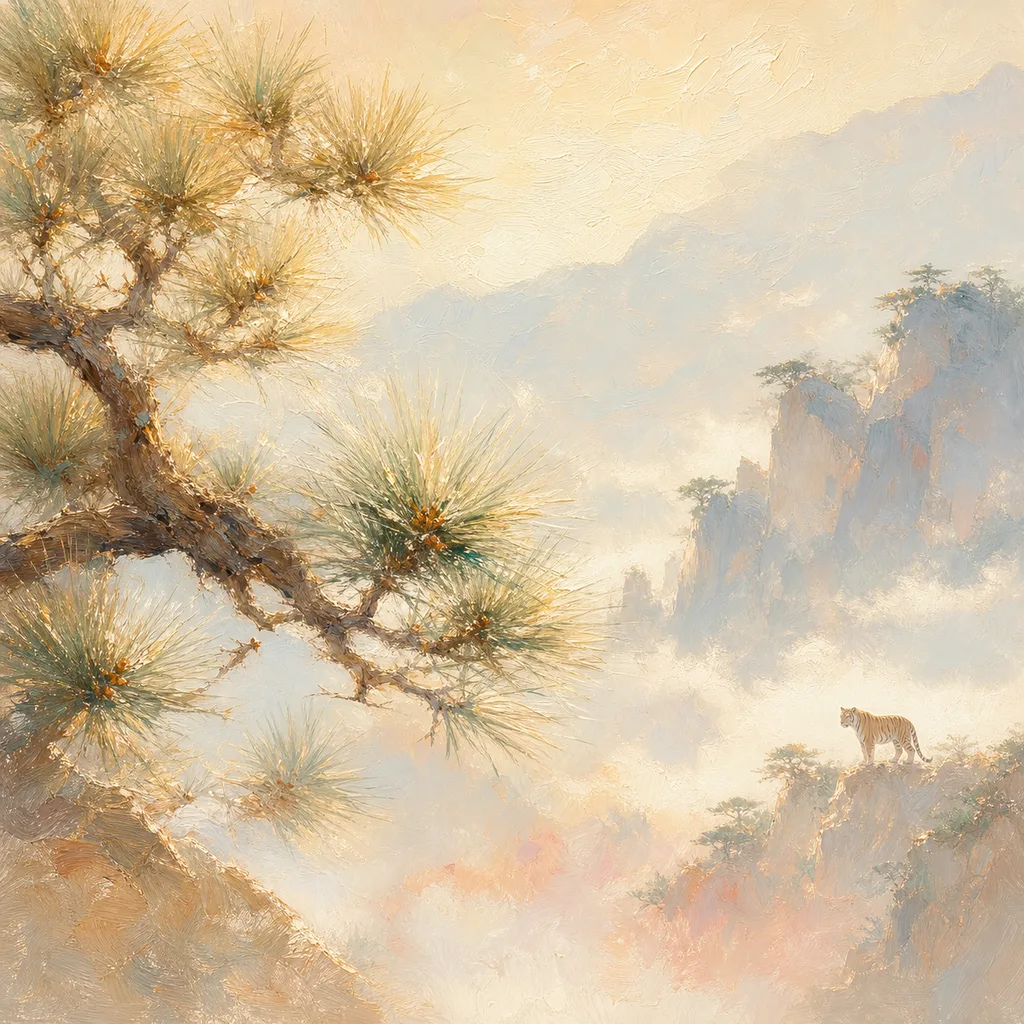
Like a pine tree rooted in rocky cliffs, the Pine-Wood Tiger stands firm amid storms. This combination tempers the Tiger’s impulsive bravery with the wood’s unyielding stability, producing a leader who doesn’t just charge—they endure. In crisis management or military strategy, they excel at holding ground while inspiring others to follow. Their charisma is not fleeting; it’s the quiet authority of an ancient tree that has weathered centuries. Their edge: they can be both the roar and the stillness, commanding respect through presence alone.
The same roots that ground them can also bind them. When out of balance, the Pine-Wood Tiger becomes rigid, mistaking stubbornness for resilience. Their boldness turns into inflexibility, refusing to adapt when a situation demands a softer approach. They may isolate themselves, believing only they can bear the weight of responsibility, like a lone pine that cannot bend in a gale. This pride can fracture relationships, as their intensity feels more like frost than shelter to those close to them.
The NaYin: Pine-Wood (松柏木 Song-Bai-Mu)
In classical Chinese astrology, each of the 60 year-stem combinations carries a specific NaYin (纳音, “assigned tone”) — a poetic elemental melody refining the Five Elements into 30 archetypes. The Pine-Wood (松柏木) NaYin represents a unique expression of the wood element.
Classical Sources
《三命通会》(Comprehensive Treatise on the Three Fates)
By 万民英 (Wan Minying), Ming Dynasty, 1587 — Volume 30, “On NaYin Elements”:
“松柏木者,岁寒之木,雪霜无以改其操,金能克之而不改其质,四时皆青,坚贞不凋。”
“庚寅,岁寒之木。雪霜无以改其操,况金能克之乎?上有庚辛,不假制治,自然成材。”
Yan Dongsou (阎东叟) commented: “庚寅地备奇,不避刑冲,宁辞衰败,乃五行坚实之木。若得和柔之气,德贵相符,必作显扬大用。”
Born in January or February?
There are two systems for determining your zodiac year. Folk tradition uses Lunar New Year (late Jan / early Feb). BaZi astrology uses Lichun (立春, Start of Spring, ~Feb 3–5). If your birthday falls in this boundary period, you might belong to the previous sign (Ox) under one system but the Pine-Wood Tiger under another. Use our BaZi Calculator to determine your exact pillar based on Lichun.
Personality
In today's fast-paced world, the Pine-Wood Tiger operates like a seasoned CEO who leads with both fire and patience. He builds organizations that last not by speed but by strategic depth, knowing when to grow upward and when to strengthen roots. His paradox: he craves change yet resists it, thriving only when he learns that true power is the courage to sway without breaking.
Imagine a lone pine tree rooted on a windswept cliff, its branches twisted but unbroken, its needles a deep, defiant green through every season. This is the image that the Pine-Wood (松柏木, Song-Bai-Mu) NaYin paints for the Tiger born under the GanZhi 庚寅 (Geng-Yin). The Tiger’s native fire—bold, impulsive, theatrical—meets the cold, enduring spirit of the pine, and the result is a personality of rare contradiction. These Tigers are not the flashy, attention-seeking rebels of the zodiac; their fierceness runs deep, like roots cracking stone. They possess the Tiger’s charisma and competitive drive, but it is tempered by a solemn, almost ancient patience. They do not roar to intimidate; they wait, and when they move, it is with the quiet force of a tree that has weathered a hundred storms.
As the Sanming Tonghui (三命通会) observes of this stem-branch pairing: ‘Geng-Yin is wood that knows the cold of winter. Frost and snow cannot alter its resolve, much less metal that seeks to cut it.’ This is the pathway to the Pine-Wood Tiger’s psychology: the Heavenly Stem Geng (庚), a blade of pure Metal, sits atop the Wood of the Tiger’s branch. In classical theory, Metal controls Wood, but here the wood is too resilient to be subdued. Instead, the Metal gives the Tiger a sharp, analytical edge—a mind that cuts through illusion—while the Wood provides the vision to build something lasting. These Tigers are idealists, but their idealism is not naive; it is forged in the knowledge of hardship. They dream grand dreams, yet they are willing to plant them in rocky soil and wait decades for them to bear fruit.
Yet this very strength can become a prison. The Pine-Wood Tiger’s resilience sometimes hardens into rigidity. They can be so convinced of their own rightness, so unwilling to bend, that they break relationships rather than compromise. The NaYin speaks of wood that ‘stands evergreen through the seasons’—but a tree that never sheds its leaves also never allows new growth. The challenge for this Tiger is to learn that true endurance is not about never changing, but about knowing when to let the dead wood fall. They are warriors, yes, but warriors who must learn the undertaking of surrender.
Love & relationships
In love, the Pine-Wood Tiger is a fortress with a single, well-guarded gate. They do not fall in love easily; they choose their partner with the same deliberation a pine tree chooses its cliff—knowing the commitment must outlast the storms. Those with the Metal stem judge potential partners with sharp precision, wanting someone equally strong and genuine who can stand firm against their fervor without seeking to subdue it. They are not interested in casual romance; every glance carries the weight of a lifetime. When they commit, they are fiercely loyal, a shelter of unwavering support. But woe to the partner who betrays that trust—the Pine-Wood Tiger’s forgiveness is as rare as a pine cone in a desert.
Their love language is one of quiet, enduring acts rather than grand declarations. They will remember the small thing you said years ago, and they will build a life around it. Yet their blind spot is a tendency toward emotional stoicism. They can appear cold, even when burning inside, because they believe endurance is more valuable than expression. The pig (亥, Hai), as their Liuhe (六合) partner, is a natural balm here—the pig’s gentle, accepting nature softens the Tiger’s harsh edges and reminds them that vulnerability is not weakness. In contrast, the snake (巳, Si), as their Liuhai (六害), can trigger their worst rigidity: the snake’s cunning feels like a threat, and the Tiger may respond by closing off entirely. For this Tiger, the pathway to a lasting bond is learning that love, like the pine, must sometimes bend in the wind to avoid breaking.
Career & professional path
The Pine-Wood Tiger’s career path is not a sprint; it is a slow, deliberate climb up a mountain that others find too steep. They are built for endeavors that require both vision and patience—fields where the reward comes not in quarters but in decades. The Metal stem gives them a precision that makes them exceptional in law, engineering, finance, and medicine, where a single mistake can have lasting consequences. But unlike the pure Metal types, who can be coldly analytical, the Pine-Wood Tiger brings a sense of purpose to their work. They do not just want to build; they want to build something that matters, something that will stand long after they are gone. This makes them natural founders of institutions, research scientists who pursue a single question for a lifetime, or artists whose work gains meaning with age.
The NaYin’s image of the pine that ‘grows stronger with time’ is their professional signature. They are not intimidated by slow progress; they trust the process. In a world obsessed with rapid disruption, the Pine-Wood Tiger is a quiet revolutionary. They will spend years learning a craft, decades perfecting it, and then, when the moment is right, they will move with an authority that cannot be challenged. Their career vulnerability, however, lies in their stubbornness. They can become so attached to their own vision that they ignore market shifts or feedback. The pine that refuses to bend may be uprooted by a hurricane. They need mentors or partners who can help them distinguish between principled persistence and foolish pride.
Health & wellness
Health for the Pine-Wood Tiger is a matter of root and branch. The Wood element governs the liver and gallbladder, and the Tiger’s intense, competitive nature can easily strain these systems. When the liver is out of balance, the Tiger becomes irritable, prone to headaches, and may experience tension in the shoulders and neck—the physical manifestation of their refusal to bend. The nervous system, too, is vulnerable: these Tigers live with a constant, low-level charge of readiness, like a tree braced for a storm. Over time, this can lead to burnout or insomnia if not managed.
Wellness practices for this pairing must honor the NaYin’s essence: endurance through gentle care, not force. The pine thrives in the cold, but it also needs deep, undisturbed roots. For the Tiger, this means prioritizing rest and recovery as much as action. Practices that soothe the liver—such as evening walks, stretching, or herbal teas like chrysanthemum and goji berry—are essential. They should also be mindful of the Metal stem’s influence on the lungs and skin; dry environments, pollution, and emotional grief can trigger respiratory issues or skin flare-ups. The antidote is moisture and rhythm: a consistent sleep schedule, humidifiers in dry climates, and foods like pear, white fungus, and daikon radish. The Pine-Wood Tiger must remember that even the sturdiest tree needs water to live.
Wealth & finances
The Pine-Wood Tiger’s relationship with money mirrors their personality: patient, strategic, and built for the long haul. They are not impulsive spenders; every purchase is weighed against its long-term value. The Metal stem gives them a sharp eye for investments—they can spot an overvalued asset or a hidden opportunity with uncanny accuracy. They are the ones who buy land in a forgotten valley and wait twenty years for the city to arrive. Their wealth grows slowly, like rings on a tree, but it grows with a solidity that paper profits cannot match.
Yet their very patience can become a trap. The Pine-Wood Tiger may hold onto an investment or a business strategy for too long, refusing to cut losses because they believe endurance will eventually be rewarded. The NaYin’s image of the ‘evergreen’ can lead to a stubborn refusal to adapt to changing markets. Their financial pitfall is not recklessness but rigidity—the belief that because they have waited this long, they must wait a little longer. The lesson for them is that a pine tree does not survive by clinging to dead branches. They must learn to prune their portfolio, to sell when the season turns, and to accept that not every seed they plant will grow into a forest. Diversification and a trusted financial advisor who can offer an outside perspective are their best allies.
Growth & self-development
The Pine-Wood Tiger’s greatest growth edge is learning the habit of flexibility. They are so accustomed to standing firm that they have forgotten how to sway. The NaYin teaches that the pine endures not because it is unbreakable, but because it knows how to bend under the weight of snow and then spring back. For the Tiger, this means cultivating the courage to admit when they are wrong, to change course, and to let go of a vision that no longer serves them. The stem Geng (庚) gives them a warrior’s discipline; now they must learn the wisdom of the willow.
An actionable practice for this pairing is to deliberately seek out experiences that challenge their certainty. This could be as simple as traveling to a place whose customs they do not understand, or taking up a hobby—like pottery or dance—that requires them to surrender control. They should also practice ‘active listening’ in conversations, resisting the urge to immediately defend their position. The goal is not to become weak, but to become supple—to realize that true strength is the ability to adapt without losing one’s core. When the Pine-Wood Tiger learns this, they transform from a solitary tree into a forest: resilient, interconnected, and able to weather any storm. They become not just a survivor, but a source of shelter for others.
Pine-Wood Tiger Years
| Year | GanZhi | Type | Details |
|---|---|---|---|
| 1950 | 庚寅 | Pine-Wood Tiger | View Profile → |
| 2010 | 庚寅 | Pine-Wood Tiger | View Profile → |
Famous Pine-Wood Tigers
Notable figures born in 1950, 2010.
25 Grammys, musical prodigy, blind since birth, Songs in the Key of Life.
Director of Hero, Raise the Red Lantern; directed the 2008 Beijing Olympics opening ceremony.
Virgin Group founder, 400+ companies, adventurer.
A Six Harmony (六合) match — the secret friend combination, naturally aligned in energy and purpose.
Frequently asked questions
How can Pine-Wood Tigers overcome their biggest blind spots?
Pine-Wood Tigers (庚寅) often struggle with stubbornness and impulsiveness due to their strong Wood element. To overcome this, they should practice patience and seek counsel from trusted friends. Meditation or tai chi can help balance their fiery nature. Additionally, wearing metal accessories (like white or gold) can temper excessive Wood energy, promoting clearer judgment. Remember that 庚寅’s Pine Wood (松柏木) is resilient but needs flexibility to thrive.
What feng shui adjustments help Pine-Wood Tigers in 2026?
In 2026 (Fire Horse year), Pine-Wood Tigers (庚寅) benefit from enhancing their Earth element to control Fire. Place a ceramic bowl or crystals in the center of your home. Avoid excessive red decor; instead, use earthy tones like beige or yellow. Keep a small water feature in the north to nourish Wood. Since 庚寅 is Pine Wood (松柏木), adding a pine tree image can reinforce stability. Avoid sharp metal objects that might clash with your Tiger’s energy.
What poetic metaphor defines the Pine-Wood NaYin?
The Pine-Wood (松柏木) of 庚寅 is likened to a solitary pine on a cliff, enduring harsh winds and snow. It symbolizes unyielding integrity and resilience—standing tall despite adversity. This metaphor reflects the Pine-Wood Tiger’s indomitable spirit and ability to thrive in difficult conditions. Just as pine wood is prized for its strength and fragrance, those born in 1950 or 2010 carry an inner nobility that shines through challenges.
How does the elemental cycle affect Pine-Wood Tiger fortune?
In the Five Element cycle, Wood (庚寅) is nourished by Water and consumed by Fire. Pine-Wood Tigers flourish in Water years (e.g., 2023 Rabbit) and face challenges in Fire years (e.g., 2026 Horse). Metal years (e.g., 2020 Rat) can weaken them, while Earth years (e.g., 2024 Dragon) offer support. Their Pine Wood (松柏木) nature makes them especially sensitive to seasonal changes—spring (Wood) boosts their luck, while autumn (Metal) may bring obstacles.
When does the next Pine-Wood Tiger year occur in the 60-year cycle?
The next Pine-Wood Tiger year (庚寅) occurs in 2070. The 60-year cycle of Chinese zodiac repeats every 60 years, with 庚寅 appearing in 1950, 2010, and then 2070. This specific Gan-Zhi combines the Heavenly Stem Geng (Metal) and Earthly Branch Yin (Tiger), but the NaYin 松柏木 (Pine Wood) gives it a Wood element identity. So while Geng is Metal, the year’s essence is Wood due to the NaYin system.
Which politicians or business leaders carry the Pine-Wood Tiger pillar?
Notable individuals born in 1950 (庚寅) include former U.S. President Bill Clinton and business magnate Richard Branson. While exact birth times are needed to confirm their full BaZi chart, the year pillar alone suggests they share the Pine-Wood Tiger’s resilience. The Pine Wood (松柏木) energy often manifests in leaders who are visionary yet grounded, like Clinton’s charisma or Branson’s adventurous spirit. Other 1950-born figures include actor John Travolta and musician Stevie Wonder.
Which secret friend complements the Pine-Wood Tiger?
By the standard Secret Friend rule (the Earthly Branch Six Harmonies, 地支六合), the Tiger’s secret friend is the Pig (亥) — the Yin–Hai (寅亥) bond. The Horse (午) belongs to a different framework: Tiger, Horse and Dog form the Fire trine of the Three Harmonies (三合, Yin–Wu–Xu), an alliance of complementary energies rather than the one-on-one secret-friend bond. These two systems coexist in Chinese astrology — Six Harmonies (六合) pairs a single secret ally, while Three Harmonies (三合) builds a three-way elemental team.
What energetic signature defines a Pine-Wood Tiger?
A Pine-Wood Tiger (庚寅) radiates the energy of a resilient pine tree (松柏木)—strong, upright, and enduring. They possess a pioneering spirit, often leading with courage and integrity. Their Geng Metal stem adds a sharp, decisive edge, while the Yin Tiger brings creativity and spontaneity. This blend makes them natural innovators who thrive on challenge. However, they must guard against rigidity. Overall, the Pine-Wood Tiger’s signature is a harmonious mix of strength and adaptability.
Why is 1950 called Pine-Wood Tiger instead of Metal Tiger?
In mainstream Chinese astrology, 1950 is often called the Metal Tiger because its Heavenly Stem 庚 (Geng) corresponds to Metal. However, the NaYin (纳音) system — a deeper layer of BaZi analysis — assigns this pillar the Pine-Wood (松柏木) resonance. Both names refer to the same year: the Stem name (Metal Tiger) describes its foundational energy, while the NaYin name (Pine-Wood Tiger) reveals its poetic-spiritual quality.
Want Your Personal Reading?
Get your complete BaZi chart with all four pillars, NaYin analysis, and life chapters.
Open Free BaZi Calculator →