
The Plain-Wood Pig
己亥 (Ji-Hai) · 平地木 (Plain-Wood) · Earth Stem
The Plain-Wood Pig defines those born in 1959 and 2019 under the Ji-Hai (己亥) pillar. While mainstream astrology often classifies this year as the Earth Pig based on its Heavenly Stem (己 = Earth), its deeper NaYin (纳音) resonance is Plain-Wood (平地木) — blending earth’s core energy with wood’s expressive quality. This combination blends the Pig’s native contentment with Wood’s creative growth force, producing an idealistic and relentlessly ambitious personality. Unlike flashier types, the Plain-Wood Pig draws resilience from being “ordinary but vigorously alive,” embodying deep, unassuming energy that steadily expands its influence.
A quick map: this is a Earth year by its Heavenly Stem (己 / Ji), while its NaYin is Plain-Wood (平地木), a Wood archetype — two parallel systems describing the same pillar, not a contradiction.
Quick Facts
| Years | 1959, 2019 |
| GanZhi | 己亥 (Ji-Hai) |
| NaYin | Plain-Wood (平地木 Ping-Di-Mu) |
| Stem Element | Earth (己) |
| NaYin Element | Wood (平地木) |
| Base Element | Water |
| Lucky Numbers | 3, 8, 25, 38 |
| Lucky Colors | Green, Teal, Brown |
| Lucky Direction | East, Southeast |
| NaYin Season | Spring |
| Trine Group | Fourth Trine (Rabbit, Goat, Pig) |
| Sexagenary Position | #36 of 60 in the Jia-Zi cycle |
| Lunar Year Dates | 1959: 1959-02-08 to 1960-01-28 2019: 2019-02-05 to 2020-01-25 |
| Six Harmony (六合) | Tiger — Secret Friend |
| Three Harmony (三合) | Rabbit · Goat · Pig (Wood Trine) |
| Six Clash (六冲) | Snake — Opposing Force |
| Five Element Cycle | Generated by Water → Wood generates Fire → Controlled by Metal |
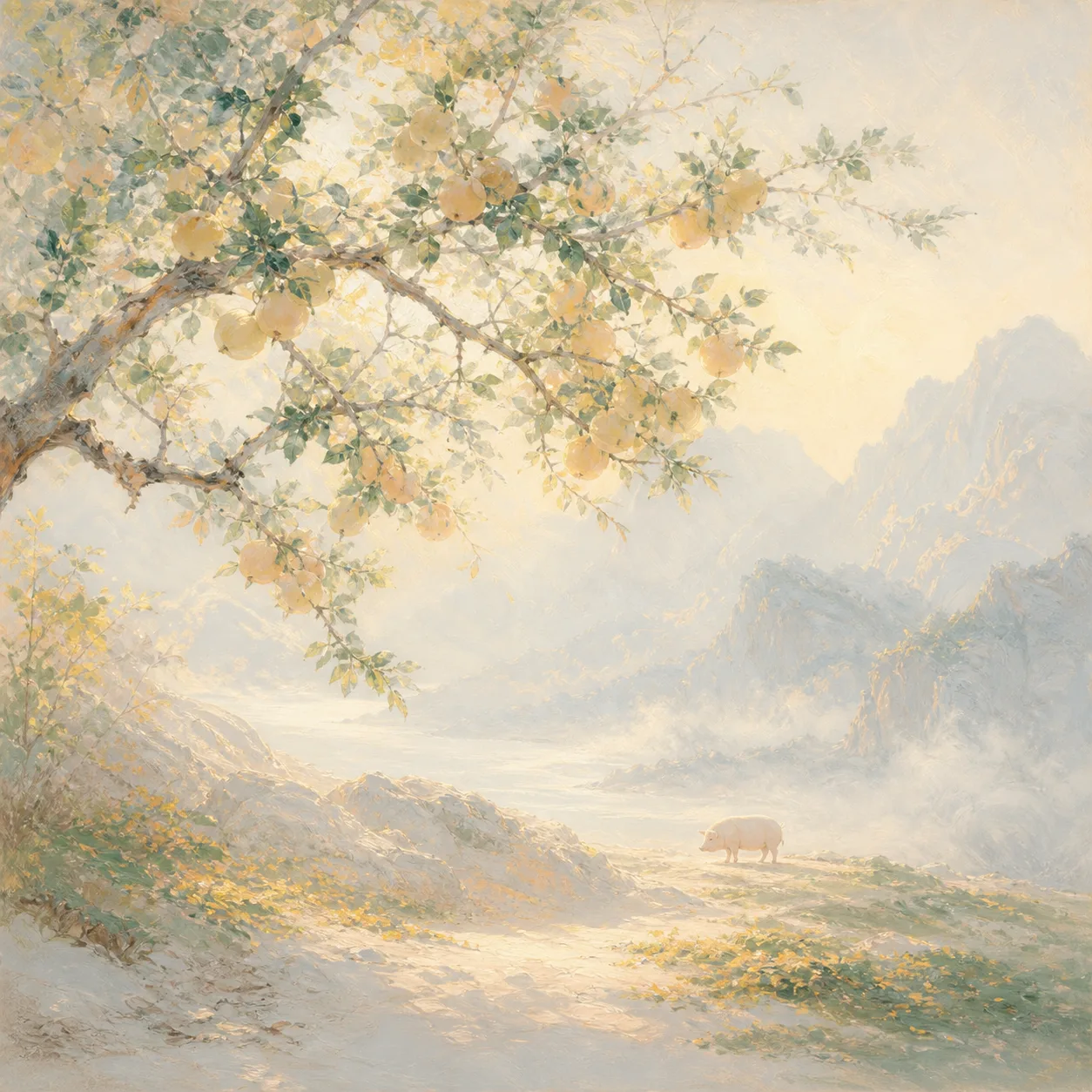
Pig Element Variants Compared
| NaYin Variant | Stem Name | GanZhi | Years | Stem Element |
|---|---|---|---|---|
| Mountain-Fire Pig | Wood Pig | 乙亥 | 1935, 1995 | Wood |
| Roof-Earth Pig | Fire Pig | 丁亥 | 1947, 2007 | Fire |
| Plain-Wood Pig | Earth Pig | 己亥 | 1959, 2019 | Earth |
| Hairpin-Metal Pig | Metal Pig | 辛亥 | 1911, 1971, 2031 | Metal |
| Ocean-Water Pig | Water Pig | 癸亥 | 1923, 1983 | Water |
Like a plain-wood tree spreading roots across open ground, the Plain-Wood Pig’s generosity takes on a quietly expansive quality. Their sincere warmth draws people in, and they excel at building networks of trust that grow organically over time. This combination thrives in community organizing, where their ability to listen without judgment and share resources freely turns casual connections into lasting bonds. Their edge lies in making everyone feel deeply valued without needing to be the center of attention.
The wide-rooted nature of plain-wood can make the Plain-Wood Pig overly accommodating, spreading themselves too thin to please everyone. Their genuine desire for harmony may cause them to suppress their own needs, leading to resentment that grows underground like tangled roots. When out of balance, they become aimless drifters, avoiding necessary conflicts and letting others take advantage of their open-heartedness. Learning to set boundaries is essential to keep their generosity from becoming self-sacrifice.
The NaYin: Plain-Wood (平地木 Ping-Di-Mu)
In classical Chinese astrology, each of the 60 year-stem combinations carries a specific NaYin (纳音, “assigned tone”) — a poetic elemental melody refining the Five Elements into 30 archetypes. The Plain-Wood (平地木) NaYin represents a unique expression of the wood element.
Classical Sources
《三命通会》(Comprehensive Treatise on the Three Fates)
By 万民英 (Wan Minying), Ming Dynasty, 1587 — Volume 30, “On NaYin Elements”:
“平地木者,初生萌蘖,始发枝条,唯资雨露之功,不喜雪霜之积,乃地上之茂材,人间之屋木。戊戌为栋,己亥为梁,最宜互换见之。”
“己亥,自生之木,根本繁盛,惟忌火盛,火盛则灰飞烟灭。”
Born in January or February?
There are two systems for determining your zodiac year. Folk tradition uses Lunar New Year (late Jan / early Feb). BaZi astrology uses Lichun (立春, Start of Spring, ~Feb 3–5). If your birthday falls in this boundary period, you might belong to the previous sign (Dog) under one system but the Plain-Wood Pig under another. Use our BaZi Calculator to determine your exact pillar based on Lichun.
Who they are
Imagine a solitary elm standing on a vast plain — its roots spread wide beneath the soil, drawing sustenance from deep, hidden waters, while its branches reach toward a sky that seems just out of touch. This is the Plain-Wood Pig (己亥, 平地木 (Ping-Di-Mu)), a soul whose generous, easygoing nature is underscored by a quiet, relentless growth force. The Pig’s native love of life’s pleasures is here tempered by a wood energy that craves purpose and expansion. The Earth Stem (己) lends a grounded, nurturing quality, while the Pig’s Water base feeds the wood from below, creating a personality that is both deeply rooted and ever aspiring.
As the Sanming Tonghui (三命通会) observes of this stem-branch pairing: “己亥, self-generating wood, its foundation luxuriant and abundant — it fears only an excess of fire, for fire would reduce it to ash.” This is the pathway to understanding the Plain-Wood Pig’s inner paradox. They possess a remarkable resilience, like the plain tree that withstands wind and drought not through flashy strength but through deep, steady vitality. Yet they can overreach, their idealism pulling them toward impossible heights. Their generosity is genuine, but it sometimes masks a need to be needed — a subtle compulsion to anchor their worth in the growth they foster in others.
In social settings, the Plain-Wood Pig is the one who quietly ensures everyone’s glass is full, who remembers the small details that make others feel seen. But beneath this warmth lies a fierce inner landscape of plans and dreams. They are builders of invisible structures — relationships, systems, creative visions — and they often measure their own success by the shade their branches provide. The danger is that they may forget their own need for sunlight, sacrificing their vitality for the sake of the grove.
In love and partnership
In love, the Plain-Wood Pig is a patient gardener — they do not rush into bloom, but once their roots have taken hold, they nurture the relationship with extraordinary devotion. Their love language is one of quiet, consistent acts: a warm meal after a long day, a hand on the shoulder during a difficult conversation, a home that feels like a sanctuary. The Earth Stem gives their affection a stabilizing quality; they are not given to grand, sweeping gestures, but to the slow, steady accumulation of shared history.
Their greatest challenge in romance is balancing stability with spontaneity. The wood within them craves growth and novelty, yet the Pig’s comfort-loving nature can settle into a rut. They may find themselves in relationships that are secure but lack the spark of mutual expansion. Their ideal partner is someone who can appreciate their depth while gently coaxing them out of their routines — a Tiger (their Liuhe match), perhaps, who brings the wind of adventure to shake their branches. The Plain-Wood Pig must beware of partners who mistake their patience for passivity, or who take their generosity for granted.
When they find a true counterpart, however, their love becomes a living thing — a tree that grows taller and stronger with each passing season. They are lovers who build a world together, not just a shared life, and their loyalty is as enduring as the wood from which their soul is made.
Professional destiny
Professionally, the Plain-Wood Pig thrives in roles where they can build something lasting — not monuments to ego, but structures that serve a community or a cause. The Earth Stem points them toward fields like real estate, agriculture, education, or healthcare — anything that requires a foundation of trust and steady, incremental progress. Their wood energy adds a creative, visionary dimension; they are not content merely to maintain the status quo but seek to improve and expand it.
A Plain-Wood Pig makes an excellent project manager, urban planner, or nonprofit director — someone who can hold the long-term vision while attending to the daily details. They excel in research that requires patience, like environmental science or historical preservation, where the fruits of their labor may take years to ripen. Their work style is methodical but not rigid; they are open to new ideas as long as those ideas are rooted in practicality.
The pitfall for this pairing is a tendency to overcommit. Like a tree that puts down too many branches, they can become spread thin, their energy dissipated across too many initiatives. They must learn to prune — to say no to projects that do not align with their deepest values. The Sanming Tonghui warns that fire can reduce their wood to ash; in career terms, this means avoiding high-pressure, fast-burn environments that demand flashy results rather than sustained growth.
Physical and mental health
The Plain-Wood Pig’s constitution is tied to the kidneys and metabolism — the deep well of vitality that the Pig’s Water base represents, nourishing the wood of ambition and creativity. When balanced, they have remarkable endurance, able to weather stress and recover from illness with quiet strength. But when out of balance, they may experience chronic fatigue, water retention, or a sluggish metabolism that mirrors their tendency to ‘hold on’ to emotional and physical weight.
To maintain their vitality, the Plain-Wood Pig must honor both elements. Practices that support the kidneys — like gentle movement (tai chi, walking in nature), warm, nourishing foods (soups, root vegetables), and adequate rest — are essential. At the same time, they need to ‘keep the wood growing’ through creative expression and time in green spaces. The greatest risk is stagnation: if they become too sedentary or too absorbed in routine, their wood energy turns to deadwood. A weekly practice of trying something new — a different walking path, a new recipe, a spontaneous outing — can keep their inner plain alive and thriving.
Money and prosperity
Financially, the Plain-Wood Pig is a long-term investor by nature. They are drawn to tangible assets — property, land, perhaps a small business that they can watch grow over time. The Earth Stem gives them a conservative streak; they prefer the slow accumulation of wealth over risky speculation. Their spending is generally deliberate, though they have a soft spot for investments that promise security for loved ones — a home that will shelter generations, an education fund that will bear fruit in a child’s future.
The NaYin image of ‘trees on flat ground’ suggests a wealth trajectory that is steady but not spectacular. The Plain-Wood Pig will not become a tycoon overnight, but they can build substantial, quiet prosperity if they avoid the trap of ‘too many branches’ — overextending into multiple ventures or lending money too freely. Their financial vulnerability lies in their generosity: they may sacrifice their own reserves to help others, forgetting that a tree must first be healthy to provide shade. The key is to create boundaries — a separate savings account for ‘self’ that is as sacred as their giving. When they balance their nurturing instinct with self-preservation, their wealth grows like a well-tended grove, year after year.
Evolution and self-mastery
The Plain-Wood Pig’s greatest growth edge is learning to embrace impermanence and change. Their nature seeks to root deeply and hold on — to people, to plans, to identities — but the health of a plain tree depends on its ability to shed old leaves and let new buds form. They must learn to ‘aerate their soil’: to regularly question which beliefs, habits, and relationships are still nourishing them, and which have become compacted earth that suffocates growth.
A specific practice for this pairing is the ‘seasonal review’ — every three months, taking a day to reflect on what has grown, what has withered, and what needs pruning. This is not about harsh self-criticism, but about tending the garden of the self with the same patience they offer others. The Sanming Tonghui describes their wood as ‘self-generating’ — capable of renewal from within. When the Plain-Wood Pig embraces this truth, they transform from a good soul into an extraordinary one: a tree that not only stands strong on the plain but becomes a landmark, a source of shelter and inspiration for all who wander near.
Plain-Wood Pig Years
| Year | GanZhi | Type | Details |
|---|---|---|---|
| 1959 | 己亥 | Plain-Wood Pig | View Profile → |
| 2019 | 己亥 | Plain-Wood Pig | View Profile → |
Famous Plain-Wood Pigs
Notable figures born in 1959, 2019.
Golden Globe winner; House, Blackadder; comedic genius with dramatic depth.
5-time NBA champion, 3 MVPs, revolutionized point guard.
A Six Harmony (六合) match — the secret friend combination, naturally aligned in energy and purpose.
People also ask
Which challenges might Plain-Wood Pigs face in 2026?
In 2026, the Fire Horse year, Plain-Wood Pigs (己亥) may face challenges due to the clash between Hai (Pig) and the year’s Zhi (Horse). This can create instability in relationships and finances. The Fire element of the year may also overconsume the Wood of 平地木, leading to burnout or health issues. Additionally, the Heavenly Stem Ji (Earth) can be weakened by Fire, potentially causing delays or miscommunications. It’s advisable for Plain-Wood Pigs to avoid risky investments and focus on self-care. Those born in 1959 or 2019 should pay extra attention to their health and emotional well-being during this period.
What counsel did imperial astrologers give to Plain-Wood natives?
Imperial astrologers advised Plain-Wood (平地木) natives of 己亥 to cultivate patience and humility, as their wood grows on level ground—neither too high nor too low. They were counseled to avoid arrogance when prosperous and despair when challenged. The combination of Earth (Ji) and Water (Hai) nourishes the wood, so they were encouraged to seek balance through education and reflection. Astrologers also warned against impulsive decisions, especially in career and marriage, and recommended aligning with Water or Wood elements for support. They believed that Plain-Wood natives thrive when they serve others rather than seeking personal glory.
What happens when wood clashes or harmonizes in a Pig chart?
In a Plain-Wood Pig (己亥) chart, Wood (from NaYin 平地木) harmonizes with Water (Hai’s hidden element) and Earth (Ji), creating a stable foundation. Clashes occur when Metal (e.g., from Monkey or Rooster) cuts the wood, leading to obstacles or health issues. Fire (e.g., from Horse) can burn the wood if excessive, causing burnout or financial loss. Harmonious elements include Water (nourishes wood) and additional Wood (strengthens). If the chart has strong Water, the wood thrives; if too much Earth, the wood may be stifled. A balance of Water and Wood brings success, while excessive Metal or Fire requires mitigation through complementary elements.
What generational traits define Plain-Wood Pig cohorts?
Plain-Wood Pig cohorts (born in 1959 and 2019 under 己亥, 平地木) are known for their grounded yet ambitious nature. The 1959 group, now in their 60s, often exhibit resilience and practicality, having weathered economic shifts. They value stability and family, with a tendency to be generous but cautious. The 2019 cohort, still young, are expected to be creative and adaptable, with a strong sense of justice. Both generations share a love for learning and a calm demeanor, but the younger group may be more tech-savvy. The Plain-Wood influence gives them a steady growth pattern, like a tree on level ground—slow but deep-rooted.
How do Plain-Wood Pig traits manifest in public figures?
Public figures born in Plain-Wood Pig years (己亥, 平地木) often display a blend of diplomacy and determination. For example, someone born in 1959 might be a steady leader who values consensus and long-term planning, like a seasoned diplomat. They are approachable yet firm, using their Earth (Ji) stem to stay grounded. Their 平地木 nature makes them appear modest but with hidden depth—they often surprise others with their strategic thinking. In entertainment or politics, they may be known for their nurturing image and ability to connect with people. However, they can also be stubborn when their core values are challenged, reflecting the pig’s strong will.
What long-term partnership strategies work for Plain-Wood Pig?
For a long-term partnership, Plain-Wood Pigs (己亥) thrive with partners who provide emotional security and intellectual stimulation. The 平地木 element benefits from Water (e.g., Rat, Ox) or Wood (e.g., Tiger, Rabbit) signs that nourish their growth. They should avoid overly critical or dominating partners (e.g., Monkey, Rooster) that may cut their wood. Communication is key; they need to express their feelings openly, as they tend to internalize stress. Shared goals and routines help stabilize the relationship. Partners should respect their need for occasional solitude. Building trust slowly, like a tree growing roots, ensures a lasting bond.
What spiritual blueprint comes with the Plain-Wood Pig pillar?
The spiritual blueprint of 己亥 (Plain-Wood Pig) is one of grounded growth and service. The 平地木 (Plain Wood) represents a tree that does not seek to dominate but to provide shelter and stability. Natives are often drawn to practices that blend practicality with spirituality, such as gardening, meditation, or community service. The Yin Earth stem (Ji) suggests a receptive, nurturing spirit, while the Pig (Hai) brings depth and intuition. This pillar encourages embracing one’s role as a quiet supporter rather than a leader. The spiritual path involves cultivating patience, generosity, and inner peace, much like a tree that grows slowly but steadily.
What personality traits are most pronounced in Plain-Wood Pigs?
Plain-Wood Pigs (己亥, 平地木) are known for their gentle strength and reliability. They are practical yet imaginative, often excelling in creative fields that require patience. Their Earth stem (Ji) makes them grounded and responsible, while the Pig adds a compassionate, sociable nature. They are generous to a fault and may struggle with setting boundaries. The 平地木 influence gives them a steady, unpretentious demeanor—they are not flashy but have a quiet confidence. They can be stubborn when pushed, but generally avoid conflict. Their intuition is strong, and they value harmony in relationships. Overall, they are the ‘rock’ in any group.
Why is 1959 called Plain-Wood Pig instead of Earth Pig?
In mainstream Chinese astrology, 1959 is often called the Earth Pig because its Heavenly Stem 己 (Ji) corresponds to Earth. However, the NaYin (纳音) system — a deeper layer of BaZi analysis — assigns this pillar the Plain-Wood (平地木) resonance. Both names refer to the same year: the Stem name (Earth Pig) describes its foundational energy, while the NaYin name (Plain-Wood Pig) reveals its poetic-spiritual quality.
Want Your Personal Reading?
Get your complete BaZi chart with all four pillars, NaYin analysis, and life chapters.
Open Free BaZi Calculator →