
The Pomegranate-Wood Monkey
庚申 (Geng-Shen) · 石榴木 (Pomegranate-Wood) · Metal Stem
The Pomegranate-Wood Monkey defines those born in 1920 and 1980 under the Geng-Shen (庚申) pillar. While mainstream astrology often classifies this year as the Metal Monkey based on its Heavenly Stem (庚 = Metal), its deeper NaYin (纳音) resonance is Pomegranate-Wood (石榴木) — blending metal’s core energy with wood’s expressive quality. This pillar blends the Monkey’s cleverness with Wood’s creativity and idealism, producing individuals of grand ambition and relentless drive. Defined by the Nayin’s symbol of abundant fruit and fullness, their distinctive quality is a unique resilience that does not flaunt itself.
A quick map: this is a Metal year by its Heavenly Stem (庚 / Geng), while its NaYin is Pomegranate-Wood (石榴木), a Wood archetype — two parallel systems describing the same pillar, not a contradiction.
Quick Facts
| Years | 1920, 1980 |
| GanZhi | 庚申 (Geng-Shen) |
| NaYin | Pomegranate-Wood (石榴木 Shi-Liu-Mu) |
| Stem Element | Metal (庚) |
| NaYin Element | Wood (石榴木) |
| Base Element | Metal |
| Lucky Numbers | 3, 8, 25, 38 |
| Lucky Colors | Green, Teal, Brown |
| Lucky Direction | East, Southeast |
| NaYin Season | Spring |
| Trine Group | First Trine (Rat, Dragon, Monkey) |
| Sexagenary Position | #57 of 60 in the Jia-Zi cycle |
| Lunar Year Dates | 1920: 1920-02-20 to 1921-02-08 1980: 1980-02-16 to 1981-02-05 |
| Six Harmony (六合) | Snake — Secret Friend |
| Three Harmony (三合) | Rat · Dragon · Monkey (Water Trine) |
| Six Clash (六冲) | Tiger — Opposing Force |
| Five Element Cycle | Generated by Water → Wood generates Fire → Controlled by Metal |
Monkey Element Variants Compared
| NaYin Variant | Stem Name | GanZhi | Years | Stem Element |
|---|---|---|---|---|
| Sword-Metal Monkey | Water Monkey | 壬申 | 1932, 1992 | Water |
| Spring-Water Monkey | Wood Monkey | 甲申 | 1944, 2004 | Wood |
| Mountain-Base-Fire Monkey | Fire Monkey | 丙申 | 1956, 2016 | Fire |
| Highway-Earth Monkey | Earth Monkey | 戊申 | 1908, 1968, 2028 | Earth |
| Pomegranate-Wood Monkey | Metal Monkey | 庚申 | 1920, 1980 | Metal |
The pomegranate wood’s abundance transforms the Monkey’s quick wit into a harvest of ideas that never runs dry. This combination excels at creating systems that generate continuous value, like building a subscription-based platform or designing a curriculum that keeps learners engaged. Their cleverness is not just for show—it’s rooted in a practical, generative energy that attracts opportunities and collaborators. The unique edge is their ability to turn every intellectual challenge into a seed for future growth, yielding results long after the initial spark fades.
Yet the very richness of the pomegranate wood can overwhelm the Monkey’s restless mind. They may scatter their talents across too many projects, each blooming but none reaching full fruit. The shadow side is a tendency to hoard ideas or connections, fearing that sharing might diminish their abundance. This can lead to burnout from over-cultivation or a refusal to prune unproductive ventures. The Monkey’s versatility, unmoored from focus, becomes a garden overgrown with potential that never ripens.
The NaYin: Pomegranate-Wood (石榴木 Shi-Liu-Mu)
In classical Chinese astrology, each of the 60 year-stem combinations carries a specific NaYin (纳音, “assigned tone”) — a poetic elemental melody refining the Five Elements into 30 archetypes. The Pomegranate-Wood (石榴木) NaYin represents a unique expression of the wood element.
Classical Sources
《三命通会》(Comprehensive Treatise on the Three Fates)
By 万民英 (Wan Minying), Ming Dynasty, 1587 — Volume 30, “On NaYin Elements”:
“石榴木者,性辛如五味,花繁而实繁,他木至午而死,至未而墓,惟石榴木至申而生气方生,其性坚贞如金。”
“庚申,自绝之木也,居绝地而反旺,金旺而木坚,得水土相资,为福厚之命。”
Born in January or February?
There are two systems for determining your zodiac year. Folk tradition uses Lunar New Year (late Jan / early Feb). BaZi astrology uses Lichun (立春, Start of Spring, ~Feb 3–5). If your birthday falls in this boundary period, you might belong to the previous sign (Goat) under one system but the Pomegranate-Wood Monkey under another. Use our BaZi Calculator to determine your exact pillar based on Lichun.
Personality
The Pomegranate-Wood Monkey operates as an intellectual orchardist: they thrive when planting diverse seeds but must learn to nurture each season's crop instead of forever chasing the next novelty. Their modern paradox is balancing prolific creativity with the discipline to harvest—a tension between being a visionary and a builder in a world that rewards both.
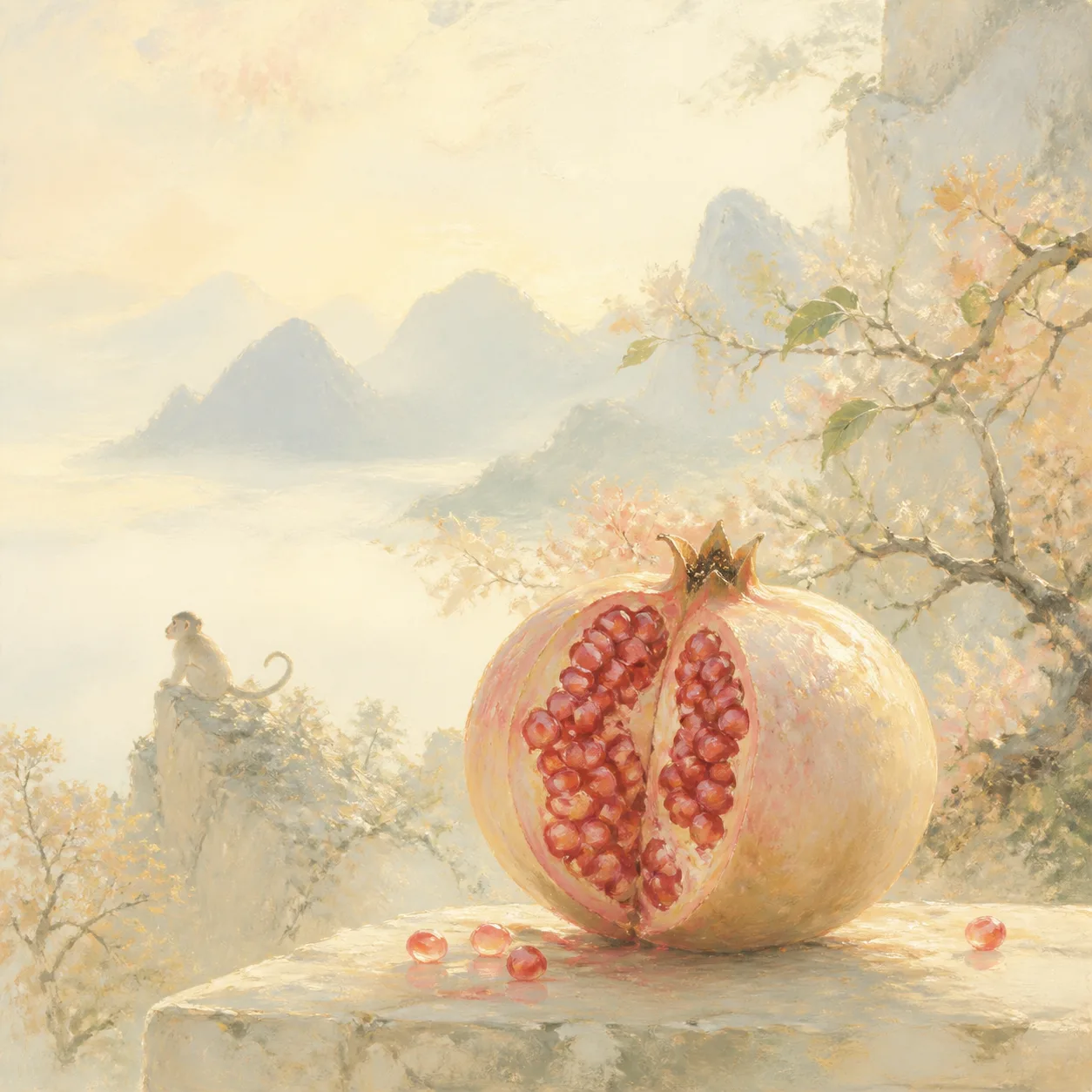
Picture a pomegranate tree that refuses to die. Its roots grip the rocky soil of a mountainside; its branches twist into the wind, heavy with fruit that cracks open to reveal seeds like rubies. This is the Pomegranate-Wood (石榴木, Shíliú Mù) Monkey—a creature of paradox, born under the stem-branch pair Geng-Shen (庚申). The Monkey’s native metal, sharp and restless, meets the NaYin wood of the pomegranate, which does not wither in autumn but instead bears its richest harvest when other trees shed their leaves. As the Sanming Tonghui (三命通会) notes, ‘Pomegranate-Wood is pungent like the five flavors, with abundant flowers and fruit; other trees die at noon and are buried at dusk, but only the pomegranate wood revives at Shen (monkey) and grows with vigor.’ This is a personality that thrives on contradiction: fiercely independent yet deeply creative, analytical yet visionary.
The heavenly stem Geng (庚) is hard metal—the blade of a sword, the edge of a chisel. But in this pairing, that metal does not simply cut; it carves. The wood of the pomegranate gives the Monkey a sculptor’s patience, transforming restless cleverness into enduring creation. These individuals are not content with quick tricks or surface-level wins. They build things that last—relationships, businesses, artistic bodies of work—with the same tenacity that a pomegranate tree holds its fruit through the first frost. Their minds are labyrinths of interlocking ideas, each corridor leading to another, and they delight in leading others through these mental mazes. Yet there is a hidden fragility: the wood is ‘self-broken’ (自绝之木), as the classical text warns, meaning that their resilience masks a deep sensitivity to criticism. They need the water of emotional support to flourish; without it, their branches grow brittle.
The Monkey branch (申) is itself a metal element, doubling down on the stem’s sharpness. This creates a person who can diagnose any problem in seconds but may struggle to accept that not every problem needs solving. The Pomegranate-Wood Monkey’s idealism is both their gift and their trap: they envision grand orchards but can become paralyzed by the gap between dream and reality. They are not meant for shallow soil. Give them a cause, a craft, a mission that demands the full weight of their intellect and imagination, and they will astonish you. Ask them to do busywork, and they will wither. The paradox of this sign is that their greatest strength—their refusal to be ordinary—is also the source of their deepest loneliness.
Love & relationships
In love, the Pomegranate-Wood Monkey approaches romance like a master gardener approaches a rare tree: with patience, precision, and a quiet ferocity. They are not swept away by passion alone; their heart is a locked gate, and the key must be earned. The metal stem Geng gives them a discerning eye—they know exactly what they want in a partner and would rather walk alone than compromise on the essentials. Their love language is one of thoughtful acts and intellectual intimacy. They will remember the book you mentioned once and buy it for you months later; they will stay up all night debating philosophy with you, not to win, but to see the spark in your eyes when you land on a shared truth.
Yet the pomegranate wood infuses their emotional life with a surprising depth. Once committed, they are fiercely loyal, their roots entwining with their partner’s. They seek not just a lover but a co-creator, someone to build a life that bears fruit year after year. The Liuhe (六合) match for the Monkey is the Snake—a pairing that blends the Monkey’s ingenuity with the Snake’s mystery and strategic depth. Together, they form a partnership of mutual fascination, each constantly discovering new layers in the other. However, the Pomegranate-Wood Monkey’s greatest challenge in love is their own idealism. They may hold their partner to an impossible standard, forgetting that even the most beautiful tree needs pruning and patience. If betrayed, they cut ties with surgical precision, leaving no room for second chances—a defense mechanism that protects their heart but can also leave it barren.
Career & professional path
The Pomegranate-Wood Monkey’s career path is written in the intersection of creation and precision. The Geng metal stem gives them the sharpness of a surgeon’s scalpel or a programmer’s logic, while the wood of the NaYin adds the vision of an architect or the patience of a master craftsman. They thrive in fields where they can build something lasting: research science, where hypotheses are tested over years; artistic disciplines like filmmaking or sculpture, where a single project demands sustained focus; entrepreneurship, where they can shape a company from seed to fruition. The pomegranate tree’s ability to bear fruit in harsh conditions makes them natural leaders in turnaround situations—rescuing failing projects or revitalizing stagnant teams.
But this pairing has a vulnerability: they can become so enamored with their own creations that they lose sight of the market or the team’s needs. The Sanming Tonghui warns that this wood ‘flourishes at Shen,’ but that very flourishing can become overgrowth if not pruned. In career terms, this means they must learn to delegate and to listen to feedback. Their ideal work environment is one that grants them autonomy but also provides a structured framework—a greenhouse, not a wilderness. Law, finance, and technology offer the rules and systems their metal side craves, while the wood side finds expression in innovation and long-term strategy. The warning: they should avoid roles that demand constant social performance or shallow multitasking. Their genius is deep, not wide.
Health & wellness
In the Five Element system, metal governs the lungs and large intestine, and the Pomegranate-Wood Monkey’s constitution is particularly sensitive to these areas. The wood element, however, adds a layer of vitality—this is not a frail combination, but one that requires careful balance. The Geng metal, if unchecked, can manifest as dry coughs, asthma, or skin conditions like eczema. The pomegranate wood, with its need for moisture, demands hydration on every level: drink warm water throughout the day, eat foods that nourish the lungs (snow pear, tremella mushroom, lily bulb, daikon radish), and avoid overly dry or smoky environments.
Mental agility is both a gift and a strain for this Monkey. Their mind never stops, and the wood element amplifies their tendency to overthink. Meditation or qigong practices that focus on the breath—the lungs’ domain—can be transformative. The pomegranate tree is a symbol of fertility and abundance, but it also needs deep roots. For health, this translates to a need for grounding routines: regular sleep, moderate exercise (swimming or yoga, which engage the lungs), and time in nature. They should be wary of burnout, as their drive to create can exhaust their reserves. A weekly digital detox, a walk in the woods, or a creative hobby that doesn’t have a deadline can restore their balance.
Wealth & finances
The Pomegranate-Wood Monkey’s financial life is a study in contrasts. The Geng metal gives them a sharp, analytical approach to money—they are natural investors who can spot undervalued assets and calculate risk with precision. They are not spendthrifts; every purchase is weighed against its long-term value. But the wood of the pomegranate introduces a curious twist: they are willing to invest heavily in things that feed their creative vision, even if the financial return is uncertain. They will pour money into a startup, an art collection, or a piece of land, seeing it as a seed that might one day become a grove.
Their greatest financial pitfall is overextension. The pomegranate tree’s abundant fruit can be a metaphor for a portfolio that becomes too complex, too scattered. They may take on too many projects or investments at once, convinced that each one will bear fruit. The classical teaching of the Sanming Tonghui reminds us that this wood ‘flourishes at Shen’—but even a pomegranate tree cannot bear fruit on every branch simultaneously. They need to prune their financial commitments ruthlessly, focusing on a few core ventures. Real estate and long-term equity investments suit their patience; speculative trading or get-rich-quick schemes do not. Their wealth grows slowly, like a tree, but the harvest, when it comes, is abundant.
Growth & self-development
The Pomegranate-Wood Monkey’s growth edge is humility—not the false humility of self-deprecation, but the genuine humility that comes from recognizing that even the most brilliant tree needs soil, rain, and seasons. The pomegranate tree does not produce its fruit by sheer will; it surrenders to the cycle of growth, dormancy, and renewal. Similarly, this Monkey must learn that not every idea needs to be pursued, not every battle needs to be won. Their metal sharpness can cut them off from collaboration; their wood vision can blind them to practical constraints. The teaching metaphor here is the pomegranate’s own fruit: the seeds are many, but each one is small. To grow, they must choose which seeds to nurture and which to let fall.
A specific practice for this pairing is the ‘One-Year Project.’ Each year, they commit to one major creative or professional endeavor—and only one. They pour all their energy into it, but they also set boundaries: no side projects, no distractions. This discipline channels their abundant creativity into a single, focused harvest. The result is not just a finished work, but a deeper understanding of their own process. Over time, they learn that the tree that bears the sweetest fruit is not the one with the most branches, but the one with the deepest roots. When they master this, they become not just a clever Monkey, but a sage—a being whose mind creates worlds, and whose heart knows when to let them grow.
Pomegranate-Wood Monkey Years
| Year | GanZhi | Type | Details |
|---|---|---|---|
| 1920 | 庚申 | Pomegranate-Wood Monkey | View Profile → |
| 1980 | 庚申 | Pomegranate-Wood Monkey | View Profile → |
Famous Pomegranate-Wood Monkeys
Notable figures born in 1920, 1980.
Oscar-nominated; La La Land, Drive, Barbie; the Monkey's quiet intensity.
Media mogul and businesswoman; SKIMS and KKW Beauty.
NBA Hall of Famer; 7'6″ basketball legend who bridged China and America.
Brazilian football magician, Ballon d'Or winner, World Cup 2002.
7 Grand Slam singles titles, 4 Olympic golds.
A Six Harmony (六合) match — the secret friend combination, naturally aligned in energy and purpose.
Frequently asked questions
What does the Three Fates Comprehensive Treatise say about Pomegranate-Wood?
The Three Fates Comprehensive Treatise describes 石榴木 as wood that grows among rocks, resilient and tenacious. For the 庚申 Pomegranate-Wood Monkey, this means an unyielding spirit and ability to thrive in difficult conditions. It symbolizes endurance and hidden strength, much like a pomegranate tree bearing fruit despite sparse soil.
How does wood depletion affect the Monkey’s wellbeing?
Wood depletion can make the Pomegranate-Wood Monkey feel drained, restless, and prone to health issues like fatigue or respiratory problems. As 石榴木, their vitality is tied to strong roots; when wood is weak, they may lose motivation and struggle with decision-making. Balancing with Metal (to trim excess) or Water (to nourish) helps restore harmony.
What is the significance of the Pomegranate-Wood Monkey in the JiaZi cycle?
In the 60-year JiaZi cycle, 庚申 (Pomegranate-Wood Monkey) occurs every 60 years, marking a phase of assertive growth and resourcefulness. 石榴木, being a yin wood, represents fruition and hidden potential. This combination signifies a time of creative bursts and strategic planning, often leading to lasting achievements.
What creative achievements are associated with Pomegranate-Wood Monkey natives?
Pomegranate-Wood Monkey natives, with 石榴木 energy, excel in arts requiring patience and detail, like calligraphy, sculpture, or music composition. Their 庚申 metal-wood blend gives them precision and originality. Many born in 1920 or 1980 became innovators in fields like engineering or design, leaving behind tangible works that endure.
What three harmonies (San He) bring luck to Pomegranate-Wood Monkey?
The Pomegranate-Wood Monkey’s San He partners are Rat (子) and Dragon (辰), forming a water-based harmony that nurtures 石榴木. These alliances enhance creativity, wealth, and social influence. Collaborating with Rat or Dragon individuals can unlock opportunities and provide emotional support, balancing the Monkey’s restless nature.
What does 2026 hold for the Pomegranate-Wood Monkey?
2026 (丙午, Horse year) is a Fire year that strongly consumes Wood. For the Pomegranate-Wood Monkey, this may bring pressure and burnout. However, their inherent ‘metal-like’ toughness helps them endure. Prioritize health and avoid overextending. Luck is mixed but manageable with caution.
What hidden sides of the Pomegranate-Wood Monkey’s personality surprise others?
Despite their outgoing monkey nature, Pomegranate-Wood Monkeys have a deep contemplative side due to 石榴木’s yin wood. They can be unexpectedly introspective and sensitive to criticism. Others are often surprised by their meticulous planning and emotional depth, which contrasts with their playful exterior. This duality makes them complex and intriguing.
What does a Pomegranate-Wood Monkey need from a partner?
A Pomegranate-Wood Monkey needs a partner who provides stability and intellectual stimulation. 石榴木 thrives with someone who appreciates their independence yet offers grounding. Water signs like Rat or Dragon are ideal, as they nourish the wood. Patience and trust are vital, as the Monkey’s restless spirit requires a calm anchor to flourish.
Why is 1920 called Pomegranate-Wood Monkey instead of Metal Monkey?
In mainstream Chinese astrology, 1920 is often called the Metal Monkey because its Heavenly Stem 庚 (Geng) corresponds to Metal. However, the NaYin (纳音) system — a deeper layer of BaZi analysis — assigns this pillar the Pomegranate-Wood (石榴木) resonance. Both names refer to the same year: the Stem name (Metal Monkey) describes its foundational energy, while the NaYin name (Pomegranate-Wood Monkey) reveals its poetic-spiritual quality.
Want Your Personal Reading?
Get your complete BaZi chart with all four pillars, NaYin analysis, and life chapters.
Open Free BaZi Calculator →