
The Spring-Water Monkey
\甲申 (Jia-Shen) · 泉中水 (Spring-Water) · Wood Stem
\The Spring-Water Monkey defines those born in 1944 and 2004 under the Jia-Shen (甲申) pillar. While mainstream astrology often classifies this year as the Wood Monkey based on its Heavenly Stem (甲 = Wood), its deeper NaYin (纳音) resonance is Spring-Water (泉中水) — blending wood’s core energy with water’s expressive quality. This combination tempers the Monkey’s native Metal base with Wood’s growth and Water’s wisdom, producing supreme adaptability and social skill, though volatility and indecisiveness may arise. Its defining quality is resilience—not a flashy power, but the steady, life-giving persistence of a spring-fed stream.
A quick map: this is a Wood year by its Heavenly Stem (甲 / Jia), while its NaYin is Spring-Water (泉中水), a Water archetype — two parallel systems describing the same pillar, not a contradiction.
Quick Facts
\| Years | 1944, 2004 |
| GanZhi | 甲申 (Jia-Shen) |
| NaYin | Spring-Water (泉中水 Quan-Zhong-Shui) |
| Stem Element | Wood (甲) |
| NaYin Element | Water (泉中水) |
| Base Element | Metal |
| Lucky Numbers | 1, 6, 13, 49 |
| Lucky Colors | Blue, Black, Silver |
| Lucky Direction | North |
| NaYin Season | Winter |
| Trine Group | First Trine (Rat, Dragon, Monkey) |
| Sexagenary Position | #21 of 60 in the Jia-Zi cycle |
| Lunar Year Dates | 1944: 1944-01-25 to 1945-02-13 2004: 2004-01-22 to 2005-02-09 |
| Six Harmony (六合) | Snake — Secret Friend |
| Three Harmony (三合) | Rat · Dragon · Monkey (Water Trine) |
| Six Clash (六冲) | Tiger — Opposing Force |
| Five Element Cycle | Generated by Metal → Water generates Wood → Controlled by Earth |
 \
\Monkey Element Variants Compared
\| NaYin Variant | Stem Name | GanZhi | Years | Stem Element |
|---|---|---|---|---|
| Sword-Metal Monkey | Water Monkey | 壬申 | 1932, 1992 | Water |
| Spring-Water Monkey | Wood Monkey | 甲申 | 1944, 2004 | Wood |
| Mountain-Base-Fire Monkey | Fire Monkey | 丙申 | 1956, 2016 | Fire |
| Highway-Earth Monkey | Earth Monkey | 戊申 | 1908, 1968, 2028 | Earth |
| Pomegranate-Wood Monkey | Metal Monkey | 庚申 | 1920, 1980 | Metal |
The Spring-Water Monkey draws from an inner wellspring that never runs dry. This combination creates a mind both quick and deep — you excel at solving puzzles that require layered insight, not just surface cleverness. In fields like strategic consulting or complex system design, you spot patterns others miss because your ideas are rooted in a steady, self-renewing source. Your versatility is grounded, your wit has depth. You don’t just move fast; you move with purpose, refreshing your approach from within.
\Yet this same inner spring can become a trap. When your curiosity splashes in too many directions, you risk diluting your depth into mere cleverness. The Monkey’s restlessness meets the water’s tendency to spread — you may start brilliant projects but lose focus before they bear fruit. At your shadow, you avoid emotional stillness, preferring the sparkle of new ideas over the quiet work of commitment. The spring needs containment to rise with force; without it, you scatter your gifts.
\The NaYin: Spring-Water (泉中水 Quan-Zhong-Shui)
\In classical Chinese astrology, each of the 60 year-stem combinations carries a specific NaYin (纳音, “assigned tone”) — a poetic elemental melody refining the Five Elements into 30 archetypes. The Spring-Water (泉中水) NaYin represents a unique expression of the water element.
\Classical Sources
\《三命通会》(Comprehensive Treatise on the Three Fates)
By 万民英 (Wan Minying), Ming Dynasty, 1587 — Volume 30, “On NaYin Elements”:
“泉中水者,寒泉清冽,取养不穷,八家凿之以同饮,万民资之以生活。此水生于金而出于木,故喜见金为福。”
\“甲申,自生之水,其气流行,宜有所归,亦藉金生,不忌众土,特嫌戊申、庚子之土。”
\Born in January or February?
\There are two systems for determining your zodiac year. Folk tradition uses Lunar New Year (late Jan / early Feb). BaZi astrology uses Lichun (立春, Start of Spring, ~Feb 3–5). If your birthday falls in this boundary period, you might belong to the previous sign (Goat) under one system but the Spring-Water Monkey under another. Use our BaZi Calculator to determine your exact pillar based on Lichun.
\Core personality traits
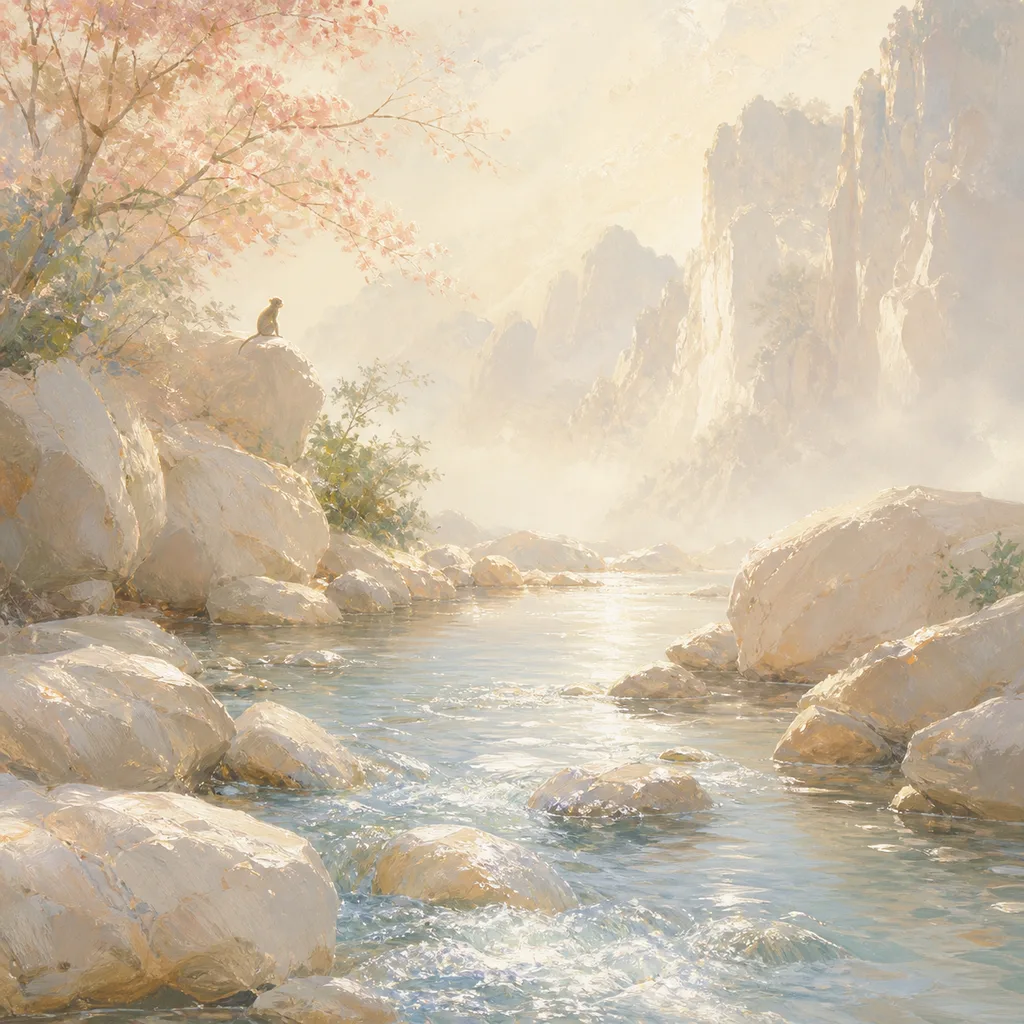
\ \Imagine a mountain spring, hidden among ancient pines, whose waters run cold and clear even in the heat of summer. This is the Spring-Water Monkey (甲申, 泉中水 (Quan-Zhong-Shui)) — a creature whose native cleverness is tempered by a deep, reflective current. Where the ordinary Monkey chatters and leaps from branch to branch, the Spring-Water Monkey pauses, listens to the underground murmur of intuition, and then acts with a precision that seems almost premeditated. The NaYin (纳音) of Spring-Water (泉中水) suggests a source that never runs dry, a wisdom that is both nourishing and elusive.
The Heavenly Stem Jia (甲), representing towering wood, grows from the Monkey’s metal branch (申), creating a dynamic tension. As the Sanming Tonghui (三命通会) notes, this is ‘self-generating water’ (自生之水), whose energy flows freely but needs direction. This pairing produces a mind that is both analytical (metal) and visionary (wood), capable of seeing the forest and the trees simultaneously. Yet this very fluidity can become a trap: the Spring-Water Monkey may overthink, second-guess, and dissolve its own resolve like water seeping into sand.
Paradoxically, their greatest strength lies in their adaptability — they can fit into any social or intellectual container. But their challenge is to remember that water, left without banks, becomes a swamp. The classical text warns against the earth of Wushen (戊申) and Gengzi (庚子), which can muddy their clarity. In essence, the Spring-Water Monkey is a genius who must learn to build a vessel for their own brilliance.
\ \Relationships and romance
\ \In love, the Spring-Water Monkey does not storm the castle — they erode the walls, drop by patient drop. Their approach to romance is osmotic: they absorb the emotions of their partner, mirroring and adapting until the boundary between self and other blurs. This makes them extraordinarily empathetic lovers, but also prone to losing themselves in the relationship. They will remember the smallest detail you mentioned months ago, and surprise you with a gift that proves they were listening when you thought they were daydreaming.
Their best match is the Snake (巳), their Liuhe (六合) partner, whose mysterious, grounded nature gives the Monkey a stable bank for their waters. Together, they create a cycle of mutual deepening — the Snake’s stillness allows the Monkey’s insights to crystallize. However, the Spring-Water Monkey must guard against their own emotional volatility. When hurt, they do not lash out but withdraw, turning their warmth to ice. They need a partner who can wait out their silences without taking them personally, who understands that even a spring can freeze in winter. Their love language is quality time and acts of service — they show devotion by being present, by slowly weaving their life with yours.
\ \Career and professional life
\ \The Spring-Water Monkey’s career is a river carving a canyon — slow, persistent, and ultimately transformative. They thrive in fields that require both intellectual agility and long-term vision: research science, where hypotheses are tested over years; environmental engineering, where they can channel their water element into sustainable solutions; or writing, where they can draw from the deep well of their imagination. The wood stem gives them an upward trajectory — they are not satisfied with lateral moves but seek to grow, to branch out, to rise.
Their work style is collaborative and adaptive. They are the person in a meeting who synthesizes everyone’s ideas into a coherent plan, the one who sees how disparate pieces fit together. But here lies the vulnerability: the Spring-Water Monkey can become so fluid that they lack a spine. They may avoid confrontation, agree to too many projects, and scatter their energy. The NaYin warns that their water, though self-generating, needs a ‘catalyst’ (the classical text mentions metal as a blessing) — they need a mentor, a system, or a clear hierarchy to channel their flow. Without it, they risk becoming a dilettante, brilliant in many things but master of none.
Career fields to avoid: those that demand rigid hierarchy or repetitive tasks. They will wither in a bureaucracy that stifles their need to explore. Instead, they should seek environments that value innovation and allow for intellectual cross-pollination.
\ \Health and wellbeing
\ \The Spring-Water Monkey’s vitality is tied to the lungs and respiratory system — the organs of exchange, where the body’s water meets the air. They are prone to seasonal allergies, asthma, or lingering coughs when their energy is blocked. Emotionally, they process stress through the breath: shallow, anxious breathing when overwhelmed, a sigh of relief when a problem is solved. The water element also governs the kidneys and adrenal system, making them susceptible to burnout if they push too hard without replenishing.
Wellness for this pairing is about flow — not just physical, but emotional and mental. Practices that regulate the breath, such as Qigong (气功) or swimming (a natural water exercise), are ideal. They should avoid environments that are too dry or too stagnant; a humidifier in winter, regular steam baths, or living near water can harmonize their element. The Sanming Tonghui reminds us that Spring-Water is ‘clear and cold’ — they need to warm it with movement and social connection. Late nights are particularly depleting; sleep before 11 PM allows the water element to replenish. A simple practice: upon waking, drink a glass of room-temperature water with a squeeze of lemon to ‘activate’ the spring.
\ \Wealth and finances
\ \Like a spring that never runs dry but also never floods, the Spring-Water Monkey’s finances tend toward steady accumulation rather than dramatic windfalls. They are natural savers, but their water nature makes them generous to a fault — they will lend money to a friend, invest in a cousin’s startup, or donate to a cause without calculating the return. Their wealth pattern, as the wood stem suggests, is ‘compound growth’: slow, patient, and rooted in long-term assets like real estate or blue-chip stocks.
The pitfall unique to this pairing is ‘dissolution’ — the tendency to let money slip through their fingers because they trust too easily or avoid detailed budgeting. The Nayin imagery of a spring suggests they must build a reservoir: an emergency fund, a diversified portfolio, a clear boundary between what they give and what they keep. They are not suited for high-risk trading or get-rich-quick schemes; the volatility would unsettle their water. Instead, they should automate savings, invest in index funds, and treat financial planning as a form of self-care. When they align their wealth with their values — funding education, environmental projects, or the arts — their money multiplies not just in quantity but in meaning.
\ \Personal growth and development
\ \The Spring-Water Monkey’s greatest growth edge is learning to say ‘no.’ Their water nature makes them inclusive, receptive, and eager to please — but a spring that tries to water every field becomes a marsh. The Sanming Tonghui hints at this: the water is ‘self-generating,’ but it needs a ‘return’ (有所归), a direction. For the Monkey, this means pruning their endless ideas, choosing depth over breadth, and committing to one path even when others beckon.
A specific practice: each morning, write down the one thing that, if accomplished, would make the day a success. Not a list, just one. This trains the mind to focus the spring’s flow into a single, powerful stream. They should also practice ‘constructive confrontation’ — speaking their truth even when it might cause ripples. The image to aspire to is that of a spring that has carved a canyon: powerful, defined, and unforgettable. When the Spring-Water Monkey learns to channel their brilliance with discipline, they transform from a clever trickster into a sage whose wisdom refreshes everyone who drinks from it.
\ \Spring-Water Monkey Years
\| Year | GanZhi | Type | Details |
|---|---|---|---|
| 1944 | 甲申 | Spring-Water Monkey | View Profile → |
| 2004 | 甲申 | Spring-Water Monkey | View Profile → |
Famous Spring-Water Monkeys
\Notable figures born in 1944, 2004.
\\ The Supremes lead singer, solo superstar, 12 #1 hits.\
\ Oracle co-founder, tech billionaire, yachting enthusiast.\
\ Star Wars creator, Indiana Jones co-creator, ILM founder.\
A Six Harmony (六合) match — the secret friend combination, naturally aligned in energy and purpose.
Common questions
\ \How can Spring-Water Monkeys overcome their biggest blind spots?
Spring-Water Monkeys (甲申) often struggle with restlessness and overthinking, as Monkey’s energy combined with Water can scatter focus. The 天河水 NaYin suggests they need structure like riverbanks to channel their talents. Practicing mindfulness and setting clear priorities helps. Those born in 1944 or 2004 should delegate minor tasks and avoid spreading themselves too thin. Regular routines anchor their fluid nature.
What feng shui adjustments help Spring-Water Monkeys in 2026?
In 2026 (Fire Horse year), Spring-Water Monkeys (甲申) should enhance their Water element to balance Fire. Place a small fountain or black objects in the north area of your home or office. Avoid red decorations in the south, as they intensify Fire energy. The 天河水 NaYin benefits from mirrors reflecting water imagery. Those from 1944 or 2004 can also wear blue or black to strengthen their intrinsic Water.
What poetic metaphor defines the Spring-Water NaYin?
The 天河水 (Spring Water) is poetically described as ‘rain falling from heaven to revive the earth.’ It evokes a gentle, life-giving force that nurtures without overwhelming. For 甲申, this metaphor highlights their ability to bring ideas to life through subtle influence, like spring showers awakening seeds. Their wisdom flows softly but reaches far, making them natural educators or healers.
How does the elemental cycle affect Spring-Water Monkey fortune?
In the Five Element cycle, Water (甲申) is controlled by Earth and nourished by Metal. Earth years (e.g., 2025, 2026) may bring challenges that require patience, as Earth dams Water. Metal years (e.g., 2024, 2025) enhance their 天河水 energy, boosting creativity and luck. Wood years (e.g., 2023, 2024) drain Water, so those born in 1944 or 2004 should conserve energy. Fire years can be volatile but rewarding if balanced.
When does the next Spring-Water Monkey year occur in the 60-year cycle?
The next 甲申 (Spring-Water Monkey) year will occur in 2064, following the 60-year cycle of the Chinese calendar. The most recent was 2004, and before that 1944. Each cycle brings the same Gan-Zhi and 天河水 NaYin, so those born in 2064 will share the Spring Water essence. Mark your calendars—it’s a year for new beginnings and fluid adaptation.
Which secret friend complements the Spring-Water Monkey?
By the standard Secret Friend rule (the Earthly Branch Six Harmonies, 地支六合), the Monkey’s secret friend is the Snake (巳) — the Shen–Si (申巳) bond. The Tiger (寅) actually sits opposite the Monkey in the Six Clashes (六冲, Shen–Yin), so the Water Tiger (壬寅) is better understood as a dynamic, high-energy pairing — stimulating but occasionally confrontational — rather than a classic secret-friend bond. For partnership synergy, Monkey–Snake combines quiet support with quick wit; Monkey–Rat–Dragon (三合) forms the Water trine team.
Why is 1944 called Spring-Water Monkey instead of Wood Monkey?
In mainstream Chinese astrology, 1944 is often called the Wood Monkey because its Heavenly Stem 甲 (Jia) corresponds to Wood. However, the NaYin (纳音) system — a deeper layer of BaZi analysis — assigns this pillar the Spring-Water (泉中水) resonance. Both names refer to the same year: the Stem name (Wood Monkey) describes its foundational energy, while the NaYin name (Spring-Water Monkey) reveals its poetic-spiritual quality.
Want Your Personal Reading?
\Get your complete BaZi chart with all four pillars, NaYin analysis, and life chapters.
\
Open Free BaZi Calculator →