
Rabbit and Dragon Compatibility: Love, Friendship & Work
In a Nutshell
Rabbit and Dragon face a challenging dynamic: the Rabbit's gentle, cautious nature clashes with the Dragon's bold, ambitious drive. Their core conflict lies in scale—the Rabbit seeks peace while the Dragon pursues grand visions.
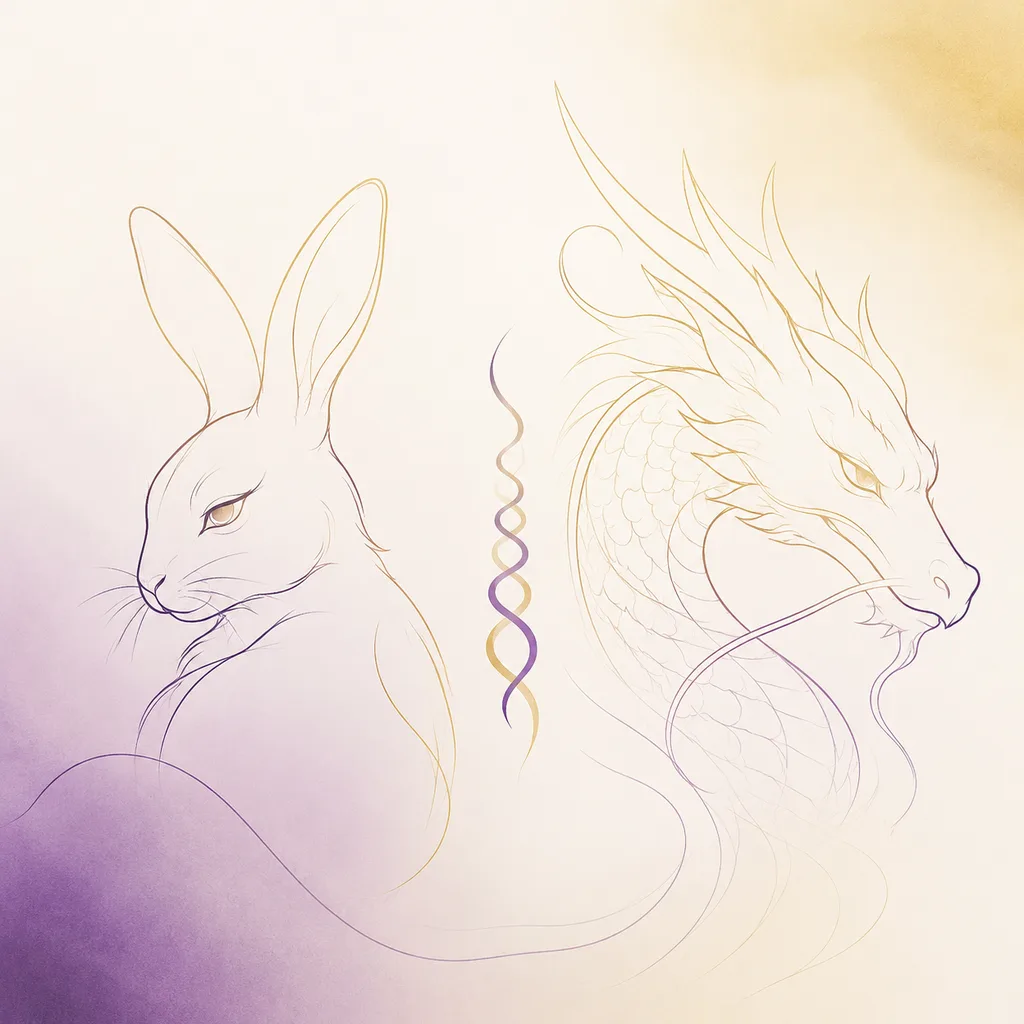
The Bond Between Rabbit and Dragon: A Classical Foundation
In the zodiac alignment, Rabbit and Dragon share a subtle but persistent friction, like wood quietly eroding earth—not explosive, but gradually weakening stability. Yet they also share a seasonal bond rooted in the energy of spring, which grants them a natural harmony that fosters mutual understanding despite the underlying tension. Together, they walk a line between unity and hidden discord.
The Element Dynamic
Wood controls earth in the five-element cycle, creating an inherent tension between Rabbit’s yin wood and Dragon’s yang earth. Rabbit is a tender, creeping vine that seeks nourishment; Dragon is a rugged cliff, proud and unyielding. The vine’s roots can fissure the cliff over time, while the cliff’s hardness may stifle the vine’s growth. This dynamic demands conscious effort — Rabbit must avoid over-critiquing, and Dragon must soften its rigidity — to transform their natural friction into a balanced, enduring bond.
Two Natures in Tension: The Diplomat and the Visionary
The Rabbit’s Inner World
The Rabbit embodies Yin Wood — the nature of a flowering vine: graceful, sensitive, growing toward beauty with patient persistence. Among the twelve signs, the Rabbit carries the most refined aesthetic intelligence — an instinct for harmony and social grace that makes them natural diplomats. Mao Wood represents mid-spring’s gentle growth: flowers opening, the world coming alive with delicate beauty.
The Rabbit’s gentle, artistic exterior hides a core of quiet resilience. While they appear to bend with the wind, their inner strength remains unbroken, allowing them to yield without truly breaking. Their deepest struggle lies in the tension between maintaining harmony and staying true to themselves—they often suppress their true feelings to keep the peace, only to quietly resent the sacrifice.
The Dragon’s Inner World
The Dragon embodies Yang Earth — the nature of a great mountain range: vast, majestic, visible from every horizon. Among the twelve signs, the Dragon carries the most expansive ambition — not merely success, but significance. Chen Earth represents late spring’s peak energy: maximum growth force, maximum potential.
Deep within, the Dragon carries a powerful mix of visionary ambition and surprising adaptability. They dream impossibly large, then attempt the impossible — driven by a grand vision that can feel at odds with everyday reality. Their defining inner tension is between what could be and what is, leaving them both inspired and frustrated by the world as it stands.
Where They Tangle
The MaoChen Harm exists alongside an interesting paradox: these two signs share a seasonal connection (YinMaoChen — the spring trine), which creates natural familiarity. Yet Wood controls Earth — the Rabbit’s growth-oriented nature actively challenges the Dragon’s stability. The harm manifests as quiet resentment that erodes the foundation: the Rabbit feels overshadowed by the Dragon’s magnitude; the Dragon feels undermined by the Rabbit’s quiet resistance.
The core tension is scale. The Dragon operates at maximum magnitude — big plans, bold visions, enormous appetite for life. The Rabbit operates at human scale — beauty, detail, personal connection, carefully curated harmony. When the Dragon’s grand schemes disrupt the Rabbit’s carefully arranged world, the Rabbit doesn’t confront — they comply outwardly while resenting inwardly. Over time, this quiet resentment accumulates into structural damage that neither saw coming, because neither addressed it directly.
Love and Romance: Harmony Meets Magnitude
The Rabbit in love is gentle, romantic, and exquisitely attentive to atmosphere. They create beautiful moments — every detail designed to make the other person feel cherished. What they need most is gentleness and harmony.
The Dragon in love is magnetic, grand, and relentlessly ambitious even in romance. They want a legendary partnership, a power couple, a love story worth telling. Their courtship is bold: grand gestures, ambitious promises. What they need most is admiration and shared ambition.
The harm manifests as scale mismatch. The Dragon’s vision of love is epic — sweeping, transformative, larger than life. The Rabbit’s vision of love is intimate — tender, detailed, personally curated. When the Dragon plans a grand gesture that ignores the Rabbit’s need for subtle beauty, the Rabbit feels overlooked. When the Rabbit creates intimate moments that the Dragon experiences as “small,” the Dragon feels unfulfilled. Neither is wrong — they’re operating at different scales of what love means.
Why It Scores 52/100
The score reflects the quiet-erosion pattern that defines the harm. Unlike explosive clashes, the Rabbit-Dragon conflict is invisible on the surface — both are agreeable, both want harmony, neither makes scenes. But beneath the surface, resentment accumulates from unaddressed scale mismatches. The productive potential is real (they share seasonal affinity), but without conscious attention to the scale gap, the relationship slowly starves.
Marriage and Long-Term Potential
The Rabbit-Dragon marriage tends toward a pattern where the Dragon dominates the partnership’s direction while the Rabbit manages its daily texture. In the best case, this creates a powerful division of labor — the Dragon leads the vision, the Rabbit curates the experience. In the worst case, the Rabbit feels like a supporting character in the Dragon’s story, accumulating quiet resentment that eventually surfaces as cold withdrawal.
The Visibility Problem
The Dragon craves visibility — they want their life and relationship to be impressive, to matter on a large scale. The Rabbit craves intimacy — they want their relationship to be deep, personal, and beautiful in its details. When the Dragon prioritizes the public-facing dimension (social events, career moves, impressive lifestyle), the Rabbit feels like a prop in a performance rather than a partner in a relationship. When the Rabbit prioritizes private intimacy over public presence, the Dragon feels the relationship isn’t living up to its potential.
The Quiet Resentment Pattern
The Rabbit’s defining coping mechanism — smiling while suffering — is the most dangerous dynamic in this marriage. The Rabbit absorbs the Dragon’s oversights (being talked over, being overshadowed, having preferences overruled) with visible grace while accumulating invisible resentment. By the time the resentment surfaces — often as sudden emotional withdrawal or inexplicable coldness — the Dragon has no idea what happened, because from their perspective, everything was fine. The harm is in the gap between what the Rabbit shows and what the Rabbit feels.
What Can Work
The Rabbit must practice direct expression: “When you did X, I felt overshadowed” rather than smiling through it. The Dragon must practice asking: “What do you need?” before charging ahead with plans. Both must recognize that intimacy and magnitude aren’t opposites — the best legendary partnerships have both. The Dragon’s vision needs the Rabbit’s curating touch to become beautiful; the Rabbit’s beauty needs the Dragon’s scale to become significant.
The Gender Lens: Why Direction Matters
Rabbit Man + Dragon Woman
The Rabbit man is gentle, cultured, and charming. He navigates social situations with grace and creates beauty wherever he goes. His romance is thoughtful and detail-oriented — he remembers preferences and creates atmosphere.
The Dragon woman is magnificent — bold, ambitious, unapologetically aiming for the top. She needs a partner who can match her energy or at least not hold her back. She doesn’t do small dreams.
The dynamic: His intimate approach meets her epic vision. She feels he’s not ambitious enough; he feels she doesn’t appreciate subtlety. Her scale makes him feel small; his attention to detail makes her feel limited.
Dragon Man + Rabbit Woman
The Dragon man is born to be extraordinary — charismatic, ambitious, convinced he’s meant for greatness. He wants a legendary life and a legendary partner. His romance is big vision and big promises.
The Rabbit woman is elegant, warm, and socially gifted. She creates beauty and harmony wherever she goes. She needs gentleness and emotional safety to thrive — harshness and neglect wound her deeply.
The dynamic: His magnitude overshadows her subtlety; her emotional needs feel like limitations to his ambition. He forgets to notice the beauty she creates; she stops creating it when it goes unrecognized.
Friction 1: The Scale Mismatch
The Dragon operates at magnitude; the Rabbit operates at detail. When the Dragon plans a grand evening focused on the overall impression, the Rabbit notices the one detail that’s wrong. When the Rabbit creates a beautiful intimate moment, the Dragon is already thinking about the next big thing. Neither feels seen by the other because they’re operating at different zoom levels.
Friction 2: The Overshadowing Dynamic
The Dragon’s natural magnetism tends to dominate any space they enter — not from malice but from sheer energy. The Rabbit, who thrives in harmonious balance, gets overshadowed. The Rabbit’s contributions — social grace, aesthetic beauty, emotional intelligence — become invisible against the Dragon’s magnitude. Over time, this dynamic makes the Rabbit feel like a supporting character rather than a co-star.
Friction 3: The Silent Resentment Spiral
The Rabbit smiles through discomfort; the Dragon doesn’t notice because everything looks fine on the surface. Each unaddressed slight — being talked over, being overlooked, having preferences overridden — adds to a silent resentment account. When the balance finally surfaces as emotional withdrawal, the Dragon is blindsided. The gap between the Rabbit’s surface and depth is the harm’s most powerful weapon.
Friendship and Business Partnerships
As Friends
Rabbit-Dragon friendships thrive when both appreciate their complementary strengths without competing for the same space. The Dragon brings energy, vision, and boldness; the Rabbit brings grace, beauty, and social intelligence. Shared cultural pursuits — art, fine dining, travel — create common ground where both contribute naturally. The friendship stays healthy when the Dragon doesn’t overshadow and the Rabbit doesn’t withdraw.
As Business Partners
In business, this pairing can create extraordinary brands — the Dragon provides the vision and ambition, the Rabbit provides the aesthetic and experience design. The Dragon wants to build something huge; the Rabbit makes it beautiful. The danger: the Dragon sees the Rabbit’s contributions as “soft” while the Rabbit feels undervalued. The solution: equal partnership in strategic decisions, with the Rabbit having final authority on brand experience and the Dragon having final authority on growth strategy.
Beyond the Zodiac: The Full BaZi Picture
An important note on accuracy: Chinese zodiac compatibility examines one layer of a complete BaZi (Four Pillars) chart — the year branch. In a full BaZi reading, compatibility is assessed across all four pillars, considering each person’s Day Master, elemental balance, structural pattern, and current 10-year luck phase. The Rabbit-Dragon Six Harm exists alongside a spring seasonal affinity — a complex picture.
The Rabbit-Dragon relationship is like a carefully arranged garden within a mountain’s shadow — both are beautiful, but one keeps being overshadowed. The full BaZi chart reveals whether there are elements that rebalance the dynamic: Fire to warm both natures and illuminate the Rabbit’s contributions, Water to soften the Dragon’s dominance and nourish the Rabbit’s growth, or Metal to give both partners shared precision and standards. The spring seasonal affinity gives them natural familiarity; the harm adds complexity that awareness can navigate.
Use our BaZi calculator to see your complete chart →
Practical Advice for Rabbit and Dragon
- Practice scale-switching. When the Dragon presents grand vision, the Rabbit contributes details that make it beautiful. When the Rabbit creates intimate moments, the Dragon stays present. Both consciously zoom in and out — different scales aren’t wrong, they’re complementary.
- The Dragon must create space for the Rabbit. In social settings, defer to the Rabbit’s hosting. In private, acknowledge specific beauty the Rabbit creates. Active space-making prevents the overshadowing dynamic.
- The Rabbit must practice the 24-hour rule. Any unaddressed hurt gets named within 24 hours. Silent resentment is the harm’s most powerful weapon — don’t let it accumulate. Direct expression isn’t harshness; it’s honesty.
- Equal partnership in decisions. The Rabbit has final authority on experience and aesthetics; the Dragon has final authority on growth and scale. Neither is subordinate — both domains are essential.
- Honor both scales of love. Legendary love (Dragon’s vision) and intimate love (Rabbit’s curation) aren’t opposites. The best partnerships have both — epic scale with beautiful details. Let each partner lead in their natural scale.
Frequently Asked Questions
Do Rabbit and Dragon share good zodiac chemistry?
Rabbit and Dragon have average chemistry with notable challenges, reflected in a compatibility score of 52/100. This pairing falls under the Six Harms (Liu Hai) relationship, a subtle dynamic where good intentions can lead to hidden resentment. Rabbit's diplomatic, gentle nature clashes with Dragon's bold, ambitious drive. Wood (Rabbit) controls Earth (Dragon), creating underlying tension. While not overtly conflictual, they may feel a persistent 'something's off' vibe. Success requires conscious effort to bridge their different energies.
What’s the love potential for Rabbit and Dragon?
It’s a love that can work, but it demands real awareness. In a Six Harms (Liu Hai) bond, Rabbit and Dragon rarely have loud fights. Instead, they experience ‘accumulated misunderstanding’—small oversights that chip away at trust. Rabbit’s sensitivity may feel bruised by Dragon’s directness, while Dragon may perceive Rabbit as evasive. To thrive, they need open communication and patience. Dragon must soften their ego, and Rabbit must voice discomforts instead of withdrawing. The overall romance potential sits at 52/100, reflecting a connection that requires steady effort.
Do Rabbit and Dragon make committed life partners?
As committed partners, Rabbit and Dragon can build a stable home if they navigate their differences thoughtfully. The Six Harms (Liu Hai) dynamic means hidden drains can erode intimacy over time. Rabbit’s artistic refinement and Dragon’s visionary energy can complement each other—Rabbit creates a cozy sanctuary, Dragon provides big-picture plans. However, Rabbit’s passive avoidance and Dragon’s domineering streak may clash. With mutual respect and honest dialogue, they can forge a resilient bond that balances gentleness with ambition.
What kind of friendship do Rabbit and Dragon build?
Rabbit and Dragon friendships often appear harmonious on the surface but harbor subtle competition. The Six Harms (Liu Hai) pattern means they may feel secretly misunderstood or rivalrous. Rabbit’s empathy and Dragon’s charisma can make for enjoyable company, yet Rabbit may resent Dragon’s need for spotlight, while Dragon may find Rabbit too cautious. The antidote is radical honesty—voicing hidden discomforts often reveals the other feels the same way. If they embrace vulnerability, their friendship can become surprisingly deep.
Can Rabbit and Dragon succeed as business partners?
Rabbit and Dragon can succeed as business partners, but it requires deliberate alignment—their partnership scores 52/100. The wood-controls-earth element dynamic creates tension: Rabbit's meticulous, diplomatic approach contrasts with Dragon's bold, risk-taking style. Rabbit excels in design, mediation, and detail, while Dragon shines in leadership and innovation. However, Dragon may steamroll Rabbit's ideas, and Rabbit's indirectness can frustrate Dragon. To succeed, they need clear roles, regular check-ins, and a willingness to appreciate each other's strengths without letting ego dominate.
How do Rabbit and Dragon typically interact?
Their interactions are a mix of charm and underlying friction. Rabbit’s gentle, refined demeanor initially attracts Dragon’s admiration, while Dragon’s confidence intrigues Rabbit. But the Six Harms (Liu Hai) dynamic means small resentments can accumulate without open conflict. Rabbit may withdraw when overwhelmed, and Dragon may push harder, mistaking Rabbit’s silence for agreement. They often talk past each other—Rabbit hints, Dragon assumes. Conscious effort to communicate directly and check assumptions is essential for smooth interaction.
Do Rabbit parents raise Dragon children well?
Rabbit parents and Dragon children face a Six Harms (Liu Hai) dynamic that can be tricky but manageable. Rabbit’s gentle, nurturing style provides emotional security, but Dragon’s bold, independent nature may clash with Rabbit’s preference for harmony. Rabbit may find Dragon too headstrong, while Dragon may see Rabbit as overprotective. The key is balance: Rabbit must allow Dragon space to lead and explore, while Dragon needs to respect Rabbit’s need for calm. With patience, Rabbit can cultivate Dragon’s confidence without stifling their fire.
Money and Financial Alignment
Financial caution needed. The Rabbit’s conservative, diplomatic approach to saving clashes with the Dragon’s ambitious, big-spending style. The Dragon’s fearless earning capacity may feel constrained by the Rabbit’s cautious budgeting. Wood (Rabbit) controlling earth (Dragon) creates tension: the Rabbit may resent the Dragon’s lavish purchases, while the Dragon sees the Rabbit as overly restrictive. Clear boundaries with separate accounts are essential to avoid resentment.
Lucky Elements at a Glance
| Element | Rabbit | Dragon |
|---|---|---|
| Lucky Numbers | 3, 4, 9 | 1, 6, 7 |
| Lucky Colors | red, pink, purple, blue | gold, silver, greyish white |
| Flowers | snapdragon, lily, jasmine | bleeding heart vine, dragon flower |
| Gems | pearl | amethyst |
More Compatibility Matches
Rabbit & Rat · Rabbit & Ox · Rabbit & Tiger · Rabbit & Snake · Rabbit & Horse · Rabbit & Goat