
Rabbit and Rooster Compatibility: Love, Friendship & Work
In a Nutshell
Rabbit and Rooster face a challenging match. The Rabbit's gentle, graceful nature clashes with the Rooster's sharp, critical observations. This creates friction, as the Rooster's directness cuts through the Rabbit's sensitivity, leading to frequent misunderstandings and a struggle for harmony.
The Bond Between Rabbit and Rooster: A Classical Foundation
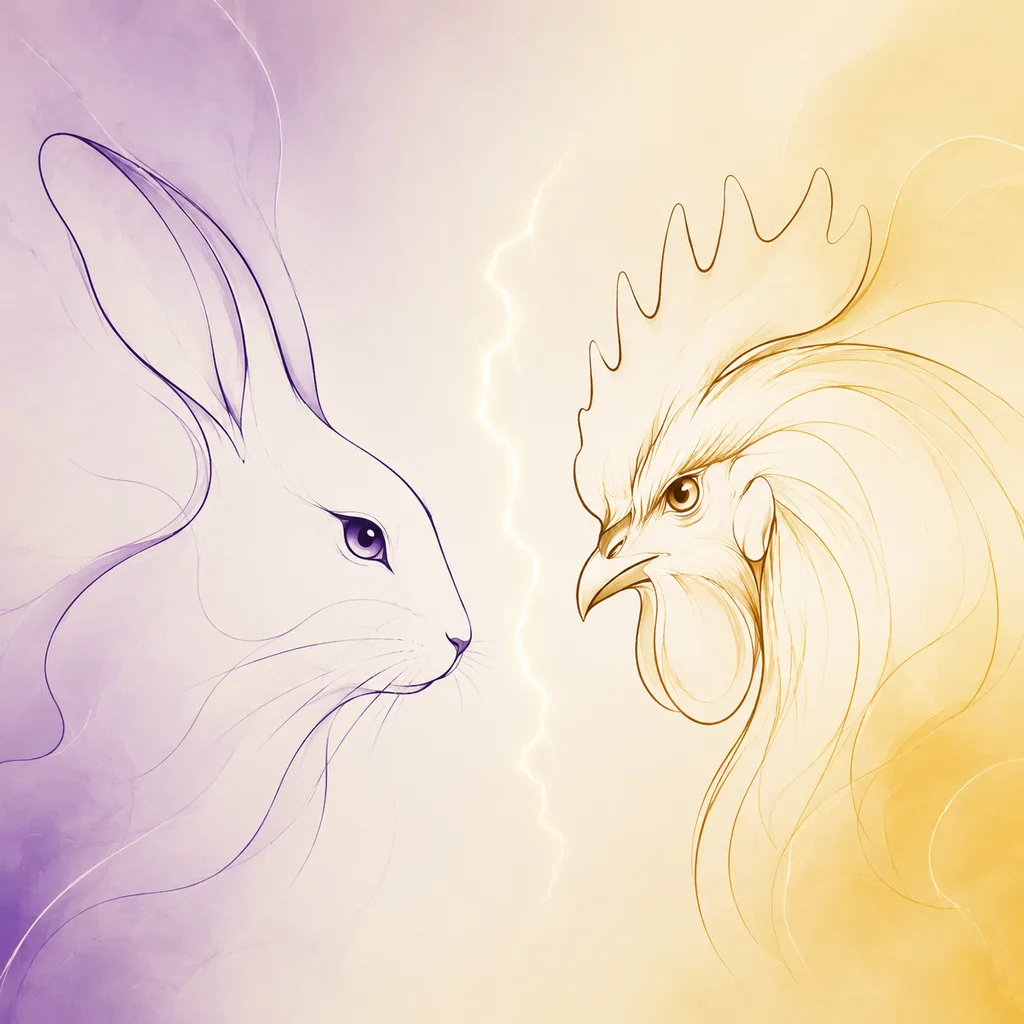
The Rabbit and Rooster face a direct clash in the zodiac — a confrontation between the gentle, yielding energy of Wood and the sharp, precise force of Metal. This is not a harmonious union but a dynamic of friction: the Rabbit’s soft, diplomatic nature meets the Rooster’s critical, perfectionist precision. Their bond is like a battlefield where tenderness is cut by sharpness, yet also a crucible for growth through tension.
The Element Dynamic
In the Five Elements, Metal controls Wood, but here it is a yielding control (ke reverse). The Rooster’s Metal is like a finely honed blade, while the Rabbit’s Wood is supple bamboo. The blade can trim the bamboo, shaping it with precision, but the bamboo’s resilience bends without breaking. This dynamic forces both to refine themselves—the Rooster learns patience, the Rabbit gains structure. Their bond is not easy, but it forges strength through opposition.
Two Natures in Collision: When Silk Meets Steel
The Rabbit’s Inner World
The Rabbit embodies Yin Wood — the nature of a flowering vine: graceful, sensitive, growing toward beauty with patient persistence. Among the twelve signs, the Rabbit carries the most refined aesthetic intelligence — an instinct for harmony, elegance, and social grace that makes them natural diplomats. Mao Wood represents mid-spring’s gentle growth: flowers opening, soft breezes, the world coming alive with delicate beauty.
Beneath their gentle, diplomatic exterior, Rabbits possess a surprising inner strength. They appear soft and yielding, but this conceals a quiet, unshakeable determination. While they may bend with the wind to avoid conflict, they never truly break. Their polite smile and patient approach are not signs of weakness; rather, they are a clever strategy for getting what they want without direct confrontation. The Rabbit’s deepest struggle is between maintaining harmony and being true to themselves. They often choose peace over authenticity, suppressing their own feelings to keep the peace, only to later feel resentful about the very suppression they chose.
The Rooster’s Inner World
The Rooster embodies Yin Metal — the nature of a polished mirror: precise, reflective, unsparingly honest about what it sees. Among the twelve signs, the Rooster carries the sharpest critical intelligence — not cruel, but exacting. You Metal represents mid-autumn’s clarity: leaves falling away, the essential structure revealed, no room for pretense.
Internally, the Rooster carries a sharp, precise energy that drives their need for order and clarity, paired with a quiet, stubborn resolve that refuses to let things slide. This combination makes them both admired and exhausting: they see every flaw, every inconsistency, every gap between intention and execution — and they feel compelled to name it. Their defining tension is standards versus acceptance — they want things to be excellent, but their pursuit of excellence can become a weapon that wounds the people they care about.
Where They Collide
The Rabbit and the Rooster represent a collision between diplomacy and directness, between maintaining harmony and speaking truth. The Rabbit’s entire social strategy is built on reading the room, smoothing rough edges, and ensuring everyone feels comfortable. The Rooster’s entire social strategy is built on identifying what’s wrong and fixing it — regardless of whether anyone asked.
Metal controls Wood: the Rooster’s sharp observations don’t just disagree with the Rabbit’s approach — they cut through it. When the Rabbit creates a carefully harmonious atmosphere, the Rooster walks in and points out the one thing that’s imperfect. When the Rooster delivers blunt criticism, the Rabbit absorbs the impact like a paper cut — small but deep, accumulating over time into real damage. The Rabbit experiences the Rooster as harsh and insensitive; the Rooster experiences the Rabbit as evasive and fragile.
Love and Romance: The Diplomat and the Critic
The Rabbit in love is gentle, romantic, and exquisitely attentive to atmosphere. They create beautiful moments — candlelit dinners, thoughtful gifts, carefully curated experiences. Their courtship is an art form: every detail designed to make the other person feel cherished. What they need most is gentleness and harmony: a partner who handles their sensitivity with care and doesn’t create scenes.
The Rooster in love is honest, devoted, and surprisingly vulnerable beneath the sharp exterior. They show love through practical service — organizing, improving, making sure everything works. Their romance language is directness: they’ll tell you exactly what they think, exactly what they feel, exactly what needs to change. What they need most is appreciation and order: a partner who values their efforts and maintains standards.
The collision is gradual but relentless. The Rabbit’s diplomatic nature means they avoid direct confrontation — swallowing criticism, maintaining a pleasant surface, quietly accumulating hurt. The Rooster’s honest nature means they deliver criticism as a form of care — pointing out flaws because they want things to be better. The Rabbit experiences the Rooster’s helpful observations as constant attack; the Rooster experiences the Rabbit’s emotional withdrawal as mysterious and manipulative.
Why It Scores 38/100
The 38/100 reflects the asymmetry of the damage. The Rooster’s criticism doesn’t feel severe to the Rooster — it’s just honesty, delivered with good intentions. But to the Rabbit’s sensitive Wood nature, each criticism is a cut. By the time the Rabbit’s accumulated hurt surfaces — often as sudden withdrawal or unexplained coldness — the Rooster has no idea what went wrong, because from their perspective, they were just being helpful. This gap makes resolution extremely difficult.
Marriage and Long-Term Potential
The Rabbit-Rooster marriage erodes through a thousand small cuts. Not dramatic conflict, not explosive arguments — just the daily accumulation of criticism meeting sensitivity until the Rabbit’s emotional reserve is depleted and the Rooster can’t understand why their partner has become distant and cold.
The Household Dynamic
The Rooster tends to become the household manager — organizing schedules, maintaining standards, noticing what needs fixing. The Rabbit tends to become the household aesthete — creating beauty, managing relationships, ensuring the home feels warm and welcoming. In theory, these roles complement. In practice, the Rooster’s standards extend to the Rabbit’s domain: the Rabbit’s beautiful table setting has a fork slightly out of place; the Rabbit’s thoughtful gift isn’t quite practical enough. Each observation is small and individually trivial. Together, they accumulate into a message the Rabbit receives clearly: nothing I do is ever good enough.
The Communication Breakdown
The core communication problem is structural. The Rooster speaks in observations — factual, specific, intended to improve. The Rabbit hears in emotional impact — each observation as evidence of inadequacy. When the Rabbit withdraws to protect themselves, the Rooster reads the withdrawal as passive-aggressive manipulation rather than self-protection. Neither can bridge the gap because they’re communicating in different languages: the Rooster in the language of standards, the Rabbit in the language of feelings.
What Would Need to Change
The Rooster must learn to distinguish between necessary feedback and compulsive criticism. Not every imperfection needs to be named. The question isn’t “is this accurate?” but “is saying this worth the cost to my partner?” The Rabbit must learn to receive feedback without absorbing it as identity — a criticism of a specific action is not a judgment of worth. Both must develop the habit of meta-communication: talking about how they talk, not just about what they talk about.
The Gender Lens: Why Direction Matters
Rabbit Man + Rooster Woman
The Rabbit man is gentle, cultured, and naturally charming. He navigates social situations with effortless grace and makes everyone feel comfortable. His romance is thoughtful — he remembers preferences, creates atmosphere, and shows love through consideration rather than grandeur.
The Rooster woman is sharp, capable, and formidably organized. She manages life with precision and expects the same from others. Her standards are high — not because she’s demanding, but because she can see exactly how things could be better and can’t understand why anyone would settle for less.
The dynamic: His gentleness meets her exacting nature. Initially, she appreciates his charm and he admires her capability. Over time, her observations about his choices — career, finances, household — feel like constant correction. His diplomatic response is to withdraw, which she reads as avoidance.
Rooster Man + Rabbit Woman
The Rooster man is precise, hardworking, and quietly devoted. He shows love through service — fixing things, organizing life, making sure everything works. His observations come from care: he wants things to be excellent because excellence is his love language.
The Rabbit woman is elegant, warm, and socially gifted. She creates beauty and harmony wherever she goes, making people feel valued through her attention to their comfort. She needs emotional safety — criticism, even well-intentioned, wounds her deeply.
The dynamic: His helpful observations land as criticism; her emotional withdrawal reads as passive-aggression. He tries harder to help (more observations); she withdraws further (more hurt). The cycle deepens because each partner’s response triggers the other’s core pattern.
Friction 1: The Thousand Small Cuts
The Rooster doesn’t deliver devastating criticism — they deliver constant small observations. “The napkins are slightly off-center.” “You used the wrong word there.” “That color doesn’t quite work.” Each one is trivial. Together, over weeks and months, they accumulate into a relentless message of inadequacy that the Rabbit absorbs silently until they’re emotionally exhausted.
Friction 2: The Silent Withdrawal
When hurt, the Rabbit doesn’t confront — they withdraw. They become quiet, distant, emotionally unavailable. From the Rabbit’s perspective, this is self-protection. From the Rooster’s perspective, it’s confusing and manipulative — “I don’t understand what happened; everything was fine.” The Rooster can’t fix what they don’t know is broken, and the Rabbit resents having to explain what should be obvious.
Friction 3: The Standards Conflict
The Rooster’s standards are high and specific — there’s a right way to do everything, and the Rooster knows what it is. The Rabbit’s approach to life is more fluid and aesthetic — beauty matters more than precision, harmony more than correctness. When these approaches collide (how to set the table, how to raise children, how to spend a budget), neither can understand why the other doesn’t see the obvious answer.
Friendship and Business Partnerships
As Friends
Rabbit-Rooster friendships work best in structured contexts — professional associations, shared hobbies, community organizations. The Rabbit provides social grace and relationship-building; the Rooster provides precision and quality control. The friendship stays healthy when both appreciate the other’s contribution without trying to change their approach. Unstructured, spontaneous hangouts tend to go wrong — the Rooster’s observations feel like judgment in casual settings.
As Business Partners
In business, this pairing can produce exceptionally high-quality work — the Rabbit handles client relationships, design, and brand experience; the Rooster handles operations, quality assurance, and financial precision. The danger: the Rooster’s perfectionism extends into the Rabbit’s creative domain, suffocating innovation with constant correction. The solution: clear quality standards defined in advance, with the Rabbit having creative authority within those standards and the Rooster having veto power only on measurable criteria, not aesthetic preferences.
Beyond the Zodiac: The Full BaZi Picture
An important note on accuracy: Chinese zodiac compatibility examines one layer of a complete BaZi (Four Pillars) chart — the year branch. In a full BaZi reading, compatibility is assessed across all four pillars, considering each person’s Day Master, elemental balance, structural pattern, and current 10-year luck phase. The Rabbit-Rooster Six Clash is a genuine year-branch warning, but it is one dimension of a multi-dimensional compatibility picture.
The Rabbit-Rooster clash is like a sensitive plant growing next to a precision instrument — both are valuable, but their proximity causes constant friction. The full BaZi chart reveals whether there are elements that cushion the contact: Water to soften Metal and nourish Wood (Metal produces Water, Water nourishes Wood — a productive bridge), or Fire to transform both through shared purpose. Without such bridges, the clash tends toward accumulated emotional damage; with them, it becomes a growth opportunity.
Use our BaZi calculator to see your complete chart →
Practical Advice for Rabbit and Rooster
- The Rooster must adopt the “worth saying?” filter. Before every observation, pause: Is this necessary? Is this kind? Is this worth the cost? Aim for a 3:1 ratio of appreciations to observations. Not every imperfection needs to be named — some are better left unseen.
- The Rabbit must practice real-time feedback. When something hurts, say so immediately: “When you said X, it landed hard.” Not hours later, not through withdrawal. The Rooster can’t fix what they don’t know is broken, and silence breeds resentment.
- Separate precision-domains from aesthetic-domains. Finances, safety, legal matters: the Rooster’s exactness leads. Home, social plans, family traditions: the Rabbit’s sense of beauty leads. Different domains have different definitions of “right.”
- Build daily appreciation rituals. The Rooster names one specific thing the Rabbit did well each day. This isn’t padding egos — it’s restoring the balance that constant observation disrupts. Appreciation is the antidote to accumulated criticism damage.
- Learn each other’s communication language. The Rooster speaks in standards; the Rabbit hears in feelings. Translate consciously: when the Rooster says “this fork is wrong,” the Rabbit must practice hearing “I want things to be good” rather than “you failed.” When the Rabbit withdraws, the Rooster must practice asking “what happened?” rather than assuming manipulation.
Frequently Asked Questions
Is the Rabbit-Rooster combination favorable?
This pairing is challenging but not doomed. They form a Six Clashes (Liu Chong) relationship, meaning their energies directly oppose each other. This creates constant friction—the Rabbit’s gentle, diplomatic nature clashes with the Rooster’s blunt, perfectionist tendencies. However, clash in BaZi isn’t purely negative; it forces growth and self-awareness. If both are willing to adapt, they can turn opposition into a dynamic, transformative bond. But without effort, the relationship feels like a constant uphill battle.
Can Rabbit and Rooster sustain romantic attraction?
Yes, but it’s a rollercoaster. Their romance score is 38/100, reflecting intense highs and lows. The Rabbit’s artistic charm and the Rooster’s sharp confidence create magnetic attraction—almost fatal tension. Yet the Six Clashes dynamic means arguments erupt easily over small things. The Rabbit craves harmony, while the Rooster’s criticism wounds. To sustain attraction, they must embrace conflict as a catalyst for deeper connection rather than letting it destroy the spark. Passion is abundant, but lasting romance requires conscious effort to balance opposing needs.
How well do Rabbit and Rooster fare as spouses?
As spouses, they face significant hurdles but can build a strong marriage with mutual respect. Their romance score of 38/100 indicates frequent disagreements. The Rabbit’s desire for a peaceful home clashes with the Rooster’s blunt honesty and need for order. The Rooster may see the Rabbit as too passive, while the Rabbit finds the Rooster overly critical. However, if the Rooster tempers its tongue and the Rabbit stands its ground, they create a balanced household. The key is leveraging the Six Clashes energy to grow together rather than apart.
What makes Rabbit and Rooster good (or challenging) friends?
Their friendship is a classic frenemy dynamic—challenging but oddly resilient. The Rabbit’s empathy and diplomacy can soothe the Rooster’s harsh edges, while the Rooster’s directness pushes the Rabbit out of its comfort zone. However, the Rooster’s critical nature easily offends the sensitive Rabbit, leading to frequent spats. The Six Clashes ensures they’ll argue, but if both have magnanimity, these clashes become growth opportunities. They’re good friends for those who value authentic, no-nonsense bonds over superficial harmony.
Do Rabbit and Rooster have complementary work styles?
Their work styles are complementary in theory but clash in practice. The Rabbit excels at diplomacy, creativity, and big-picture thinking, while the Rooster brings precision, diligence, and attention to detail—a classic Wood-Metal dynamic. However, the metal controlling wood creates tension: the Rooster’s perfectionism can stifle the Rabbit’s flow, and the Rabbit’s indirectness frustrates the Rooster. Their business compatibility is 38/100, meaning success requires clear role division and mutual appreciation. When they respect each other’s strengths, they can achieve remarkable results.
What can Rabbit and Rooster expect from their relationship?
They can expect a relationship full of friction, growth, and magnetic attraction. The Six Clashes (Liu Chong) dynamic means constant push-pull—the Rabbit’s gentleness versus the Rooster’s sharpness. Expect frequent arguments but also deep passion and moments of profound connection. With a 38/100 overall score, the relationship demands effort but offers transformation. They’ll challenge each other’s weaknesses: the Rabbit learns assertiveness, and the Rooster gains empathy. If they embrace the clash as activation rather than destruction, they can build something uniquely powerful.
Are rabbit and rooster enemy signs in the Chinese zodiac?
They are not enemies in a traditional sense, but they form a Six Clashes (Liu Chong) opposition—the most confrontational relationship in BaZi. This means their zodiac branches directly oppose each other, creating inherent tension. However, clash is not the same as enmity; it’s more like a high-voltage connection that can spark either fireworks or fires. While they face more challenges than many pairings, with awareness and effort they can channel the friction into mutual growth. Calling them ‘enemies’ oversimplifies the complex, transformative potential of their bond.
Money and Financial Alignment
Financial caution needed. The Rabbit’s conservative, diplomatic approach to investing clashes with the Rooster’s meticulous, detail-oriented budgeting style. While the Rabbit prefers slow, steady growth, the Rooster’s honest, hardworking nature drives them to track every expense. The Metal (Rooster) controlling Wood (Rabbit) element dynamic creates a yielding tension, where the Rooster may dominate financial decisions, leaving the Rabbit feeling sidelined. To avoid imbalance, they must respect each other’s methods: the Rabbit’s gentleness can soften the Rooster’s rigidity, while the Rooster’s courage can motivate the Rabbit to take calculated risks.
Lucky Elements at a Glance
| Element | Rabbit | Rooster |
|---|---|---|
| Lucky Numbers | 3, 4, 9 | 5, 7, 8 |
| Lucky Colors | red, pink, purple, blue | gold, brown, yellow |
| Flowers | snapdragon, lily, jasmine | gladiola, cockscomb |
| Gems | pearl | citrine |
More Compatibility Matches
Rabbit & Rat · Rabbit & Ox · Rabbit & Tiger · Rabbit & Dragon · Rabbit & Snake · Rabbit & Horse