
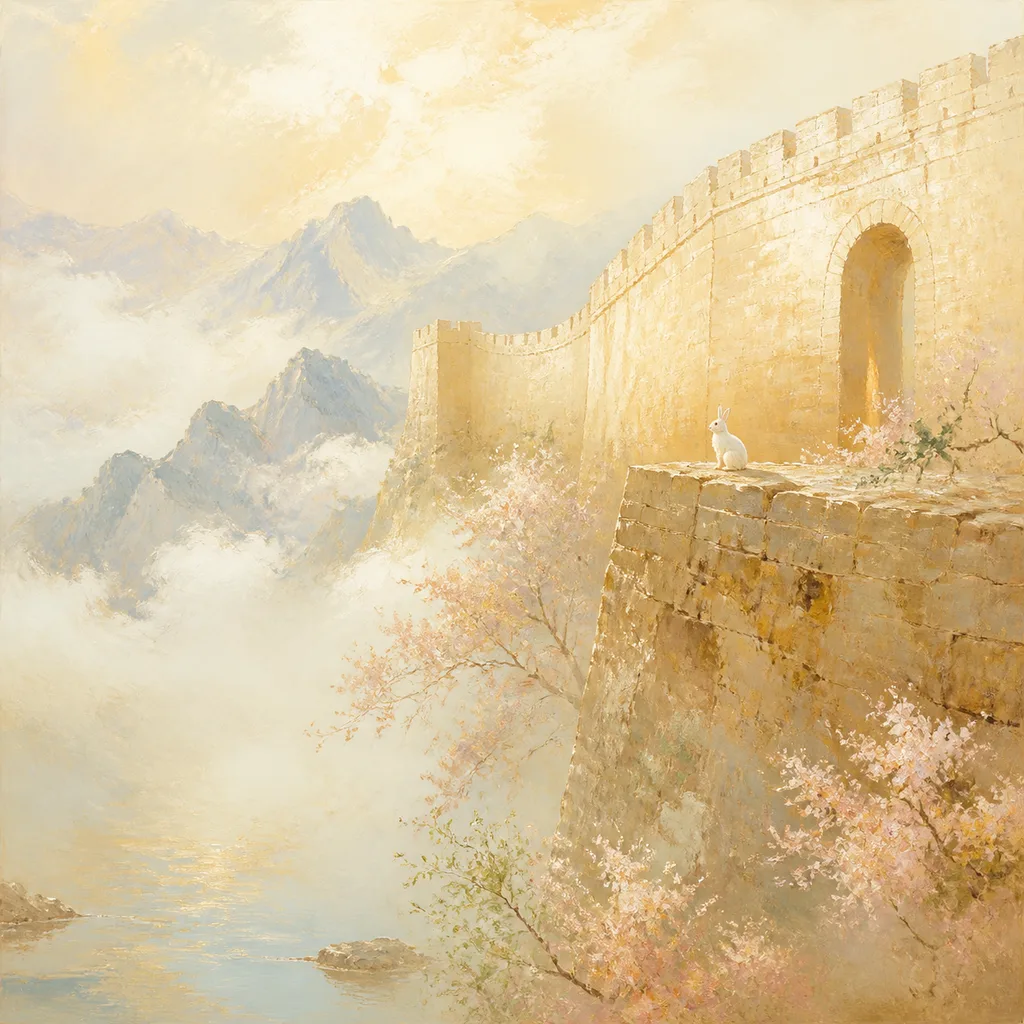
The Wall-Earth Rabbit
己卯 (Ji-Mao) · 城头土 (Wall-Earth) · Earth Stem
The Earth Rabbit (己卯 Ji-Mao) is the Wall-Earth (城头土) NaYin combination, with birth years 1939 and 1999. This pillar blends the Rabbit’s native sensitivity with earth’s stability and pragmatism, producing a grounded, reliable personality with great endurance. Defined by the Wall-Earth image, it possesses a deep, contained resilience—not flashy power, but steady, protective strength.
Quick Facts
| Years | 1939, 1999 |
| GanZhi | 己卯 (Ji-Mao) |
| NaYin | Wall-Earth (城头土 Cheng-Tou-Tu) |
| Element | Earth (Earth Stem) |
| Base Element | Wood |
| Lucky Numbers | 5, 6, 15, 50 |
| Lucky Colors | Yellow, Brown, Beige |
| Lucky Direction | Center, Southwest, Northeast |
| NaYin Season | Late Summer (transitional) |
| Trine Group | Fourth Trine (Rabbit, Goat, Pig) |
| Sexagenary Position | #16 of 60 in the Jia-Zi cycle |
| Lunar Year Dates | 1939: 1939-02-19 to 1940-02-08 1999: 1999-02-16 to 2000-02-05 |
| Six Harmony (六合) | Dog — Secret Friend |
| Three Harmony (三合) | Rabbit · Goat · Pig (Wood Trine) |
| Six Clash (六冲) | Rooster — Opposing Force |
| Five Element Cycle | Generated by Fire → Earth generates Metal → Controlled by Wood |
Rabbit Element Variants Compared
| Variant | GanZhi | Years | Stem Element |
|---|---|---|---|
| Hearth-Fire Rabbit | 丁卯 | 1927, 1987 | Fire |
| Wall-Earth Rabbit ← You are here | 己卯 | 1939, 1999 | Earth |
| Pine-Wood Rabbit | 辛卯 | 1951, 2011 | Metal |
| Gold-Leaf-Metal Rabbit | 癸卯 | 1903, 1963, 2023 | Water |
| Creek-Water Rabbit | 乙卯 | 1915, 1975 | Wood |
Like earth atop a rampart, the Wall-Earth Rabbit guards peace with quiet authority. Their natural diplomacy is fortified by a sense of responsibility that makes them exceptional mediators in high-stakes conflicts — think corporate crisis negotiators or community liaisons during urban development disputes. They blend aesthetic refinement with protective instincts, creating safe, beautiful spaces. Their unique edge: they don’t just keep the peace; they build the walls that make peace possible.
The rampart’s burden can become a prison. This Rabbit’s protective nature may tip into overprotectiveness, stifling the very harmony they seek to maintain. Their gentle diplomacy can curdle into passive aggression when they feel their structures are threatened. The wall they build to shield may also block fresh perspectives, leaving them isolated within their own fortifications. They risk becoming gatekeepers of stale traditions, mistaking rigidity for stability.
The NaYin: Wall-Earth (城头土 Cheng-Tou-Tu)
In classical Chinese astrology, each of the 60 year-stem combinations carries a specific NaYin (纳音, “assigned tone”) — a poetic elemental melody refining the Five Elements into 30 archetypes. The Wall-Earth (城头土) NaYin represents a unique expression of the earth element.
Classical Sources
《三命通会》(Comprehensive Treatise on the Three Fates)
By 万民英 (Wan Minying), Ming Dynasty, 1587 — Volume 30, “On NaYin Elements”:
“城头土者,天京玉垒,帝里金城,龙盘千里之形,虎居四维之势。其取象为堤防之功,立国为民。”
“己卯,自死之土,贵得丁卯、甲戌、乙亥、己未之火,由合而来,以致其福。”
Born in January or February?
There are two systems for determining your zodiac year. Folk tradition uses Lunar New Year (late Jan / early Feb). BaZi astrology uses Lichun (立春, Start of Spring, ~Feb 3–5). If your birthday falls in this boundary period, you might belong to the previous sign (Tiger) under one system but the Earth Rabbit under another. Use our BaZi Calculator to determine your exact pillar based on Lichun.
Who they are
Imagine a wall that has stood for centuries, its bricks worn smooth by wind and rain, yet the mortar between them holds firm. This is the Wall-Earth Rabbit (己卯, 城头土 (Cheng-Tou-Tu)). The Rabbit’s natural grace and diplomacy are here encased in a substance that does not yield easily. Where a typical Rabbit might bend with every breeze, this one plants its feet and considers the weight of each step. The NaYin image of ‘city wall earth’ is not mere dirt—it is the rammed earth of ancient fortifications, the substance that defined the boundaries of kingdoms. As the Sanming Tonghui (三命通会) notes, this is ‘the celestial capital’s jade ramparts, the imperial city’s metal walls’—a material shaped for protection and endurance.
The earthly branch of the Rabbit (卯) brings a Wood nature that seeks harmony and growth, but the Heavenly Stem of Ji (己) is Earth, and Earth can suffocate Wood if it becomes too dense. This creates a paradox: a person who desires connection and movement yet feels a deep pull toward stability and tradition. They are not the Rabbit who flits from social event to social event; they are the one who builds a home and invites the world to come to them. Their caution is not timidity but a form of wisdom—they have learned that what is built slowly lasts longest.
Yet this solidity has its shadow. The same earth that provides foundation can become a prison. The Wall-Earth Rabbit can be stubborn, resistant to change even when change is necessary. They may cling to outdated habits or relationships long after their usefulness has passed. The classical text warns that this is a ‘self-dead earth’ (自死之土), needing the fire of inspiration—represented by combinations like Ding-Mao (丁卯) or Jia-Xu (甲戌)—to rekindle its fertility. Without that spark, the wall becomes a tomb.
There is a quiet dignity to this Rabbit. They do not seek the spotlight, but they are the reason the stage exists. Their presence is a reassurance, a reminder that some things are built to last. The challenge lies in remembering that even the strongest wall must have a gate.
In love and partnership
In love, the Wall-Earth Rabbit does not rush. They observe from a distance, weighing the character of a potential partner with the same care a mason assesses a stone. Their love language is not grand gestures but quiet acts of service—a repaired shelf, a meal prepared exactly as you like it, a steady presence during life’s storms. They seek not a whirlwind romance but a relationship that feels like home. The Dog (戌), their Liuhe (六合) match, resonates deeply with this need for loyalty and mutual protection. With a Dog, the Rabbit finds a guardian who respects their boundaries, while the Rabbit offers the Dog a sanctuary of peace.
Yet the earth that makes them so reliable can also make them predictable. They may struggle to introduce spontaneity or playfulness into the relationship, mistaking routine for security. Their partner might feel more like a cohabitant than a lover if the Rabbit forgets to tend the emotional garden. The NaYin of city wall earth suggests a fortress mentality—they may inadvertently build walls not just around themselves but around the relationship, shutting out the very elements that could keep it alive.
The key for this Rabbit is to learn that vulnerability is not weakness. Letting the ivy of romance climb over their carefully built walls is not a breach but a blessing. They need a partner who understands their need for stability but also gently encourages them to step outside the gate. Once they trust that love will not crumble their foundations, they become the most devoted and steadfast of partners—a wall that shelters, rather than imprisons.
Professional destiny
The Wall-Earth Rabbit’s career path is written in the very substance of their NaYin: they are builders of structures, both literal and metaphorical. Real estate, architecture, urban planning, and civil engineering are natural domains—fields where the earth element can manifest as tangible, lasting results. But their talent extends to any role that requires creating systems of support: human resources, administration, logistics, or even academic research where they can construct a body of knowledge over a lifetime. They do not seek the flashiest titles; they seek the satisfaction of a job well done, a foundation that will hold.
Their work style is methodical, patient, and thorough. They are the colleague who double-checks the numbers, the manager who remembers everyone’s birthday, the leader who builds consensus rather than demanding obedience. The Rabbit’s natural diplomacy, when grounded by earth, makes them exceptional mediators in workplace conflicts. They can see all sides and propose compromises that feel solid, not flimsy.
However, their vulnerability lies in resistance to change. In fast-moving industries, the Wall-Earth Rabbit may be left behind if they refuse to adapt. The very earth that gives them stability can become quicksand if they cling to outdated methods. They must learn to see innovation not as a threat to their foundations but as a renovation. The classical text suggests that this earth ‘needs fire’—the fire of inspiration, of new ideas. Without it, they risk becoming a monument to what once was, rather than a living structure that grows.
Physical and mental health
In the Five Element system, Earth corresponds to the spleen and stomach, while the Rabbit’s Wood nature governs the liver and tendons. The Wall-Earth Rabbit must therefore attend to the fragile equilibrium between digestion and emotional flow. When the earth element is too dominant, it can ‘insult’ wood, leading to stagnation: digestive issues like bloating, poor appetite, or chronic fatigue, coupled with emotional rigidity or suppressed anger. The very caution that serves them in life can turn into anxiety if the earth energy becomes blocked.
To maintain vitality, this Rabbit needs practices that ‘loosen the soil’—both literally and metaphorically. Gentle, rhythmic exercise like walking, yoga, or tai chi helps move the liver qi and prevents earth from becoming too heavy. In their diet, they should favor warm, cooked foods that are easy to digest: soups, stews, and root vegetables like sweet potatoes and carrots. The NaYin of city wall earth reminds us that even the strongest wall needs maintenance; cracks must be filled, and the mortar must be kept moist. For this Rabbit, that moisture comes from emotional expression—journaling, art, or simply allowing themselves to cry or laugh freely. A weekly practice of ‘letting go’—whether through a physical purge of clutter or an emotional release—will keep their inner walls strong but not suffocating.
Money and prosperity
The Wall-Earth Rabbit’s approach to money mirrors their personality: cautious, conservative, and oriented toward long-term security. They are natural savers, not spenders, and they have a particular talent for investing in tangible assets—real estate, land, or even precious metals. The NaYin of city wall earth suggests a wealth pattern that is built layer by layer, like the rammed earth of a fortress. They are not interested in get-rich-quick schemes; they would rather own a small plot of land outright than gamble on stocks. Their financial philosophy is one of slow, steady accumulation, and they often excel in careers that provide stable, predictable income.
Yet this very conservatism can be their undoing. They may become so attached to their assets that they miss opportunities for growth. The wall that protects can also imprison, and the Rabbit must beware of hoarding money out of fear. The classical text hints that this earth ‘needs fire’—the fire of calculated risk, of investing in oneself or in ventures that require faith. A specific pitfall for this pairing is holding onto underperforming assets for too long, whether it’s a property that no longer appreciates or a savings account that inflation erodes. They would benefit from a trusted financial advisor who can gently push them toward diversification. True wealth for the Wall-Earth Rabbit is not a fortress of gold but a living estate that includes both security and the freedom to enjoy it.
Evolution and self-mastery
The Wall-Earth Rabbit’s greatest growth edge is learning to become permeable. They have spent so long building walls—against disappointment, against change, against the chaos of life—that they risk becoming a prisoner of their own design. The NaYin of city wall earth teaches that a wall is only as valuable as the gate it contains. Without a gate, a wall is just an obstacle. For this Rabbit, the gate is the willingness to let new experiences, people, and ideas enter their carefully ordered world.
A specific practice for them is the ‘weekly gate-opening ritual.’ Once a week, they should deliberately do something outside their routine: take a different route to work, try a cuisine they’ve never tasted, or strike up a conversation with a stranger. The goal is not to abandon their nature but to soften it—to let the ivy of spontaneity climb over their walls. They might also explore creative outlets like pottery or gardening, where they can literally shape earth with their hands and then break the form to start anew. The Sanming Tonghui describes this earth as needing ‘fire to come and unite’—the fire of passion, inspiration, and connection. When the Wall-Earth Rabbit learns to let that fire in, they transform from a mere fortress into a living city—a place of shelter, yes, but also of vibrant life and endless possibility. They become not just a good Rabbit, but an extraordinary one.
Wall-Earth Rabbit Years
| Year | GanZhi | Type | Details |
|---|---|---|---|
| 1939 | 己卯 | Wall-Earth Rabbit | View Profile → |
| 1999 | 己卯 | Wall-Earth Rabbit | View Profile → |
Famous Wall-Earth Rabbits
Notable figures born in 1939, 1999.
Gandalf in LOTR, Magneto in X-Men, LGBTQ+ activist.
Queen of Rock and Roll, 8 Grammys, Simply the Best.
The Godfather trilogy, Apocalypse Now, New Hollywood era.
A Six Harmony (六合) match — the secret friend combination, naturally aligned in energy and purpose.
People also ask
How can you confirm you are an Earth Rabbit based on your birthday?
To confirm you are an Earth Rabbit, your birth year must be 1939 or 1999. In the Chinese lunar calendar, these years correspond to the Gan-Zhi pillar 己卯 (Ji-Mao). The Heavenly Stem 己 (Ji) represents Earth, and the Earthly Branch 卯 (Mao) is the Rabbit, making you an Earth Rabbit. The NaYin of 己卯 is 壁上土 (Wall Earth), which further defines your elemental nature. Check your exact birth date against the lunar calendar, as the Chinese New Year date varies. If you were born in early 1939 or 1999 before the lunar New Year, you may belong to the previous animal sign.
How do modern celebrities reflect the Wall-Earth NaYin qualities?
Modern celebrities born in Earth Rabbit years (1939 or 1999) often exhibit the 壁上土 (Wall Earth) qualities of stability, protection, and quiet strength. For example, actors or musicians born in 1999 may show a grounded yet resilient nature, often supporting others behind the scenes. Wall Earth symbolizes a solid foundation, so these individuals may excel in roles that require endurance and reliability. They are not flashy but provide essential support, much like a wall that holds up a structure. Their success often comes from steady effort and a calm demeanor rather than aggressive ambition.
How do elemental clashes affect Earth Rabbit partnerships?
The Earth Rabbit (己卯, 壁上土) is most compatible with Fire and Metal elements, as Fire produces Earth and Earth produces Metal. Clashes occur with Wood and Water elements. Wood (e.g., Tiger, Rabbit) can overcontrol Earth, leading to tension. Water (e.g., Rat, Pig) can wash away Earth, causing instability. In partnerships, an Earth Rabbit may feel drained or challenged by strong Wood or Water personalities. However, these clashes can also bring growth if balanced. For example, a Wood partner’s creativity might inspire the Rabbit, but too much can overwhelm. The key is mutual respect and understanding of elemental dynamics.
What karmic imprint does the Earth Rabbit carry?
The Earth Rabbit (己卯, 壁上土) carries a karmic imprint of building foundations and protecting others. The NaYin 壁上土 (Wall Earth) suggests a past life role as a guardian or a builder of safe havens. This lifetime, they may feel a duty to create stability for family and community. Their karma involves learning to balance their own needs with their protective instincts. They may encounter situations where they must stand firm like a wall, yet remain flexible. Any past life neglect of self-care may manifest as a tendency to overextend. Healing comes from recognizing their worth beyond their service to others.
Which character traits make Earth Rabbit individuals stand out?
Earth Rabbit individuals (己卯, 壁上土) stand out for their quiet determination and reliability. Like the Wall Earth, they are solid and unshakeable once committed. They are diplomatic and avoid conflict, preferring to create harmony. Their calm exterior hides a strong will, and they are often the peacemakers in groups. They have a keen eye for detail and are excellent planners. Unlike other Rabbits, Earth Rabbits are less flighty and more grounded, making them trustworthy friends and partners. Their patience and perseverance allow them to achieve long-term goals without seeking the spotlight.
Which three harmonies (San He) benefit the Earth Rabbit most?
The Earth Rabbit (卯) belongs to the Rabbit-Pig-Goat triad (亥卯未). The three harmonies are Pig (亥), Rabbit (卯), and Goat (未). These signs form a powerful support network. The Pig brings emotional depth and generosity, complementing the Rabbit’s diplomacy. The Goat offers creativity and gentleness, enhancing the Rabbit’s artistic side. Together, they create a harmonious cycle of mutual understanding. For an Earth Rabbit, these relationships provide emotional security and collaborative success. Engaging with Pigs and Goats in work or personal life can amplify the Rabbit’s natural talents and bring balance to their Earth element.
Which industries resonate most with Earth Rabbit talents?
Earth Rabbits (己卯, 壁上土) thrive in industries that require stability, attention to detail, and nurturing. Real estate, construction, and architecture align with their Wall Earth NaYin, as they build solid structures. Education and counseling suit their diplomatic and supportive nature. They also excel in finance, accounting, or administration, where precision and reliability are key. Their artistic side may draw them to design, landscaping, or pottery. Any field that values patience and long-term planning will resonate. They avoid high-risk or volatile environments, preferring steady progress over quick gains.
What sleep patterns work best for Earth Rabbit?
Earth Rabbits (己卯, 壁上土) benefit from consistent, grounding sleep routines. Sleep by 11 PM (Zi hour) to align with Earth’s yin energy, as the Wall Earth NaYin favors stability. A dark, quiet bedroom with earthy tones (brown, beige) enhances their elemental balance. Avoid late nights, as overthinking can disturb sleep. Napping in the afternoon (Wei hour, 1-3 PM) can recharge their Earth element. Regular sleep schedules help them maintain their calm demeanor. Incorporating relaxation practices like meditation or light stretching before bed can prevent restlessness. Their sleep quality improves when they feel secure in their environment.
Want Your Personal Reading?
Get your complete BaZi chart with all four pillars, NaYin analysis, and life chapters.
Open Free BaZi Calculator →