
The Yi Gui Noble (天乙贵人) is BaZi’s helpful-people star, and its whole lookup fits in five lines: ten day stems, five fixed branch pairs. Your day stem selects exactly two Earthly Branches, and those two branches mark where and when help tends to find you. This guide gives the full table, the activation rules for natal charts, luck pillars, and flow years, and the honest boundary on what the star can promise.

Key Takeaways
- The Yi Gui Noble (天乙贵人) marks helpful people: mentors, rescues, and introductions that land at the right moment.
- The lookup runs off your day stem, never your zodiac animal, and the two branches it names stay valid for life.
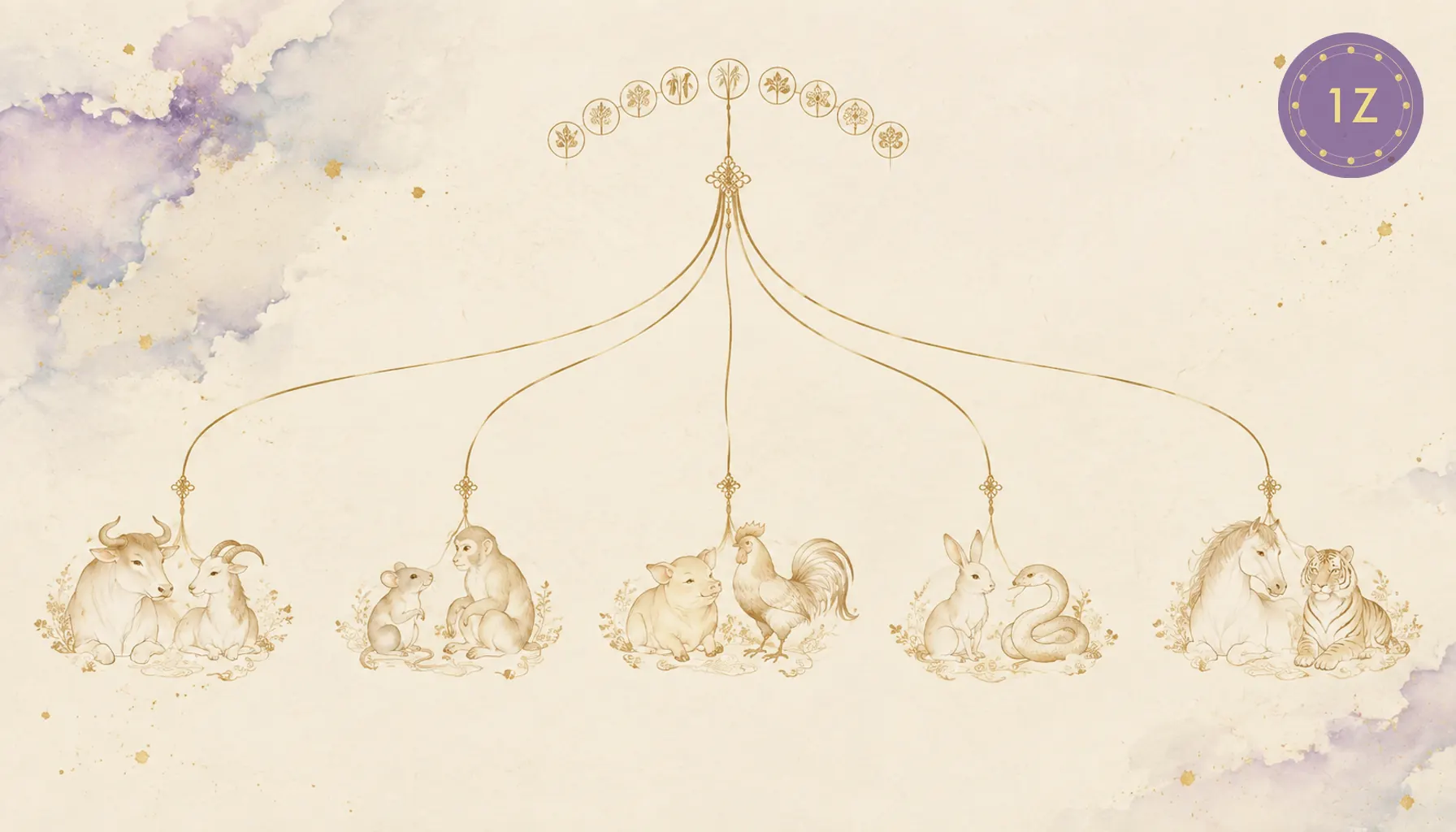
- Five fixed pairs cover all ten stems. Jia, Wu, and Geng pair with Ox and Goat; Yi and Ji with Rat and Monkey; Bing and Ding with Pig and Rooster; Ren and Gui with Rabbit and Snake; Xin with Horse and Tiger.
- The star lights in a natal pillar, a 10-year luck pillar, or a flow year whose branch matches one of the pair; the Horse year 2026 (丙午) lands directly on the Xin-stem pair.
- Ten of the twelve Earthly Branches serve as Nobleman branches for somebody; only the Dragon (Chen) and Dog (Xu) branches never do.
- The star bends conditions toward help and guarantees nothing; the four annual stars overview shows where it sits among its siblings.
What the Yi Gui Noble Means in a Birth Chart
Classical destiny study ranks the Yi Gui Noble first among the benefactor stars, and compilers such as the Ming-era 《San Ming Tong Hui》(《三命通会》) preserved its lookup in rhyme form. Where the Peach Blossom marks attraction and the Travel Horse marks movement, the Yi Gui Noble marks people.
It describes the mentor who names a strength you had stopped noticing, the contact whose one introduction changes a project, the second chance that arrives through someone else’s decision.
The lookup belongs to the day-stem family of stars. Your Day Master, the Heavenly Stem sitting over your day pillar, is the personal center of any BaZi chart, and the Nobleman table reads off that stem alone. That is why the star survives every birthday: stems cycle through ten, branches through twelve, and the pairing your day stem fixes at birth does not drift.
In my experience reading charts, this is the star clients recognize fastest once they see it in their own history. The help it describes rarely looks mystical in hindsight; it looks like the right person already being in the room.
The Full Nobleman Table: All Ten Day Stems
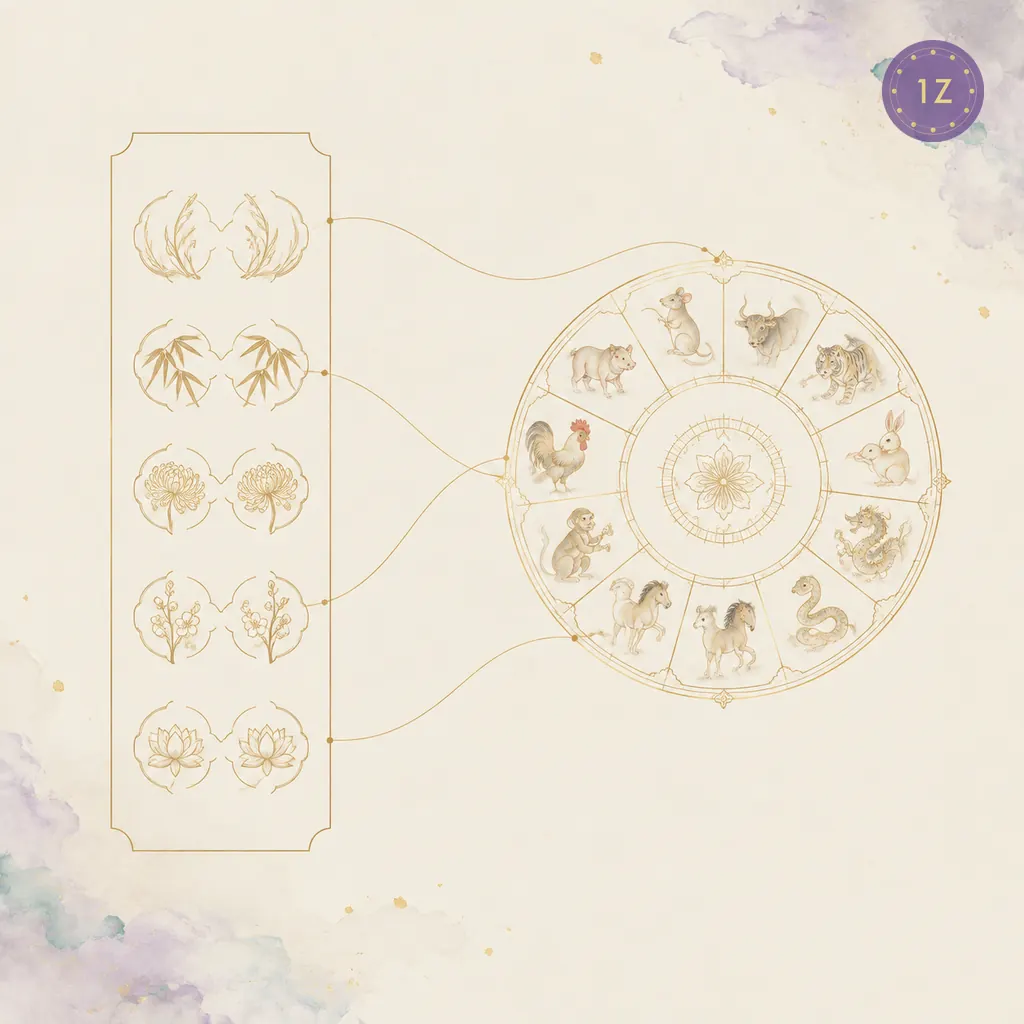
How do you find your Nobleman branches? You read them off your day stem in the table below, the same lookup our engine runs.
| Day Master (day stem) | Nobleman branches | Animals |
|---|---|---|
| Jia (甲) | Chou, Wei | Ox, Goat |
| Wu (戊) | Chou, Wei | Ox, Goat |
| Geng (庚) | Chou, Wei | Ox, Goat |
| Yi (乙) | Zi, Shen | Rat, Monkey |
| Ji (己) | Zi, Shen | Rat, Monkey |
| Bing (丙) | Hai, You | Pig, Rooster |
| Ding (丁) | Hai, You | Pig, Rooster |
| Ren (壬) | Mao, Si | Rabbit, Snake |
| Gui (癸) | Mao, Si | Rabbit, Snake |
| Xin (辛) | Wu, Yin | Horse, Tiger |
Anyone whose day stem is Jia, Wu, or Geng, regardless of birth year, carries the Ox and Goat branches as the two Nobleman positions. Find your own stem by pulling your chart in the free BaZi calculator, which lists the day pillar first. The grouping is a fixed classical table: the Ox-Goat line holds a wood, an earth, and a metal stem together.
Two structural facts fall straight out of the table. Ten of the twelve branches serve as a Nobleman branch for at least one stem, which leaves only Chen (辰, the Dragon) and Xu (戌, the Dog) outside the star’s reach. The pair structure stays tight as well: every stem gets exactly two branches, five pairs across ten stems, and a three-stem group is the largest the table allows.
When I check a chart for this star, I look for the two branches first and the story second.
Why the Day Stem of Your Birth Chart Decides the Nobleman, Not the Zodiac Animal
Your zodiac animal comes from the year pillar, the broadcast layer of a chart that everyone born in the same year shares. The day stem is the personal layer, and the Nobleman star lives there. Two people born in the same Rat year can carry a Yi day stem and a Geng day stem. Their Nobleman branches then differ completely: Rat and Monkey for the Yi stem, Ox and Goat for the Geng stem. Reading the star off the year animal would hand both people one shared answer, and it would be wrong for at least one of them.
The confusion has a specific origin: popular summaries often list the star next to zodiac animals, and the animal names do sit on the branches. The lookup, though, keys on the stem above those names.
For a Xin day master, the practical difference is immediate. Anyone whose day stem is Xin, whatever their birth year, waits for Tiger or Horse years and reads the Horse year 2026 (丙午) as a Nobleman year. I tell Xin-stem clients exactly this in a Horse year: the calendar is already on your side; accept the introduction and take the meeting.
Where the Nobleman Sits in a Birth Chart and When It Lights
Placement changes the flavor. A Nobleman branch in the natal chart is a standing note that colors the area of life its pillar governs, and the four-pillar palace reading gives each placement its window.
| Pillar holding your branch | Classical reading | Life window |
|---|---|---|
| Year pillar | Help through elders, family networks, early mentors | Youth, roughly ages 1 to 16 |
| Month pillar | Help inside school, workplace, and professional circles | Roughly ages 17 to 32 |
| Day pillar | The spouse palace itself carries help; partners open doors | Midlife, roughly ages 33 to 48 |
| Hour pillar | Late support, protégés, and younger allies | After roughly age 49 |
Then the calendar layers on top of the natal note. A 10-year luck pillar that carries one of your branches turns a whole decade toward the same assist, and a flow year whose branch matches one of the pair concentrates it into twelve months. The Horse year 2026 (丙午) is the live case: the annual branch Wu is itself a Nobleman branch for Xin day masters. The star stands front and center for Xin-stem natives and rests for everyone else. Per our engine’s canonical reading, the same year activates the Peach Blossom for the Snake-Rooster-Ox trine and no Travel Horse for anyone, because Travel Horses occupy only the Four Birth Branches (Yin-Si-Shen-Hai) and Wu belongs to the Four Cardinals.
The Goat year 2027 (丁未) hands the year to the other side of the table: Wei is a Nobleman branch for Jia, Wu, and Geng day masters. The three-stem group gets its turn while Xin natives look ahead to the next Tiger or Horse year.
How Far the Nobleman Actually Reaches
Classical practice keeps one boundary around this star, stated cleanly: stars modify, they do not decide. A Nobleman year raises the odds that help is available; it does not guarantee that help arrives, and it cannot stand in for the structural work a chart still has to do. In practice, the star shows up as introductions and second chances far more often than as a dramatic rescue.
Structure does most of the talking in a chart, and the people layer earns its own star precisely in the space structure leaves. In our editorial analysis of 78 zodiac pairings, 48 of 78 pairs (62%) carry no classical branch relationship at all, a denominator our methodology page documents in full. Where structure is silent, timing and people fill the space.
In Mei Lin Chen’s practice notes on reluctant-leader charts, one 1967 Fire Goat client spent years doing senior-level work without the title. The turning point arrived through a person: a mentor pointed out the authority her chart had been carrying all along. She accepted a leadership role at 45, then steered a non-profit through a crisis year. That is the Yi Gui pattern in the wild. The star rarely moves events on its own; it makes sure the right person is standing nearby when the moment opens.
What stands out about this star, after years of reading charts for it, is how unglamorous the confirmations are. Nobody reports thunder. They report the colleague who made one call.
Why do the Ox and Goat actually answer for three different day stems?
The Ox and Goat pair serves the Jia, Wu, and Geng day stems as one group, the largest grouping in the Nobleman table. The reason is inheritance rather than derivation. The classical verse tradition preserves the lookup in rhyme, one line of which pairs those three stems with the Ox and the Goat, and our tables follow that mainstream line. The other four lines cover the remaining seven stems: Yi and Ji, Bing and Ding, and Ren and Gui travel as stem pairs, while the Xin line stands alone as the table’s only single-stem entry. That brings the table to ten stems in five lines. No element or polarity pattern re-derives the grouping; treat it the way you treat a multiplication table: look up, then read. Three stems out of ten sharing one pair does mean the Ox-Goat answer is the single most common Nobleman result in any room of people.
How can I tell which years light the Nobleman star for each day stem?
The flow year lights your Nobleman whenever its branch is one of your two Nobleman branches, which makes the map predictable years ahead. The Horse year 2026 (丙午) covers Xin day masters. The Goat year 2027 (丁未) covers Jia, Wu, and Geng. The Monkey year 2028 (戊申) covers Yi and Ji. The Rooster year 2029 (己酉) covers Bing and Ding. The Snake year 2025 (乙巳) just finished the same job for Ren and Gui. Two kinds of years light it for nobody: Dog years and Dragon years, which includes 2030 (庚戌) and 2024 (甲辰), the two branches outside the star’s reach. If you are planning around helpful people, those five lines of arithmetic put a rough calendar on the whole table.
Is it true that a Nobleman year guarantees that help arrives?
It does not, and classical practice says so plainly: the star modifies the conditions of a period, it does not decide outcomes. A Nobleman year raises the odds that help is available when you ask for it. The assist still has to be used, which is where the practical work sits: send the message back, accept the introduction, take the senior person’s call. Classical texts also count several benefactor-type stars beyond the Yi Gui Noble, and a chart can carry more than one helping signal, though the Yi Gui remains the one most readers meet first. Treat the year as an open door, not a completed conversation.
How is the Yi Gui Noble different from the Peach Blossom star?
The two stars come from different lookup families and mark different things. The Peach Blossom derives from your trine frame and marks attraction and magnetism, while the Yi Gui derives from your day stem and marks helpful people. The branches they use overlap in interesting ways. The Rooster branch (酉) is both the Bathing Position of the Shen-Zi-Chen trine and a Nobleman branch for Bing and Ding day stems; one branch can carry two different stars for two different questions. In a chart holding both, the same Rooster reads as social magnetism for the trine question and as a helper marker for the day-stem question. Keep the questions separate and the two stars stop competing.
Conclusion
The Yi Gui Noble distills to a short sequence: find your day stem, read its two branches, then watch for those branches in your pillars and in the calendar. Check your own two branches with the 12Zodiacs zodiac tools and see which years put helpful people on your side of the table.
Sources
Sexagenary cycle, Wikipedia: backs the ten-stem, twelve-branch framework and the day-stem rotation the Nobleman lookup runs on.
Heavenly Stems, Wikipedia: backs the ten stems and their cycle order.
Hong Kong Observatory: backs the calendar methodology behind branch and solar-term calculation.