
Annual BaZi stars (流年神煞) are the 4 star types a flowing year can drop onto your chart, checked across years of readings and hundreds of charts: Peach Blossom (social magnetism), the Travel Horse (movement and relocation), the Nobleman (helpful people), and the Academic Star (study and certification luck). None of them is guessed; each is derived mechanically, from your own chart’s trine frame for the first two and from your Day Master for the last two. This article derives all four, works them with the 2026 Fire Horse year as a live example, and sets the honest boundary: stars are a layer of flavor over your chart, never a verdict.

Key Takeaways
- Four annual signals: Peach Blossom (咸池), Travel Horse (驿马), Heavenly Nobleman (天乙贵人), and Academic Star (文昌).
- Peach Blossom and Travel Horse derive from your trine frame: each trine has a fixed Blossom seat (its element’s Bathing Position among the Four Cardinals) and a fixed Horse seat among the Four Birth Branches.
- Nobleman and Academic Star derive from your Day Master via a fixed lookup, no trine needed, and both stay valid for life.
- A star activates only when the flowing year or luck pillar carries the matching branch; without the match, the star sleeps.
- Stars modify a reading’s flavor; they never override structure, and no single star predicts an event.
The Four Signals and How Each Is Derived
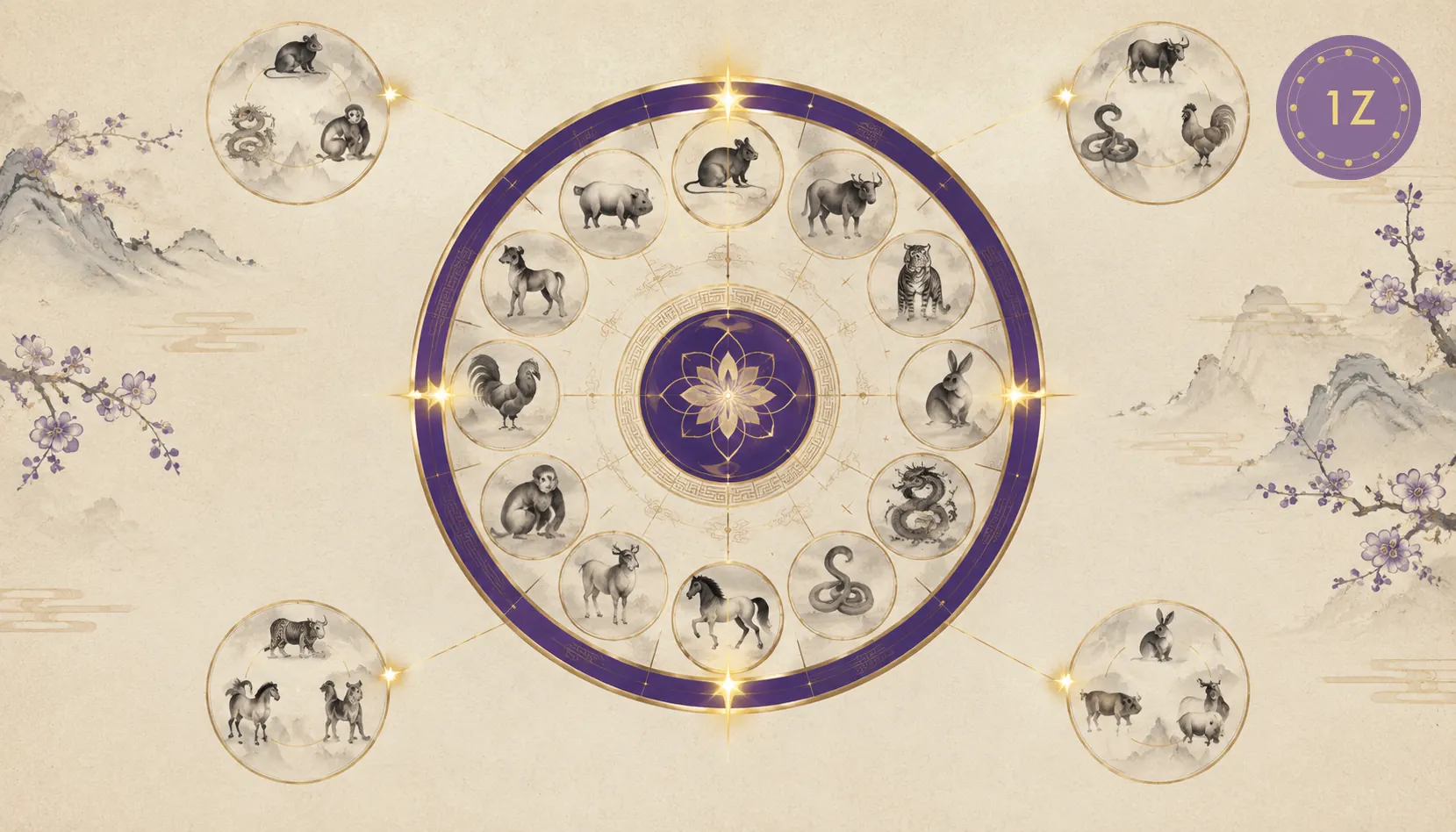
The four stars split into two derivation families, and knowing which family a star belongs to tells you what information you need to compute it. Peach Blossom and the Travel Horse come from your trine frame, the three-seat alliance your year branch (or day branch) belongs to. The Nobleman and Academic Star come from your Day Master alone, through fixed classical lookups that never change.
The trine family works like this: each of the 4 trines has two fixed star seats, and the classics name them by position family rather than by counting. The Peach Blossom is each trine’s Bathing Position (沐浴), the place where its element’s qi is fresh and exposed to the world, and the four Bathing Positions together are the Four Cardinal branches: Rat, Horse, Rabbit, Rooster. The Travel Horse belongs to the other family of seats, the Four Birth Branches: Tiger, Monkey, Snake, Pig, the places where the four elements each take root. The Day Master family is simpler still: a fixed stem-to-branch table gives each Day Master its Nobleman branches and its Academic Star branch, unchanged since the classics.
| Star | Family | Derived from | Sits only in |
|---|---|---|---|
| Peach Blossom 咸池 | Trine frame | The trine’s Bathing Position (沐浴) | Four Cardinals (Rat/Horse/Rabbit/Rooster) |
| Travel Horse 驿马 | Trine frame | Fixed by trine, classically from its Birth Branch | Four Birth Branches (Tiger/Monkey/Snake/Pig) |
| Heavenly Nobleman 天乙 | Day Master | Fixed stem lookup | Varies by stem |
| Academic Star 文昌 | Day Master | Fixed stem lookup | Varies by stem |
Two inputs decide everything: the trine frame for the first pair, the Day Master for the second.
The Four Meanings, Honestly Framed
Each star colors a zone of life, and each carries a classical caveat that pop readings drop. Peach Blossom, in my reading experience, marks social magnetism and attraction, charm that draws people toward you, a social growth point rather than a fixed trait; the classical caveat is that the same magnetism draws entanglement, which is why the classics pair it with the phrase “romance or complication, depending on the chart’s discipline.” The Travel Horse marks movement: relocation, travel, role changes, logistics in motion; its caveat is restlessness, motion without a destination.
The Heavenly Nobleman is the gentlest of the four: helpful people arriving at the right moment, mentors, rescues, introductions that land. Its activation is the most consistently pleasant in classical experience, though it still only bends the conditions of a period rather than guaranteeing rescues. The Academic Star marks study, exams, writing, and certification luck, the scholar’s assistant. Its caveat: it supports your preparation, it does not sit the exam for you. In my experience this is the most misused star of the four, and I would ban the “destined affair” framing outright if I could, exactly because students mistake support for substitution.
In our experience, after years of readings, the 4 stars read best as a seasonal accent set: a year with your Peach Blossom feels more socially alive, a Horse year moves things, a Nobleman year brings assists, an Academic year favors study. In our analysis of the 78 zodiac pairings, even structural lines like trines and harmonies stay lines rather than verdicts, and stars sit one layer softer than those. How these figures are computed is laid out under methodology. Four accents, four caveats: magnetism, motion, assistance, preparation, and none of them a verdict.
Four accents and four caveats, then, but magnetism, motion, assistance, and preparation arrive on the chart’s terms, never as verdicts.
Activation: When a Star Actually Lights Up
A star on your natal chart is a permanent sensitivity; a star lit by a flowing year is an event-grade accent. In practice, the activation rule is mechanical: the year branch must match the star’s seat. If your Peach Blossom is the Rooster, Rooster years light it, most recently 2017 in that 12-year rhythm. If your Travel Horse is the Tiger, Tiger years move you. The same rule extends to luck pillars: a decade carrying your Blossom seat colors that chapter’s social register for 10 years, and we watch readers light up when they see the pattern in their own history.
Worked example, the 2026 Fire Horse year: the Horse is the peak seat of the fire trine (Tiger-Horse-Dog) and simultaneously the Peach Blossom seat of the metal trine (Snake-Rooster-Ox, whose Bathing Position of Metal is the Horse). So the Horse year lights the Peach Blossom for metal-frame charts, while fire-frame charts feel their peak seat occupied, a different texture again. One year, different lights for different charts, and I find this the cleanest demonstration of why generic horoscope columns fail. This is exactly why newspaper “year of the Horse” columns are structurally incapable of being personal.
Two honest notes on activation. First, a lit star still only accents: a Blossom year with no Output line feeding your social zone is charm with nowhere to go. Second, count the break layer before celebrating a Horse-year travel plan. A clash or break line landing on the same seat can flip motion into disruption, which we have seen derail 2 travel plans that looked perfect on paper.
A natal star is sensitivity, a year-matched star is accent, and structure decides whether the accent has anywhere to land.
The Boundary: Stars Are a Layer, Not a Life
The classical boundary, stated once cleanly: stars modify, they do not decide. A Peach Blossom does not cause an affair, a Travel Horse does not force a move, a Nobleman does not guarantee rescue, and an Academic Star does not pass exams. What each does is shift the texture of the period they light, and the shift is real, readers across centuries have consistently observed it, but it operates one layer under structure.
That is also why a competent reading checks stars last, after strength, roles, and timing are set: a star accenting a strong structure lands differently than the same star accenting a weak one. If you want the structural layers first, the Chinese zodiac hub holds the seat layer, our Ten Gods table walks the role layer, and the element cycle page is the grammar underneath them both.
Stars season a chart; structure feeds it, and I would keep that distinction even if it cost half the star lore in circulation.
Annual BaZi stars vs. zodiac sign predictions: what is the difference?
The difference is mechanism and personalization. Zodiac sign predictions are broadcast: one message for everyone born in a sun-sign window, derived from nothing but the sun’s position. Annual BaZi stars are narrowcast signals: Peach Blossom (social magnetism), Travel Horse (movement and relocation), Heavenly Nobleman (helpful people), and Academic Star (study and certification luck), each read off your own chart, from your trine frame for the first two and your Day Master for the last two. A star only activates when the year branch matches its seat, which is why the same year lights different stars for different people.
Which years light my Peach Blossom?
It depends on your trine frame, which your year or day branch determines. Metal-frame charts (Snake, Rooster, Ox) light the Blossom in Horse years; fire-frame charts (Tiger, Horse, Dog) in Rabbit years; water-frame charts (Monkey, Rat, Dragon) in Rooster years; and wood-frame charts (Pig, Rabbit, Goat) in Rat years. The pattern worth noting is the position family: every Blossom is a Bathing Position, one of the Four Cardinal branches, so only Rat, Horse, Rabbit, and Rooster can ever be anyone’s Blossom. The day-branch frame is the more personal of the two checks, and classical readers weight it first.
Is the Travel Horse actually a good star, or does it depend on the chart?
It depends on the chart, always. The Horse is a motion signal, and motion is direction-neutral: it favors relocation, travel, role changes, and getting unstuck, and the caveat is restlessness, movement without destination. In my experience the honest read is conditional: a Horse-year activation inside a chart that wants change reads as doors opening, while the same activation in a chart whose structure resists movement reads as friction and churn. The star sets the direction of travel; the chart’s structure sets the vehicle.
Do BaZi stars predict events?
No, and any reading that converts a star into a scheduled event has left the method behind. Stars are accent layers that shift the texture of a period, social register, mobility, assistance, study luck, and they always operate under structure: strength, roles, and timing set first, stars season after. Even the strongest structural interactions in our dataset stay lines rather than verdicts, and stars sit one layer softer than structure. The reliable use is preparatory: knowing an Academic Star year is coming tells you when to invest in study, not that a certificate will arrive by mail.
Sources
- Four Pillars of Destiny – Wikipedia: the chart framework the stars accent
- Chinese zodiac – Wikipedia: the branch wheel and trine frames behind star derivation
- Chinese astrology – Britannica: the classical context of symbolic stars
Conclusion
Four mechanical signals, two derivation families, one honest boundary: annual stars season your chart’s years with magnetism, motion, assistance, and study luck, and they never outrank structure. Find your own seat and its trine frame on the Chinese zodiac hub, then check which star the current year lights for you.