
The twelve Tai Sui gods (太岁十二神) are the year layer’s full staff of symbolic stars (the shen sha, 神煞): twelve offices counted out from the year’s own branch, one office for every birth branch, 2026 included. The Tang-dynasty astronomer Li Chunfeng (李淳风) set the sequence down and the Qing court’s 1739 calendar manual kept the count; the mechanism is the count itself, and your birth animal is the only input. Below: the full table, the 2026 and 2027 arrays, the named officers, and the line between office and verdict.

Key Takeaways
- The twelve Tai Sui gods are a counted roster, not a personality list: count 0 is Tai Sui itself, the year’s own branch, and each further count steps one branch forward.
- The searched-for officers sit at fixed counts: Funeral Gate at 2, Five Ghosts (Official Talisman) at 4, Death Symbol at 5, Dragon Virtue at 7, Fortune Virtue at 9, Mourning Guest at 10.
- In 2026, Bing Wu (丙午) at seat 43 of 60, the Funeral Gate sits with the Monkey, Five Ghosts with the Dog, Dragon Virtue with the Ox, Fortune Virtue with the Rabbit, Mourning Guest with the Dragon.
- In 2027, Ding Wei (丁未) at seat 44, every office moves one branch forward, and count 6 again lands on the year branch’s own clash partner.
- An office is texture on a year, never a verdict, and the sources that define the grief-named seats attach no outcome to them.
The Twelve Gods of Tai Sui: An Office for Every Branch
BaZi star-lore sorts its symbolic stars by lookup type, and the year layer holds three families: the trine-frame annual stars, Peach Blossom and Travel Horse, read off your trine alliance, while the Nobleman and Academic Star read off your Day Master. The twelve gods of Tai Sui belong to the third family, a counted array starting at the year’s own branch, so the lookup needs nothing but a birth branch and a year.
The sourcing runs deep. Classical tables, from Li Chunfeng’s Si Li San Yuan (四利三元) in the seventh century to the 1739 imperial manual Xie Ji Bian Fang Shu (协纪辨方书), preserve the same twelve names in order, and the Qing manual, quoting the Jisui Li (纪岁历), fixes the Funeral Gate two branches ahead of the year (岁前二辰) and the Mourning Guest two behind (岁后二辰). What stands out about this family is the double coverage: the same counting turns up in the Liu Ren divination corpus (六壬大全).
In our framework we read the result as a staff roster: counts 0 through 11 on twelve branches means every branch is staffed every year, each holding exactly one office. The counting gives you what alarm lists never do, twelve named textures instead of one flat warning.
The Full Tai Sui Gods Table: Twelve Seats, Counted
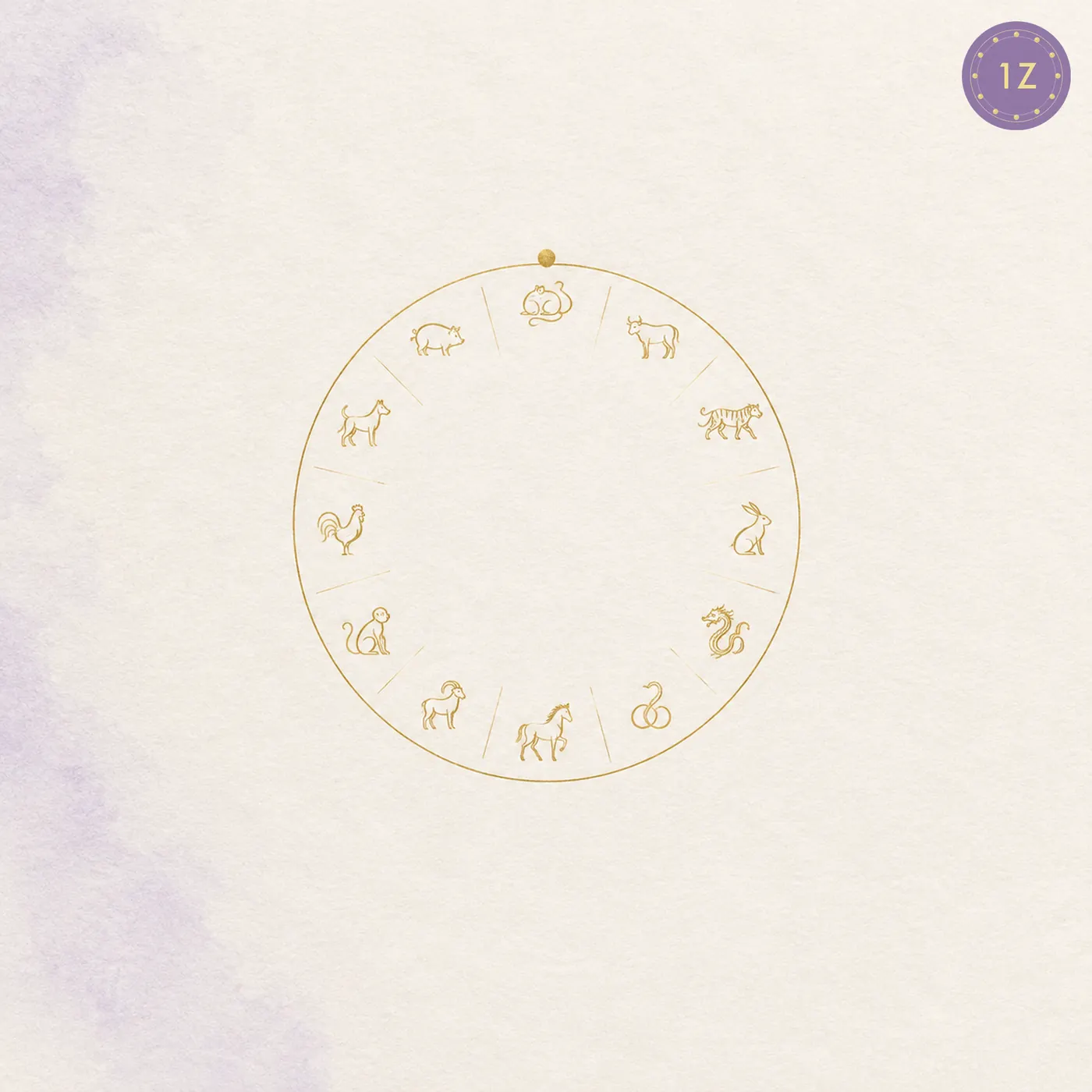
Here is the whole roster: fix the year’s branch at count 0, then step forward and read the name.
| Count | Officer | Chinese | Anchor |
|---|---|---|---|
| 0 | Tai Sui | 太岁 | the year’s own branch, the presiding seat |
| 1 | the Sun | 太阳 | one branch forward |
| 2 | Funeral Gate | 丧门 | two branches ahead of the year |
| 3 | the Moon | 太阴 | three forward |
| 4 | Official Talisman, folk name Five Ghosts | 官符,俗名五鬼 | four forward |
| 5 | Death Symbol, also Small Consumer | 死符(小耗) | five forward |
| 6 | Year Breaker, also Great Consumer | 岁破(大耗) | the year branch’s own clash partner |
| 7 | Dragon Virtue | 龙德 | seven forward |
| 8 | White Tiger | 白虎 | eight forward |
| 9 | Fortune Virtue | 福德 | nine forward |
| 10 | Mourning Guest | 吊客 | two branches behind the year |
| 11 | Heavenly Dog | 天狗 | schools differ: some lists print the Illness Star (病符) here |
Official Talisman (官符) is the classical name for count 4, with Five Ghosts (五鬼) as the folk register English star lists adopted. 死符 is the Death Symbol office, 小耗 reads as Small Consumer, 岁破 is the Year Breaker, 大耗 reads as Great Consumer, with 耗 in both pairs the word for consumption. Count 6 earns its second name by identity: the seat six steps away is the branch’s own clash partner, Zi to Wu, Chou to Wei, fixed Six Clash pairs in our tables. It is also the one officer the contact frameworks treat as a full contact, with its own treatment in the four Tai Sui contacts piece. Count 11 is the contested seat: the Heavenly Dog in one tradition, the Illness Star (病符) in the other, schools differ, and an honest table marks the seam.
The roster’s symmetry is, in my reading, its own argument: only two names carry grief, seated at counts 2 and 10. A family of twelve with exactly two scary names is a calendar, misread as prophecy whenever only the scary names travel.
Three Steps to Your Officers, Worked on 2026
The lookup is arithmetic you can run on one hand.
- Fix the year branch. The branch year turns at Li Chun (立春), the solar-term crossing near February 4, and 2026 is Bing Wu (丙午), seat 43 of the 60-pairing cycle, branch Wu, the Horse.
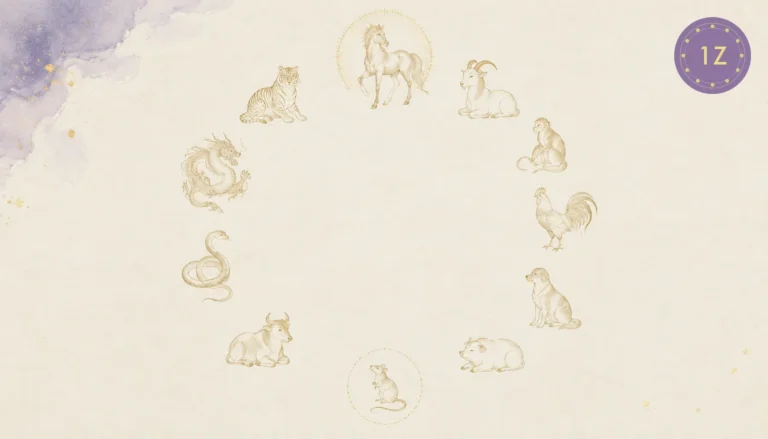
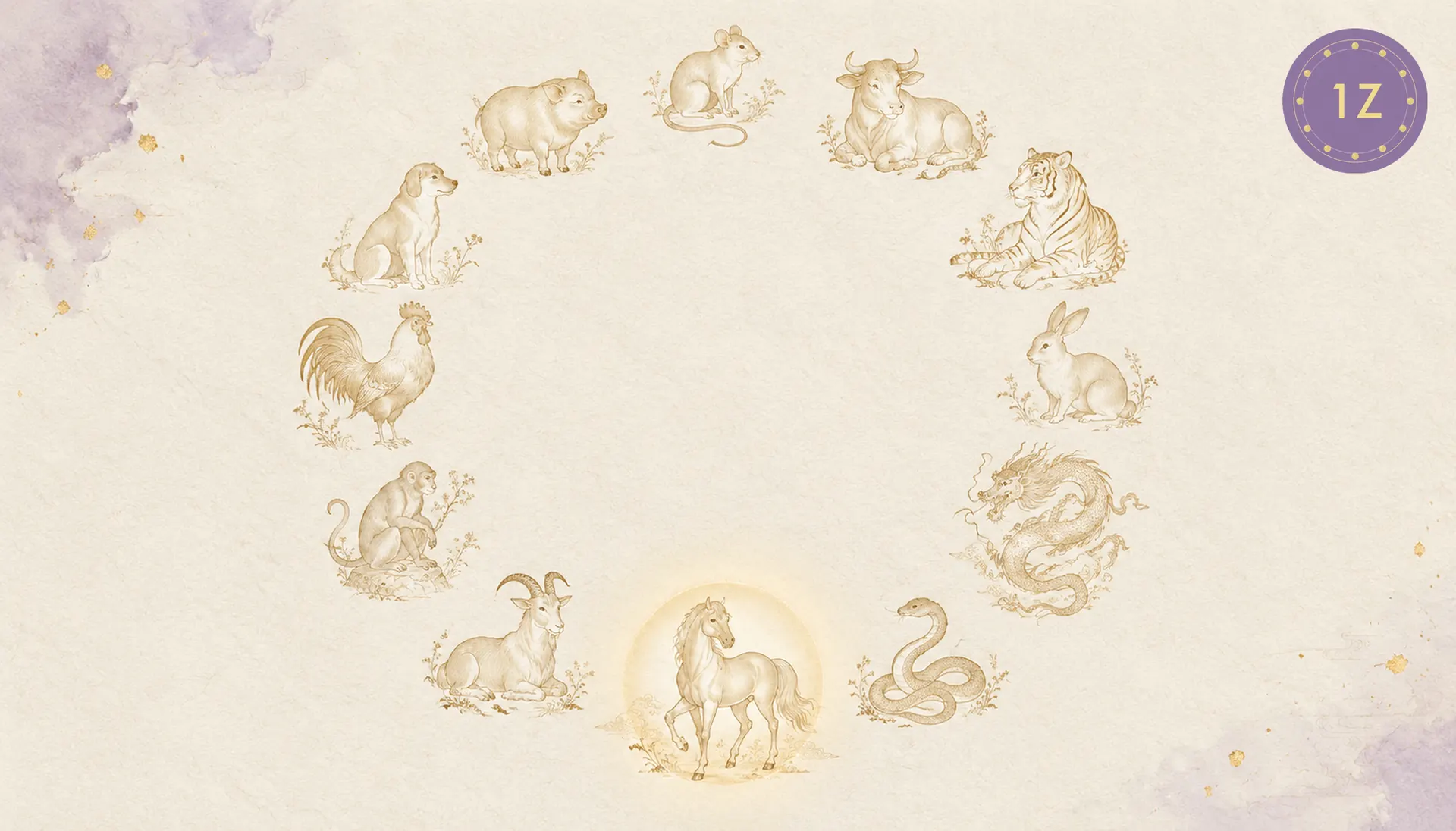
- Count forward from Wu. Wu is count 0, Tai Sui’s own seat, and the wheel order is fixed: Zi Rat, Chou Ox, Yin Tiger, Mao Rabbit, Chen Dragon, Si Snake, Wu Horse, Wei Goat, Shen Monkey, You Rooster, Xu Dog, Hai Pig.
- Read the officer at the landing branch. Count 2 lands on Shen, the Monkey, holder of the Funeral Gate; count 4 lands on Xu, the Dog; count 7 lands on Chou, the Ox, holder of Dragon Virtue.
| Officer in 2026 | Count from Wu | Seat | Branch holder |
|---|---|---|---|
| Tai Sui | 0 | Wu (午) | Horse |
| Funeral Gate | 2 | Shen (申) | Monkey |
| Official Talisman / Five Ghosts | 4 | Xu (戌) | Dog |
| Death Symbol / Small Consumer | 5 | Hai (亥) | Pig |
| Year Breaker / Great Consumer | 6 | Zi (子) | Rat |
| Dragon Virtue | 7 | Chou (丑) | Ox |
| Fortune Virtue | 9 | Mao (卯) | Rabbit |
| Mourning Guest | 10 | Chen (辰) | Dragon |
Count 6 puts the Year Breaker on Zi, the Rat, the Horse branch’s exact clash partner, and count 10 puts the Mourning Guest on Chen, two branches behind the year. No chart was consulted: the wheel reads off the birth branch alone, though stems and pillars shape how a texture lands.
One Branch Forward: The 2027 Array of Twelve Gods
The Ding Wei (丁未) year, seat 44 of 60, moves the roster one branch forward; running the same count on Wei, the Goat, shows the wheel turn.
| Officer in 2027 | Count from Wei | Seat | Branch holder |
|---|---|---|---|
| Tai Sui | 0 | Wei (未) | Goat |
| Funeral Gate | 2 | You (酉) | Rooster |
| Official Talisman / Five Ghosts | 4 | Hai (亥) | Pig |
| Death Symbol / Small Consumer | 5 | Zi (子) | Rat |
| Year Breaker / Great Consumer | 6 | Chou (丑) | Ox |
| Dragon Virtue | 7 | Yin (寅) | Tiger |
| Fortune Virtue | 9 | Chen (辰) | Dragon |
| Mourning Guest | 10 | Si (巳) | Snake |
Two identities survive the move: count 6 again lands on the year branch’s clash partner, Chou the Ox facing the Goat as the Rat faced the Horse in 2026, and counts 2 and 10 again sit symmetric.
The pattern that emerges across the two arrays is one branch of advance per office per year, so your own office year returns on a twelve-year rhythm. Horse years hand the Monkey branch the Funeral Gate, 2026 and again 2038. Monkey years hand the Horse branch the Mourning Guest, 2028 and again 2040.
Reading the Named Officers: Funeral Gate, Five Ghosts, Dragon Virtue
Five names draw nearly all the search traffic, and four sound alarming, so each gets read against its own sources.
Funeral Gate (Sang Men, 丧门). The classical definition is the count, two branches ahead of the year (岁前二辰), and there the certainty ends. Schools read the seat as a nudge toward preventive care, current paperwork, and time with elders. For most Monkey natives, 2026 is simply the year their branch staffs it, a maintenance texture; the counting sources announce no outcome.
Mourning Guest (Diao Ke, 吊客). Ten counts forward is two branches behind the year (岁后二辰), the Funeral Gate’s mirror, the guest who attends and pays respects: a texture of looking in on people. English queries arrive here as “death god” searches, so say it plainly: “god” is a translation convention for 神, the character rendered as star, spirit, or office elsewhere on this site, a calendar position the sources never attach a death to.
Official Talisman, the Five Ghosts Seat (Guan Fu / Wu Gui, 官符 / 五鬼). The classical name points at the civil service, 官 being the character for officialdom: documents, filings, contracts, disputes. Five Ghosts is the folk name that stuck, and some English directories file it under dispute topics, register rather than mechanism. A Five Ghosts year reads as a documents year, contracts read twice, disagreements documented, no more haunting than a ledger.
Dragon Virtue (Long De, 龙德). Seven counts forward sits the roster’s most protective name. The sources file it among the beneficial offices, a texture of responsibility converting into standing: orderly, visible work tends to be noticed. The seat bends conditions, it does not hand out outcomes, and a year with no orderly work has nothing to convert.
Fortune Virtue (Fu De, 福德). Nine counts forward sits the blessing-and-virtue office. Classical readers attached a comfort texture to it, resources arriving with less grinding and benefactors easier to reach, conditional as ever: easier conditions are not guaranteed outcomes. In 2026 the Rabbit branch holds it.
I tell clients the same thing every Tai Sui season: the roster hands out seats, never sentences.
The other seats. The Sun, the Moon, the White Tiger, and the Heavenly Dog draw lighter traffic; the count treats them identically.
Tai Sui Contacts Versus Tai Sui Gods: Drawing the Line
The contacts frame and the offices frame run off the same year branch, and separating them keeps both honest. The contacts frame, value, clash, punishment, harm, marks fixed pair relations between your branch and the year’s, and such relations are scarce: four of twelve birth branches hold a contact in 2026, the Horse doubly so, and four again in 2027. In our published scoring framework, all 12 animals hold exactly one secret friend and one clash partner, a fixed geometry, and that geometry is the contacts frame’s entire content.
The offices frame is ordinal rather than relational: no pair scores, every branch staffed, and exactly one shared seat, count 6, which both traditions read as the clash seat. A contact tells you where a year presses; an office tells you what texture the year hands you.
A client born in 1990, a Metal Horse year (庚午), arrived last spring convinced 2026 was closed for business, flagged in her feeds for offending the year. The office table reads quieter: her branch holds count 0, the presiding seat itself, and a Horse return year carries the self-punishment rider, inner friction layered on the amplification, while the Rabbit branch holds Fortune Virtue and the Dragon branch the Mourning Guest in the same twelve months. One year, twelve offices, no broadcast verdict in the arithmetic, and her year still wants deliberate pacing with a measure of deliberate cooling, which the contact tables spell out for her doubled seat. The wheel handed her a map instead of a scare, and when I map years on it, that is the usual trade.
A third frame stays outside both wheels: when a whole pillar returns, stem and branch alike, the classics name it Fu Yin, a pillar-layer event with its own Fu Yin and Fan Yin mechanics. To see which offices and contacts your four pillars hold in 2026, pull them from the free BaZi calculator and read both frames.
The contacts tell you where the pressure sits, the offices tell you what the year is wearing, and neither layer ever needed to be a fortune.
Why do English sites call a BaZi star a “death god” or “death star”?
Both phrases are translation artifacts pointing at different seats. The 神 behind “god” is the character rendered as star, spirit, or office across BaZi vocabulary, and “death” lands on whichever grief- or loss-named seat a list translates most literally. “Death god” searches usually target the Mourning Guest at count 10, “death star” searches the Death Symbol at count 5, paired with the Small Consumer name. The two seats sit five counts apart on a twelve-branch wheel, so the years they light alternate gaps of five and seven. A Horse branch reads its Death Symbol seat in Ox years, 2021 and 2033, because the Ox sits five branches behind the Horse. The direction mirrors the canonical 2026 fact: the Funeral Gate two ahead of the Horse year lands on the Monkey. Its Mourning Guest seat lights in Monkey years, 2028 and 2040. Neither seat schedules an event.
How do I find my Funeral Gate year without a full chart?
Run the count backward from your own branch: the office lands on your branch only when the year sits two branches behind it. A Horse branch reads its Funeral Gate seat in Dragon years, most recently 2024 and next in 2036. A Rat branch reads it in Dog years, most recently 2018 and next in 2030. The only input is your birth branch, the year pillar’s branch, turning at Li Chun near February 4, so late-winter-corridor births should confirm their pillar year first. The same backward count works for every seat: twelve officers, one subtraction each, no software required.
Do the twelve gods make a Tai Sui year unlucky?
The sources argue against the word unlucky: the sequence entered the record as calendar work, a Tang-era star table and a 1739 imperial manual cataloguing the twelve offices for date selection, by counting rather than outcomes. The unlucky-year reading is a later folk layer, and it collapses on the roster’s own structure: the same 2026 that hands the Monkey branch the Funeral Gate hands the Rabbit branch Fortune Virtue and the Ox branch Dragon Virtue, all twelve branches staffed at once. Texture varies by seat, verdicts belong to no seat, stars season a year and never decide one, and the contacts frame alongside answers the separate pressure question.
Conclusion
One wheel, twelve offices, one unchanging count: the Tai Sui gods turn year-reading from a verdict into a roster, and the roster always has a seat for your branch. For the offices and contacts your own four pillars hold this year, start with the free BaZi calculator.
Sources
- Wikipedia, “Tai Sui”: the year-spirit tradition behind the name.
- Wikipedia, “Sexagenary cycle”: the 60-year stem-branch calendar that fixes each year’s seat (2026 = 43, 2027 = 44).
- Encyclopaedia Britannica, “Chinese astrology”: the classical setting of star-based Chinese calendrical practice.
- Wikipedia, “Li Chunfeng”: the Tang astronomer behind the earliest twelve-gods sequence.