
Aries in Chinese is 白羊座, literally “white ram sign,” and it is a Western import: the Chinese zodiac itself has no Ram seat, because its twelve animals ride a twelve-year cycle while Aries rides a monthly solar segment. The two systems measure different clocks, which is why the question “which Chinese animal is Aries” has no single answer, only a method. This article gives you that method, plus the two honest ways to hold both signs at once.
Key Takeaways
- 白羊座 is the standard Chinese name for Aries, used in both mainland China and Taiwan with minor character variants.
- The Chinese zodiac assigns animals by birth year, so Aries natives born in different years land on different Chinese signs.
- The closest structural parallel is the Sheep (未 Wei), because both symbols carry the ram’s horns.
- A birth chart in the Chinese system needs the full four pillars, not just the year animal.
- In our editorial scoring of 78 compatibility pairings, structural bonds span 38 to 95 points; a Western sign alone predicts none of it.

The Name: 白羊座 and What It Carries
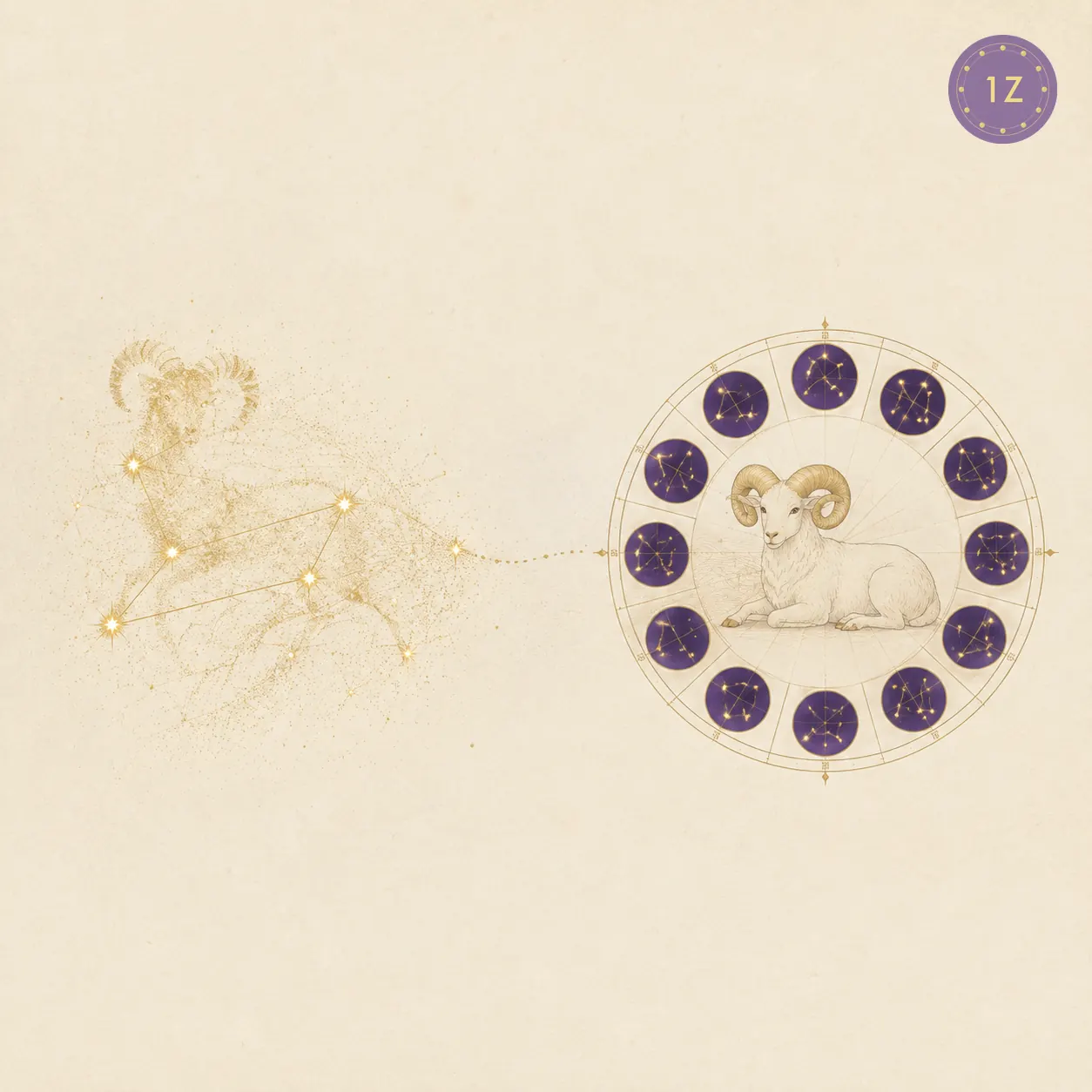
The standard Chinese term for Aries is 白羊座: 白 means white, 羊 means ram or sheep, and 座 marks it as a constellation seat, so if you see 白羊 in a Chinese horoscope column, you are reading Western astrology, not the local wheel. Taiwan writes the same idea with the traditional characters 白羊座. The Japanese use a near-identical compound, and the concept travels the same way Western astrology did: as an imported layer laid on top of much older local systems.
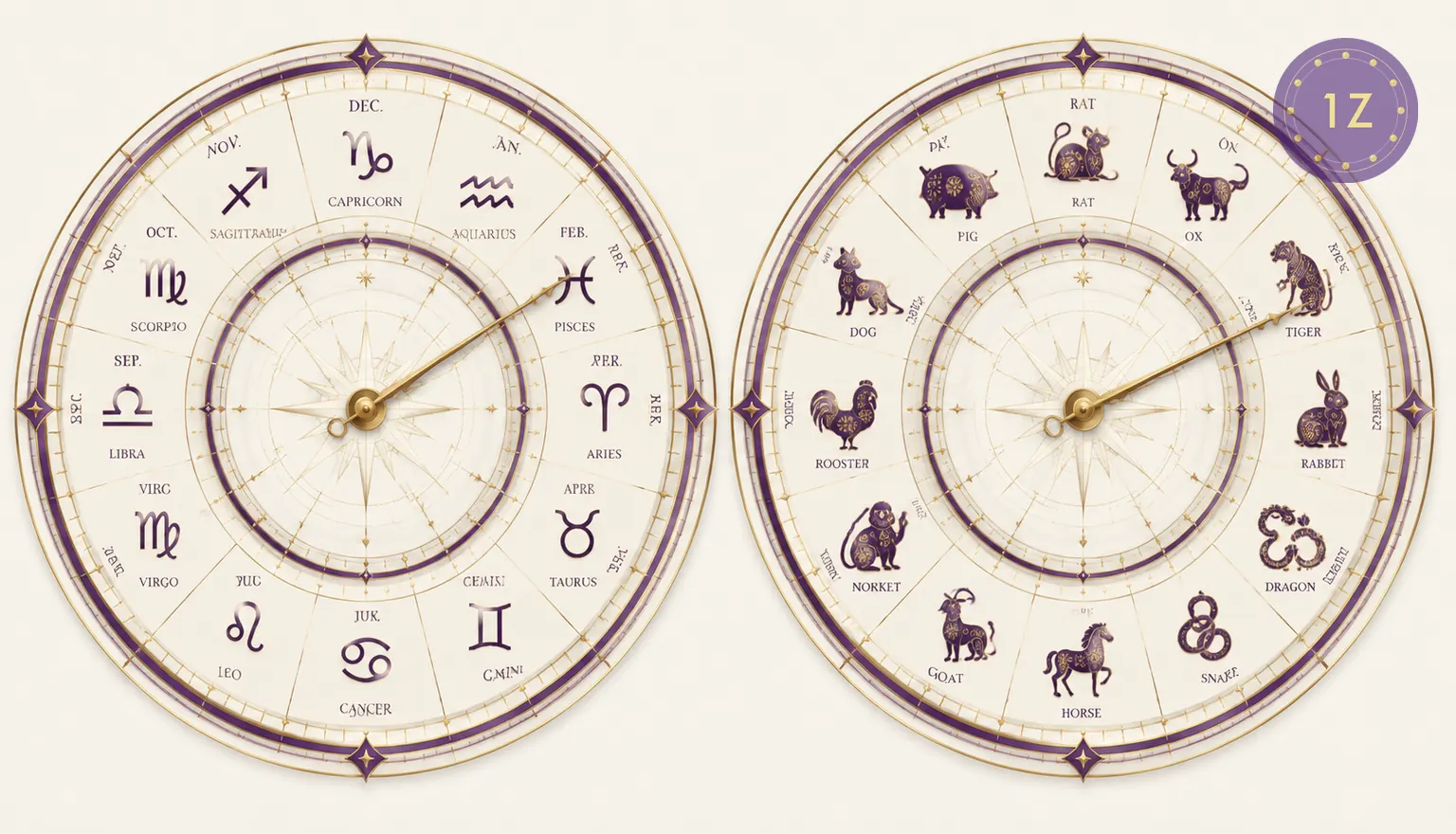
That layering is the key fact, and what stands out about it is how recent it is: Western astrology arrived as a modern import. When Chinese speakers say 白羊座, they are speaking Western astrology in Chinese vocabulary. When they say 你属羊 , they are speaking the native twelve-year animal system. The two sentences answer different questions: one reads your birth month against the solar zodiac, the other reads your birth year against the lunar-cycle animals. A March-born Aries could be a Horse, a Goat, or a Tiger by year depending on which twelve-year seat the calendar assigned.
Practical takeaway: 白羊座 is Aries in Chinese words, not a Chinese-zodiac sign.
Why No Ram Sits in the Twelve-Year Wheel
The Chinese zodiac’s twelve seats went to animals of the agrarian calendar: rat through pig, one per year, cycling every twelve years. Aries, by contrast, occupies roughly March 21 to April 19 in the tropical solar zodiac, one twelfth of a single year. The systems differ in both unit and axis: years versus months, lunar-new-year anchors versus equinox anchors.
The closest native cousin to the Ram is the Sheep (羊, branch Wei 未), the eighth animal. The resemblance is one of imagery, not calendar: both are horned grazing animals with a docile-but-stubborn temperament tag. The seasons differ, and honestly so. Aries rides March 21 to April 19 in mid-spring, while the Wei seat opens late summer (the sixth solar month, Xiao Shu to Da Shu). No native seat shares Aries’s spring window exactly; the Sheep is a cousin by symbol, not by season. Syncretic astrologers occasionally map Aries onto the Horse for its fiery initiative, but that is analogy, not tradition. In our framework we read the Sheep as the structural parallel: same animal family, symbolic logic, same branch-based interactions (Wei clashes Chou and harmonizes with Wu, the 午未 Six Harmony).
| System | Unit | Aries/Ram position | Anchor |
|---|---|---|---|
| Western (tropical) | Month segment | March 21 to April 19 | Vernal equinox |
| Chinese zodiac | Year (12-cycle) | No Ram seat; Sheep is 8th | Lunar new year / Li Chun |
| Vietnamese variant | Year (12-cycle) | No Ram seat; Cat replaces Rabbit | Lunar new year |
Practical takeaway: the Sheep is the closest native seat by symbol (not by season); the Horse mapping is modern analogy.
The Method: Find Your Chinese Sign by Birth Year
Because the Chinese system keys on birth year, an Aries native’s Chinese sign depends entirely on which twelve-year seat that year occupied. An Aries birthday in 2003 falls on the Goat seat (癸未 year, Water Goat); an Aries birthday in 1990 falls on the Horse (庚午 year, Metal Horse); an Aries birthday in 1999 falls on the Rabbit (己卯 year, Earth Rabbit). Same Western sign, different years, entirely different Chinese seats. Same Western sign, different Chinese animals, different interaction maps.
The lookup rule has one boundary that catches everyone: the Chinese year does not start on January 1. Based on our analysis of reader corrections, late-January births produce the most sign errors of any birth window. It starts at lunar new year, and for chart-grade precision the pivot is Li Chun (usually February 4), not the festival date. A person born in late January straddles two Chinese years, and the festival date alone has misled thousands of self-readings.
| Date (solar) | Western sign | Chinese year | Chinese sign |
|---|---|---|---|
| April 5, 2003 | Aries | 癸未 Gui Wei | Goat (Water) |
| April 5, 1990 | Aries | 庚午 Geng Wu | Horse (Metal) |
| April 5, 1999 | Aries | 己卯 Ji Mao | Rabbit (Earth) |
| April 5, 1996 | Aries | 丙子 Bing Zi | Rat (Fire) |
Practical takeaway: your Chinese sign follows the year seat, and late-January births need the Li Chun check.
Holding Both Systems: The Moon-Sign Method
Practitioners who read both systems professionally use a two-layer approach. The Western sign describes the month-level temperament layer: Aries contributes initiative, directness, and spring-fire symbolism. The Chinese year animal and its branch describe the relationship and timing layer: how the native interacts with other year-seats, which clash years activate, and which harmony partners soften the ride.
The layers do not compete; they read different dials: Aries-by-month plus Horse-by-year reads very differently from Aries-by-month plus Rat-by-year, because the Horse’s branch Wu sits in a Six Clash with the Rat’s branch Zi while the Horse harmlessly coexists with the Goat. If you want the branch arithmetic for your own pairing, our compatibility hub scores every pair; in our editorial dataset of 78 pairs, Six Clash pairs all score exactly 38 points while Six Harmony pairs reach 94-95, and 48 of 78 pairs (62%) carry no classical interaction at all.
When I teach this two-layer method, the same mistake appears every time: students try to force one system to translate the other, word for word. I have watched that approach fail for years. The systems are parallel dials, not translation tables; read both dials and the picture sharpens.
In my experience, students who keep the two dials separate outperform the ones who merge them into one grand translation table, and I say that after watching every attempt at a full translation collapse. Practical takeaway: Western sign for temperament, Chinese sign for interaction and timing.
Is Aries the same sign as the Chinese Sheep?
Not the same sign, but the closest cousin seat. There is no direct animal, because Aries is a month-segment sign in the Western solar zodiac while Chinese zodiac animals are year-seats in a twelve-year cycle. The lookup method is by birth year: an Aries born in 1990 is a Horse, born in 2003 a Goat, born in 1999 a Rabbit. The closest symbolic cousin is the Sheep (羊, branch Wei), which shares the ram’s horns and grazing temperament though not Aries’s spring season (Wei opens late summer), and some modern writers map Aries onto the Horse for its fire-initiative, but that is analogy rather than tradition.
How is the Chinese zodiac different from Western astrology?
The two systems measure different clocks with different units. Western astrology divides the solar year into twelve month-segments anchored at the vernal equinox, while the Chinese zodiac divides a twelve-year cycle into year-seats anchored at lunar new year (or Li Chun for chart precision), and Western signs read temperament by birth month while Chinese animals read interaction and timing by birth year. Practitioners who use both treat them as parallel dials rather than competing systems.
Is Aries actually the same animal as the Chinese Sheep year?
Yes and no, and it is common: the systems assign from different clocks. A person born March 28, 2003 is an Aries by month and a Goat (Water Goat, 癸未) by Chinese year seat, because 2003 was the Sheep’s year. The Sheep is also the symbol closest to the Ram, which makes this combination feel coherent: both layers carry the horned, grazing-animal imagery (though their seasons differ, spring versus late summer). The only boundary to respect is late January births, where the Chinese year assignment flips at lunar new year rather than January 1.
How accurate are BaZi readings compared to Western sign readings?
They measure different layers, so accuracy claims do not transfer between them. Western sun-sign columns compress the entire system into one month-segment, which is why they feel generic; a full BaZi chart uses four pillars and roughly 13 million stem-branch combinations before interactions, which is why two Aries a year apart can read completely differently in the Chinese system. In our editorial framework the comparison that matters is within-system rigor: BaZi interpretation is a four-layer structured reading (pillars, elements, Ten Gods, combinations), and its value scales with how many layers you actually read.
Sources
- Aries (astrology) – Wikipedia: tropical zodiac dates and symbol origin
- Chinese zodiac – Wikipedia: twelve-year cycle, branch assignments, Sheep seat
- Chinese astrology – Britannica: the four-pillar framework and calendar anchoring
Conclusion
Aries is 白羊座 in Chinese, but your Chinese-zodiac seat comes from your birth year, not your birth month. Run your own year through the Chinese zodiac hub and read both dials.