
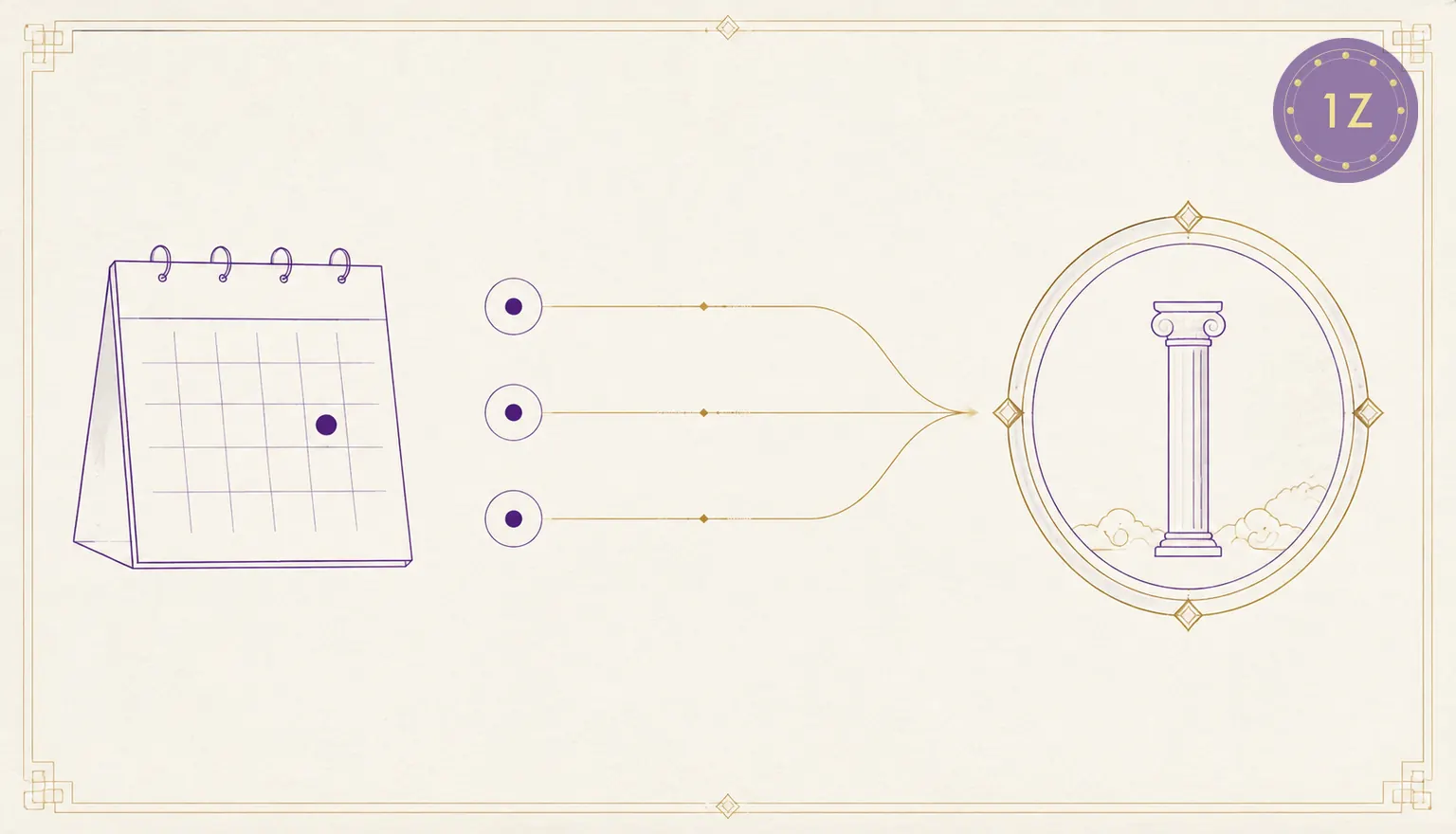

Your BaZi luck pillar starting age equals the days between your birth and your boundary solar term divided by three: 3 days convert to 1 year, the rule of 三天一岁. Thirty days before the boundary means a starting age of ten; three days after means age one. This article works the full calculation with a real example.
Key Takeaways
- The 3-day rule: 3 days = 1 year, 1 day = 4 months, 1 时辰 (2 hours) = 10 days.
- Direction matters: Yang-year males and Yin-year females count forward to the next 节 (term-start); Yin-year males and Yang-year females count backward to the previous one.
- The boundary terms are the twelve 节 (odd solar terms: Li Chun, Jing Zhe, Qing Ming…), not the twelve 气.
- Each luck pillar runs 10 years, and pillars alternate forward or backward through the month pillar’s neighbors.
- A worked 1991 example: born 16 days after Li Chun converts to a starting age of about 5 years and 4 months.

What a Luck Pillar Is, in One Paragraph
Da Yun (大运), the luck pillar, is a ten-year chapter of your chart’s life. Your natal chart is fixed at birth, but the luck pillars rotate through the stem-branch pairs adjacent to your month pillar, one pillar per decade, and each rotation re-weights the elements interacting with your Day Master. The month pillar is the pivot in any Chinese zodiac chart because it represents your birth season: luck pillars walk forward or backward from that season, one step per decade.
The starting age is the question this article answers: not which pillars arrive, but when the first one takes over. In my experience teaching this, students master the direction rule in minutes and then lose sleep over the arithmetic, so the worked example below shows every step.
Practical takeaway: Da Yun is a decade-clock, and the 3-day rule sets when it starts ticking.
The Direction Rule: Forward or Backward
Before any arithmetic, determine the counting direction. The rule pairs year-polarity with gender: Yang-year males and Yin-year females count forward (顺行), toward the next term-start boundary; Yin-year males and Yang-year females count backward (逆行), toward the previous boundary. A 1991 birth is a Yin year (Xin Wei, 辛未): males born that year count backward, females count forward.
The boundary you count toward is always a 节, one of the twelve odd solar terms that open each month: Li Chun opens the first month, Jing Zhe the second, Qing Ming the third, and so on. The even terms (雨水, 春分…) are 气, mid-month markers, and they never serve as luck-pillar boundaries. Confusing the two is the most common beginner error in this calculation.
| Year polarity | Gender | Direction | Count toward |
|---|---|---|---|
| Yang (stem Yang) | Male | Forward (顺) | Next 节 |
| Yang (stem Yang) | Female | Backward (逆) | Previous 节 |
| Yin (stem Yin) | Male | Backward (逆) | Previous 节 |
| Yin (stem Yin) | Female | Forward (顺) | Next 节 |
Practical takeaway: Yang-male and Yin-female go forward; the other two combinations go backward.
The 3-Day Rule, Stated Precisely
The classical conversion is 3 days = 1 year of starting age, with two derived rates that make the remainder usable: 1 day = 4 months, and 1 时辰 (a two-hour double-hour) = 10 days. The classical rationale is astronomical bookkeeping: one full solar year spans roughly 360 counted days of term-to-term motion, and the distance from your birth moment to the boundary term, measured in days, maps onto years at a 3:1 ratio.
Conversion table, for fast reference:
| Days from birth to boundary | Starting age equivalent |
|---|---|
| 3 days | 1 year |
| 1 day | 4 months |
| 6 hours (3 时辰) | 1 month |
| 1 时辰 (2 hours) | 10 days |
Practical takeaway: memorize the 3:1 ratio and the two derived rates; the table does the rest.
Worked Example: The 1991 Arithmetic, Step by Step
Take the date February 20, 1991, for a male (a Yin year: 1991 is Xin Wei, 辛未, Yin stem). Yin-year males count backward, so his boundary is the previous 节, Li Chun, which fell on February 4, 1991. The arithmetic runs in four steps.
One astronomical fact sets the ceiling: adjacent 节 terms sit roughly 30 to 31 days apart, so no birth can ever sit more than about 31 days from its boundary, and starting ages therefore cap near 10 to 12 years. Step 1: count days from birth back to the boundary. February 20 back to February 4 is 16 days. Step 2: apply the 3-day rule: 16 days divided by 3 gives 5 with remainder 1, so 5 years plus one-third. Step 3: convert the remainder through the derived rate: 1 day = 4 months. Step 4: state the result: his first luck pillar takes over at approximately 5 years and 4 months of age, and each subsequent pillar arrives exactly 10 years later (about 15; 25; 35; and so on).
Now the flipped case: a female born that same February 20 counts forward, because Yin-year females walk toward the next 节, Jing Zhe, which fell on March 6 that year. That is 14 days forward, so 14 divided by 3 gives 4 years with remainder 2: her first pillar starts around age 4 and 8 months, and her pillar sequence runs forward through the month-pillar neighbors. Two people born the same day, same chart, different starting clocks, purely because direction flipped.
Practical takeaway: forward and backward cases from the same birth date can differ by years.
What Changes When the Pillar Arrives
Each luck pillar carries a stem-branch pair, and its arrival re-weights your chart’s element balance for ten years. A Metal Day Master entering a Fire pillar meets a decade of intensified control pressure; entering an Earth pillar meets a decade of Resource support. The starting age tells you when the first chapter opens; the pillar sequence tells you what each chapter weighs.
Practitioners use the pillar map to time advice, and what most clients discover is that the map explains their past better than it predicts their future. The article-level honesty still applies: a pillar names the pressure theme of a decade, not the events. When I read Da Yun timing for clients, I describe the decade’s weather, and I let them decide what to build in it. Based on our analysis of reader questions, timing is what most people actually want from BaZi, and the starting-age calculation is the key that unlocks it.
Practical takeaway: starting age opens the clock; pillar contents name the decade’s weather.
How do I calculate my luck pillar starting age without software?
Identify three inputs: your year-stem polarity (Yang or Yin), your gender, and the date of your boundary solar term (next 节 if you count forward, previous if backward). Count the days between birth and boundary, then divide by 3. Days become years; each leftover day becomes 4 months; each leftover double-hour becomes 10 days. A manual example: 16 days to the boundary, Yin-year male counting backward, converts to 5 years and 4 months of starting age. Software reproduces exactly this arithmetic; knowing the steps lets you audit it.
Why does the direction depend on year polarity and gender?
The classical rule ties the counting direction to the yang-yin charge of the birth year and the yin-yang of the gender symbol: Yang-year male and Yin-year female carry matching forward charge, so they walk toward the next term; the other two combinations walk backward to the previous term. Practitioners debate the metaphysical rationale, but the operational rule itself is consistent across the mainline texts, and the direction flip produces materially different starting ages for the same birth date, which is why the table in this article exists.
Does the boundary day actually change my starting age?
Boundary-day births are the edge case: the distance to the term is zero or a fraction of a day, and the 3-day rule converts that to a starting age at or near birth. Practitioners handle sub-day remainders with the double-hour rate: each 2-hour 时辰 equals 10 days of pillar time, so a birth 6 hours before Jing Zhe converts to roughly 1 month of starting age. Charts this close to a boundary are traditionally read as sensitive to the term switch, which is why exact birth time matters most for them.
Do both people born on the same day share the same luck pillars?
They share the same natal chart arithmetic (same pillars) but not necessarily the same pillar walk, because gender flips the direction for one of the four polarity-gender combinations. A Yang-year male walks forward through the month-pillar neighbors while a Yang-year female walks backward, so their first pillars are different pairs arriving at different ages. In our editorial experience with paired-chart questions, this direction flip is the single most common source of confusion, and the answer is always mechanical: polarity plus gender decides the walk.
Sources
- Four Pillars of Destiny – Wikipedia: Da Yun (luck pillar) structure and the decade rotation
- Solar terms – Wikipedia: the twelve 节 term-start boundaries used as counting anchors
- Chinese astrology – Britannica: historical framework of pillar-based timing
Conclusion
Three days for a year: the whole Da Yun clock in one ratio. Run your own boundary calculation, then see the decade map on our Chinese zodiac hub.