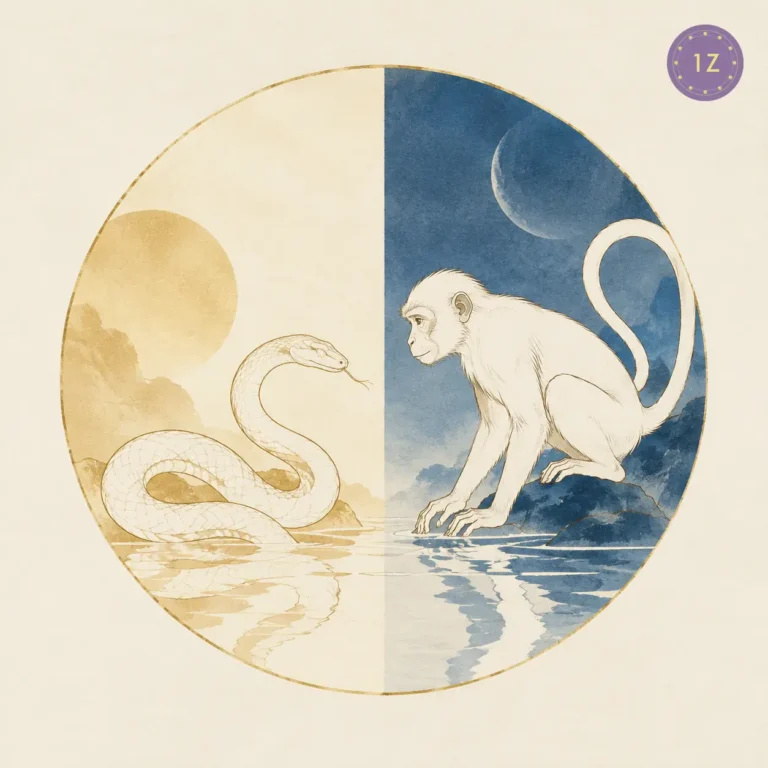
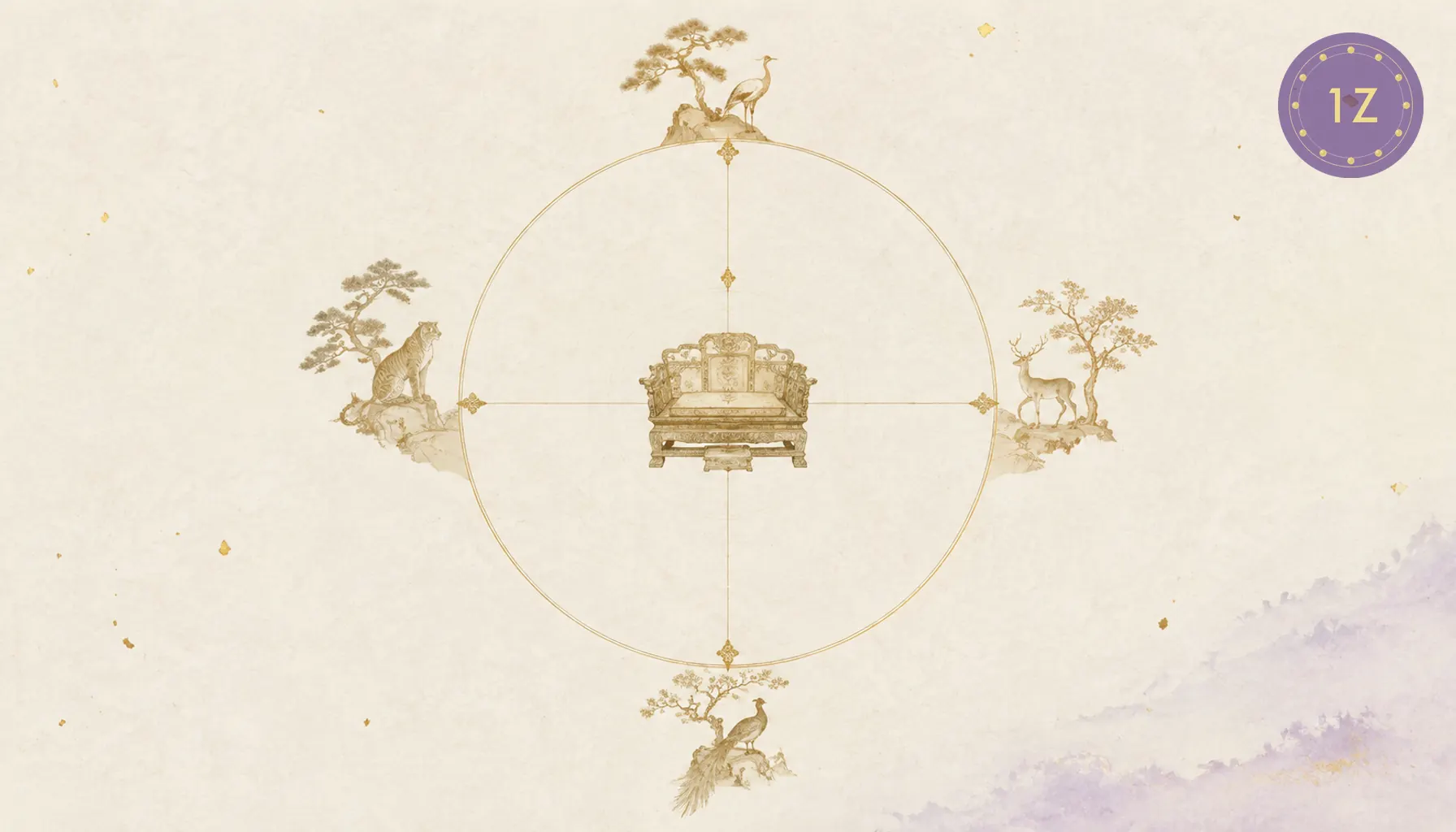

BaZi and Feng Shui are two different disciplines built on the same five-element engine: BaZi reads the elements present at your birth moment, while Feng Shui arranges space so the five elements flow well through a room. The chart-to-room connection runs through one rule that most casual guides skip: any element you bring into your space should be your chart’s Favorable Element, not the element of your zodiac year. Below is the classical direction map, the rule, and a conditional way to apply both.

Key Takeaways
- BaZi is a time reading (the elements at your birth moment); Feng Shui is a space discipline (how elements move through a room); the shared engine is the five-element cycle.
- The classical map assigns each element a season, a color, and a direction: Wood to the East, Fire to the South, Metal to the West, Water to the North, and Earth to the Center.
- Four compass directions belong to Wood, Fire, Metal, and Water; Earth holds the Center and no compass point.
- The rule most guides skip: adjustments should target your chart’s Favorable Element, computed from the full birth chart, not from the year animal alone.
- Direction and color are application layers, not cures; a chart judgment comes first.
- Our five elements guide covers the engine; the BaZi calculator computes the chart that feeds it.
What a Birth Chart and Feng Shui Actually Share
The Four Pillars system builds a birth chart from the stems and branches of your birth year, month, day, and hour, and reads the balance of five elements inside it. Feng Shui, classically translated as wind and water, studies how qi moves through a space and how the five elements express themselves in directions, colors, and forms. One discipline reads a moment in time; the other reads a place, and the shared cycle of 60 years keeps both on the same clock, one cycle for every full pass of the stem-branch wheel. The shared vocabulary is the engine underneath both: Wood, Fire, Earth, Metal, and Water, with their generation and control cycles that our element cycle guide documents.
That shared engine is why the two disciplines keep appearing together. A chart describes which elements run strong or thin at your birth moment, computed across the four pillars of your birth year, month, day, and hour. A room expresses elements through orientation, color, and material, and each of the 5 elements carries one classical season. The classical move is to read the chart first, then shape the space toward what the chart actually needs.
That junction deserves its own rule. The element your chart needs is computed from the full four-pillar balance, the Favorable Element, rather than read off the zodiac year or the day stem alone, and running the computation is what turns a personalized discipline into more than decoration.
The Five-Element Direction Map
The classical correspondences are fixed and worth having in one place:
| Element | Season | Classical color | Direction |
|---|---|---|---|
| Wood | Spring | Green | East |
| Fire | Summer | Red | South |
| Earth | Late Summer | Yellow | Center |
| Metal | Autumn | White | West |
| Water | Winter | Black | North |
The map’s quiet detail is Earth’s seat. Wood, Fire, Metal, and Water each hold one compass direction, while Earth holds the Center: the classical texts place it at the axis rather than on the rim. If you have ever wondered why a five-element map fills only four compass points, that asymmetry is the reason, and it repeats in our lucky elements overview.
Every row also carries a generation neighbor. Wood feeds Fire, Fire feeds Earth, Earth feeds Metal, Metal feeds Water, and Water feeds Wood, so a room built around one element always pulls its neighbors into the reading.
The Birth Chart Rule Most Feng Shui Guides Skip
Here is the rule, stated as our practice applies it: an adjustment makes sense when it serves the chart’s Favorable Element, and the Favorable Element comes from the full birth chart, never from the year animal alone. A recurring pattern in our consultation files shows what happens without it. A 1985 Wood Ox client, a crystal healer by trade, spent 10 years wearing green crystals for her Wood element, the standard color mapping, and her results stayed inconsistent. Her actual chart, Yi Wood born in the Chou month of late winter, ran cold, and what it needed was Fire to warm the frame. The generic mapping pointed her at her own element; the personalized reading pointed at the element her chart lacked. The reds worked where the greens had not. I have watched that gap between the size chart and the fitting settle arguments in both directions.
Think of it as the difference between a size chart and a fitting. The color and direction tables are the size chart: true for everyone as a framework. The Favorable Element is the fitting: true for your chart specifically, computed from all eight characters. In practice, our framework stops short of computing that fitting inside an article, because a whole-chart judgment needs your full pillars; the free calculator is where the computation happens, and it takes your birth data rather than your guess. Our engine resolves birth years 1900 to 2099 (200 years of data), so the pillars underneath the reading are exact.
How to Bring the Birth Chart Map Into a Room, Conditionally

Once a Favorable Element is known, the map becomes a set of conditional lines rather than a shopping list:
| If the Favorable Element is… | Classical direction line | Classical color line | The caution |
|---|---|---|---|
| Wood | East | Green | Wood feeds Fire; watch excess |
| Fire | South | Red | Fire is intense; small doses first |
| Earth | Center | Yellow | Earth anchors; avoid clutter-as-earth |
| Metal | West | White | Metal controls Wood; context matters |
| Water | North | Black | Water feeds Wood; cold rooms run colder |
That said, two habits keep the application honest, and they protect you from the most common mistakes. First, one element at a time: a room that expresses three elements at once stops expressing any of them, and the direction lines lose meaning in the noise. Second, direction lines bend to room function: a home office needs a desk that faces a workable spot, and the classical East line does not override where the window and the door actually sit. I tell clients to treat the map as a tiebreaker between two workable layouts, never as a rule that beats the architecture, and I have rarely regretted the restraint.
For most rooms, the honest sequence is chart first, function second, direction third. The chart names the element; the function picks the zone; the map picks the orientation among options that already work.
Is BaZi really accurate enough to base room decisions on?
BaZi’s mechanical layers are exact and its interpretive layers are judgment, and room decisions sit on the interpretive side. The mechanical part is reproducible: the same birth data always yields the same four pillars, and our calendar engine computes them from astronomical solar-term data cross-checked against the Purple Mountain Observatory record, so the chart itself is not in question. The interpretive part, which element your chart favors, is a reading of that chart’s balance, and two practitioners can weigh a chart differently the way two analysts can read one balance sheet differently. For room decisions, the honest position is that a Favorable Element reading gives you a structured hypothesis, not a guarantee: try the direction and color lines associated with that element, watch how the room actually functions, and keep what works. Structure first, judgment second, feedback last.
How should you avoid over-adjusting a room for a BaZi element?
Work one element at a time and let the room stay a room. The most common failure is enthusiasm: a reader decides their Favorable Element is Wood and fills a study with plants, green textiles, and eastern exposure until the space stops functioning as a study. The classical map describes expression, not quantity, so a single strong expression of the element (one wall of color, one orientation choice, one material) carries the line, and more stops adding signal. The second guard is the generation cycle itself: each element feeds its neighbor, so overloading one element eventually energizes the next one in the cycle, and the room drifts somewhere you did not aim. If you want a second element line in the same room, take it from the cycle’s neighbor deliberately rather than by accident. Function remains the referee; the map loses to a door that cannot open.
Can a shared home use BaZi directions for one person?
A shared home can apply one person’s direction lines in that person’s own zones, and the honest boundary is exactly there. The classical way to scope a personal adjustment is by territory: a bed, a desk, a meditation corner are personal zones where one person’s Favorable Element direction can sensibly lead, while kitchens, hallways, and living rooms serve everyone and stay better served by neutral design. Direction lines also bend to fixed architecture; a north-facing desk line does not survive a north wall with no window, and function wins those collisions. For couples or housemates with different charts, the practical pattern is to map each person’s personal zones separately and leave the shared zones to taste. The chart personalizes your seat, not the whole floor plan, so you can share a home without sharing a diagnosis.
Conclusion
BaZi and Feng Shui share one engine and differ in direction: the chart reads your birth moment’s element balance, the room expresses elements through direction and color, and the Favorable Element rule connects the two honestly. To find the chart half of the equation, run your birth data through our free BaZi calculator.
Sources
- Feng shui (Wikipedia): backs the spatial discipline, its classical vocabulary, and the wind-water framing.
- Four Pillars of Destiny (Wikipedia): backs the birth-chart structure and the five-element engine.
- Chinese astrology (Britannica): backs the classical five-element correspondences used in the direction map.