
A Ji Earth day master born in the Mao month runs the weakest configuration the strength system recognizes: the month branch carries Yi Wood at its seasonal peak, and Wood controls Earth, so the month restrains the Day Master directly. Our strength engine scores the state as 死 (Dead), the weakest of the five states, which reads as heavy seasonal pressure rather than a broken chart. Below is the full verdict with the classical explanation, the twelve-month table that puts the Mao month in context, and the two support lines that can change the picture in a full birth chart.

Key Takeaways
- Ji (己) is Yin Earth, one of the two Earth stems, and the Mao month (卯, Rabbit) is mid-spring: the season of peak Wood.
- Wood controls Earth, and the month element restrains the Day Master, so the classical state is 死 (Dead), classified Weak (weakest).
- In Earth’s twelve-month row, 6 months run strong, 2 run resting, and 4 run weak, with the weak band split between Dead (Yin, Mao) and Imprisoned (Zi, Hai).
- Against a Ji day master, Yi Wood reads as Seven Killings (七杀), the same-polarity control star.
- Two support lines matter in a full chart: Fire (the Resource line, since Fire generates Earth) and Earth’s own four root branches (Chen, Xu, Chou, Wei).
- The month sets the heaviest single weight, not the final verdict; run your full chart before concluding anything.
What Ji Earth in the Mao Month Means
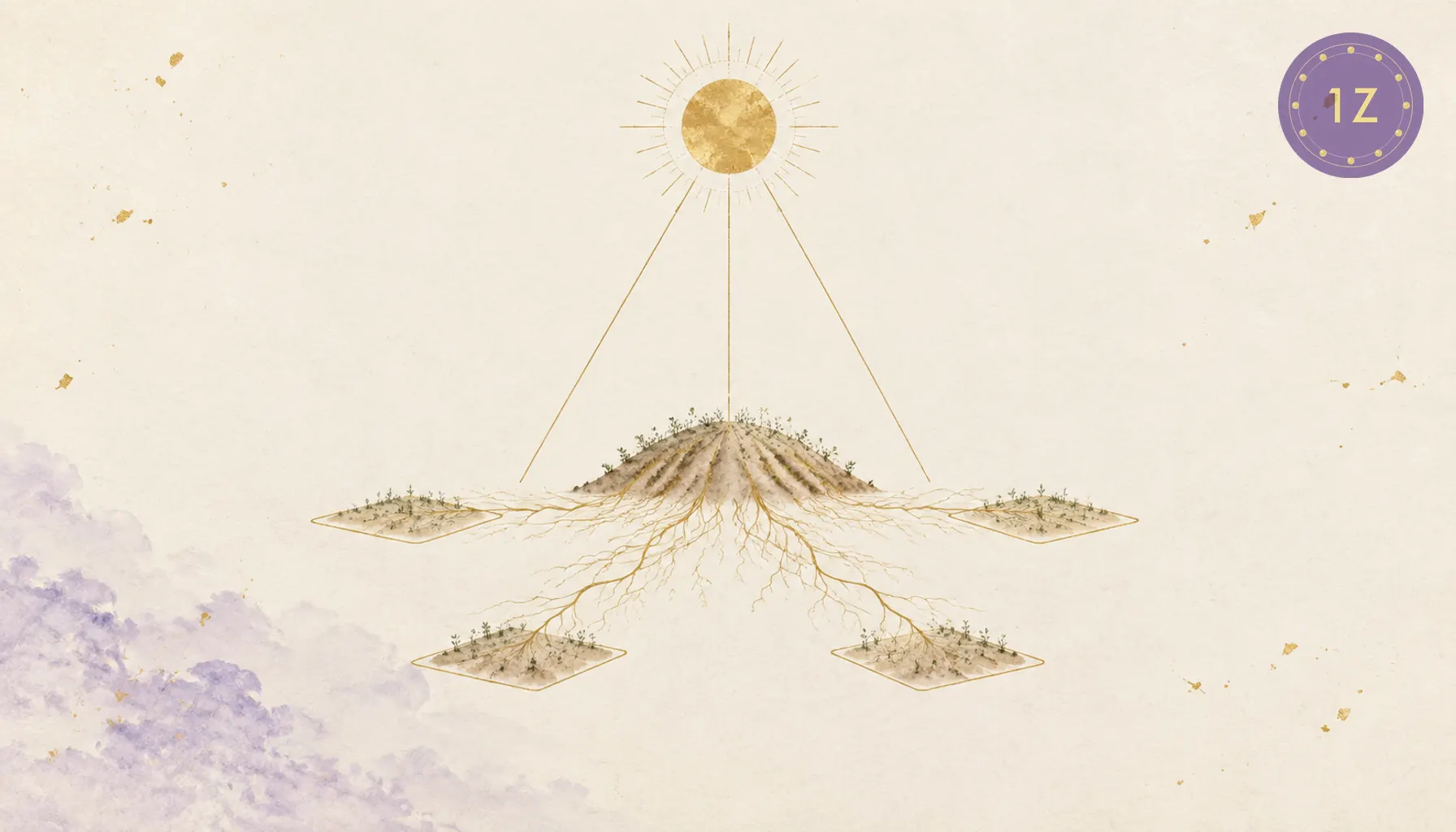
Ji (己) is the Yin Earth stem: soil that has been worked, furrowed, and planted. In contrast, its Yang partner Wu (戊) is the raw ground and the terrace wall. In a birth chart, the Day Master is the stem of the day pillar, and our Day Master guide covers how to find yours. Ji people are classically read as the gardener’s earth: patient, absorbing, good at holding things and helping things grow in managed rows. If you have your birth details at hand, the day stem is the one to check.
The Mao month (卯) is the second month of the solar-term year, running from Jingzhe (惊蛰) to Qingming (清明), the heart of mid-spring. Its branch is the Rabbit, and per the classical hidden-stem table, Mao is a single-qi branch storing pure Yi Wood: no mixture, no secondary stems, just the season’s Wood at full concentration. In a birth chart, a Mao month therefore hands the whole seasonal stage to Wood.
Put the two together and the tension is structural. Ji is Earth; the season is Wood; Wood controls Earth. The month does not merely disagree with the Day Master. It restrains it.
The Five-State Verdict: Dead (死), the Weakest Configuration
Classical BaZi grades a Day Master’s seasonal strength in five states: Peak (旺), Supported (相), Resting (休), Imprisoned (囚), and Dead (死). Our strength engine, the same deterministic matrix documented on our methodology page and used in Mei Lin Chen’s chart reviews, reproduces the classical output without interpretation. For Earth in the Mao month the output is unambiguous. The canonical explanation, copied from the engine, runs: “Earth in a Wood month is 死 (Dead): Wood controls Earth (the month element restrains the Day Master), the weakest configuration.” The state is classified Weak (weakest).
The twelve-month row for Earth puts that verdict in proportion:
| Month branch | Season | Earth’s state | Band |
|---|---|---|---|
| Chou, Chen, Si, Wu, Wei, Xu | various | Peak or Supported | Strong (6 months) |
| Shen, You | autumn | Resting (Earth generates Metal) | Draining (2 months) |
| Zi, Hai | winter | Imprisoned (Earth controls Water) | Weak (2 months) |
| Yin, Mao | spring | Dead (Wood controls Earth) | Weak, weakest (2 months) |
What most charts miss is the split inside the weak band. Yin and Mao are the two Dead months, where the season’s element controls Earth outright; Zi and Hai are the two Imprisoned months, where Earth expends itself restraining Water. Both bands are weak, but the Mao-month kind is the weakest of the four. The controlling element holds the seasonal peak, and it holds it alone.
The Seven Killings Reading of the Same Fact
Naming the roles sharpens the picture. Against a Ji day master, Yi Wood is the element that controls Earth, and because both are Yin, the Ten Gods mapping reads the pair as Seven Killings (七杀), the same-polarity control star, rather than the gentler Direct Officer. A Mao month for Ji Earth is therefore a season in which the chart’s control star holds the loudest seat in the whole structure. Classical matchers treat that seat with respect, because a control star at seasonal peak shapes the whole conversation between the Day Master and its year.
I read the month first in any chart, because the month answers the weight question before anything else does. I tell clients the month sets the heaviest single weight, and the other pillars argue with it, sometimes successfully. In practice, that is exactly how a Dead-state month should be held: as the dominant voice in the room, not the only one.
What Can Change the Picture in a Full Birth Chart
The month is one pillar of four, and two support lines can shift a Ji Earth chart’s balance. The first is Fire. Fire generates Earth (Fire→Earth, the classical generation cycle), so Bing or Ding stems sitting elsewhere in the chart act as the Resource line, feeding the Day Master from outside the month’s Wood economy. The second is Earth itself. Earth is the only element that holds four branches outright (Chen, Xu, Chou, Wei all store Earth as main qi), so roots for a Ji day master can form under the surface even in a hostile season.
| Support line | Mechanism | Where it sits in a chart |
|---|---|---|
| Fire stems (Bing, Ding) | Fire generates Earth, the Resource line | year, day, or hour stems |
| Earth roots (Chen, Xu, Chou, Wei) | Earth stored as main qi in 4 branches | any branch position |
| Earth companions (Wu, Ji) | same-element reinforcement | other visible stems |
The honest reading keeps the direction conditional. If the chart is weak and needs support, the Resource line (Fire) is the classical first place to look, and stored Earth is the second; a chart that already carries plenty of either reads differently, and adding more would overshoot the balance our balanced chart guide describes. Whether support is actually needed in your chart is a whole-chart judgment, which is exactly the line this article stops at: the mechanism is public, the verdict is personal. I would rather stop at that line than guess.
A contrast from our case files shows the same physics from the other side. A 1988 Earth Dragon client, an Earth-heavy chart with thick Wu Chen storage, came in asking why her largest goals kept slipping while small ones landed; the reading found her Earth so abundant that it needed Wood to regulate it, and her timing only opened in Wood-element years. Too little Earth under peak Wood and too much Earth with no Wood are both imbalance stories. The Mao-month Ji chart lacks the resource; the Wu Chen chart drowns in it; balance is the target in both directions.
Can a Ji Earth day master still be strong in the Mao month?
The month state is the heaviest single weight, not the ceiling, so a Ji Earth chart can still reach workable strength in the Mao month when the other pillars contribute enough. Strength in classical practice totals the whole chart: the month branch counts most, but stems and branches in the year, day, and hour pillars add their own weight. Fire stems (Bing, Ding) generate Earth and act as the Resource line; Earth stored in the four Earth-holding branches (Chen, Xu, Chou, Wei) gives the day stem roots; Earth companions in the stems add direct reinforcement. A Mao-month Ji chart with two or three of those supports reads very differently from one with none. What the Dead state fixes is the starting position: the season’s Yi Wood controls Ji Earth at full concentration, so the chart begins from the weakest footing and must earn its balance from the other three pillars.
How do Yin Earth and Yang Earth differ in the same spring month?
The two stems share the element and the season’s verdict, and they differ in character rather than in strength. Wu (戊) is Yang Earth, the raw ground, the terrace wall; Ji (己) is Yin Earth, the worked soil of the garden. Each element holds exactly two of the ten Heavenly Stems, one Yang and one Yin, and Wu and Ji are Earth’s pair, so the seasonal matrix grades them identically: both run Dead in the Mao month, because the state tracks the element (Wood controls Earth) rather than the polarity. The polarity shows up in the role assignments instead. Against a Ji day master, the month’s Yi Wood reads as Seven Killings, the same-polarity control star; against a Wu day master, the same Yi Wood reads as the Direct Officer, the opposite-polarity version. Same season, same pressure, different flavor of supervisor.
Is a Dead-state month really the worst news for a Ji Earth chart?
A Dead-state month is the weakest starting position, and calling it the worst news misreads what the state describes. The five-state system grades seasonal support, not fortune: Dead in the Mao month means the month’s element (Wood) controls the Day Master’s element (Earth) while holding the seasonal peak, so the chart starts from maximum pressure. Pressure is workable when the rest of the chart supplies what the season withholds, and the support lines are concrete: Fire stems that generate Earth, and Earth stored in the four Earth-holding branches. The reverse scenario is worth remembering too. In our case files, an Earth-heavy 1988 Earth Dragon chart needed Wood precisely because it had too much Earth, and its opportunities opened in Wood years. For most Earth natives, the real question is never whether Wood exists in the chart; it is whether the total mix balances. The Mao month tilts the mix hard; the other pillars decide where it settles.
Conclusion
Ji Earth in the Mao month stands in a field at peak growing season: the season’s Wood controls the Earth outright, the five-state engine grades it Dead (the weakest configuration), and the Seven Killings reading names the pressure directly. The verdict is about the season, not the person; the other three pillars and their Fire and Earth supports decide where the balance lands. To see your own month state and the full chart around it, run your birth data through our free BaZi calculator.
Sources
- Four Pillars of Destiny (Wikipedia): backs the pillar structure and the Day Master concept described above.
- Earthly Branches (Wikipedia): backs the twelve-branch month system and the Mao month’s classical associations.
- Chinese astrology (Britannica): backs the five-element framework the strength states rest on.