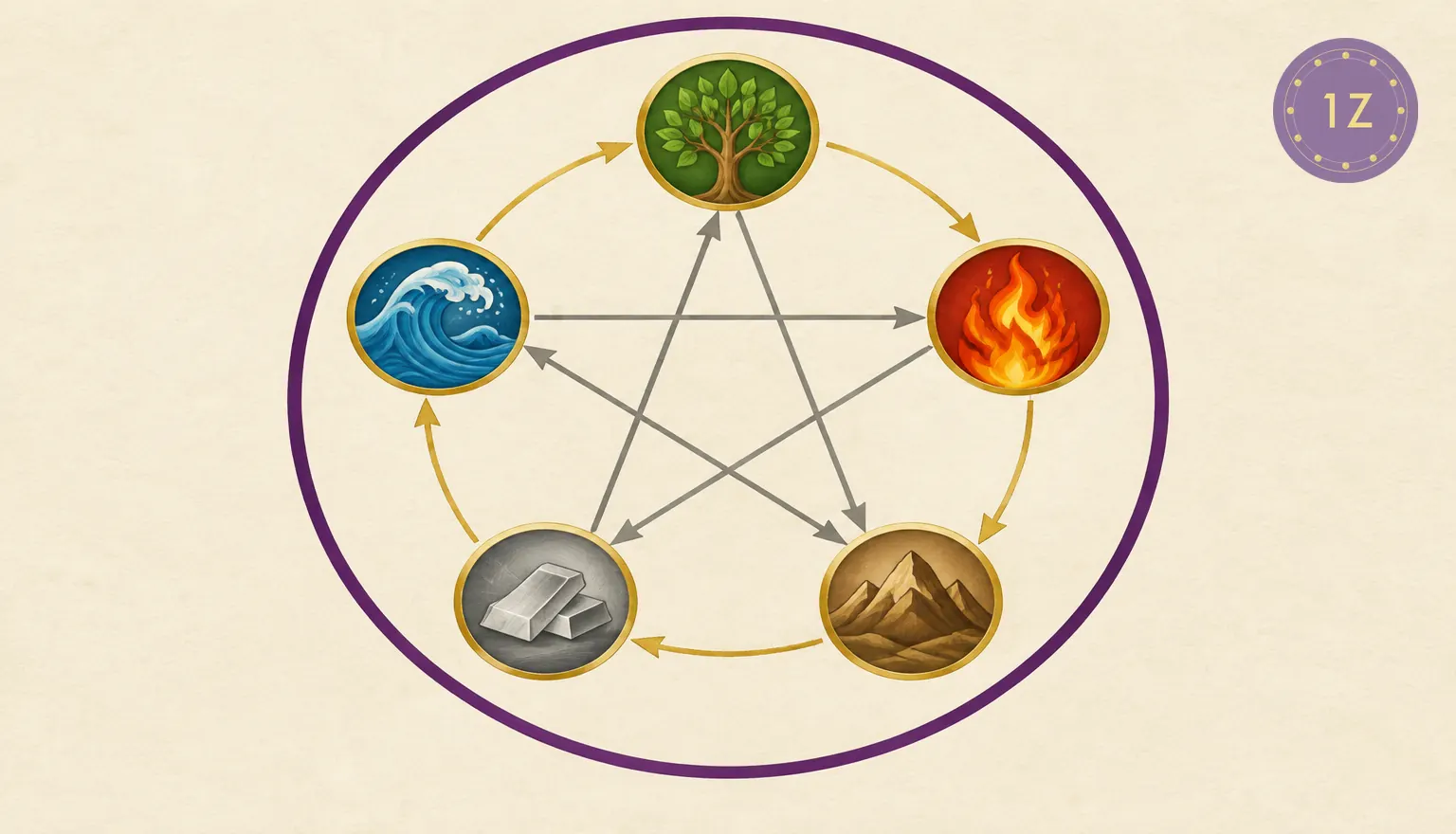

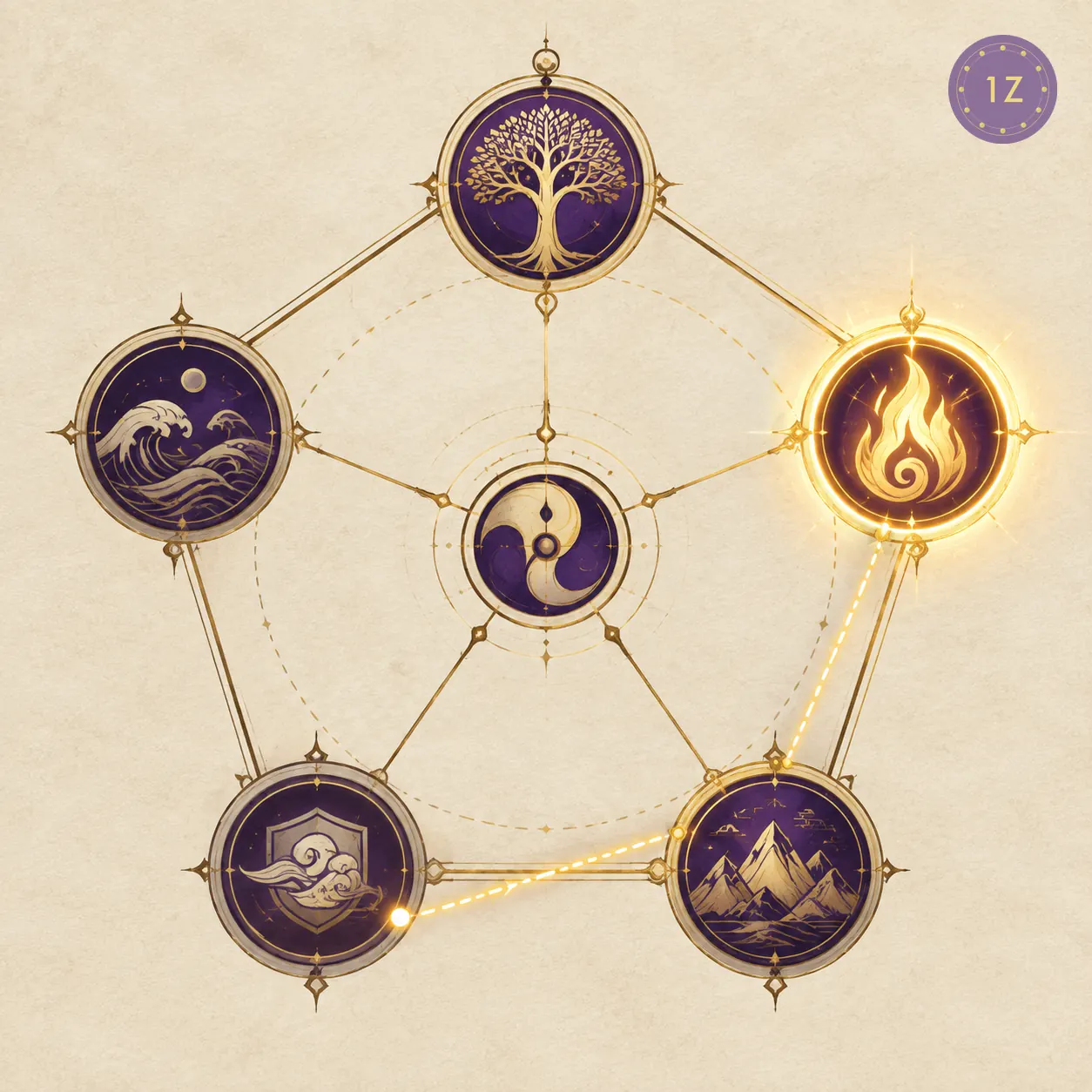
The BaZi element cycle is the grammar every chart speaks: 5 phases, Wood, Fire, Earth, Metal, Water, linked by 2 loops, one feeding each phase into the next and one checking across the circle. 10 pairs in total, and every relationship in your chart, between stems, inside branches, across two people’s charts, reduces to one of them, and you can trace each one in the loops below. This article walks both loops pair by pair and notes where the honest limits sit.

Key Takeaways
- Ten pairs run the whole system: 5 generating (相生) and 5 controlling (相克), verified pair by pair against a deterministic tool.
- The generating loop’s receiver sits at the arrow’s end: Water feeds Wood, so Wood receives and Water spends.
- The controlling loop shapes rather than destroys: Fire melting Metal tempers it into form.
- Both loops run at once; every phase is fed by one neighbor and checked by another.
- The cycle is the reference layer: Ten Gods, branch interactions, and yearly weather all project from it.
The Generating Loop, Pair by Pair
The generating cycle (相生) walks the pentagon clockwise, its 5 pairs each carrying a distinct texture: Wood generates Fire: the log becomes the flame, potential becomes visible output. Fire generates Earth: ash settles into soil, expression becomes territory. Earth bears Metal: soil concentrates ore, territory yields structure. Metal collects Water: cold metal draws condensation, structure yields depth. Water grows Wood: depth germinates the next cycle, and the loop closes.
2 reading habits attach to this loop. First, the receiver sits at the arrow’s end: when Water feeds Wood, Wood is the one banked higher, and Water is the one spending. Beginners reverse this constantly, so every claim should be checked against the direction rule. Second, generating is not always gentle: a weak receiver flooded by a strong feeder drowns rather than grows, which is why classical reading weighs both sides’ strength before calling a feed nourishing.
Think of this loop as a diagnostic wheel: I have watched it settle hundreds of charts, because every blocked line traces upstream to its feeder.
Five feeds, one receiver at each arrow’s end, and strength decides whether the feed nourishes or floods.
The Controlling Loop, Pair by Pair
The controlling cycle (相克) cuts across the pentagon, its 5 pairs the system’s form-givers, like a favorable element map drawn over the feeding loop. Wood controls Earth: roots break soil, planning organizes territory. Earth controls Water: banks dam the flow, structure gives depth a bed. Water controls Fire: dousing tempers blaze. Fire controls Metal: smelting refines ore into tools. Metal controls Wood: the saw shapes the trunk. Each pair reads as pressure that produces shape, the classical reason controlled elements are called “usable” rather than harmed.
The same strength caveat applies here in mirror: control exercised by a weak factor over a strong one fails, and control without any generating balance turns oppressive. Fire tempers Metal into a blade only if the fire is hot enough and the metal willing to melt; a candle under an anvil changes nothing. This is why we always read the cycle as a network, never as isolated pairs: the third factor feeding either side flips the outcome.
I teach control as form-giving pressure: it needs strength on the pressing side and a network behind it, and that is why isolated pair readings fail.
How the Cycle Anchors a Reading
Every layer of a chart projects from this cycle. The Ten Gods roles are the cycle wearing labels: what your Day Master generates is your Output line, what it controls is Wealth, what controls it is Officer, what generates it is Resource, and what matches it is Companion. Branch geometry speaks the same grammar: trines pool by shared element, six harmonies bond mirror seats (per our compatibility hub), and clash diameters put opposing seats face to face (often a controlling pair, though the two Earth-Earth diameters clash without controlling). Even the flowing years speak it: a Wood year feeds a Fire chart’s output line and pressures an Earth chart’s territory, per the same 5-and-5 pairs.
The cycle doubles as the diagnostic map when a chart feels stuck. If expression is blocked, walk backward from the Output line to see whether the generator (the Companion line feeding Output) is starving. If wealth leaks, trace upstream to its feeder, the Output line that generates Wealth, and check the controlling line too: a strong Companion competing for the same assets is the classic leak, while the Officer line only guards it indirectly by checking that Companion. In my experience, most “my chart feels contradictory” questions resolve once the blocked line is traced to its feeder, because the cycle always names the upstream factor.
| Line | Generated by | Checked by |
|---|---|---|
| Output | Your Companion feeds it | Resource checks it (the Owl seizes Food) |
| Wealth | Output feeds it | Companion competes for it |
| Officer | Wealth feeds it | Output challenges it (Hurting Officer sees Officer) |
| Resource | Officer feeds it | Wealth controls it |
| Companion | Resource feeds it | Officer checks it |
Because the cycle is diagnostic, trace any blocked line upstream to its feeder and you will usually find the starving phase. Learn the images rather than a table, and you can walk the loop in either direction whenever you need it.
Where the Honest Limits Sit
| Blocked line | Trace upstream to | Classic read |
|---|---|---|
| Output blocked | Companion starving | Expression without fuel |
| Wealth leaking | Output starving upstream, or Companion over-competing | Source dry or assets split |
| Officer pressured | Output checking it (Hurting Officer sees Officer) | Voice undermining structure |
| Resource thin | Wealth controlling it (wealth chokes study), or Officer not feeding it | Learning without authority or support |
The cycle describes relations between factors, not outcomes between people, and three limits keep it honest. First, it is direction-grammar, not prediction: it says who feeds and who checks, never when or whether events arrive. Second, strength mediates everything: the same controlling pair tempers or crushes depending on both sides’ support, so pairs are read inside networks, not in isolation. Third, the cycle has no moral valence: being controlled is not bad, and controlling is not good, since every controlled phase is also a shaped, usable one.
What stands out after years of readings is how often people ask the cycle to be a scorecard, when its real gift is as a map. A chart is not graded on which phase dominates; it is narrated by how the phases trade, and a reading that honors that distinction stays useful for decades.
Grammar, then, not scorecard: the cycle narrates trades, it does not grade them.
What is the BaZi element cycle?
The BaZi element cycle is the two-loop system linking the five phases: a generating loop (Wood feeds Fire, Fire feeds Earth, Earth feeds Metal, Metal feeds Water, Water feeds Wood) and a controlling loop (Wood controls Earth, Earth controls Water, Water controls Fire, Fire controls Metal, Metal controls Wood). Ten pairs total, five feeds and five checks, and every relationship in a chart reduces to one of them. Both loops run simultaneously, which is why each phase is always both supported and restrained.
How do I remember which element controls which?
Use the physical images rather than a list: Wood breaks soil (Wood controls Earth), banks hold water (Earth controls Water), water douses fire (Water controls Fire), fire melts ore (Fire controls Metal), and the saw shapes wood (Metal controls Wood). Each image is the pair’s actual dynamic, and the images chain: the pairs interlock, so one image usually calls up its neighbors, which makes the loop walkable once two images stick (who actually prevails still depends on both sides’ strength, as the network section noted).
Does being controlled mean an element is bad?
No, and reading control as harm inverts the system. The controlled phase is shaped, and shaping is what makes raw material usable: ore becomes a blade under fire’s tempering, and soil becomes territory under wood’s organization. Classical reading calls controlled elements “usable” for exactly this reason. What is genuinely difficult is unbalanced control, pressure without any feed on the receiving side, or control so strong it crushes rather than forms, and that is a network judgment, never a single-pair verdict.
How does the cycle relate to the Ten Gods?
The Ten Gods are the cycle wearing role labels relative to your Day Master: what it generates becomes your Output line, what it controls becomes Wealth, what controls it becomes Officer, what generates it becomes Resource, and what matches it becomes Companion. Every Ten Gods interaction, feeding, checking, draining, is a cycle pair in costume, one face of the 66 sign-to-sign pairings our dataset scores, the 10 element pairs projected across them. Learn the cycle once and the Ten Gods stop being a memorization task and become a reading of the same 5-and-5 grammar with names attached.
Sources
- Wuxing (Chinese philosophy) – Wikipedia: both cycle directions and the phase correspondences
- Chinese astrology – Britannica: the classical four-pillar framework
- Chinese zodiac – Wikipedia: stems and branches carrying the five phases
Conclusion
Five phases, ten pairs, two loops always running: the element cycle is the grammar under every chart you will ever read. Find your own factors on the Chinese zodiac hub, then walk both loops around your Day Master and hear your chart speak.