
BaZi compatibility analysis compares two complete Four Pillars birth charts to map where a relationship flows and where it costs effort, rather than reducing two people to a single animal-sign match. The method weighs each person’s Day Master, the five-element balance between the charts, and the yearly zodiac branch as three separate layers.
Key Takeaways
- A BaZi compatibility analysis reads two full Four Pillars charts, not the birth-year animal alone.
- Our framework scores all 78 zodiac pairings from 38 to 95, typed by Earthly Branch relationship theory.
- The reading works in three layers: each chart alone, how the two charts interact, and whether their 10-year luck cycles run in step.
- Six Clash pairs (score 38) are not doomed; structured professional relationships often outlast intimate ones.
- Run your own side-by-side reading with the 12Zodiacs BaZi calculator before drawing conclusions.
What Is BaZi Compatibility Analysis?
BaZi compatibility analysis is the practice of placing two people’s complete birth charts next to each other and reading the interaction. Each BaZi chart, or “Four Pillars” (八字), contains four pillars built from the year, month, day, and hour of birth, with a Heavenly Stem and Earthly Branch in every position. The day pillar’s Heavenly Stem is the Day Master (日主), the anchor that represents the person themselves.
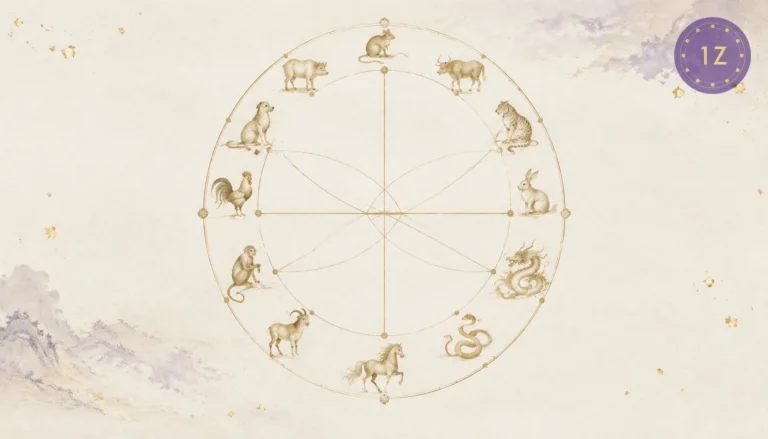
Most casual compatibility checks stop at the year branch, the animal sign. That is the thinnest slice of the chart. A real analysis treats the year branch as only one of three signals, because two people are far more than their birth years. The Chinese zodiac compatibility system the year branch feeds into is useful, but it cannot see pace, decision style, or long-term pressure points. Those show up when the full charts are read together, not when the 12 Chinese zodiac signs are matched in isolation.
What stands out about genuine BaZi compatibility work is that it never answers “should you be together.” It answers where the relationship will be easy and where it will demand effort. The 78 pairings in our framework span a scored range of 38 to 95, and the number is a map of dynamics, not a verdict.
The Three Layers of a Real Compatibility Reading
A serious compatibility reading is built bottom-up in three layers. Skip one and the rest is guesswork.
Layer 1 reads each chart on its own. The analyst identifies each person’s Day Master, whether it is strong or weak, and which elements it welcomes or resists. Whether the two sets of favorable elements complement each other is the foundation, and you can review the full five elements interaction system before going deeper. Miss this and everything above is speculation.
Layer 2 is where compatibility becomes its own discipline. The two Day Pillars meet, and the day branch is the Spouse Palace (配偶宫), the seat of the marriage dynamic. The Ten Gods (十神) of one chart are cross-mapped onto the other, and every pillar position is checked for combinations and clashes. Two charts read separately still have to be computed again together.
Layer 3 checks timing. Luck cycles move in ten-year steps, and whether two people’s cycles run in step decides which years feel easy and which take work. The same couple does not pay the same cost at every life stage.
The 78-Pair Score Framework
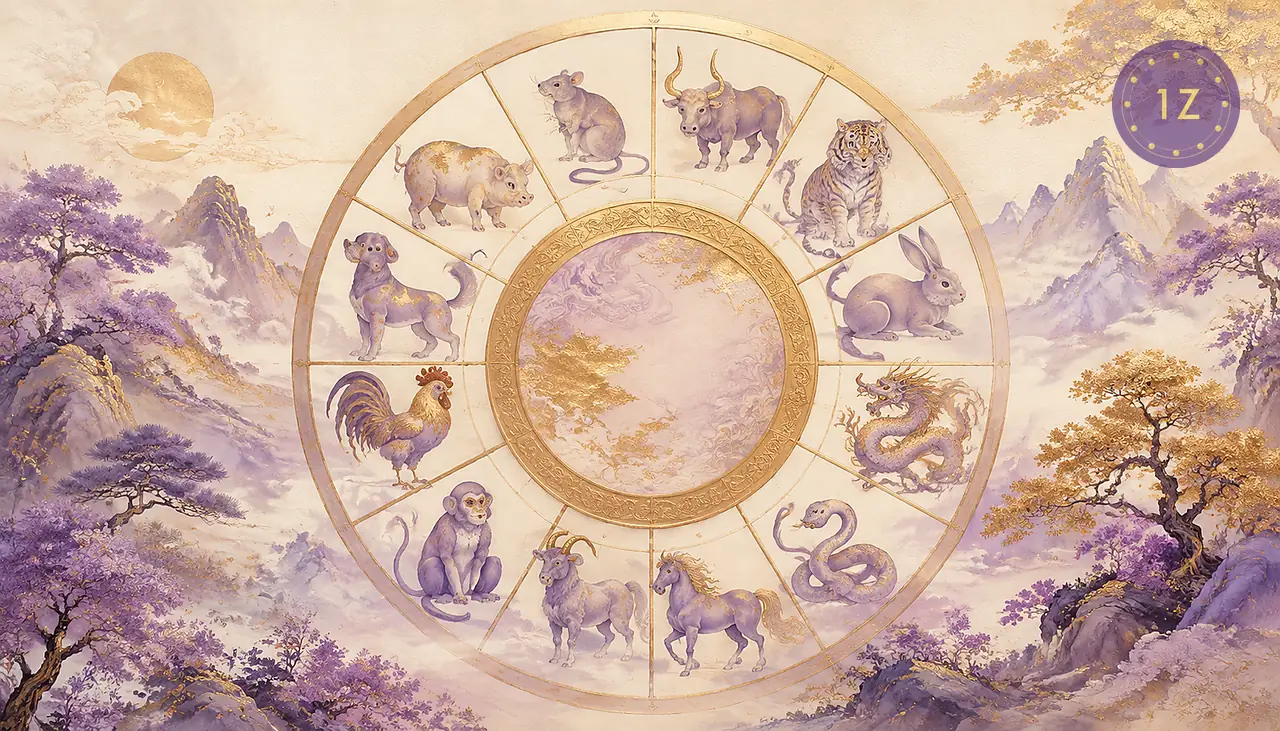
Our compatibility scoring weighs Earthly Branch relationships and element interaction across all 78 unique pairings, producing a range from 38 to 95. The highest scores belong to the Six Harmony (六合) pairs, the secret-friend bonds. Tiger and Pig reach 95, the top of the entire framework. Rat and Ox score 94, Rabbit and Dog 94, Dragon and Rooster 95, Horse and Goat 95, and Snake and Monkey 94.
The Three Harmonies (三合) trine allies sit just below, from 88 to 89, because shared trine frequency supports but does not fuse two people. At the other end, the Six Clash (六冲) pairs all score a flat 38. Rat-Horse, Ox-Goat, and Tiger-Monkey land at 38, and so do Dragon-Dog and Snake-Pig. Between them, the Six Harms (六害) pairs run 52 to 55, a subtler erosion rather than open opposition.
| Relationship type | Score range | Example pairs | Dynamic |
|---|---|---|---|
| Six Harmony (六合) | 90–95 | Tiger-Pig 95, Rat-Ox 94 | Secret-friend bond, deep complement |
| Three Harmonies (三合) | 88–89 | Same-trine allies | Shared frequency, role complement |
| Six Harms (六害) | 52–55 | Rat-Goat 52, Rooster-Dog 55 | Quiet erosion, trust friction |
| Six Clash (六冲) | 38 (all six) | Rat-Horse 38, Dragon-Dog 38 | Direct opposition, high friction |
Year Branch Is One Layer, Not the Whole Answer
A common mistake is treating the animal-sign match as the entire compatibility verdict. Independent calculators that publish their weights show the year branch contributes roughly 30 percent of a layered score, with the Day Master layer carrying about 40 percent and the five-element layer the remaining 30 percent. The year branch is real, but it is the lightest of the three signals.
That proportion matters because a Six Clash year pair, scoring 38 on the branch layer, can still function when the Day Masters support each other and the elements balance. The reverse is also true: a smooth year match with an elemental imbalance reads very differently once the full charts are open. A sign-only calculator cannot see that distinction, which is exactly where a full BaZi compatibility analysis earns its place.
The sixty stem-branch years (twelve animals paired with five element rotations) mean the same animal appears in five different elemental versions. Two “Horses” are not the same chart any more than two people named the same thing share a biography.
What the Reading Examines Beyond the Birth Year
Beyond the year branch, the reading opens the Spouse Palace, the day branch, to see how each person approaches partnership itself. The Ten Gods of one chart, the symbolic roles like Shang Guan (伤官) or Qi Sha (七杀), are mapped onto the other to find where they challenge or nourish. A Qi Sha in one chart met by the right supporting star in the other is a growth point, not a flaw.
The ten-year luck pillars, the Da Yun (大运), show when pressure arrives. Two charts whose luck cycles step in sync move through life’s hard years as a unit; mismatched cycles mean one person is expanding while the other is contracting. BaZi marks these periods by solar terms, never by lunar calendar months, because the system is built on astronomical solar boundaries.
The favorable element, the 喜用神, computed from the full chart rather than the zodiac year, tells each person what they most need from a partner. That single calculation is why generic “wear green for Wood” advice from crystal books so often misses.
Can a Low-Scoring Pair Still Work?
A low score is not a sentence. In our practice reading charts over the past 15 years, a Metal Rat and Fire Horse client pair, a textbook Six Clash at 38, built a successful import company by assigning clearly separated business domains rather than merging them. The Rat’s precision channeled the Horse’s scattered energy into directed action. They never married, and the structured professional boundary is precisely why the pairing worked.
The pattern holds across the framework. Six Clash pairs tend to function better in defined professional relationships than in intimate ones, because structure replaces the constant negotiation that the clash demands. By contrast, same-trine pairs scoring in the 80s often fail not from conflict but from overlap. They need explicit role differentiation, not fusion, or they compete for the same ground.
For most Fire-element natives entering a year heavy with Water, the lesson is the same: name the friction early and give it a container. The score tells you where the container is needed. It does not tell you the relationship is over.

Is BaZi compatibility analysis the same as Chinese zodiac animal matching?
They are related but not the same, and the difference changes the result. Chinese zodiac animal matching reads only the birth-year branch, the sign, and assigns one of the 78 pair scores, from 38 for a Rat-Horse clash to 95 for a Tiger-Pig harmony. BaZi compatibility analysis keeps that year-branch signal but adds two heavier layers: the Day Master comparison at roughly 40 percent of a layered score and the five-element balance at about 30 percent, with the zodiac branch itself contributing only around 30 percent. That is why a 38 clash year can still function when the Day Masters support each other and the elements balance, while a smooth year match can hide an elemental imbalance a sign-only check never sees. The practical takeaway is to treat the animal match as a starting hint, then open the full charts before deciding anything.
What does a BaZi compatibility reading actually examine beyond the birth year?
A full reading examines four structures the year branch cannot reach. First, the Spouse Palace, the day branch, shows how each person behaves inside partnership itself. Second, the Ten Gods of one chart are cross-mapped onto the other to locate where they challenge or nourish, with roles like Shang Guan and Qi Sha read as growth points rather than flaws. Third, the ten-year luck pillars reveal whether two people’s cycles step in sync or pull apart during life’s hard years. Fourth, the favorable element, the 喜用神, shows what each person most needs from a partner, computed from the whole chart and not the zodiac year. In Mei Lin Chen’s practice, these four structures carry more of the relationship’s real texture than the animal sign ever does, which is why a two-chart reading and a sign-only match can point in different directions.
Can a low-scoring pair, a Six Clash, still build a lasting relationship?
Yes, and the mechanism is structure, not denial. The Six Clash pairs all score 38 because their branches sit in direct opposition, but in our analysis of all 78 pairings, the lowest scores describe friction, not fate. Definitions, denominators, and limits sit on the methodology page. An anonymized Metal Rat and Fire Horse pair, a 38 clash, built a durable import business by splitting domains so the Rat’s precision directed the Horse’s energy instead of colliding with it. They succeeded precisely because they kept the relationship professional and bounded. The same clash in an intimate merger usually costs more, because the opposition demands constant negotiation with no container. The honest read is that a low score tells you where to build the container, and which relationship form fits the pair, not whether the bond is allowed to exist.
Conclusion
BaZi compatibility analysis is a three-layer reading of two full charts that maps relationship dynamics with a scored range of 38 to 95, not a single animal-sign verdict. For your own side-by-side reading, try the free BaZi calculator at 12Zodiacs.
Sources
- Four Pillars of Destiny (BaZi) on Wikipedia: overview of the four-pillar chart structure, Heavenly Stems, Earthly Branches, and Ten Gods.
- Chinese zodiac on Wikipedia: the 12 animal signs and the 60-year sexagenary cycle the year branch draws from.
- Hong Kong Observatory: authoritative source for the astronomical solar-term and lunar data that underpin BaZi chart calculation.