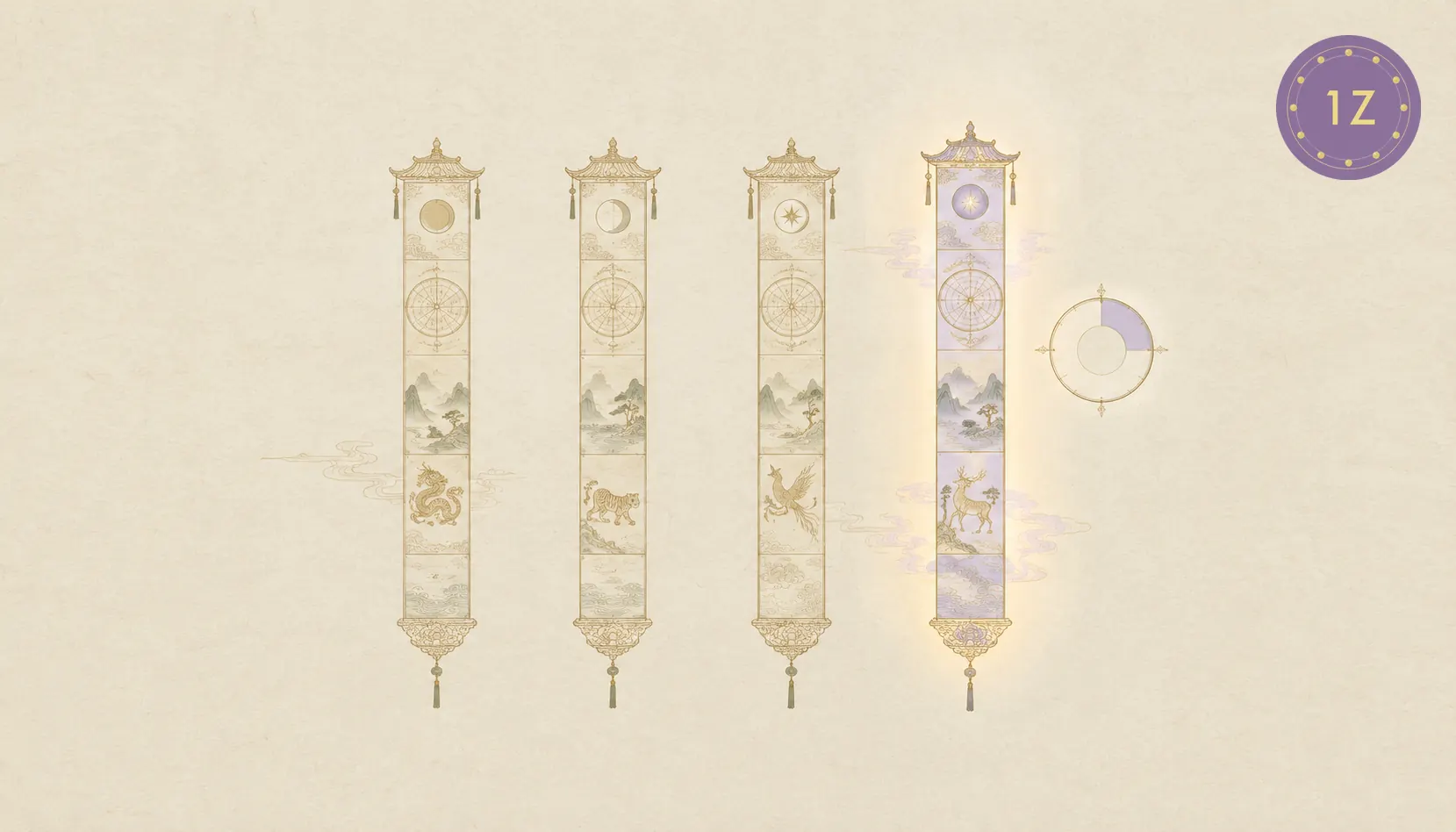

The BaZi hour pillar represents your children, your later years, and the private world you keep once the career race ends, with classical palace maps filing it under roughly 49 and after. The column holds two seats: a Heavenly Stem (one of 10 cycle characters) on top, an Earthly Branch (one of 12, animal-bearing) underneath; its stem is the one stem in a birth chart you never pick directly, because your day stem computes it. This guide walks the palace, the 12 hour windows, and the years that press this column.

Key Takeaways
- The hour pillar represents children and the later years, roughly 49 and after, plus the private world classical texts file under it.
- 12 fixed two-hour windows set the hour branch, running from Zi (23:00-01:00) to Hai (21:00-23:00).
- The five rats rule derives the hour stem from the day stem, so no hour stem stands alone.
- Ten Gods labels give the hour stem its meaning, always measured against the day stem.
- Only a year whose branch interacts with your hour branch presses this palace, and 2028 is the next such year for Yin-hour charts.
The Hour Pillar: the Birth Chart’s Fourth Column
Every BaZi birth chart stacks four pillars: year, month, day, and hour. Each pillar pairs one of 10 Heavenly Stems with one of 12 Earthly Branches. Polarity rules allow only yang-with-yang and yin-with-yin pairings, and those two facts yield exactly 60 legal pillar combinations stepping through the ancient sexagenary cycle. The hour column is the fourth of the four and the fastest-moving address in the chart. A year branch holds its seat for 12 months; the hour branch turns over every two hours and runs all 12 branches across a single day.
In practice, this speed is why serious readings ask for your exact birth time. A client who rounds 22:50 to “around eleven” has silently swapped the Hai hour (21:00-23:00) for the Zi hour (23:00-01:00), two different branches and two different hour pillars. In my files the hour pillar is the column people skip at first and then need most, because it answers questions the other three never hear.
What the Hour Pillar Governs in a Birth Chart
Classical palace maps give each pillar a register of life. The year pillar covers ancestors and the early stretch, the month covers parents and career foundation, and the day pillar carries the self and the marriage seat. The hour pillar governs children, the later years (roughly 49 and after), and the private world: subordinates and pet projects that carry your name alone. That said, age bands vary by school, so treat the 49-and-after line as a reading aid rather than a timer. The traditional image helps here: root, seedling, flower, and fruit, with the hour column as the fruit, the part of a chart that ripens last. Marriage questions keep their own address in the day branch, which we walk separately in the spouse palace guide.
Children deserve one careful sentence here rather than a table. Classical reading treats certain Ten Gods labels (the ten role-names assigned relative to the day stem) as children stars. Officer lines carry that signal in a male chart and output lines in a female chart, and the Ten Gods table holds the full mapping. What the hour pillar adds is the room where those signals sit.
A 1977 Fire Snake client of mine shows what the later-years register feels like in practice. The law career came first, and at 45 the hour-pillar questions arrived ahead of any timetable: what is the second half for, and who is it for. Her chart’s Ding Fire reads as candlelight, the guided flame rather than the wildfire, and the practice she eventually built, mediation work folded with counseling, followed that register exactly. The hour palace is where a chart keeps its most private instructions.
The 12 Hour Windows of a Birth Chart
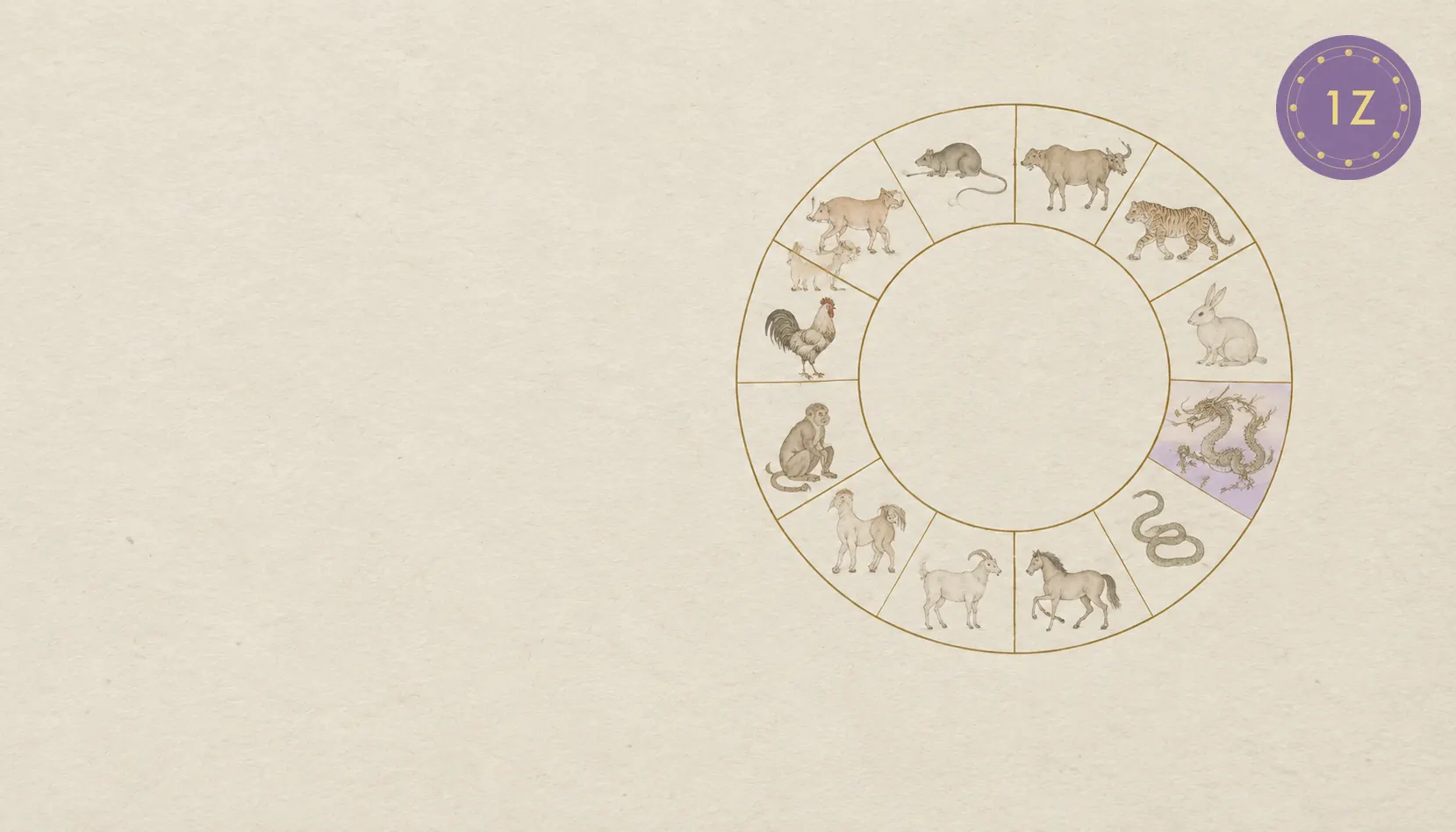
Your hour branch comes from a fixed timetable, not from impression. The 12 Earthly Branches divide the day into 12 two-hour windows, and the clock decides the branch.
| Branch | Animal | Clock window |
|---|---|---|
| Zi | Rat | 23:00-01:00 |
| Chou | Ox | 01:00-03:00 |
| Yin | Tiger | 03:00-05:00 |
| Mao | Rabbit | 05:00-07:00 |
| Chen | Dragon | 07:00-09:00 |
| Si | Snake | 09:00-11:00 |
| Wu | Horse | 11:00-13:00 |
| Wei | Goat | 13:00-15:00 |
| Shen | Monkey | 15:00-17:00 |
| You | Rooster | 17:00-19:00 |
| Xu | Dog | 19:00-21:00 |
| Hai | Pig | 21:00-23:00 |
Two border habits keep the table honest. A 22:50 birth still belongs to Hai (21:00-23:00) while a 23:05 birth belongs to Zi (23:00-01:00). Whether the day column itself rolls at 23:00 or at midnight is a school-by-school call, so border births deserve a check against exact calendar data. When I read a chart for a border birth, I ask for the recorded clock minute before I interpret anything else.
Clocks add a second wrinkle: charts read the birthplace’s local standard time, and daylight saving shifts the civil clock by one hour in the countries that use it. Our free BaZi calculator normalizes time zones before it assigns a window.
The conversion tables at the Hong Kong Observatory are the reference our engine cross-checks for births near any border.
The Five Rats Rule: the Hour Stem You Don’t Choose
The hour stem never arrives alone. Classical texts fix it with the five rats rule (五鼠遁, the “five rats” mnemonic): your day stem decides which stem opens the Zi hour, and the remaining hour stems count forward one step per window. A Bing or Xin day opens its Zi hour with Wu Zi (戊子); a Jia or Ji day opens with Jia Zi. The full grid takes five lines.
| Day stem | The Zi hour opens with |
|---|---|
| Jia or Ji | Jia Zi |
| Yi or Geng | Bing Zi |
| Bing or Xin | Wu Zi |
| Ding or Ren | Geng Zi |
| Wu or Gui | Ren Zi |
Month pillars obey the same logic, with the year stem fixing the first month’s stem through the five tigers rule, the month pillar’s twin derivation. The consequence for your chart is direct. Two people born inside the same 15:00-17:00 window sit under different hour stems whenever their day stems differ, and the full hour stem table lays out all 12 windows for each of the 10 day stems. Read the hour stem through the day stem, never as a free-floating label.
A Birth Chart Reads Its Hour Stem Through the Day Stem
Ten Gods labels turn the hour stem into a reading. Every label is measured against your day stem, the reference point classical reading calls the Day Master, so the same hour stem changes meaning as the day stem changes. Two Jia-day examples make the mechanics concrete.
A birth between 11:00 and 13:00 on a Jia day lands on the hour pillar Geng Wu, and Jia reads the Geng stem as Seven Killings, the pressure-and-drive label. A birth between 17:00 and 19:00 on that same Jia day lands on Gui You, and Jia reads the Gui stem as Direct Resource, the care-and-shelter label. One day, two hours, two different readings. The branch under each stem carries hidden stems (the smaller stems stored inside every branch) that receive labels the same way, main qi first.
For the hour pillar’s family register, the classical placement is compact: an officer-line hour stem carries the children signal in a male chart, an output-line hour stem carries it in a female chart. Where the hour stem instead sits in your Resource or Wealth line, the palace speaks more about the later years than about children, and that is a normal chart rather than a defective one. In my practice the hour column reads best as a private brief the chart writes to itself.
When a Year Presses on the Later-Years Palace
A palace matters when a year arrives at its address, and the arrival rule is positional: the hour palace registers a year only when that year’s branch interacts with your hour branch. Interactions with your month branch belong to the month’s register, and interactions with your day branch belong to the marriage seat. The same year can press one person’s hour palace and pass another person’s by entirely.
The 2028 Wu Shen year gives the working example. Shen clashes Yin, a Six Clash pair (one of the six opposing branch pairs on the wheel). If you were born in the 03:00-05:00 window and carry Yin as your hour branch, 2028 is a year when the later-years and children zone of your chart comes under pressure. That theme is worth pacing rather than fearing, and it runs on a 12-year rhythm whose previous stop was 2016. If your hour branch is Chou instead, the same Shen year passes your hour palace with no direct clash and no harmony bond, which our engine confirms on both counts. Across our 78-pair dataset, each sign’s year activates exactly one clash, one harm, and two trine allies, a fixed geometry (methodology) that makes these arrivals predictable years in advance. What the geometry never licenses is a prediction. A clash at the hour palace stresses a theme zone; the content of that stress belongs to a full chart read with a practitioner, not to a blog table.
Can two people born on the same day really have different hour pillars?
Two people born on the same day can carry different hour pillars, and on a Jia day the spread runs the full column. The day opens with Jia Zi in the Zi window (23:00-01:00), and the hour stem advances one step per window until the day closes with Yi Hai in the Hai window (21:00-23:00). One calendar day produces 12 distinct hour pillars. The branch follows the clock table, while the stem follows the five rats rule from that day’s stem. Two births inside the same Shen window on different days share the Monkey branch yet sit under different stems. Daylight saving shifts the civil clock by one hour in countries that use it, which can quietly move a recorded birth time across a window border. When in doubt, run the exact recorded time, not the rounded one.
Is it true that the hour pillar tells you how many children you will have?
The hour pillar does not hand out a headcount. Classical reading treats the hour column as the palace where children themes sit, alongside the private register of subordinates and personal projects. That shared register is one structural reason a child count cannot be read mechanically off the column. What the palace supports is tendency and timing: which Ten Gods lines occupy the hour stem, which years interact with the hour branch, and whether the children register reads supported or pressured. The 12-branch cycle brings every hour branch back around once each 12 years, so the theme recurs on a schedule, while the count never arrives at all. In consultation I read the hour column for tendency and timing, and I tell every client who asks for a number that this system keeps its family readings qualitative on purpose.
How is the hour palace different from the luck pillars that cover your later years?
The hour palace is a fixed address in your natal chart. Luck pillars (Da Yun, 大运, the ten-year schedule layered over the natal chart) are the timetable that visits the address, and the two answer different questions. The natal hour pillar holds the later-years register in place from birth, roughly 49 and after by the classical map, whatever the decade. Luck pillars march one step per ten years, launching from a start age that most charts place between 1 and 10. Their direction depends on the birth year’s stem polarity paired with your gender, so two people with identical hour pillars can walk completely different decades through the same later years. Read the hour pillar for the room and the luck pillars for the visiting schedule. A pressured decade in the later years usually means a luck pillar is interacting with that fixed natal address, not that the address itself changed.
Conclusion
The hour pillar represents what a chart keeps for last: children, the later years from roughly 49 onward, and the private world that outlasts every career. Run your birth date and exact time through our free BaZi calculator to see which of the 12 windows holds your hour branch, and which stem your day stem assigns to sit above it.
Sources
Four Pillars of Destiny, Wikipedia: backs the four-pillar structure and the palace framework over the four life stages.
Sexagenary cycle, Wikipedia: backs the 60-combination pillar arithmetic and the 10-by-12 cycle behind the hour column.
Gregorian-Lunar Calendar Conversion Tables, Hong Kong Observatory: backs exact time conversion for hour-window border births.