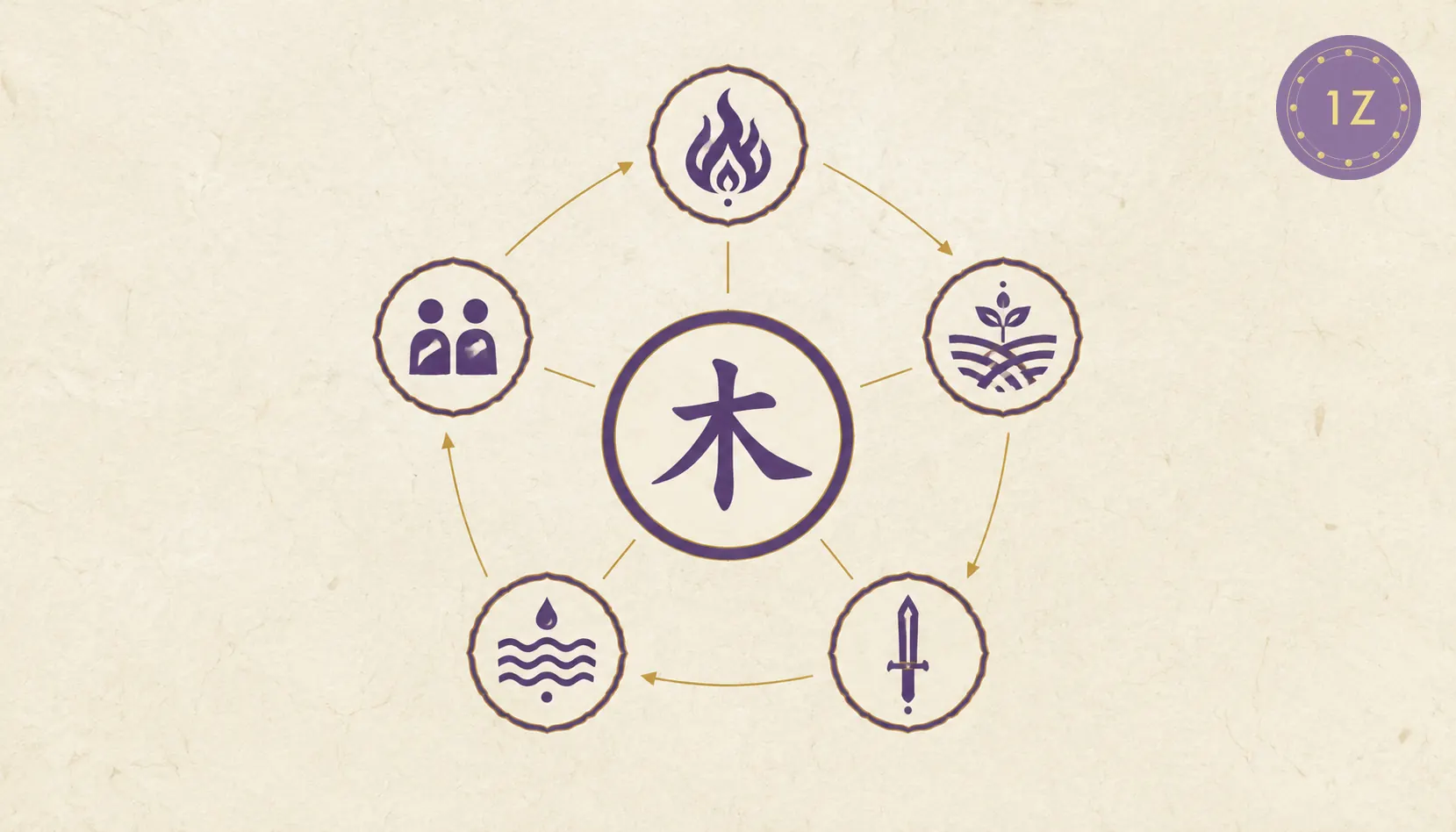

The Ten Gods (十神) are the role-assignment layer of a BaZi chart: every stem around your Day Master plays exactly one of ten roles, fixed by two questions, element relation and polarity. The table itself is mechanical, reproducible, and small enough to hold in one view. This article gives you the complete Ten Gods table, the two-step rule that generates it, and a fully worked example with Jia Wood as Day Master so you can verify every cell yourself.

Key Takeaways
- Ten Gods = 5 element relations (same, I-produce, I-control, controls-me, produces-me) × 2 polarities (same, opposite).
- For Wealth, Officer, and Resource, opposite polarity yields the Direct star and same polarity the Indirect star; for Output and Companion the twins carry their own names (same polarity gives Friend and Eating God, opposite gives Rob Wealth and Hurting Officer).
- The Day Master itself is the reference: Jia Wood reading is not Geng Metal reading.
- The role layer interacts by the same five-element generating cycle it came from.
- Ten Gods is a vocabulary of pressures, not a list of fates: roles name what a chart reaches for.
The Two-Step Rule
Every Ten Gods assignment is two checks, in order. First the element relation: what does the stem’s element do relative to the Day Master’s? Same element means the Companion family; the Day Master produces it means Output; the Day Master controls it means Wealth; it controls the Day Master means Officer; it produces the Day Master means Resource. Second the polarity: for the Wealth, Officer, and Resource families, opposite polarity selects the Direct star and same polarity the Indirect one, while Output and Companion twins carry their own names (Eating God versus Hurting Officer, Friend versus Rob Wealth). Two questions, one role, no judgment involved: the full table is 10 cells, 5 families times 2 twins, and the rule itself takes minutes to understand, with fluency following after a little practice.
Because the rule is deterministic, the whole table of 10 roles can be verified rather than memorized, a check that takes minutes at first and repays itself across years of readings. The worked example below runs a Jia Wood Day Master against all 10 stems, one row per stem, readable in minutes, and each row is the bazi-tool’s deterministic output, not a recollection. If you hold a different Day Master, the same two questions regenerate your table in minutes.
Practical takeaway: two questions, one role; the table is arithmetic, not memory.
The Complete Table (Jia Wood Day Master)
The reference row is Jia (甲, Yang Wood). Each row below shows the stem meeting the Day Master, its element relation, the polarity verdict, and the resulting role, exactly as the deterministic tool outputs it.
| Meeting stem | Element relation | Polarity | Role (Ten God) |
|---|---|---|---|
| Jia 甲 | Same element | Same (Yang) | Friend (比肩) |
| Yi 乙 | Same element | Opposite (Yin) | Rob Wealth (劫财) |
| Bing 丙 | Day Master produces | Same | Eating God (食神) |
| Ding 丁 | Day Master produces | Opposite | Hurting Officer (伤官) |
| Wu 戊 | Day Master controls | Same | Indirect Wealth (偏财) |
| Ji 己 | Day Master controls | Opposite | Direct Wealth (正财) |
| Geng 庚 | Controls Day Master | Same | Seven Killings (七杀) |
| Xin 辛 | Controls Day Master | Opposite | Direct Officer (正官) |
| Ren 壬 | Produces Day Master | Same | Indirect Resource (偏印) |
| Gui 癸 | Produces Day Master | Opposite | Direct Resource (正印) |
Read the table twice, once vertically for the five families, once horizontally for the twins. The family a stem belongs to is decided by element alone; the twin is decided by polarity alone. We teach the families first because that separation is what makes the table learnable in one sitting, and the five families, not the ten roles, are the natural unit of interpretation.
Practical takeaway: five families by element, two twins by polarity; check both, in that order.
The Five Families in Reading
The Companion family (Friend, Rob Wealth) is the self and its rivals: peers, siblings, the colleagues who share your element. The Output family (Eating God, Hurting Officer) is what the Day Master produces: craft, expression, performance, the visible work. The Wealth family (Direct Wealth, Indirect Wealth) is what the Day Master controls: assets, territory, the spouse star in a male chart. The Officer family (Direct Officer, Seven Killings) is what controls the Day Master: structure, authority, the spouse star in a female chart. The Resource family (Direct Resource, Indirect Resource) is what produces the Day Master: learning, support, the mother line.
The twins differ in texture, not in kind. Direct Officer is the negotiable authority of rules and titles; Seven Killings is the same controlling pressure arriving blunt and unbuffered, the battlefield commission rather than the office. Direct Wealth is the managed, kept asset; Indirect Wealth is the opportunistic, windfall-flavored one. Eating God flows gently as craft and enjoyment; Hurting Officer burns brighter and challenges authority, which is why classical texts read Hurting Officer meeting Direct Officer as friction (伤官见官). In our experience, students who learn the families first and the twins second stop confusing texture with category across dozens of charts.
One boundary note with force: these are roles relative to a Day Master, not personality types standing alone. A Geng Metal Day Master assigns completely different stems to the Officer role than a Jia Wood one does, and reading a chart’s roles without anchoring the Day Master first is the most common beginner error. For how the roles interact with each other, the five-element cycle is the fixed reference: Resource feeds Companion, Companion feeds Output, Output feeds Wealth, Wealth feeds Officer, Officer feeds Resource, and the control lines cross the same circle.
| Family | Twins | Reads for |
|---|---|---|
| Companion | Friend / Rob Wealth | Peers, siblings, self-rivals |
| Output | Eating God / Hurting Officer | Craft, expression, performance |
| Wealth | Direct / Indirect | Assets, territory, male spouse star |
| Officer | Direct / Seven Killings | Structure, authority, female spouse star |
| Resource | Direct / Indirect | Learning, support, mother line |
Practical takeaway: families are the unit of meaning; twins are shades of the same pressure.
Placement: Where Roles Sit Matters
A role’s meaning shifts with its seat. A Direct Officer star sitting in the month pillar reads as career structure in the parents’ generation’s weather; the same star in the day pillar sits close to the self, which is why marriage readings work palace and star together (宫星互参): the spouse palace’s hidden roles describe the marriage zone’s native weather, while the spouse star named earlier describes the bond the chart reaches for, and the two are read as a pair. The hour pillar’s roles speak for the late-life zone and children. Same role, different room.
The hidden stems extend the table below the surface. Each branch carries 1 to 3 hidden stems, up to 3 roles per branch (Mao 卯 carries only Yi 乙; Shen 申 carries 3, listed here by strength share with the main qi first: Geng 庚 the main qi, then Ren 壬 the middle qi, then Wu 戊 the residual qi (classical tables list residual first in calendar order; both orders describe the same three stems)), and every hidden stem takes a role just as visible stems do. A chart thin on visible Officer may still hold Officer pressure inside the day branch, which changes the marriage reading without changing the visible count. In our experience, the single biggest upgrade in a beginner’s reading accuracy comes from checking hidden-stem roles after the visible ones. If you want the full four-pillar walkthrough, our BaZi chart interpretation guide covers it layer by layer.
Practical takeaway: count visible roles first, then read the hidden ones; the room changes the reading.
Who are the Ten Gods in Chinese astrology, mechanically?
They are ten role labels assigned by a two-step rule: element relation (same, produces-me, I-produce, I-control, controls-me) selects one of five families, then polarity (same or opposite versus the Day Master) selects the twin within the family. The full set is Friend, Rob Wealth, Eating God, Hurting Officer, Direct Wealth, Indirect Wealth, Direct Officer, Seven Killings, Direct Resource, Indirect Resource. Despite the name, they are not deities: the label 十神 is classical shorthand for ten relational positions, each naming a pressure the chart exercises or receives.
How do I build my own Ten Gods table without memorizing?
Anchor your Day Master, then ask the two questions for every stem. Worked with Jia Wood as the Day Master (anyone whose day stem is Jia, regardless of birth year): Jia and Yi are same-element, the Companion twins (Friend and Rob Wealth by polarity); Bing and Ding are produced by Jia (Output family); Wu and Ji are controlled by Jia (Wealth family); Geng and Xin control Jia (Officer family, with Geng the blunt Seven Killings and Xin the Direct Officer); Ren and Gui produce Jia (Resource family). Verify your version against a deterministic tool rather than memory, because one polarity slip silently swaps a twin, and the twins read differently in every interpretation that follows.
Do the Ten Gods actually predict personality?
They describe pressures and leanings, not fixed personality. A chart dense with Output roles reaches for expression and craft; dense Officer roles live inside structure and accountability; dense Resource roles accumulate learning and support. What the roles do not do is force behavior: two charts with identical role counts can express them differently by strength, placement, and the owner’s choices. Based on our analysis of paired readings, the most useful frame is vocabulary rather than verdict: the roles name what the chart has to work with, and the life decides what to build with it.
What is the difference between Direct Officer and Seven Killings?
They are the twins of the Officer family, both controlling the Day Master, separated by polarity. Direct Officer (正官) is the opposite-polarity form: negotiable authority, rules, titles, the structured career line, classically the husband star in a female chart. Seven Killings (七杀) is the same-polarity form: the same controlling pressure arriving blunt and unbuffered, read as intensity, competition, and raw challenge that needs channeling rather than the office door. Charts heavy in Seven Killings with a buffer (Resource converting pressure into support) read very differently from the same charts without one, which is why the twins are never interchangeable in interpretation.
Sources
- Four Pillars of Destiny – Wikipedia: the Day Master reference and role framework
- Chinese astrology – Britannica: the classical four-pillar tradition behind 十神
- Chinese zodiac – Wikipedia: stems, branches, and the five-element cycle the roles project from
Conclusion
Five families, two twins, one Day Master as the anchor: that is the whole Ten Gods table. Build yours on the Chinese zodiac hub, verify it against the tool, and read the roles as pressures you can spend.