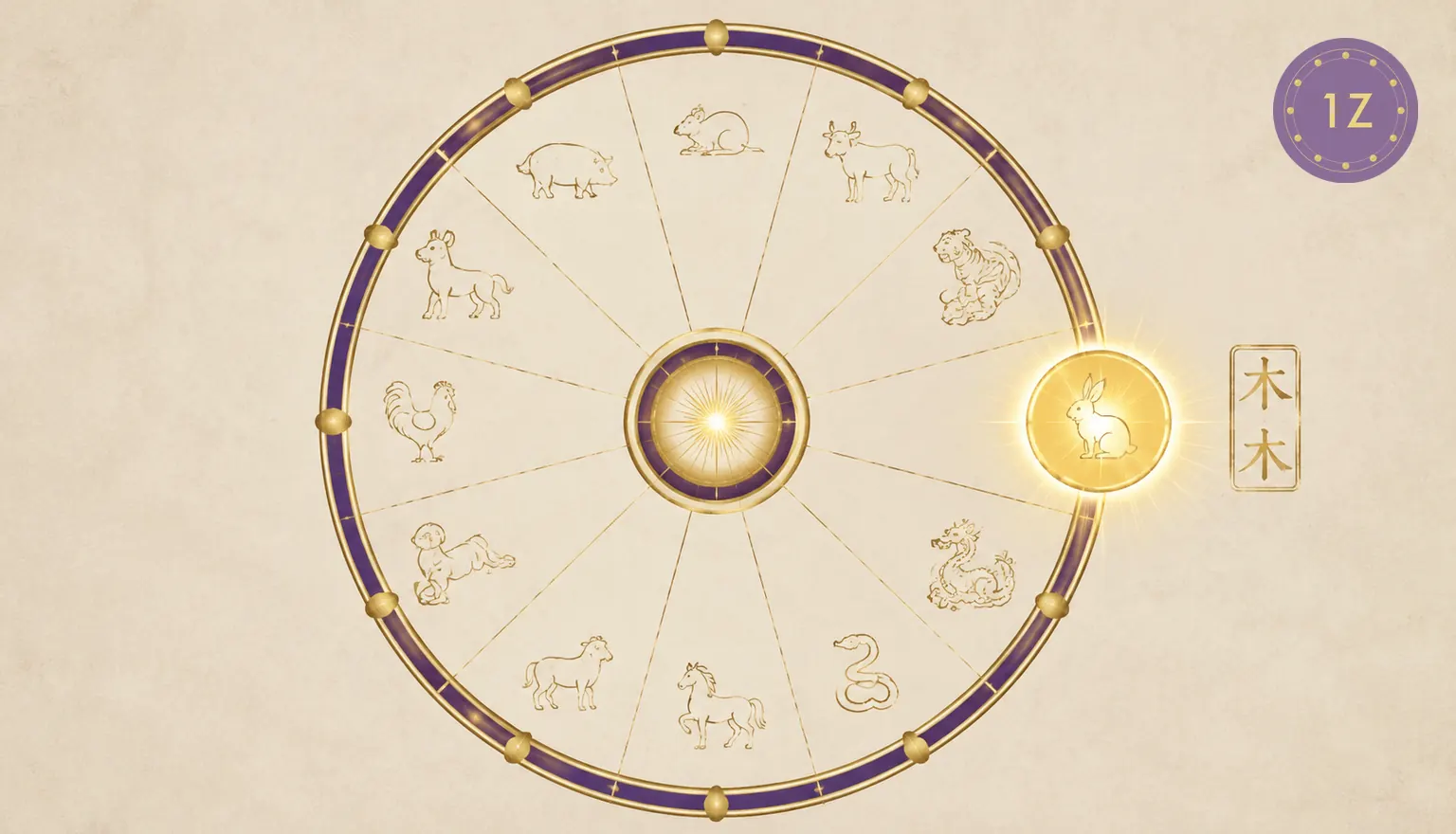

The Mao month (卯, the Rabbit’s branch) is mid-spring, running from Jing Zhe to Qing Ming, roughly March 6 to April 4, a window of about 30 days, or 720 hours, at the heart of spring, and for Wood it is the throne room: the month order itself is Wood, and every Wood stem arriving here stands at its strongest station. In the twelve-stage life cycle, Jia Wood sits at Di Wang, imperial prosperity, its absolute peak, while Yi Wood holds Lin Guan, the official’s arrival. This article walks what “prosperous Wood” mechanically means, how to read a Wood Day Master born in Mao month, and where the honest reading stops.

Key Takeaways
- Mao month = mid-spring (惊蛰 Jing Zhe to 清明 Qing Ming, roughly March 6 to April 4), month order element Wood.
- Jia Wood at Mao = Di Wang (imperial peak) in the twelve-stage cycle; Yi Wood at Mao = Lin Guan.
- A Wood Day Master in Mao month reads Strong by month-order rule (the heaviest single weight).
- Mao hides exactly one stem, Yi Wood: a single-qi branch, pure Wood.
- Prosperous Wood wants output or control, not more Wood: the strong chart reaches for Metal to prune or Fire to flower.
The Month: What Mao Actually Is
The twelve solar-term months each carry a branch. Mao is the second of the 3 months of spring: it opens at Jing Zhe (around March 6) and closes at Qing Ming (around April 4), spanning roughly 30 days, about 1 month of the solar calendar. Its season is mid-spring, the heart of the wood season rather than its opening. The month order element is Wood, and classical practice weights the month order as the first determinant of strength, worth more than several scattered stems elsewhere.
Mao’s hidden-stem structure is the cleanest in the zodiac: exactly one hidden stem, Yi Wood, and nothing else beside it. Mao is one of the three single-qi branches (with Zi and You, per our category tables), which makes it pure Wood territory, a branch with no secondary agenda. When a chart says “Mao month,” the season itself votes Wood, with the clearest ballot in the calendar.
| Feature | Value |
|---|---|
| Branch | Mao (卯), the Rabbit |
| Season | Mid-spring (仲春), second month of spring |
| Solar-term window | Jing Zhe to Qing Ming, roughly March 6 to April 4 |
| Month order element | Wood |
| Hidden stems | Yi Wood only (single-qi branch) |
Practical takeaway: Mao month is Wood’s home field, and the purest one.
The Peak: Di Wang and Lin Guan
The twelve-stage life cycle (十二长生) maps each stem across the twelve branches as a life arc: Growth, Bathing, Capping, Official, Imperial Prosperity, Decline, onward to Tomb and back to Womb. For yang stems the arc runs forward; for yin stems it runs backward. Jia Wood’s arc begins at Hai, where Water births Wood, and peaks four steps later, through Zi, Chou, and Yin to Mao. At Mao, Jia sits at Di Wang, the emperor’s seat and the cycle’s absolute maximum.
Yi Wood tells the mirrored story. Its arc begins at Wu (where wood’s form flourishes in high summer) and runs backward; at Mao it holds Lin Guan, the official’s arrival, the seat just below the throne. Both Woods in Mao month are therefore at or near their structural maximum, and this is what “wood prosperous” mechanically names: not a mood, but a specific seat in a fixed cycle.
One honest note on schools: the twelve-stage cycle has two traditions. The forward-backward arrangement used here is standard for imagery and classical citation; a same-direction arrangement is used by some strength purists. What stands out about the Mao month reading is that both traditions agree: Wood in Mao month is maximally strong. The month-order rule (bazi-tool strength) says the same thing a third way. Three roads, one destination.
| Stem | Cycle position at Mao | Meaning |
|---|---|---|
| Jia (甲, yang Wood) | Di Wang (帝旺) | Imperial peak, cycle maximum |
| Yi (乙, yin Wood) | Lin Guan (临官) | Official’s arrival, just below peak |
Practical takeaway: prosperous is a seat on a fixed cycle, not an adjective; Jia peaks, Yi holds the second seat.
Reading the Chart: Strong Wood Behaviors
A Wood Day Master born in Mao month reads Strong by the month-order rule, the heaviest single weight in classical assessment. The bazi-tool’s deterministic lookup confirms it: Wood in Mao classifies as Prosperous (旺), the top classification. I read strength as a budget, not a virtue or a flaw, and I tell students the word “strong” in a chart means the same thing “funded” means in a company. Strong Wood has resources to spend, and the classical question becomes what to spend them on.
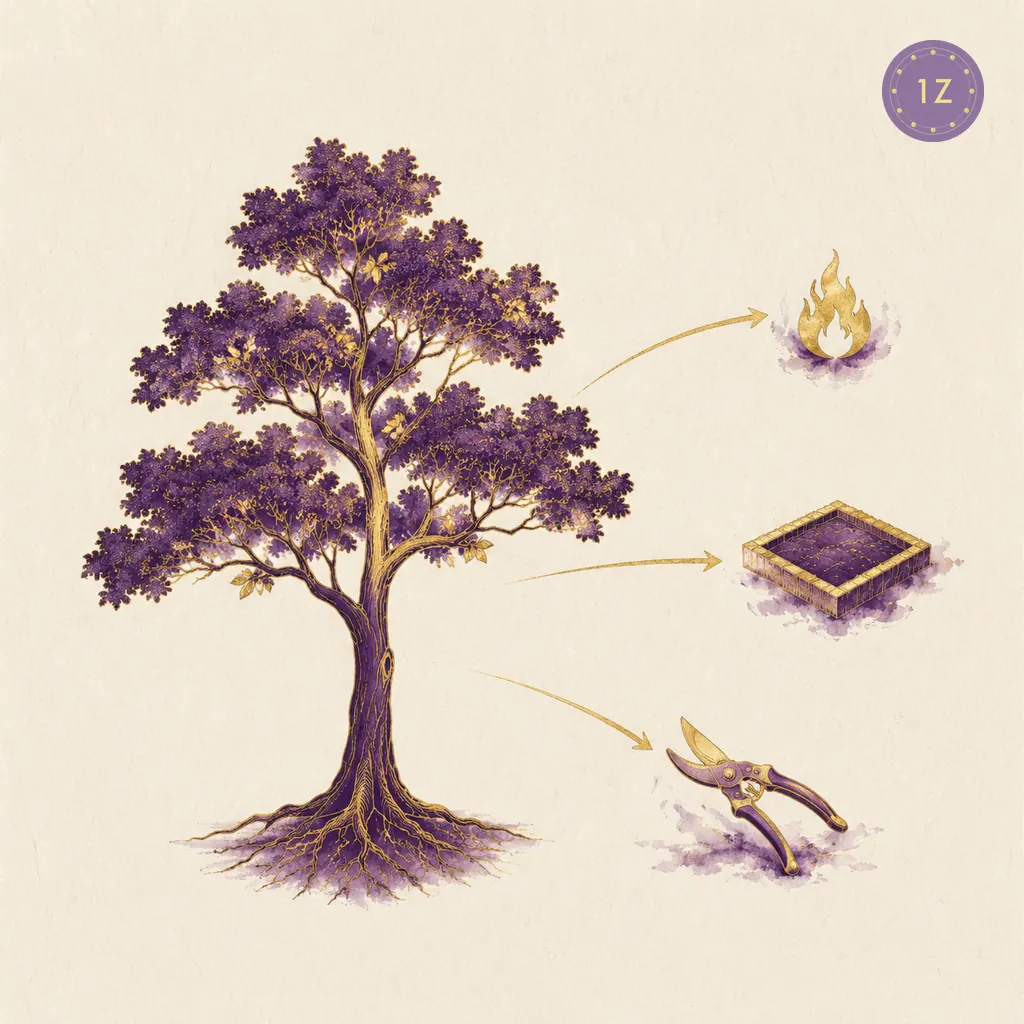
The spending options follow the element cycle. Output (Fire) flowers the Wood (expression, craft, visibility); Wealth (Earth) is what the Wood controls (territory, assets, management). Officer (Metal) prunes the Wood: structure, discipline, the shears that shape a tree into architecture. A prosperous Wood chart with healthy Metal reads as managed strength. The same chart with no pruning reads as an unmanaged grove, vigorous but shapeless.
What strong Wood does not want is more Wood: companions compete for the same sunlight, and Water (Resource) keeps feeding a tree already at canopy. In my experience, and I say this having read Mao-month charts for years, the charts that struggle in Mao month are rarely too weak, they are Wood-heavy charts that doubled down on their own element. Based on our analysis of reader corrections, the most common misread is treating “prosperous” as a compliment to be amplified rather than a budget to be deployed.
Practical takeaway: strong is a budget; spend it on Fire, Earth, or Metal, not on more of itself.
Timing: When the Peak Activates
A Mao-month Wood chart feels the years through the same geometry every chart uses. The most direct activations are structural. Flowing years whose stems transparently carry the element the chart reaches for (a Metal year bringing the pruning Officer into the heavens), or whose branches bond with or clash against the day branch, lead the list. You (酉), the Rooster’s branch, clashes with Mao directly: a Rooster year shakes the Mao month’s throne, pressuring the month-pillar zones, the career field and the parents’ generation’s weather. The marriage zone joins only when Mao also serves as the day branch, the spouse palace, which is a separate question from the month seat.
The luck-pillar layer adds the decade view, chapters of 10 years each, 8 in a typical span. Luck pillars march from the month pillar, forward for yang-year males and yin-year females, backward for the mirror cases, and the starting age comes from the 3-days-per-year arithmetic. For a Mao-month chart, the 2 decades immediately neighboring Mao matter most: a Chen decade (harmony with You, earth arriving) reads differently than an Yin decade (Jia’s official seat at Lin Guan, where the grove thickens further).
Three honest limits hold here as everywhere: timing names windows of weather, not scheduled events; strength names budget, not destiny; and a single layer never decides anything alone.
Practical takeaway: Rooster years clash the throne; neighboring-month decades set the weather.
What does “wood prosperous” actually mean in a BaZi chart, mechanically?
Mechanically it means Wood holds the strongest position available. The month order is Wood (a Mao month, or the neighboring spring months); the twelve-stage cycle seats Jia at Di Wang or Yi at Lin Guan; and the bazi-tool lookup classifies the Day Master as Prosperous (旺), the top of its scale. Read practically, prosperous Wood is a budget, not a verdict: the chart has maximum structural resources to spend on Output (Fire), Wealth (Earth), or Officer (Metal), and it does not want more Wood or more Water feeding an already-complete canopy.
Is Jia Wood or Yi Wood actually stronger in the Mao month, and why the different seats?
Both sit at their structural maximum, in different seats: Jia (yang Wood) holds Di Wang, the imperial peak itself, while Yi (yin Wood) holds Lin Guan, the official’s arrival one seat below. The month-order rule weights them identically, since the month’s element is Wood either way. In my experience the productive distinction is style, not strength: Jia in Mao reads as a canopy tree at full height wanting pruning, while Yi in Mao reads as living wood at full run wanting form. Same budget, different spending habits.
What happens when a Mao-month chart meets a Rooster year?
The Rooster’s You branch clashes Mao directly (卯酉冲, one of the six clash diameters). Classical reading treats this as activation pressure on everything the Mao seat holds: the month pillar’s zones (career field, the parents’ generation’s weather) and, when Mao is the day branch, the spouse palace. A clash year is friction and motion, not doom, and the standard practitioner advice is maintenance, not fear: lower the stakes in the activated zones, expect movement, and read the clash as the year the throne gets shaken, not overthrown.
Does a prosperous Wood Day Master mean good luck?
No, and conflating the two is the most common beginner error with this keyword. Prosperity is strength, and strength is capacity; luck in the practical sense depends on what the chart does with the capacity. A prosperous Wood chart with balanced Fire, Earth, and Metal reads as managed power with channels to spend it, while a prosperous chart that is all Wood and Water reads as a flooded engine, strong and stuck. The honest formula: prosperity tells you the size of the budget; the rest of the chart tells you whether the money is spendable.
Sources
- Chinese zodiac – Wikipedia: the twelve branches and the solar-term month structure
- Four Pillars of Destiny – Wikipedia: month order and Day Master strength framework
- Chinese astrology – Britannica: the classical four-pillar tradition
Conclusion
Mao month is Wood’s throne room: Jia at the peak, Yi at the gate, and the season itself voting Wood. Find your own seat on the Chinese zodiac hub, then check what your chart spends its strength on.