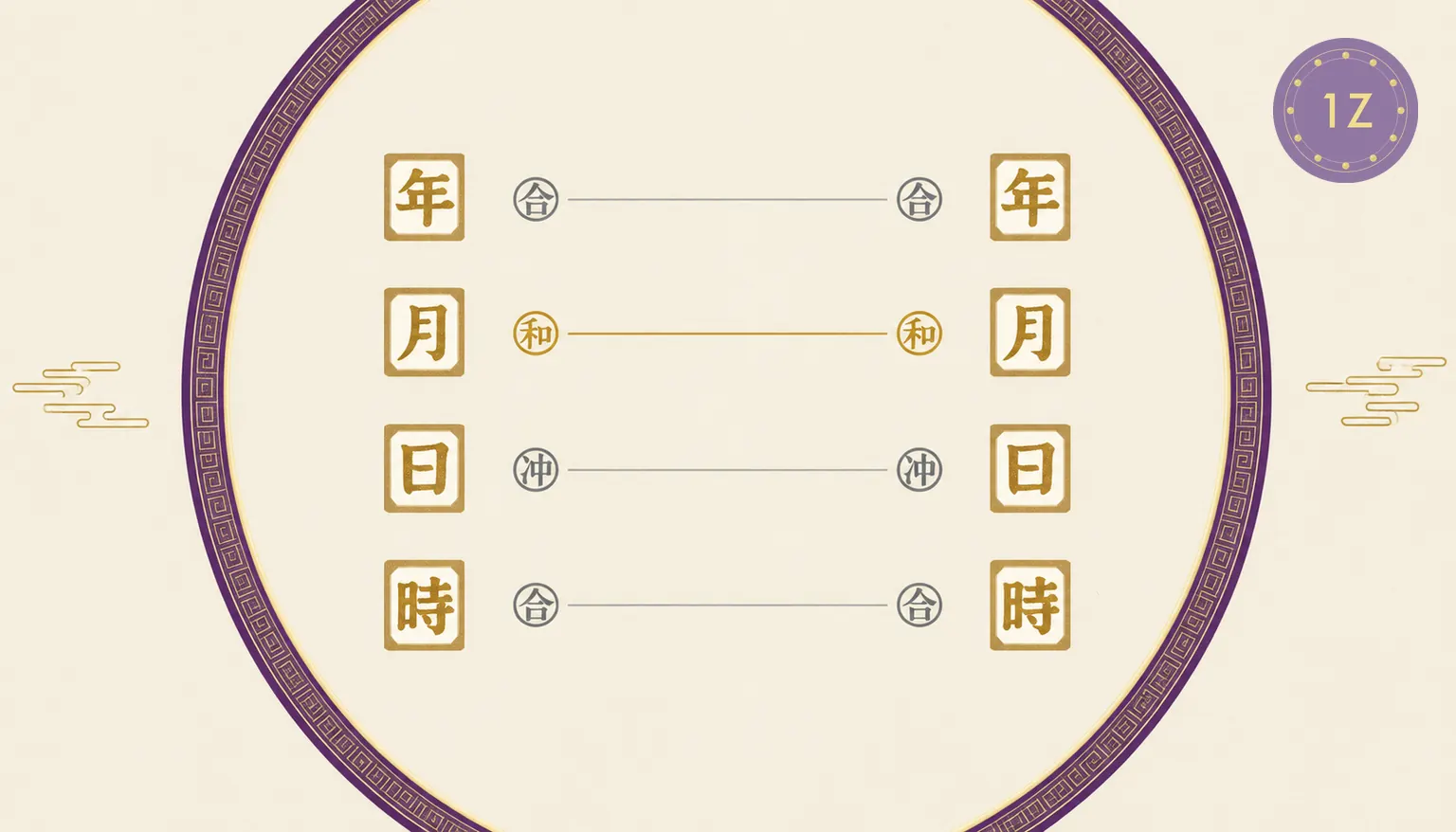

A BaZi match lays two four-pillar charts side by side and reads four structural layers, the year seats through fixed interaction geometry, the day branches (each person’s self-seat), the spouse palaces (each person’s marriage zone), and the star overlaps (what each chart reaches for), plus one master overlay above them all: element complementarity, whether each chart supplies what the other lacks. The quick online version stops at layer one and prints a number; the full method reads all four and reports friction and support, not compatibility percentages. This article walks the whole method with a worked example: the Rat-Ox pairing, one of the six Six Harmony seats.

Key Takeaways
- Five comparison weights: year-seat geometry, day-branch pair, palace cross-read, spouse star overlap, and useful-god element complementarity at the top.
- The year-seat layer scores in fixed bands: clash 38, harm low 50s, trine 88-89, harmony 94-95 in our dataset.
- Rat-Ox is a Six Harmony bond (子丑): baseline weight 94 in our dataset, a water-earth intimacy that transforms to Earth only when a transforming stem or earth month is present.
- Day branches matter more than year seats, because the day pillar is each person’s self.
- A match maps friction and support; it does not score love or predict duration.
Layer One: The Year Seats
The quick layer you meet first: two birth-year animals checked against the interaction wheel. Six clash pairs sit opposite (Rat-Horse, Ox-Goat, and four more), 4 trine triangles pool elements (a two-person meeting reads as a half-alliance, 半合, awaiting the third seat), 6 harmony pairs fold mirror seats across the wheel into support, and everything else reads neutral. In our editorial scoring of all 78 possible pairings (methodology), every clash pair carries a baseline weight of 38, harmony pairs of 94-95, trine pairs of 88-89, harm pairs in the low 50s (single-layer geometric baselines, not overall percentages; punishments, 刑, excluded by design): 30 interacting pairs in total, leaving 48 of 78 pairs (62%) with no six-series geometric bond, no harmony, clash, or harm among them, a spread of 57 points across the 38-95 scale.
Our worked example: Rat and Ox. The Rat’s Zi (子) and the Ox’s Chou (丑) form one of the six Six Harmony bonds, folding mirror seats across the wheel into mutual support. The pair carries a baseline weight of 94 in our dataset, near the ceiling of the harmony band. A precision note on the bond’s element. The classical reading treats 子丑 as water-earth intimacy: the two seats share a hidden Gui Water stem, and Chou’s earth banks Zi’s water. The bond only fully transforms into Earth when conditions hold, a transforming Earth stem in the heavens or an earth-dominant month. Without those, it stays a close, damp alliance. In our experience this is the layer readers ask about and the layer worth the least on its own: it describes generational weather between two people, not their private chemistry.
| Interaction | Baseline weight (dataset) | Example |
|---|---|---|
| Six Harmony | ceiling band | Rat-Ox, this article’s worked pair |
| Trine | alliance band | Rat-Dragon-Monkey triangle |
| Six Harm | friction band | Rat-Goat seam friction |
| Six Clash | floor | Rat-Horse diameter |
| None | unscored | most pairings of all |
Practical takeaway: the year layer is the handshake, not the marriage.
Layer Two: Day-to-Day Resonance
The day pillar is each person’s self, so the day-branch pair is where the match gets personal. Two day branches in harmony read as two selves that cushion each other; a day-branch clash reads as selves that shake each other when activated; a punishment reads as slow structural friction. Practitioners weight this layer above the year seats for exactly this reason: you live with someone’s day branch, not their birth-year animal.
The honest note: day-branch interactions use the same fixed geometry as year seats (the same clash pairs, the same harmony pairs), but their weight differs because the day branch is closer to the self. When we read a match, we check the day branches first and the year seats second, and based on our analysis of paired readings, the two layers disagree often enough that reading only one of them is where most pop compatibility goes wrong.
Practical takeaway: day branches are the private chemistry layer; read them before the headline animal.
Layer Three: Palace Environment (External Cross-Read)
A note on structure before this layer: the spouse palace IS the day branch, the same entity Layer Two reads. Layer Two compared the two day branches against each other; this layer turns the lens and asks how each partner’s other branches (year, month, hour) treat the other person’s day branch. It is one entity read from two directions, and we carry both readings because the two questions differ: chemistry between selves versus support arriving at each self from the partner’s chart. A palace cushioned by the partner’s branches reads as a marriage zone the relationship itself supports; a palace clashed by the partner’s branches reads as a zone the relationship shakes. The method here follows our marriage prediction guide.
This cross-read is where matches get interesting, because it can flip the headline. A year-seat harmony whose branches simultaneously clash a spouse palace is a match that looks great at the party and feels rough at home. A neutral year-seat pair whose day branches harmonize each other’s palaces is a match the wheel barely notices and you feel at home. We have watched this layer explain more real relationship texture than the other three combined.
Practical takeaway: the palace cross-read can flip the headline; never skip it.
Layer Four: The Star Overlaps
The final layer compares what each chart reaches for: each person’s spouse star (Wealth in male charts, Officer in female charts, in the classical scheme) and its condition. Do the two charts reach for the same kind of bond? The cleanest question: whether one partner’s dominant element matches what the other’s chart designates as the spouse star, including the mirrored ideal where each partner is the other’s spouse-star element. Then the support question, measured against the other chart’s designation: does one chart’s dominant element feed that designated star, or attack it? A star fed by the partner’s chart reads as a bond the relationship strengthens; a star attacked reads as a bond the relationship strains.
Combined with the palace layer, the stars complete the honest match report: where the support lives, where the friction lives, and what the bond reaches for on each side. What stands out about this layer is how often it explains attraction that the geometry misses: two charts with modest seat scores can share a strong star overlap and feel magnetic, because both are reaching for the same thing.
Practical takeaway: stars explain the pull; geometry explains the ride.
The Fifth Weight: Element Complementarity
Above all four structural layers sits the one classical matchers weight most heavily: useful-god complementarity (喜用互济), the five-element balance read. If one chart is Metal-water heavy and thirsty for Fire, a partner whose chart carries strong, healthy Fire supplies what the first chart lacks; if both charts run the same excess, they amplify each other’s imbalance. Traditional matchers rank this layer above seat geometry for the same reason a physician ranks constitution above symptoms: the seats describe interactions, while the useful gods describe what each chart actually needs. In our experience, the matches that feel nourishing over decades are usually the ones where each chart feeds the other’s useful god, even when the seat geometry is unremarkable.
Reading the Full Report, Honestly

| Layer | Compares | One-line verdict |
|---|---|---|
| Year seats | Two year branches | The weather between families |
| Day branches | Two day branches | The chemistry between selves |
| Spouse palaces | Palace vs partner branches | The home-zone cushioning |
| Star overlaps | Both spouse stars | The pull and the strain |
A complete BaZi match is a report of four structural layers, seats (weather), day branches (chemistry), palaces (home zone), stars (pull and strain), under one master overlay: element complementarity. Each line names support or friction, and the report as a whole maps the relationship’s terrain: what comes easy, what needs maintenance, and which chapters of 10 years activate which layer. For the full 78-pair seat map, our compatibility hub scores every pairing.
The three honest limits, once more with feeling: no match scores love, no match predicts duration, and no match should read one layer alone. If you bring a 94 harmony seat home, you bring beautiful weather between two years; it is still not a marriage. A 38 clash is real friction; it is not a verdict. The charts map terrain, and reading all 4 layers takes about 2 hours of honest cross-work. The people walk it.
Practical takeaway: four lines, one map, zero verdicts.
How does a BaZi match differ from a zodiac compatibility check?
A zodiac compatibility check reads one layer: two birth-year animals against the interaction wheel. A full BaZi match reads four structural layers, the year seats, the day branches (each person’s self-seat), the spouse palaces (each marriage zone cross-read against the partner’s 4 pillars), and the spouse star overlaps, plus useful-god complementarity at the top. The year layer assigns fixed baseline weights (38 for every clash pair, 94-95 for harmony in our 78-pair dataset); the deeper layers add the personal chemistry and the home-zone reading that year animals cannot see.
Is Rat and Ox actually a good BaZi match?
On the year-seat layer, yes: Rat-Ox is one of the six Six Harmony bonds, baseline 94 in our dataset, and the 子丑 bond reads as a water-earth blend both seats can draw on. But that is the handshake layer, and the full answer requires the day branches, palaces, and stars of both charts. Based on our analysis of paired readings, the harmony seat gives Rat-Ox couples an excellent starting climate, while the day-branch and palace layers decide whether the climate holds at home.
Can a BaZi match predict whether a marriage will last?
No, and the method itself says so. A match maps structural support and friction: which layers cushion, which layers shake, which years activate which pressure. Duration is a decision lived inside that terrain, not a property of the terrain, and the classical literature records durable marriages inside clashed geometry and breakups inside harmony seats. What a match honestly offers is maintenance information: know your friction layers, brace for your activation years, and treat the map as weather rather than verdict.
Are free BaZi match calculators actually accurate?
They are accurate at exactly one layer if they are built on correct tables: the year-seat baseline, which is fixed arithmetic (every clash pair is 38, every harmony pair sits in the 94-95 band, and the trine tier holds steady at 88-89, all baselines in our dataset). They are incomplete rather than wrong, because a real match also reads day branches, spouse palaces, star overlaps, and the useful-god overlay, which requires both charts in full, a reading that takes a practitioner about 2 hours per match. Use calculators for the layer they actually compute, and read the deeper layers before making any decision the calculator cannot see.
Sources
- Chinese zodiac – Wikipedia: branch interaction geometry and the 78-pair structure
- Four Pillars of Destiny – Wikipedia: day pillar as self and spouse palace
- Chinese astrology – Britannica: the four-pillar framework behind cross-chart reading
Conclusion
Four structural layers plus one master overlay: seats for weather, day branches for chemistry, palaces for home, stars for pull, element balance over all. Run your pairing on the compatibility hub, then read the layers the calculator cannot see.