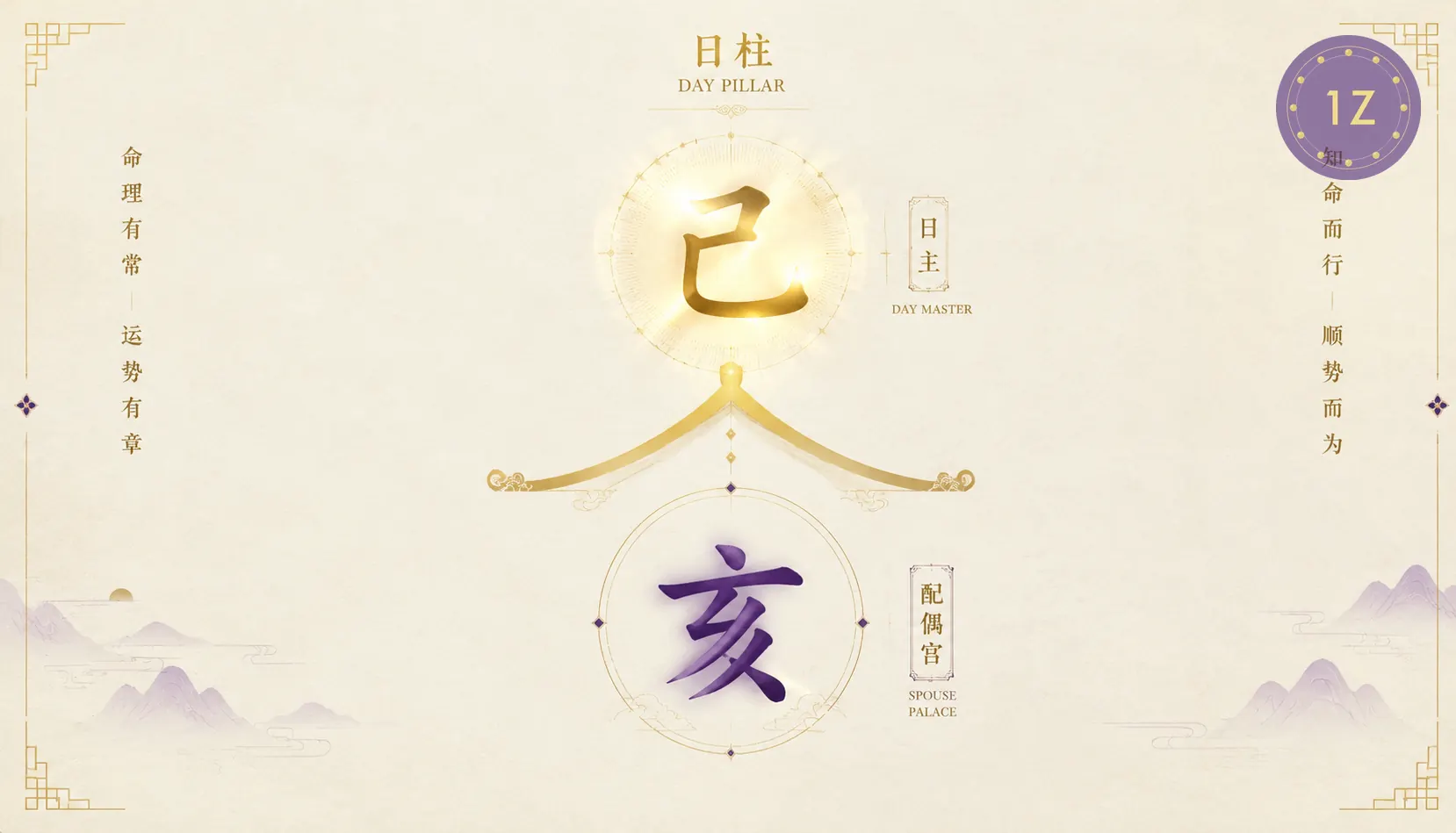

BaZi marriage prediction reads two structures: the spouse palace, which is the day branch (the earthly branch under your Day Master), and the spouse stars, which are the Wealth star for men and the Officer star for women in the classical assignment. The method predicts zones and timing windows, not wedding dates or specific partners. This article walks both structures, the timing mechanics, and exactly where the honest reading stops.

Key Takeaways
- Spouse palace = your day branch; spouse stars = Wealth (male charts) or Officer (female charts) in the classical scheme.
- The palace tells you the marriage zone’s weather; the stars tell you what kind of bond the chart reaches for.
- Timing windows come from luck pillars (chapters of 10 years) and flowing years that activate the palace or the stars.
- In our 78-pair dataset, year-seat compatibility spans 38 (clash) to 95 (harmony ceiling), a spread of 57 points on a 100-point scale: structure, not romance scores.
- Prediction here means pressure mapping: strong-marriage years vs friction years, never named dates or named partners.
The Two Structures: Palace and Stars
The spouse palace is structural. It is the branch of your day pillar, the seat directly under your Day Master, and it describes the marriage zone itself rather than any person. A palace that sits in a clash shows instability pressure in the zone; a palace blessed by a harmony shows support. Because the palace is your own branch, everything read from it stays inside your chart.
The spouse stars are role-based, with a polite-blunt split that matters. In the classical assignment, the Wealth star (what the Day Master controls) represents the spouse in a male chart, and it splits by polarity: Direct Wealth (正财) is the wife star proper, Indirect Wealth (偏财) the secondary bonds. The Officer star (what controls the Day Master) represents the spouse in a female chart, split the same way: Direct Officer (正官) the husband star proper, Seven Killings (七杀) the blunt, secondary bond.
Read mechanically, both stars describe one thing without gender. The chart’s Wealth line is what it holds and manages; its Officer line is what disciplines it. Classical reading maps these onto the spouse for heterosexual charts. For same-sex pairs the same mechanics apply, read as the bond each chart reaches for, with the polarity split marking primary versus secondary expressions. The star shows what the chart reaches for in a bond. A Resource-adjacent Wealth star reaches for supported comfort; an Officer star in a strong chart reaches for structure and shared ambition. In our experience, palace and star must be read together, because they answer different questions: the palace is the room, the star is the guest.
| Structure | What it is | What it reads |
|---|---|---|
| Spouse palace | Day branch (under Day Master) | The marriage zone’s weather |
| Spouse star (male) | Wealth star (controlled element) | The bond the chart reaches for |
| Spouse star (female) | Officer star (controlling element) | Same, mirrored |
| Palace + star | Read together | Room and guest, zone and tenant |
Practical takeaway: the palace is the room, the star is the guest; read both or read neither.
Reading the Palace: Weather, Not Verdicts
The day branch interacts with the rest of the chart by fixed geometry. A clashed palace (day branch in 1 of the 6 clash pairs) reads as instability pressure: the marriage zone gets shaken when activation years arrive. A palaced harmony reads as support: the zone is cushioned. A punishment touching the palace reads as slow friction rather than rupture, and the classical texts themselves treat harm and punishment as milder weights than clash.
Two honest notes belong here, worth 2 hours of reflection before any verdict. First, a clashed palace is a pressure, not a divorce sentence: the classical literature records strong marriages with clashed palaces where the timing was managed well. Second, in our editorial scoring of the 78 possible year-seat pairings (methodology), every clash pair scores exactly 38 while harmony pairs reach 94-95, but that measures year-seat structure between two people, not your palace in isolation. What stands out about palace readings is how much they change once you add timing: a clashed palace in a calm decade behaves differently than the same palace in an activation year.
Practical takeaway: palace weather is real, but it is a climate, not a forecast.
Reading the Stars: What the Chart Reaches For
The spouse star’s element and condition shape the bond’s flavor. A Wealth star that is well-supported in a male chart reads as a bond that strengthens both sides; the same star crowded by companions reads as a bond contested from outside. An Officer star in a female chart that arrives with resource support reads as structured partnership; an officer star that arrives raw, especially the blunt twin (Seven Killings) without a buffer, reads as intensity that needs channeling.
The star’s position matters as much as its condition. A spouse star sitting in the day pillar itself (stem or palace) is classically read as marriage being close to the self, central rather than peripheral. A star buried in the year pillar reads as marriage tied to family, origin, or the long past. When we read charts for marriage questions, I check three things in order: where the star sits, what feeds or attacks it, and whether any layer repeats its element. We have watched this three-point check catch more real relationship patterns than any single-factor reading.
The honest boundary, straight from the framework’s own grammar: the star names the pressure and the reach, never the person. A strong Officer star does not mean a specific husband with specific traits; it means the chart reaches for structure and will meet intensity on the way.
Practical takeaway: the star is a compass heading for the bond, not a portrait of a person.
Timing: When Marriage Years Light Up
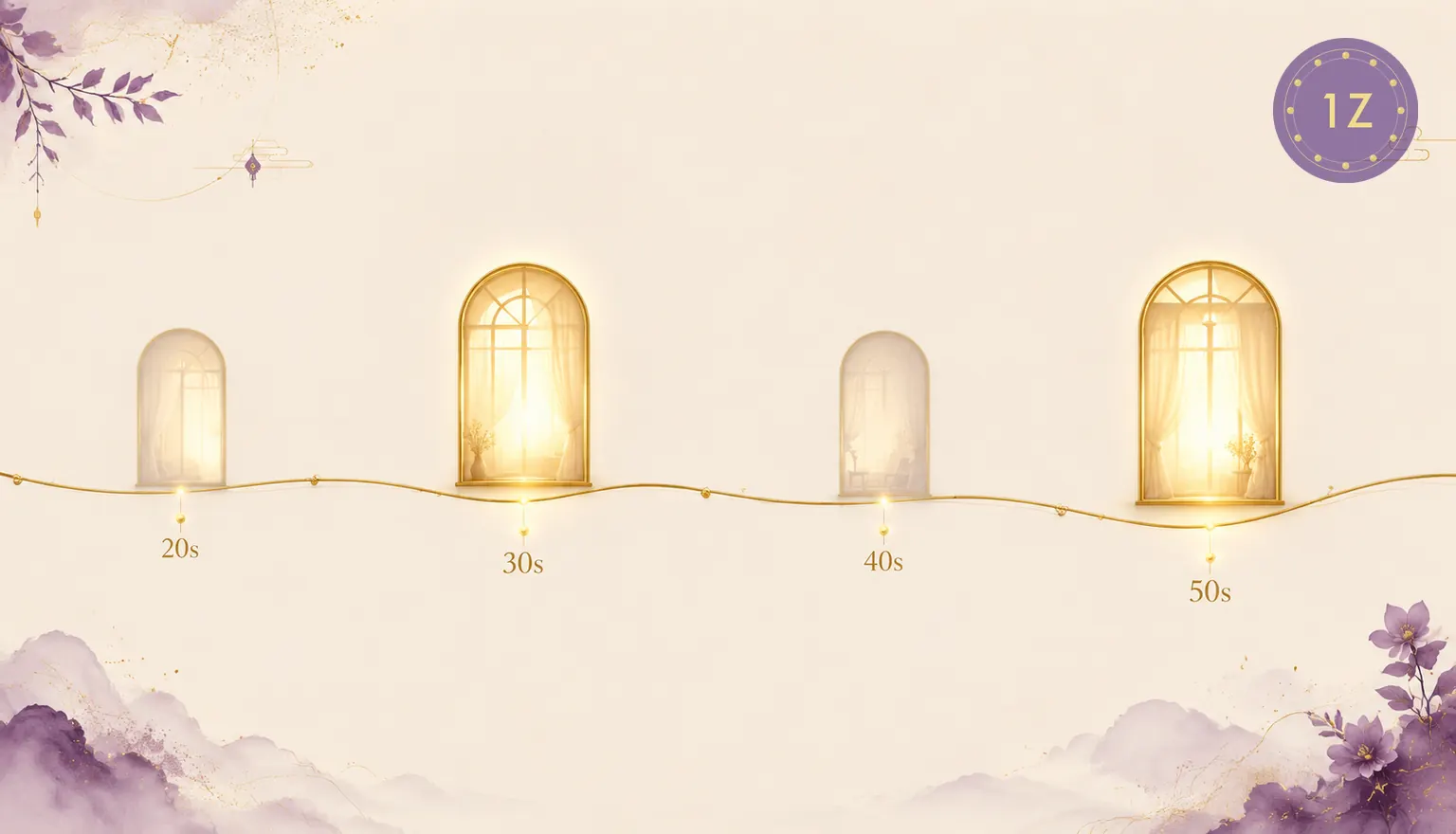
BaZi timing for marriage reads activation: the years and decades when the spouse palace or spouse stars get touched. A flowing year whose branch harmonizes with your day branch lights the palace, and a year that clashes it shakes the zone. The most direct activations are structural. A flowing year whose heavenly stem transparently carries the spouse star’s own element puts the star in the heavens (透出); a branch that bonds with or clashes against the day branch moves the palace itself. Feeding years come next: Output years for a male chart feed the Wealth star, and Wealth years for a female chart feed the Officer star. One honest caution: in a weak Day Master chart, those same feeding years can pile pressure onto a spouse star already running hot, reading as intensity rather than ease. A luck pillar that carries the star’s element into a readable position opens a multi-year window. These are windows measured in spans of 1 to 2 years, and the classical phrase for reading them is closer to “marriage-timing energy present” than “wedding this year.”
The reverse also maps: clash years to the palace (the same six-pair geometry) read as friction years for the zone, which practitioners use for maintenance advice, not doom. Based on our analysis of paired charts, the couples who use BaZi timing best treat activation years as “bring your best self” seasons and friction years as “lower the stakes” seasons, and both turn out better than treating every year as identical.
Three no-write lines apply with full force here: no named dates, no guaranteed outcomes, no third-party verdicts about a partner you have never read. Timing windows are weather reports. You still decide whether to sail.
Practical takeaway: windows, not dates; weather, not verdicts.
Compatibility: The Second Chart
Marriage prediction usually meets a second question: does the match work? That is a different structure, scored per our dataset methodology: cross-chart compatibility, read through the interaction geometry between two people’s branches.
| Cross-chart layer | Compares | Tells you |
|---|---|---|
| Year-seat geometry | Two year branches | Support/friction band (38-95) |
| Day-branch pair | Two day branches | Close-zone chemistry |
| Palace cross-read | Each palace vs other chart | Where cushioning lives |
| Star overlap | Both spouse stars | What the bond reaches for |
The strongest honest position: cross-chart reading measures structural support and friction, not love or duration. Two harmony-bonded seats can drift apart; two clashed seats can build something durable by managing the friction. In our experience the compatibility layer is most useful for understanding what a couple argues about and when, rather than whether they should be a couple at all.
Practical takeaway: compatibility maps the friction and the support; the couple supplies the rest.
How does BaZi predict marriage timing?
By reading activation windows: flowing years whose branches harmonize with or clash against your day branch (the spouse palace), and years or luck pillars whose elements feed or stress your spouse star. A year branch that bonds with your palace lights the marriage zone; a clash year reads as friction. The method gives windows measured in spans of 1 to 2 years, not dates, and honest practitioners phrase it as “marriage-timing energy present” rather than “wedding in June.”
Is the BaZi spouse star actually accurate as a prediction?
The mechanical layer is verifiable: which star sits where, fed or attacked by what, is fixed arithmetic that any practitioner can reproduce from your chart. The interpretive layer, what the star means for your actual marriage, is judgment, and it improves when read together with the palace and the timing windows rather than alone. What the star does not do is describe a specific person: it is a compass heading for the bond your chart reaches for, and based on our analysis of paired readings, single-factor star readings miss more than they catch.
Can BaZi predict divorce or a bad marriage?
It can flag structural pressure: a clashed spouse palace in an activation year, a spouse star under sustained attack, a chart whose marriage zone carries punishment friction. It cannot predict divorce, because divorce is a decision inside a marriage rather than a structure, and the classical texts themselves record strong marriages inside pressured structures. The honest use of the friction flags is maintenance: know your pressure years, lower the stakes in them, and do not read geometry as destiny.
How is BaZi marriage matching done between two people?
The quick layer compares year seats through fixed geometry: harmony, trine, clash, harm, or no interaction, with all 78 pairings scored in our dataset from 38 (every clash pair, 6 clash pairs in total) to 94-95 (harmony band); the compatibility hub holds the full map. The full method adds day-branch interactions, spouse palace cross-reads, and star overlaps across both charts. The result maps structural support and friction: what the pair will argue about and when. It does not score love or duration, and any matching that promises “92 percent compatible” is selling a precision the framework does not contain.
Sources
- Four Pillars of Destiny – Wikipedia: day pillar as self and spouse palace
- Chinese zodiac – Wikipedia: branch interaction geometry used in cross-chart matching
- Chinese astrology – Britannica: the four-pillar framework behind star assignments
Conclusion
A palace, a star, and a calendar of windows: that is BaZi marriage prediction done honestly. Trace your own seat on the Chinese zodiac hub, then read the timing layer before you make any big-season decision.