
A BaZi reading starts with four pillars, eight characters, and one question: what does this structure carry? The pillars encode your birth year, month, day, and hour (each a window of 2 hours, 12 windows per day total) as stem-branch pairs; the reading decodes the balance of five elements, the roles the stems play, and the interactions between branches. This primer walks the whole path in plain English, from raw pillars to what a practitioner actually tells you, and where the honest reading stops.

Key Takeaways
- Four pillars: year, month, day, hour, each one stem plus one branch, eight characters total.
- The day stem is the Day Master: the self every other character is read against.
- Five elements (Wood, Fire, Earth, Metal, Water) are counted, then weighted by season.
- Ten Gods assign each stem a role: Companion, Resource, Output, Wealth, or Officer.
- A reading names pressures and tendencies; it does not schedule events (the three no-write lines).
The Four Pillars: What You’re Looking At
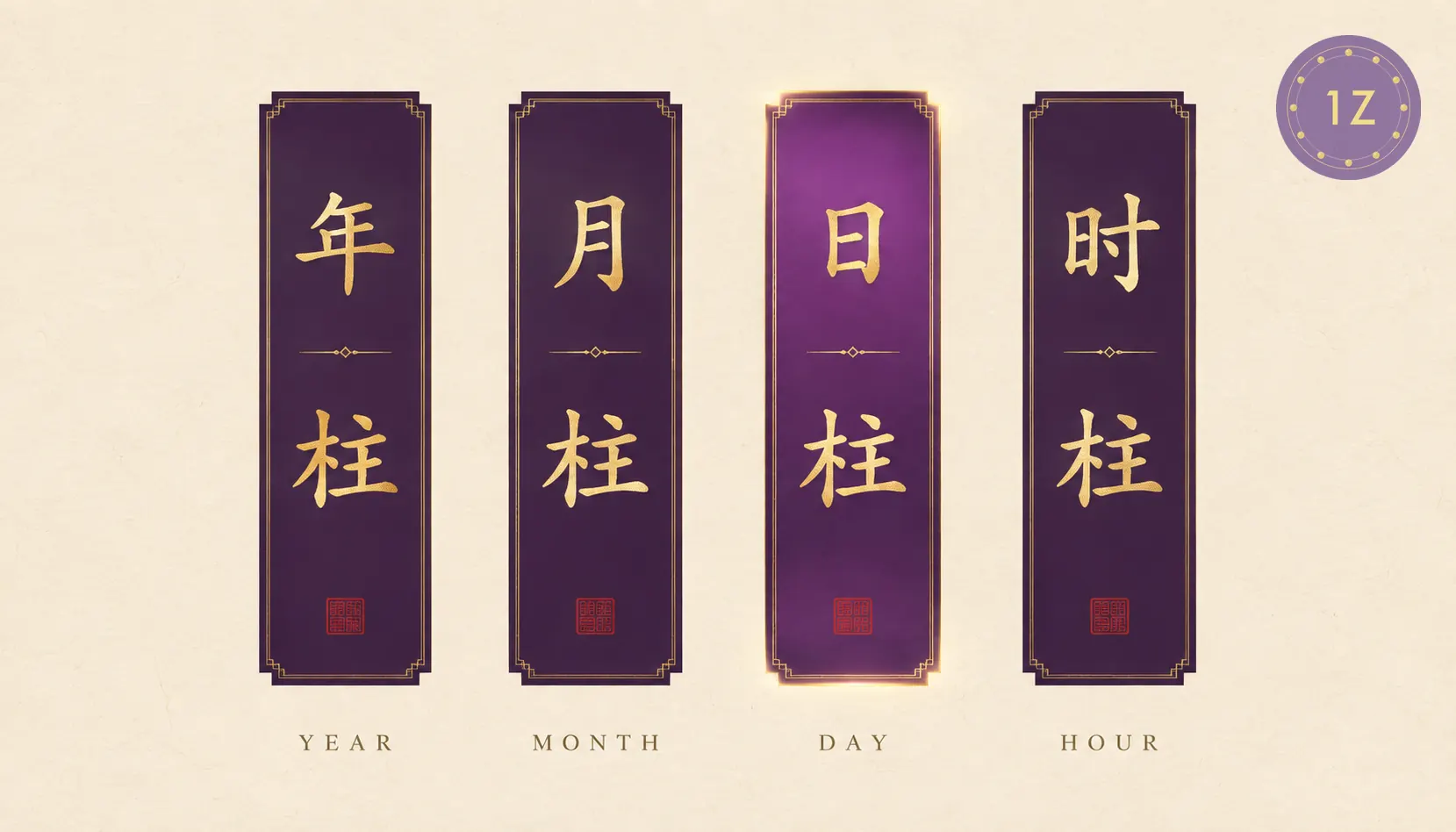
A BaZi chart is four vertical columns. Each column is one pillar: a heavenly stem (天干, from a cycle of ten) stacked on an earthly branch (地支, from a cycle of twelve). The year pillar marks roots, ancestors, and the childhood zone (the classical first age-division), the month pillar your youth season and career field, the day pillar your adult self, and the hour pillar your late-life zone: the four pillars double as four life stages. That is 8 characters from 4 pillars spanning 60 cycle positions in all, which is why BaZi is called the Eight Characters (八字), one of roughly 13 million charts in the cycle.
The day stem is the anchor, called the Day Master. If your day pillar is Geng Chen, your Day Master is Geng: Yang Metal. In our experience the fastest way to make a chart feel personal is to identify the Day Master first and read everything else as weather around it. I have watched beginners go from lost to oriented in minutes once they stop trying to weigh all eight characters at once.
| Pillar | Built from | Reads for |
|---|---|---|
| Year | Birth year | Roots and ancestors, early childhood zone (roughly the first 16 years), outer world |
| Month | Birth month (solar terms) | Season, career field, parents’ era |
| Day | Birth day | Self (Day Master) and spouse zone |
| Hour | Birth hour (2-hour window) | Children, late life, private ambition |
Practical takeaway: eight characters, one anchor; find the Day Master before anything else.
The Five Elements: Counting the Weather
Every stem and every branch carries one of five elements: Wood, Fire, Earth, Metal, or Water. Before any counting, one anchor comes first: the month order (月令), the season of birth, which weighs a single element so heavily that classical practice treats it as the first determinant of strength, worth more than several scattered stems elsewhere. Only after the month order is established does the raw element count (including each branch’s hidden stems, one to three per branch) add its contribution.
The classical generation cycle feeds in a circle: Wood feeds Fire, Fire banks Earth, Earth bears Metal, Metal collects Water, and Water grows Wood. The control cycle crosses the circle: Wood breaks Earth, Earth dams Water, Water douses Fire, Fire melts Metal, and Metal chops Wood, and based on our analysis of reader questions, most beginner mistakes happen right here, so say it once more: generation and control are two different circles, and the direction of each is fixed.
The order matters because a count without the month order inverts the logic: three Fire stems in a winter chart are embers in the cold, while the same three in a summer chart are a furnace. A Metal-heavy chart is not “too much Metal”; it is raw material whose meaning depends on the month order first (Metal born in autumn wears its Metal differently than Metal born in spring) and on what the chart as a whole needs. The verdict layer belongs to the practitioner, and honest readings show their work.
Practical takeaway: count first, judge later; generation and control are fixed circles, not vibes.
Ten Gods: The Role-Assignment Layer
Once the Day Master is fixed, every other stem plays one of five roles relative to it, each split into a polite and a blunt twin by polarity. Same element is Companion (比劫). What the Day Master produces is Output (食伤). What it controls is Wealth (财). What controls it is Officer (官杀). What produces it is Resource (印). The Ten Gods are these five roles and their twins, and they are the vocabulary of every real reading.
A chart thick with Officer stars lives inside structure and accountability; a chart led by Output stars lives by craft and expression. The blunt-versus-polite split matters constantly: Direct Officer is the negotiable authority of rules and titles, while Seven Killings is the same controlling pressure arriving blunt and unbuffered, the battlefield commission rather than the office. If you want these roles unpacked in depth, our BaZi chart interpretation guide walks the full four-layer method.
What stands out about this layer is how fast it turns jargon into insight, and the discipline that keeps it honest is role-literalism: each heavenly stem plays exactly one role per Day Master, and the roles interact through the same element cycles they came from. Branches are different: each branch hides two or three stems (Yin hides Jia, Bing, Wu), so a branch carries a small stack of roles rather than exactly one. When a reading leaps from “Officer star present” to “you will hold high office,” it has left role-assignment and entered fortune-telling. The star names a pressure; the life decides what to build with it.
Practical takeaway: Ten Gods is a vocabulary of pressures, not a list of fates.
Branch Interactions: The Geometry Layer
The twelve branches interact through fixed geometry. Six Clash pairs sit diametrically opposite on the wheel, half a cycle apart (Rat-Horse, Ox-Goat, and four more): destabilizing, activation pressure. Four trine triangles (Rat-Dragon-Monkey, and three more) pool their elements into one force. Six Harmony pairs (Rat-Ox, Tiger-Pig, and four more) soften and support. Six Harm pairs ride the seams of broken harmonies at lower intensity.
In our editorial scoring of all 78 possible pairings (methodology), every Six Clash pair scores exactly 38, all Six Harmony pairs sit at 94-95, trine pairs at 88-89, and Six Harm pairs in the low 50s, and most pairings carry none of the four classical interactions: 30 interacting pairs in total (6 clash, 6 harmony, 12 trine, 6 harm), which leaves 48 of 78 pairs (62%) with no interaction among those four types (the punishment tier, 刑, sits outside this count by design, and same-seat pairs like Chen-Chen are the 12 self-pairs completing the 78). Neutrality, not drama, is the statistical norm, and a reading that finds conflict everywhere is overreading the geometry.
| Interaction | Geometry | Example | Score (dataset) |
|---|---|---|---|
| Six Clash | 6 diameter pairs | Rat-Horse | 38 |
| Six Harmony | 6 mirror pairs | Rat-Ox | 94-95 |
| Trine triangle | 4 triangles | Rat-Dragon-Monkey | 88-89 |
| Six Harm | 6 seam pairs | Rat-Goat | low 50s |
| None | all remaining pairs | most pairings | no classical score |
Practical takeaway: branches interact by fixed geometry, and most pairings carry no interaction at all.
What a Reading Covers, and Where It Stops
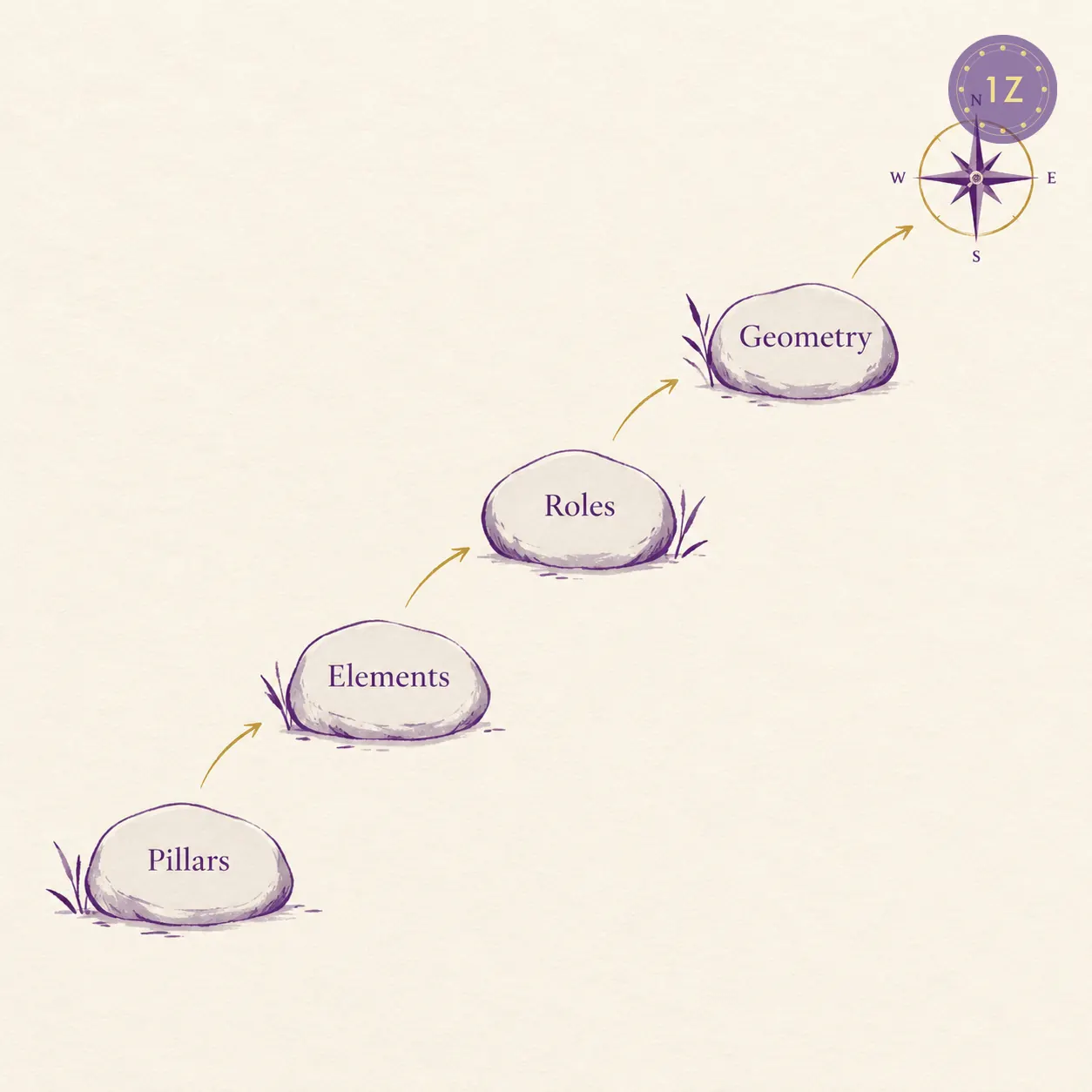
A full reading walks the layers in order: pillars, element counts, Ten Gods roles, branch interactions, then (if you ask for timing) the luck pillars, the chapters of 10 years each, 8 chapters in a typical lifetime of 80 years that rotate through the month pillar’s neighbors, starting from a starting age you can compute. The reading names pressures (where the chart is strong, where it is thin, which zones carry load) and translates them into tendency language.
Where it stops matters just as much. A reading does not schedule specific events, does not issue guarantees, and does not read one layer in isolation. In our experience, the clients who benefit most treat the reading as a mirror with a fixed grammar: structure they can verify, pressures they can weigh, decisions that stay theirs. If you want to go deeper after this primer, the Chinese zodiac hub holds the year-seat layer, and the interpretation guide holds the full four-layer walkthrough.
Practical takeaway: verify the arithmetic, weigh the judgment, keep the agency.
How do I read my BaZi chart step by step?
Start with the four pillars and find your Day Master (the day stem), because every other character is read against it. Second, count the five elements including hidden stems, just to see the raw material. Third, assign Ten Gods roles to every stem: same element is Companion, what you produce is Output, what you control is Wealth, what controls you is Officer, what produces you is Resource. Fourth, map branch interactions: clashes, trines, harmonies. Each layer constrains the next, and skipping layers is where most beginner misreadings begin.
How do I calculate my BaZi without a paid tool?
The four pillars are mechanical. The year pillar follows the solar calendar (the Li Chun boundary near February 4, not January 1). The month pillar follows the twelve solar terms (Jing Zhe, Qing Ming, and so on), each opening a new month. The day pillar cycles through the sexagenary sequence; any perpetual calendar or the free calculators on the search results page will locate yours. The hour pillar derives from your day stem via the five rats rule: five possible openings, then advance one stem per two-hour window. The calculation is arithmetic; the reading is where judgment enters.
Is BaZi actually accurate, or is it cold reading?
The mechanical layers are arithmetic and reproduce identically for anyone who follows the rules: the same birth data always yields the same eight characters. The interpretive layers (strength, usefulness, combination outcomes) are judgment, and practitioners differ, the way two analysts can read one balance sheet differently. Cold reading it is not: a BaZi session is anchored to a fixed chart you can verify, not to flexible statements shaped by your reactions. The honest position is that BaZi offers a structured vocabulary for self-observation, and its value scales with how verifiable each layer of the reading is.
What does a BaZi reading actually tell you about your future?
It tells you about structure and pressure, not scheduled events. A reading can say which zones of life carry structural load (career, relationships, health patterns), which element would balance the chart, and which luck-pillar decades activate which themes. It cannot honestly say you will change jobs in March or meet a partner in June, and any reading that does is selling certainty the framework does not contain. Based on our analysis of reader corrections, the most useful reframe is timing vocabulary: learn which decades carry which weather, then decide what to build in it.
Sources
- Four Pillars of Destiny – Wikipedia: pillar structure and the eight-character frame
- Chinese zodiac – Wikipedia: twelve branches and the sexagenary cycle
- Chinese astrology – Britannica: the historical four-pillar framework
Conclusion
Four pillars, one anchor, five elements, ten roles, and a fixed geometry: that is the whole basic frame. Build your chart on the Chinese zodiac hub and read your first eight characters this week.