
The Pine-Wood Rabbit
辛卯 (Xin-Mao) · 松柏木 (Pine-Wood) · Metal Stem
The Pine-Wood Rabbit defines those born in 1951 and 2011 under the Xin-Mao (辛卯) pillar. While mainstream astrology often classifies this year as the Metal Rabbit based on its Heavenly Stem (辛 = Metal), its deeper NaYin (纳音) resonance is Pine-Wood (松柏木) — blending metal’s core energy with wood’s expressive quality. This pillar blends the Rabbit’s native grace with the Pine-Wood’s evergreen resilience, producing individuals of abundant creativity, grand ideals, and relentless ambition. Defined by an ability to grow stronger through adversity, they embody a distinctive quality of steadfast endurance that weathers all seasons.
A quick map: this is a Metal year by its Heavenly Stem (辛 / Xin), while its NaYin is Pine-Wood (松柏木), a Wood archetype — two parallel systems describing the same pillar, not a contradiction.
Quick Facts
| Years | 1951, 2011 |
| GanZhi | 辛卯 (Xin-Mao) |
| NaYin | Pine-Wood (松柏木 Song-Bai-Mu) |
| Stem Element | Metal (辛) |
| NaYin Element | Wood (松柏木) |
| Base Element | Wood |
| Lucky Numbers | 3, 8, 25, 38 |
| Lucky Colors | Green, Teal, Brown |
| Lucky Direction | East, Southeast |
| NaYin Season | Spring |
| Trine Group | Fourth Trine (Rabbit, Goat, Pig) |
| Sexagenary Position | #28 of 60 in the Jia-Zi cycle |
| Lunar Year Dates | 1951: 1951-02-06 to 1952-01-27 2011: 2011-02-03 to 2012-01-23 |
| Six Harmony (六合) | Dog — Secret Friend |
| Three Harmony (三合) | Rabbit · Goat · Pig (Wood Trine) |
| Six Clash (六冲) | Rooster — Opposing Force |
| Five Element Cycle | Generated by Water → Wood generates Fire → Controlled by Metal |
Rabbit Element Variants Compared
| NaYin Variant | Stem Name | GanZhi | Years | Stem Element |
|---|---|---|---|---|
| Hearth-Fire Rabbit | Fire Rabbit | 丁卯 | 1927, 1987 | Fire |
| Wall-Earth Rabbit | Earth Rabbit | 己卯 | 1939, 1999 | Earth |
| Pine-Wood Rabbit | Metal Rabbit | 辛卯 | 1951, 2011 | Metal |
| Gold-Leaf-Metal Rabbit | Water Rabbit | 癸卯 | 1903, 1963, 2023 | Water |
| Creek-Water Rabbit | Wood Rabbit | 乙卯 | 1915, 1975 | Wood |
Pine-Wood lends the Rabbit a rare backbone: where other Rabbits bend, this one remains rooted, blending gentle diplomacy with unshakeable conviction. Their aesthetic refinement becomes a tool for building durable structures—whether in curating a gallery’s legacy collection or mediating long-term community pacts. They excel at weaving harmony into systems that last, not through force but through patient, principled alignment. Their edge lies in knowing when to stand firm as a pine and when to move softly as a rabbit.
The Pine-Wood Rabbit’s quiet strength can harden into rigid refusal to adapt. Their love of peace may become passive resistance, where they remain rooted in comfort zones, avoiding necessary conflict. The wood’s resilience turns brittle under pressure—they may withdraw rather than bend, mistaking stubbornness for integrity. This can lead to isolation, as their refusal to engage in messy dynamics leaves relationships uncultivated and opportunities to grow through friction missed.
The NaYin: Pine-Wood (松柏木 Song-Bai-Mu)
In classical Chinese astrology, each of the 60 year-stem combinations carries a specific NaYin (纳音, “assigned tone”) — a poetic elemental melody refining the Five Elements into 30 archetypes. The Pine-Wood (松柏木) NaYin represents a unique expression of the wood element.
Classical Sources
《三命通会》(Comprehensive Treatise on the Three Fates)
By 万民英 (Wan Minying), Ming Dynasty, 1587 — Volume 30, “On NaYin Elements”:
“松柏木者,岁寒之木,雪霜无以改其操,金能克之而不改其质,四时皆青,坚贞不凋。”
“辛卯,自旺经制之木。不畏霜雪,气节凌云,可制之以金,损之以火,而逢旺相,即成巨室之材。”
Yan Dongsou (阎东叟) commented: “辛卯木自旺,春夏则气节挺拔,建功立事;生于秋则狂狷折挫,劲气不伸。”
Born in January or February?
There are two systems for determining your zodiac year. Folk tradition uses Lunar New Year (late Jan / early Feb). BaZi astrology uses Lichun (立春, Start of Spring, ~Feb 3–5). If your birthday falls in this boundary period, you might belong to the previous sign (Tiger) under one system but the Pine-Wood Rabbit under another. Use our BaZi Calculator to determine your exact pillar based on Lichun.
Who they are
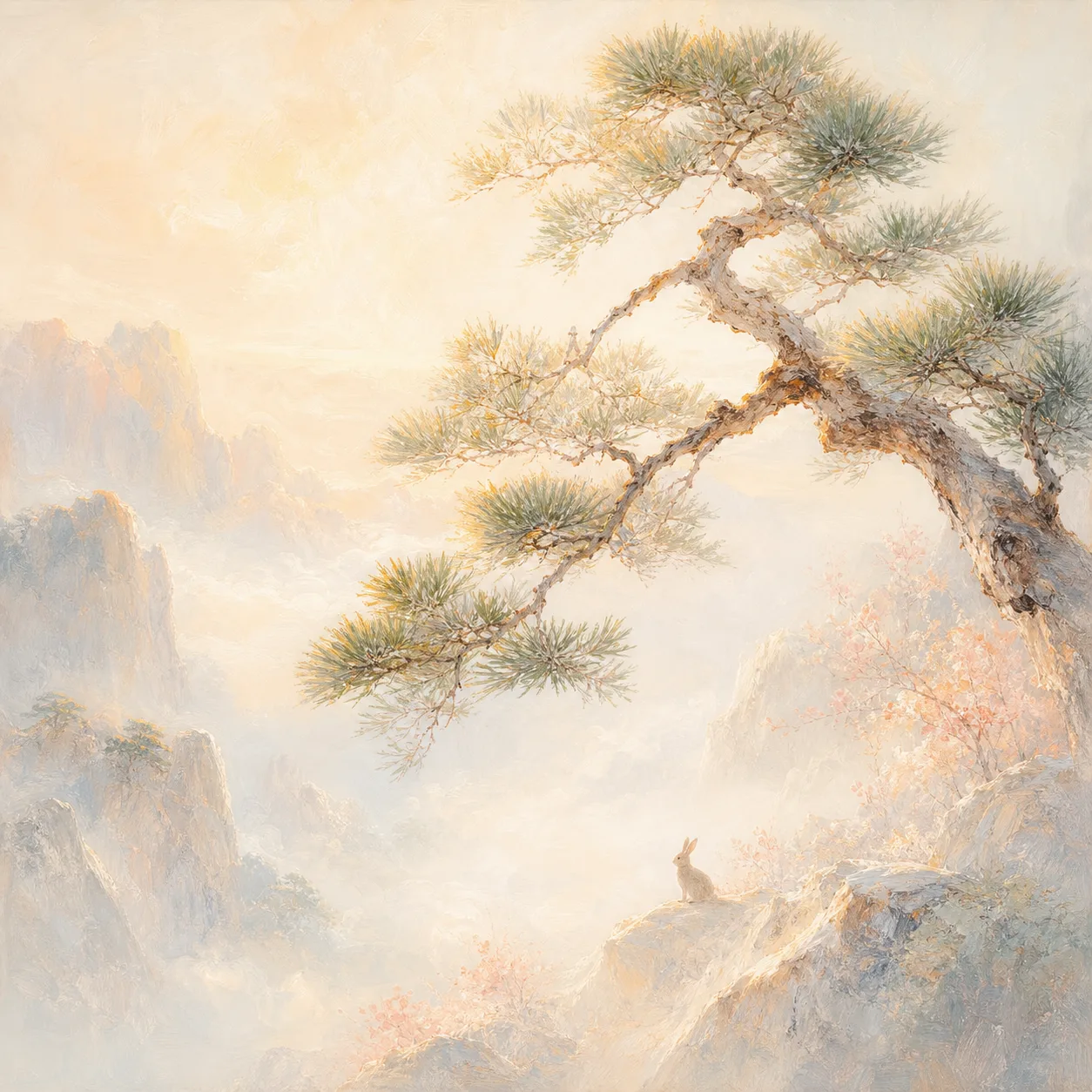
Imagine a pine tree that has taken root in a rabbit’s form — that is the essence of the Xin-Mao (辛卯) Pine-Wood Rabbit. Unlike the soft willow or the flowering peach, this is wood of a different order: dense, resinous, and defiant. The Sanming Tonghui (三命通会) describes Pine-Wood as ‘the tree of deep winter, whose resolve neither frost nor snow can alter.’ This Rabbit carries that same quiet defiance beneath its elegant exterior. Where the ordinary rabbit might hop away from conflict, the Pine-Wood Rabbit stands firm, its roots sunk deep into principle. The heavenly stem Xin (辛) is refined metal, and here it acts not as a blade to cut the wood, but as a file that polishes it, giving the Rabbit’s natural diplomacy a sharpened edge — it can be gracious without being pliable.
This pairing is marked by a paradoxical stillness. The Rabbit’s native Wood branch provides the sensitivity and social grace, but the Pine-Wood NaYin adds a layer of ‘evergreen’ permanence. These individuals are not easily swayed by trends or fads; they hold to their values with the same stubbornness that keeps a pine green through winter. Yet this very strength can become rigidity. Yan Dongsou warned that those born in autumn become ‘wild and frustrated, their vigorous energy repressed.’ The Pine-Wood Rabbit must guard against becoming too fixed in its ways, mistaking stubbornness for integrity.
The interaction between the metal stem and the rabbit branch creates a fascinating tension. Metal wants to carve, Wood wants to grow. This Rabbit feels an inner pull between the desire to refine itself (through discipline, rules, precision) and the need to expand (through creativity, exploration, connection). This is not a conflict that can be resolved — it is a dynamic that must be danced. The result is a personality of rare depth: someone who can be both a visionary and a pragmatist, but who must work consciously to keep those two selves in dialogue.
In love and partnership
In love, the Pine-Wood Rabbit is the kind of partner who remembers the exact date of your first meeting and the specific shade of the sky that day. The Xin metal stem gives their affections a quality of ‘precision’ — they have clear criteria for a mate and would rather remain solitary than settle for a comfortable compromise. But do not mistake this for coldness. The Pine-Wood NaYin brings a deep, slow-burning loyalty. Once they commit, they are like the pine that withstands storms: unmoving, protective, providing shelter. Their love language is not grand gestures but consistent, quiet acts of devotion — showing up, year after year, through seasons of change.
However, this pairing has a blind spot: they can idealize their partner, projecting onto them the same ‘evergreen’ permanence they themselves possess. When reality reveals a human, flawed beloved, the Pine-Wood Rabbit may feel a shock of betrayal disproportionate to the offense. They must learn that love, like a pine forest, includes fallen needles and broken branches — imperfection is part of the living system. Their best match is the Dog (Liuhe), whose loyalty matches theirs but whose earthy practicality can ground the Rabbit’s tendency to drift into fantasy. The Dog’s playful warmth also softens the Rabbit’s occasional emotional reserve.
Professional destiny
The Pine-Wood Rabbit’s career path is one of slow, vertical ascent — like a tree growing toward light through a canopy of competitors. Their strengths lie in fields that reward patience, precision, and a long view. The Xin metal stem gives them an aptitude for systems: law, finance, auditing, research science, and technology, where rules and structure are paramount. They are natural architects of order, able to see the grain in complex data and carve out clear solutions. The Pine-Wood NaYin adds the capacity for endurance — they can work on a single project for years, refining it with the same care a tree puts into each annual ring.
Yet this very strength is their career vulnerability: they can become so focused on their own growth that they miss the forest around them. The Pine-Wood Rabbit needs a team or mentor who can pull their gaze outward, reminding them that collaboration amplifies impact. They are not natural networkers, preferring depth to breadth in relationships. This can leave them isolated in large organizations. Careers in conservation, landscape architecture, or traditional crafts — where the Pine-Wood symbolism of enduring natural beauty is literal — can be surprisingly fulfilling. But wherever they land, they must guard against the belief that their way is the only way. The tree that bends in the storm survives; the one that refuses to sway breaks.
Physical and mental health
In the Five Element system, Wood governs the liver, the eyes, and the tendons. The Pine-Wood Rabbit’s constitution is like a tree that grows well but can become overgrown. Their health challenges often stem from emotional blockage — the liver, in Chinese medicine, is the organ of free-flowing Qi, and the Rabbit’s tendency to suppress feelings for the sake of harmony can create stagnation. This manifests as tension in the shoulders, jaw clenching, or digestive issues. The Pine-Wood NaYin’s ‘evergreen’ quality suggests resilience, but also a danger of becoming ‘hardened’ — emotionally and physically rigid.
Wellness for this pairing must focus on movement that encourages flexibility, both literal and metaphorical. Qigong, especially the ‘Flowing Water’ forms, can loosen the Wood energy. Sour foods (lemon, vinegar, sauerkraut) in moderation support the liver, while the color green — in leafy vegetables, green tea, and time in nature — nourishes the Wood element. Most importantly, the Pine-Wood Rabbit needs an emotional outlet: journaling, art, or therapy to vent the pressure that builds when they try to be ‘strong and unchanging’ at all times. The paradox of health for them is that true strength is supple, not stiff. A pine that cannot sway in the wind will uproot.
Money and prosperity
The Pine-Wood Rabbit approaches wealth as a gardener, not a gambler. They build financial security slowly, invested in things that grow over time: real estate, blue-chip stocks, fine art, or even a business they can nurture for decades. The Xin metal stem gives them a sharp eye for value — they can spot a bargain or a flawed investment with uncanny accuracy. They are natural savers, but their caution can become a trap. The Pine-Wood NaYin’s ‘evergreen’ imagery suggests a fear of loss that keeps them from taking necessary risks. They may hold onto cash or conservative investments so tightly that inflation slowly erodes their purchasing power.
The specific pitfall for this pairing is ‘over-pruning’ — cutting expenses and opportunities too early, before they have a chance to bear fruit. The Pine-Wood Rabbit must learn to distinguish between reckless risk and calculated growth. A financial advisor who understands their temperament can be invaluable. Their wealth trajectory mirrors the pine: slow in the early years, but accelerating as the tree matures. They should invest in their own education and skills in their twenties and thirties, trusting that the compound interest of expertise will pay off later. The key is to remember that even the tallest pine started as a seed that risked being eaten by a bird — no growth without exposure.
Evolution and self-mastery
For the Pine-Wood Rabbit, the great work of a lifetime is learning to bend without breaking. Their natural inclination is toward rigidity — holding to their principles, their plans, their vision of how things ‘should be.’ The NaYin of Pine-Wood (松柏木) teaches both the beauty of resilience and the danger of brittleness. A pine that refuses to bend in a gale snaps at the trunk. The Sanming Tonghui reminds us that this wood is ‘unaffected by snow and frost’ — but the snow that does not break the branch can still weigh it down so that it never reaches the sun. Growth for this Rabbit means softening the edges of their perfectionism, allowing for detours, mistakes, and the messiness of being human.
A specific practice: once a week, do something that has no goal. Walk without a destination, start a conversation without an agenda, make something that will be thrown away. This trains the mind to flow rather than fix. The Pine-Wood Rabbit’s potential is magnificent — they can become a pillar of their community, a steady force for good, a person whose integrity inspires others simply by existing. But to fulfill that potential, they must embrace the paradox at their heart: that the strongest tree is the one that can dance in the wind, its roots deep enough to hold, its branches supple enough to let the storm pass through.
Pine-Wood Rabbit Years
| Year | GanZhi | Type | Details |
|---|---|---|---|
| 1951 | 辛卯 | Pine-Wood Rabbit | View Profile → |
| 2011 | 辛卯 | Pine-Wood Rabbit | View Profile → |
Famous Pine-Wood Rabbits
Notable figures born in 1951, 2011.
Oscar winner, Mrs. Doubtfire, Dead Poets Society, comedy genius.
A Six Harmony (六合) match — the secret friend combination, naturally aligned in energy and purpose.
People also ask
How do Pine-Wood Rabbits approach money and finances?
Pine-Wood Rabbits (辛卯) approach money with a blend of caution and creativity. The Pine Wood (松柏木) nature makes them resilient yet prudent; they prefer steady, long-term investments over risky ventures. Their Rabbit instincts drive them to save for security, but their Xin (辛) metal element adds a sharp, analytical edge to financial decisions. They often find wealth through artistic or intellectual pursuits, avoiding flashy displays of riches.
How do Pine-Wood Rabbits find their life purpose?
Pine-Wood Rabbits (辛卯) discover purpose through quiet introspection and connection with nature. The Pine Wood (松柏木) symbolizes endurance and growth, guiding them to roles where they can nurture others or create lasting beauty. Their Rabbit sensitivity helps them detect subtle life cues, while Xin metal refines their vision. They often feel called to careers in art, healing, or environmental stewardship, where their gentle persistence yields meaningful impact.
How will the 2026 annual energies interact with Pine-Wood Rabbit luck?
In 2026, the Year of the Fire Horse brings dynamic energy that both challenges and energizes Pine-Wood Rabbits (辛卯). Fire feeds Pine Wood (松柏木), potentially boosting creativity and recognition, but the Horse’s impulsive nature may clash with the Rabbit’s cautious rhythm. Those born in 1951 or 2011 should guard against overextension. Career opportunities arise, but careful planning is needed to avoid burnout. Relationships may spark with new passion.
What elemental dynamics make Pine-Wood unique among the 30 NaYin?
Pine-Wood (松柏木) stands out for its combination of resilience and refinement. Unlike other Wood NaYin, it contains Xin metal (辛) within the Gan-Zhi 辛卯, giving it a sharp, enduring quality. This wood is ‘evergreen’—it bends but doesn’t break, representing longevity and moral integrity. Its interaction with fire can produce great art, while water nourishes its roots deeply. It’s the most ‘noble’ of the wood types.
Which of the five wood-type Rabbits is most powerful?
Among the five Pine-Wood Rabbits, 辛卯 (Xin-Mao) with Pine Wood (松柏木) is considered the most powerful due to its inherent strength and durability. The Pine symbolizes unyielding character, and the Xin metal element adds precision and authority. While other wood Rabbits may be more flexible or decorative, 辛卯 embodies steadfastness and quiet influence. This pillar’s energy is ideal for leadership roles that require patience and resilience.
How do intercalary months impact Pine-Wood Rabbit determination?
Intercalary months (leap months) in the lunar calendar can temporarily disrupt the Pine-Wood Rabbit’s (辛卯) steady rhythm. The extra month may create a sense of delay or repetition, testing their patience. However, Pine Wood (松柏木) thrives on challenge; these periods often strengthen their resolve. For those born in 1951 or 2011, intercalary years may bring unexpected opportunities to solidify long-term goals, provided they adapt with flexibility.
What can we learn from famous Pine-Wood Rabbit life stories?
Famous Pine-Wood Rabbits (辛卯), such as those born in 1951 (e.g., actors or thinkers), demonstrate how Pine Wood (松柏木) resilience leads to lasting influence. Their lives teach the value of quiet persistence—they often achieve greatness through steady effort rather than flashy moves. The Rabbit’s diplomacy combined with Xin metal’s precision allows them to navigate complex social landscapes. Their stories remind us that true power is often understated and rooted in integrity.
Which astrological combinations amplify Pine-Wood Rabbit connection?
Pine-Wood Rabbits (辛卯) connect best with combinations that nourish Pine Wood (松柏木). Water elements (like 癸亥 or 壬子) provide deep roots, enhancing emotional depth. Fire elements (like 丙午) can ignite their creativity, but must be balanced to avoid burnout. The Rabbit’s harmony with Dog, Pig, and Goat signs creates supportive relationships. Avoiding clashes with Rooster or Dragon is wise. The presence of 乙卯 in a chart can amplify the wood’s vitality.
Why is 1951 called Pine-Wood Rabbit instead of Metal Rabbit?
In mainstream Chinese astrology, 1951 is often called the Metal Rabbit because its Heavenly Stem 辛 (Xin) corresponds to Metal. However, the NaYin (纳音) system — a deeper layer of BaZi analysis — assigns this pillar the Pine-Wood (松柏木) resonance. Both names refer to the same year: the Stem name (Metal Rabbit) describes its foundational energy, while the NaYin name (Pine-Wood Rabbit) reveals its poetic-spiritual quality.
Want Your Personal Reading?
Get your complete BaZi chart with all four pillars, NaYin analysis, and life chapters.
Open Free BaZi Calculator →