
The Hearth-Fire Rabbit
丁卯 (Ding-Mao) · 炉中火 (Hearth-Fire) · Fire Stem
The Fire Rabbit (丁卯 Ding-Mao, Hearth-Fire 炉中火) corresponds to the years 1927 and 1987. This combination tempers the Rabbit’s natural gentleness with the Hearth-Fire’s contained intensity, producing individuals who are charismatic and passionate yet prone to impatience. Like a furnace that requires steady fuel to burn usefully, their leadership and resilience emerge only when their inner fire is consciously controlled.
Quick Facts
| Years | 1927, 1987 |
| GanZhi | 丁卯 (Ding-Mao) |
| NaYin | Hearth-Fire (炉中火 Lu-Zhong-Huo) |
| Element | Fire (Fire Stem) |
| Base Element | Wood |
| Lucky Numbers | 2, 7, 18, 27 |
| Lucky Colors | Red, Orange, Purple |
| Lucky Direction | South |
| NaYin Season | Summer |
| Trine Group | Fourth Trine (Rabbit, Goat, Pig) |
| Sexagenary Position | #4 of 60 in the Jia-Zi cycle |
| Lunar Year Dates | 1927: 1927-02-02 to 1928-01-23 1987: 1987-01-29 to 1988-02-17 |
| Six Harmony (六合) | Dog — Secret Friend |
| Three Harmony (三合) | Rabbit · Goat · Pig (Wood Trine) |
| Six Clash (六冲) | Rooster — Opposing Force |
| Five Element Cycle | Generated by Wood → Fire generates Earth → Controlled by Water |
Rabbit Element Variants Compared
| Variant | GanZhi | Years | Stem Element |
|---|---|---|---|
| Hearth-Fire Rabbit ← You are here | 丁卯 | 1927, 1987 | Fire |
| Wall-Earth Rabbit | 己卯 | 1939, 1999 | Earth |
| Pine-Wood Rabbit | 辛卯 | 1951, 2011 | Metal |
| Gold-Leaf-Metal Rabbit | 癸卯 | 1903, 1963, 2023 | Water |
| Creek-Water Rabbit | 乙卯 | 1915, 1975 | Wood |
A Hearth-Fire Rabbit doesn’t just seek peace—they actively generate warmth that draws others in. Their diplomacy isn’t passive avoidance but a controlled flame that defuses tension before it ignites. This makes them exceptional mediators in high-stakes environments like corporate restructuring, where they can soothe egos while keeping the fire of progress alive. Their aesthetic refinement extends beyond art to reading social dynamics precisely, knowing when to add fuel and when to let embers glow. The unique edge: they create harmony not by extinguishing conflict but by transforming it into productive energy.
When the hearth burns too brightly, their gentle nature can become smothering. A Hearth-Fire Rabbit may over-nurture relationships, feeding others’ needs until their own fuel is depleted. Their aversion to confrontation can lead them to suppress their own fire, becoming a cold hearth that draws resentment. The shadow side emerges when they prioritize harmony over truth—they might dampen necessary conflict, letting problems smolder into crises. Without conscious tending, their warmth curdles into people-pleasing, and their refined sensitivity turns into fear of being disliked.
The NaYin: Hearth-Fire (炉中火 Lu-Zhong-Huo)
In classical Chinese astrology, each of the 60 year-stem combinations carries a specific NaYin (纳音, “assigned tone”) — a poetic elemental melody refining the Five Elements into 30 archetypes. The Hearth-Fire (炉中火) NaYin represents a unique expression of the fire element.
Classical Sources
《三命通会》(Comprehensive Treatise on the Three Fates)
By 万民英 (Wan Minying), Ming Dynasty, 1587 — Volume 30, “On NaYin Elements”:
“炉中火者,天地为炉,阴阳为炭,颓光辉耀,力可熔金。”
“丁卯,伏明之火,气弱宜木生,忌阴水,以水多则灭火故也。”
Yan Dongsou (阎东叟) commented: “丁卯火,不如丙寅赫曦之旺,为伏明之火,但借木气以生。”
Born in January or February?
There are two systems for determining your zodiac year. Folk tradition uses Lunar New Year (late Jan / early Feb). BaZi astrology uses Lichun (立春, Start of Spring, ~Feb 3–5). If your birthday falls in this boundary period, you might belong to the previous sign (Tiger) under one system but the Fire Rabbit under another. Use our BaZi Calculator to determine your exact pillar based on Lichun.
Who they are
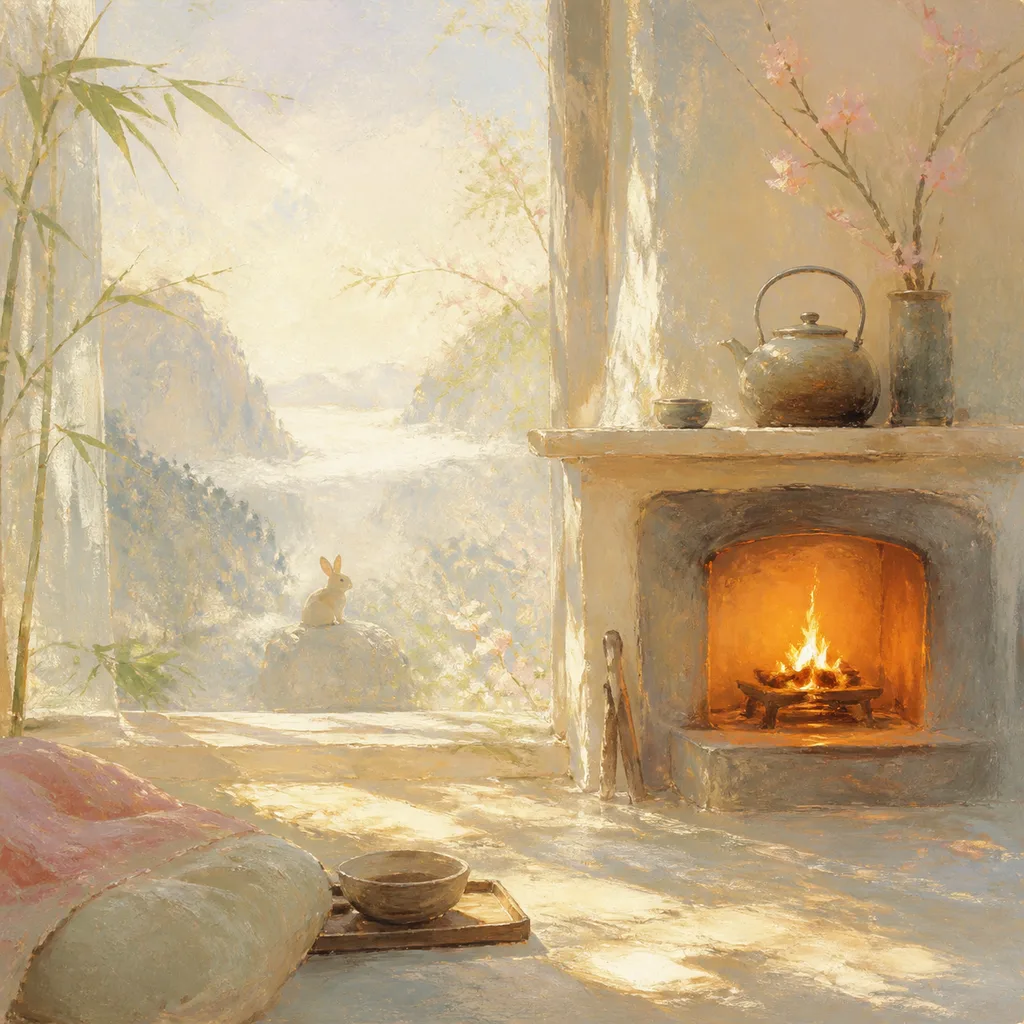
Imagine a hearth in a quiet temple — not the roaring bonfire of a battlefield, but a contained, steady flame that warms a room without consuming it. That is the essence of the Hearth-Fire Rabbit (丁卯). The Rabbit’s natural grace and diplomacy are here infused with a quiet intensity, like embers glowing beneath ash. The Heavenly Stem Ding (丁) is a yin fire — a candle flame, a lantern’s glow — while the Rabbit’s Wood base (卯) feeds it, making the fire intimate rather than explosive. As the Sanming Tonghui (三命通会) notes, this is ‘the subdued bright fire, weak in qi, relying on wood to grow.’ Unlike the Tiger’s Hearth-Fire, which bursts with yang ambition, the Rabbit’s version is a slow burn — a warmth that draws others in rather than commanding them.
This pairing creates a personality that is both gentle and fiercely protective. The Rabbit’s instinct to avoid conflict is tempered by a fire that refuses to be extinguished. They are the diplomat who speaks softly but whose words carry the heat of conviction. Their charm is not performative but genuine, a natural emanation of the fire within. Yet this same fire can flare into impatience when fuel runs low — when they feel unheard or undervalued, the hearth smolders with resentment. The NaYin image of ‘furnace fire’ (炉中火) reminds us that this energy needs containment: without a proper vessel, it either suffocates or burns out of control.
The classical text describes this fire as ‘able to melt metal’ when properly tended. So too does the Hearth-Fire Rabbit possess a hidden strength — they are not passive, as some Rabbits can be, but quietly transformative. They reshape their environment through presence rather than force, like a hearth that changes a room’s atmosphere simply by being lit. Their intuition is sharp, almost psychic, picking up on the emotional temperatures of others. This makes them exceptional confidants and mediators, though they must guard against absorbing others’ fire into their own hearth, risking burnout.
The paradox of this pairing lies in its duality: the Rabbit craves security, yet the fire yearns to expand. They may appear placid while inwardly restless, seeking a balance between the comfort of the familiar and the heat of new passions. Their life is a continuous act of tending their own flame — ensuring it is neither smothered by caution nor fanned into recklessness. In this, they embody the ancient wisdom that the most enduring fires are those that know their limits.
In love and partnership
In love, the Hearth-Fire Rabbit burns with a quiet ardor that surprises even themselves. Their romance is not the grand gesture but the steady warmth — a hand held a moment longer, a meal prepared with care, a listening ear that remembers every detail. Yet beneath this tenderness lies an intensity that can flare unexpectedly. When they fall, they fall completely, like kindling catching flame. Their love language is one of devoted attention and subtle acts of service, but they also need their partner to stoke the fire with appreciation and reciprocated warmth. If neglected, the hearth grows cold, and the Rabbit’s natural tendency to withdraw can harden into icy distance.
The Hearth-Fire Rabbit is drawn to partners who respect their need for both intimacy and independence. Their Liuhe (六合) match, the Dog, offers the loyalty and groundedness that stabilizes their flame — a partnership where trust fuels the fire without smothering it. They also harmonize with Goat and Pig, forming the Wood trine (三合), where emotional depth and creative expression flow freely. However, the Rooster (their Liuchong, 六冲) may trigger their impatience, as the Rooster’s directness can feel like a wind threatening to extinguish their delicate flame. In conflict, the Hearth-Fire Rabbit tends to hold in their heat until it escapes in a sudden burst — words sharp as sparks. They must learn to vent frustration gently, before the hearth overheats.
Their romantic blind spot is a tendency to idealize the fire itself, mistaking intensity for depth. They may rush into passion without ensuring the vessel — the relationship’s foundation — can contain it. Long-term love requires them to tend the fire with patience, allowing it to burn low and steady rather than always seeking the dramatic blaze. When they master this, their partnership becomes a sacred hearth, a source of enduring warmth for both.
Professional destiny
The Hearth-Fire Rabbit thrives in careers where their quiet intensity can illuminate rather than overwhelm. The Rabbit’s diplomacy and the fire’s creativity make them natural in fields that require both sensitivity and spark — branding, design, counseling, or the arts. They excel as mediators, editors, or curators, where their ability to refine raw material into something beautiful mirrors the hearth’s transformation of fuel into warmth. The NaYin’s image of ‘furnace fire’ suggests a talent for work that involves shaping or tempering: a chef perfecting a recipe, a jeweler setting a stone, a therapist guiding a breakthrough. Their fire is not the spotlight but the lamp that helps others see clearly.
However, this pairing’s vulnerability lies in its need for the right environment. The Hearth-Fire Rabbit cannot burn in a vacuum — they need a ‘fuel supply’ of inspiration, collaboration, and purpose. In bureaucratic or overly rigid settings, their flame suffocates, leading to boredom or resentment. They are entrepreneurs at heart, even if they work within organizations, finding side projects or creative outlets to keep their fire alive. The fire stem also gives them a knack for rapid monetization — they sense trends and can pivot quickly, but they must guard against chasing every spark. A scattered career path, hopping from one passion to the next, can leave them feeling burnt out rather than fulfilled.
Their greatest career lesson is sustainability. Like a hearth that must be tended continuously, they need to build routines that feed their creativity without exhausting them. The Sanming Tonghui warns that this fire is ‘weak in qi’ — it cannot sustain constant high output. They must learn to pace themselves, alternating between periods of intense focus and restorative downtime. When they find their rhythm, they become the quiet force that keeps an entire enterprise warm — the one everyone relies on, yet never takes for granted.
Physical and mental health
For the Hearth-Fire Rabbit, health begins with the heart — both literally and metaphorically. Fire corresponds to the heart and small intestine in Chinese medicine, and this pairing is prone to ‘excessive heart fire,’ manifesting as insomnia, a racing mind, or a flushed complexion. The Rabbit’s natural sensitivity amplifies this, making them susceptible to emotional turbulence that sparks physical symptoms. Palpitations, mouth ulcers, or restlessness are signs that the hearth is burning too hot, consuming its own fuel. To cool this flame, they must embrace practices that calm the shen (spirit) — meditation, gentle yoga, or walks in nature. Cooling foods like mung beans, lotus seeds, and cucumber help temper the internal fire, while avoiding stimulants (caffeine, spicy dishes) prevents flare-ups.
The Rabbit’s earthly branch also governs the liver and tendons, which can become tight and rigid when the fire element overacts. The Hearth-Fire Rabbit may experience tension headaches or digestive issues when stressed. They benefit from regular stretching, especially in the evening, to release pent-up heat from the muscles. The NaYin image of the hearth reminds them that fire needs a proper vessel — their body is that vessel. Overwork or emotional suppression can crack it, leading to burnout. They must prioritize sleep as the time when the hearth cools and repairs. A nightly ritual of herbal tea (chrysanthemum or goji berry) and journaling helps extinguish the day’s sparks, ensuring they wake with a clean, steady flame.
Money and prosperity
The Hearth-Fire Rabbit’s relationship with money is as dynamic as their inner flame. They have a talent for generating wealth quickly — their fire element lends them an instinct for trends and a charisma that opens doors. They can monetize their creativity and social networks with surprising ease, often finding income streams that seem to appear out of thin air. However, the same fire that creates can also consume: money flows through their hands as quickly as it arrives, spent on experiences, beauty, or impulsive investments. The NaYin’s ‘furnace fire’ warns that without a proper container, wealth burns away. They must learn to build financial structures — savings accounts, long-term assets — that act as a hearth, holding and transforming their earnings into lasting warmth.
Their financial pitfall is a tendency to treat money as fuel for emotional fires. They may overspend when feeling low, seeking the temporary glow of a purchase, or take financial risks on a whim, trusting their intuition too far. The Rabbit’s cautious side can help, but only if they engage it before the spark of an opportunity ignites. A wise practice is the ‘cooling-off period’ — waiting 24 hours before any significant financial decision. When they balance their fire with the Rabbit’s innate prudence, they become adept at turning quick gains into stable wealth. Their best investments are those that grow steadily, like a well-tended hearth, rather than those that promise a dramatic blaze. Real estate, art, or a business they can nurture over time aligns with their nature, transforming fleeting sparks into enduring prosperity.
Evolution and self-mastery
The Hearth-Fire Rabbit’s greatest growth edge lies in mastering containment. Their fire is a gift, but without discipline, it either rages uncontrollably or gutters out. The NaYin image of the furnace teaches them that the most powerful fire is one that knows its boundaries — a hearth that holds the flame, distributes its heat evenly, and does not consume its surroundings. For the Rabbit, this means learning to channel their intensity into sustained effort rather than sporadic bursts. They must resist the urge to start a dozen projects and instead commit to one, tending it like a slow-burning log that gives warmth through the night.
A specific practice for this pairing is the ‘daily ember’ ritual: each morning, they set one small, non-negotiable intention — a single task, a single creative act, a single moment of stillness. This ember, fed consistently, grows into a fire that does not need to be relit every day. They can also benefit from practices that ground their fire, such as Tai Chi or calligraphy, which teach the body to move with controlled energy. The classical text says this fire ‘relies on wood to grow’ — and wood is the Rabbit’s native element. Their growth comes from rooting themselves in their own nature, trusting that the quiet flame within, when properly tended, can light a path for others. When the Hearth-Fire Rabbit learns to be both the hearth and the keeper, they become a source of warmth that never burns out — a presence that transforms every room they enter into a home.
Hearth-Fire Rabbit Years
| Year | GanZhi | Type | Details |
|---|---|---|---|
| 1927 | 丁卯 | Hearth-Fire Rabbit | View Profile → |
| 1987 | 丁卯 | Hearth-Fire Rabbit | View Profile → |
Famous Hearth-Fire Rabbits
Notable figures born in 1927, 1987.
Pulitzer Prize for Music, 17 Grammys, To Pimp a Butterfly.
8-time Ballon d'Or; the Rabbit's quiet brilliance — genius without shouting.
24 Grand Slam titles, most weeks at #1 ever.
Built a wind turbine from scrap at 14 — resourcefulness in its purest form.
Nobel Literature, One Hundred Years of Solitude, magical realism.
A Six Harmony (六合) match — the secret friend combination, naturally aligned in energy and purpose.
People also ask
What opportunities should Fire Rabbits seize in 2026?
In 2026, a year of the Fire Horse, the 丁卯 Fire Rabbit should pursue creative collaborations and public speaking roles. The Hearth Fire energy thrives when shared, so team projects or community initiatives will succeed. Financial opportunities in hospitality or energy-related fields are favorable. However, avoid impulsive investments; the Rabbit’s cautious nature should temper the Horse’s speed. Networking events in spring and autumn yield the best connections.
How does Hearth-Fire energy manifest differently from surface Fire?
炉中火 is a contained, transformative fire, unlike surface Fire’s wild, destructive blaze. For 丁卯, this energy manifests as steady warmth, nurturing growth from within, and a focus on inner refinement. Surface Fire is immediate and dramatic, while Hearth Fire simmers—it fuels long-term projects, deep relationships, and gradual mastery. Fire Rabbits often appear calm but possess a persistent, smoldering drive that emerges in crises.
How does fire interact with the Rabbit’s fixed element?
The Rabbit’s fixed element is Wood, which fuels Fire. For 丁卯 (Ding Fire on Mao Wood), this creates a symbiotic relationship: Wood provides stability and growth, while Fire gives warmth and energy. However, if overactive, Fire can consume Wood, leading to burnout. Balance is key—Fire Rabbits should nurture their Wood nature through rest, nature, and creative outlets, preventing the Hearth Fire from exhausting their resources.
Which historical Fire Rabbits left a lasting legacy?
Margaret Thatcher (born 1927, 丁卯) reshaped British politics with her Hearth Fire resilience—steady, transformative, and unyielding. Another is Japanese filmmaker Akira Kurosawa (born 1910 is Dog, not Rabbit); correct: 1927 Fire Rabbit includes American poet Maya Angelou, whose work smoldered with enduring warmth and wisdom. Her legacy of empowerment mirrors the 炉中火’s ability to refine and illuminate over time, leaving a lasting cultural impact.
How do Fire Rabbits handle betrayal or heartbreak?
Fire Rabbits (丁卯) respond with controlled intensity. The 炉中火 energy makes them initially withdraw to process emotions internally, like embers banked for preservation. They don’t explode but simmer, analyzing the situation deeply. Over time, they use the pain as fuel for personal transformation, emerging stronger and more refined. They may become more guarded but rarely seek revenge, preferring to let the fire of experience temper their character.
What makes someone a true Fire Rabbit?
A true Fire Rabbit is born in a 丁卯 year (1927, 1987) with the 炉中火 NaYin. They embody the Rabbit’s grace and sensitivity combined with a steady, transformative inner fire. Unlike other Rabbits, they are driven by a need to create lasting warmth and value, often excelling in roles that require patience and refinement. They appear gentle but possess a resilient core, capable of turning adversity into wisdom.
Want Your Personal Reading?
Get your complete BaZi chart with all four pillars, NaYin analysis, and life chapters.
Open Free BaZi Calculator →