
The five factors of a BaZi chart are Wood, Fire, Earth, Metal, and Water (五行), five phases of one process rather than five substances: a single cycle that feeds itself forward and checks itself across. Every stem carries one factor, and every branch hides one to three; every interaction in the chart, from stems and branches to luck pillars and flowing years, ultimately speaks this language. This article walks the two cycles, the personalities the factors carry, and how a reading actually uses the balance, worked with the tool rather than memory.

Key Takeaways
- Five factors: Wood 木, Fire 火, Earth 土, Metal 金, Water 水, five phases of one cycle, not 5 separate materials stacked side by side, but 1 cycle seen 5 ways, together spanning all 12 months of the year and every one of 24 hours.
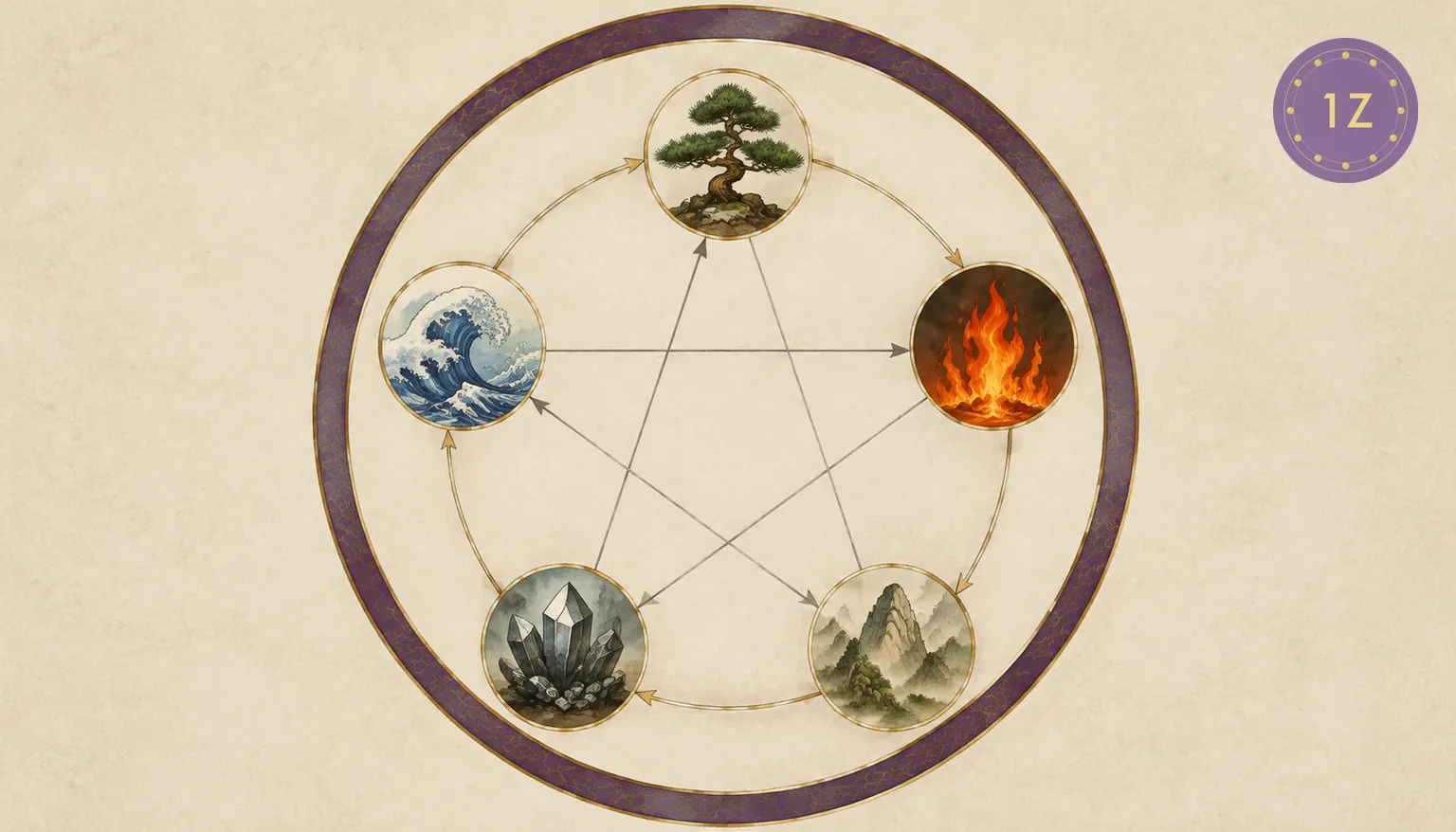
- Generating cycle feeds forward in a circle: Wood → Fire → Earth → Metal → Water → Wood; the receiver sits at the arrow’s end.
- Controlling cycle checks across the circle: Wood controls Earth, Earth dams Water, Water douses Fire, Fire melts Metal, Metal chops Wood.
- Each factor anchors a stem pair, a season, a direction, and a body-emotion correspondence.
- Balance means usable structure, not equal counts: a chart wants its thin factor fed and its excess factor spent.
The Two Cycles
The generating cycle (相生) runs clockwise around the pentagon: Wood feeds Fire, Fire banks Earth, Earth bears Metal, Metal collects Water, and Water grows Wood. Each arrow names who pays and who receives. The receiver always sits at the arrow’s end: when Water feeds Wood, Wood receives and Water spends. This direction rule is the single most violated fact in beginner writing about the elements, which is why the deterministic tool states it in one line per pair.
The controlling cycle (相克) crosses the same pentagon: Wood breaks Earth, Earth dams Water, Water douses Fire, Fire melts Metal, and Metal chops Wood. I read control as restraint, not destruction: the controlled factor is pressured, shaped, and held to form. I teach it that way because the distinction changes every downstream reading. The two cycles run simultaneously on the same five nodes, and that simultaneity is the system’s stability. Every factor is fed by one neighbor and checked by another, so no phase runs away unchecked in a healthy chart.
| Cycle | Direction | Example pairs |
|---|---|---|
| Generating (相生) | feeds forward, receiver at arrow end | Wood → Fire → Earth |
| Controlling (相克) | checks across, controlled factor pressured | Wood controls Earth; Fire melts Metal |
Practical takeaway: two cycles on five nodes, one feeds and one checks, both always running.
The Five Personalities
Each factor anchors a coherent stack of correspondences: two stems (one yang, one yin), a season, a direction, an organ pair, and an emotional register. Wood is growth and planning: liver, anger, spring, east. Fire is expression and visibility: heart, joy, summer, south. Earth is mediation and storage: spleen, worry, center, late summer. Metal is structure and decision: lungs, grief, autumn, west. Water is depth and adaptation: kidneys, fear, winter, north.
| Factor | Stems | Season | Direction | Reads for |
|---|---|---|---|---|
| Wood 木 | Jia 甲, Yi 乙 | Spring | East | Growth, planning, the strategist |
| Fire 火 | Bing 丙, Ding 丁 | Summer | South | Expression, visibility, the performer |
| Earth 土 | Wu 戊, Ji 己 | Late summer | Center | Mediation, storage, the settler |
| Metal 金 | Geng 庚, Xin 辛 | Autumn | West | Structure, decision, the judge |
| Water 水 | Ren 壬, Gui 癸 | Winter | North | Depth, adaptation, the philosopher |
In my experience the fastest way to internalize the five is the cycle itself, not memorization: each factor is what the previous one becomes when its work is done. Wood’s growth becomes Fire’s flowering; Fire’s ash becomes Earth; Earth’s compression concentrates Metal; Metal’s cold surface collects Water; Water’s depth germinates the next Wood. Learn the transformations, and the table stops being a table.
Practical takeaway: five factors, five seasons of one process; each is the previous one’s output.
Reading the Balance
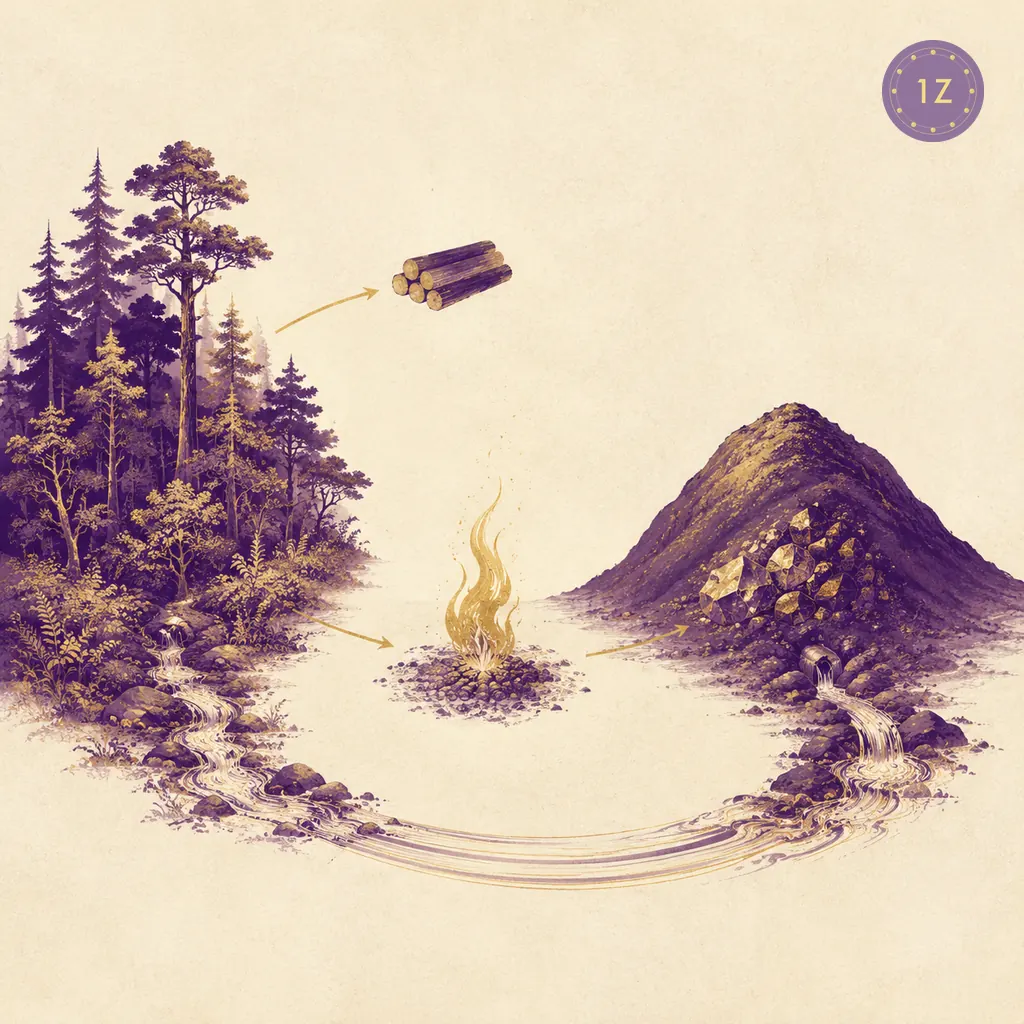
A chart’s factor count is raw material, and the month order is the first weight: a factor strong in its own season wears differently than the same count out of season, which is why classical practice reads strength month-first. After the count and the season, the reading asks three questions. Which factor runs thin, and does anything feed it? Which runs excess, and does anything spend or check it? And does the structure hold, or does one unchecked phase crowd the rest?
What stands out about balance questions after years of readings is this: balance is not equal counts. A chart with five-of-each is not the ideal. Most strong charts are visibly asymmetric, thick where the structure spends and thin where it does not need supply. What balance means operationally is that the excess factor has an outlet (the one it generates, or the one it controls) and the thin factor has a source (the one that generates it). A Wood-heavy chart with healthy Fire is a managed forest; the same chart with no Fire and no Metal is an unmanaged thicket.
Practical takeaway: count, weigh by season, then ask where the outlets and sources are.
How the Factors Anchor Everything Else
Everything layered above the elements speaks their language. The Ten Gods roles project directly from factor relations: what matches your own factor is the Companion line; what your factor controls is your Wealth line; what controls you is your Officer line. What you produce is Output, and what produces you is Resource. Branch interactions translate factor logic into geometry: the Monkey-Rat-Dragon trine pools into Water, the six harmony pairs bond mirror seats across the wheel, and the Dragon-Dog and Ox-Goat clash diameters shake the vault branches. Even the annual weather speaks factors: 2026 is Bing Wu, the Fire Horse, a Fire-dominant year: solar, broad pressure on Metal charts and warmth arriving for Earth charts.
I consider this anchoring the reason the five factors are the first thing to learn and the last thing to check, across 15 years of practice and hundreds of charts. If you want the role layer built on top of the factors, our Ten Gods table walks it cell by cell; if you want the year-seat layer, the Chinese zodiac hub holds the animal wheel; and the seasonal strength layer starts with the same five nodes read against the month order.
Practical takeaway: learn the five once, and every other layer becomes a dialect you already speak.
How do I know my five elements?
Count the factors in your four pillars: each stem carries one (Jia is Wood, always), and each branch hides one to three stems that count toward the total, month-first for weighting. A quick sketch: find your birth year’s pillar, its stem’s factor is your year-layer element, but the full picture needs all four pillars, since the day stem’s factor, your Day Master, is the self every other factor is read against. The count takes minutes with a deterministic tool, and the payoff compounds for years of readings afterward; the interpretation, season, outlets, sources, is where the reading lives.
What is a five-element personality?
It is the temperament texture that a chart’s dominant factors suggest: strong Wood reads as growth-minded and planning-heavy, strong Fire as expressive and visibility-seeking, strong Earth as mediating and storage-oriented, strong Metal as structural and decisive, strong Water as deep and adaptive. The honest caveats: personality in this frame is a leaning, not a type; the Day Master anchors the reference; and no single factor decides anything alone. In my experience of paired readings, factor texture describes how a chart prefers to spend its energy, not what kind of person owns it.
How do you balance five elements in a chart?
You read the structure, then feed the thin and spend the excess. If Water, as the Resource line, runs thin in a Wood chart that is itself weak and needing support, Metal years and Metal directions (the factor that generates Water) are classically read as supply arriving; if Wood runs heavy with no Fire, Fire years and Fire pursuits give the forest its outlet. One honest caveat: in a strong Wood chart already thick with Water, more supply is the last thing it needs, and the same thin-Water count would read differently there. In my reading, balance here is operational, not cosmetic: the excess factor needs somewhere to go and the thin factor needs a source, and a chart can be strongly asymmetric and still balanced by that definition.
What colors represent the five elements?
The classical correspondences: Wood green, Fire red, Earth yellow or ochre, Metal white, Water black or deep blue. These pair with the direction map (Wood east, Fire south, Earth center, Metal west, Water north) and the seasons, and they are used in the same conditional way as every other layer: as vocabulary for reading environments and timing, not as prescriptions. A Fire-thin chart reading a Fire year is classically “supported,” and the color language names the same support, but the chart’s own structure decides what any of it means.
Sources
- Wuxing (Chinese philosophy) – Wikipedia: the five phases and both cycle directions
- Chinese astrology – Britannica: the four-pillar framework built on the elements
- Chinese zodiac – Wikipedia: stems, branches, and the factor anchoring beneath them
Conclusion
Five factors, two cycles, one system: everything else in the chart is built on this floor. Find your own seat on the Chinese zodiac hub, count your factors, and read the balance before any other layer.