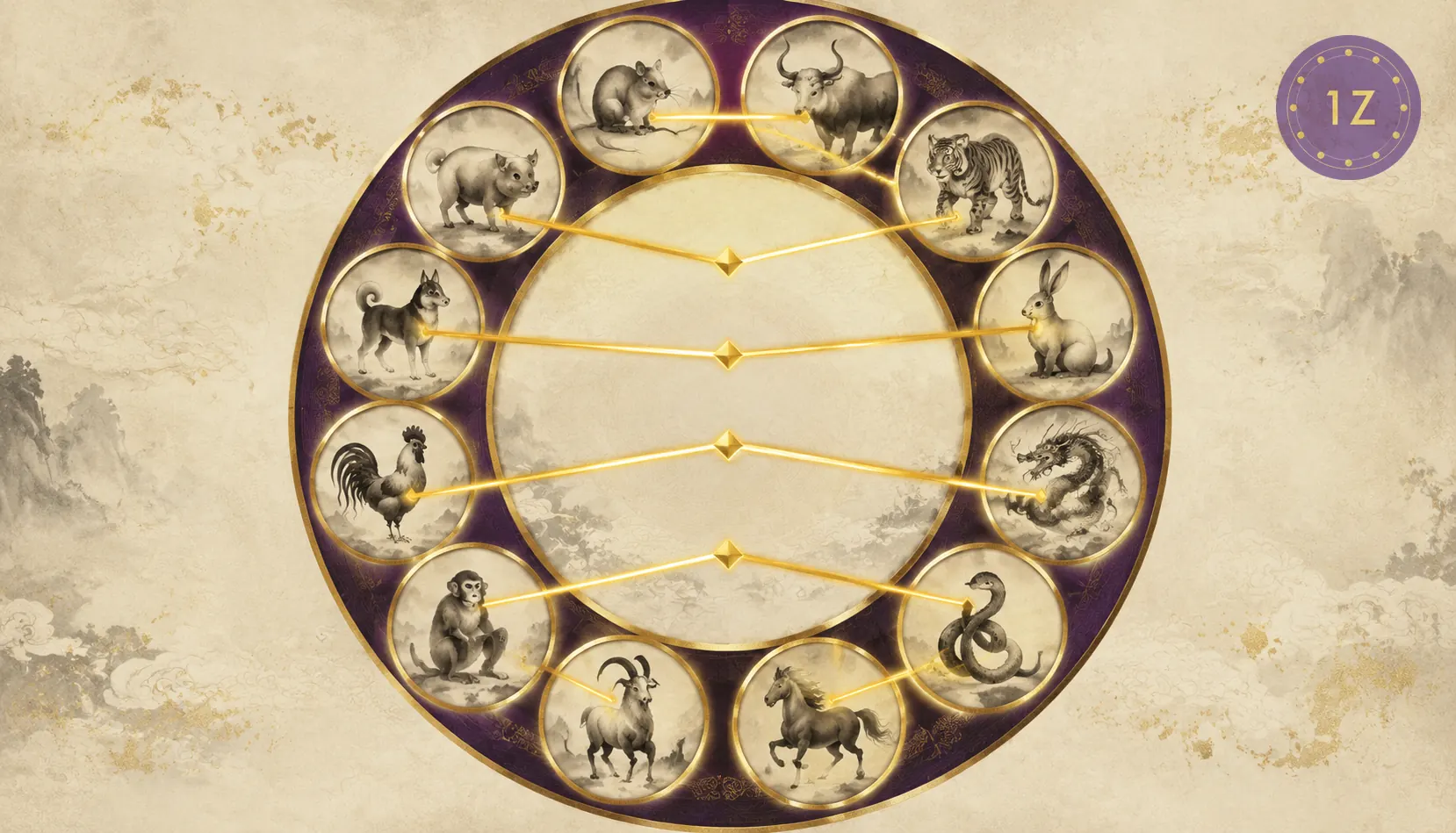

The six harmony combinations (六合) are the pair bonds of the BaZi branch wheel: six fixed pairs, each folding 2 seats into 1 alliance, 6 alliances covering all 12 branches, the wheel folded 6 times over, Rat with Ox, Tiger with Pig, Rabbit with Dog, Dragon with Rooster, Snake with Monkey, Horse with Goat. In our dataset every six-harmony pair carries a baseline weight of 94-95, near the ceiling of the pairing scale, which is why matchers treat the bond as the strongest single-line support two branches can offer each other. These counts come from a scoring framework whose methodology is public. This article walks all six pairs, the chemistry each bond creates, and the honest conditions layer that decides how much of that chemistry actually lands.

Key Takeaways
- Six fixed pairs: Rat-Ox 子丑, Tiger-Pig 寅亥, Rabbit-Dog 卯戌, Dragon-Rooster 辰酉, Snake-Monkey 巳申, Horse-Goat 午未.
- Each bond pairs two seats that mirror each other across the wheel’s horizontal axis and pulls toward a transformation element (structural potential, not automatic).
- Baseline pairing weight: 94-95 in our 78-pair dataset (methodology), the harmony ceiling.
- The transformation needs conditions to complete: the transforming element in season, a transparent stem lead, and no strong clash breaking the bond.
- Harmonies are bonds, not verdicts: they describe support weather, not guaranteed outcomes.
The Six Pairs at a Glance
The six harmonies follow one geometric rule: each pair joins two branches that mirror each other across the wheel’s horizontal axis, so the six lines read as one fold of the circle along that axis. The six folds cover all twelve branches exactly once, which is why the set is complete at six and why every branch has exactly one harmony partner, the way every lock has one key.
| Pair | Branches | Transformation potential | Memory anchor |
|---|---|---|---|
| Rat-Ox | Rat 子 + Ox 丑 | Earth 土 | Vault and its key |
| Tiger-Pig | Tiger 寅 + Pig 亥 | Wood 木 | Water feeds wood |
| Rabbit-Dog | Rabbit 卯 + Dog 戌 | Fire 火 | Wood feeds fire |
| Dragon-Rooster | Dragon 辰 + Rooster 酉 | Metal 金 | Earth bears metal |
| Snake-Monkey | Snake 巳 + Monkey 申 | Water 水 | Forge and coolant |
| Horse-Goat | Horse 午 + Goat 未 | Fire or Earth (school-dependent) | High summer sun over soil |
The sixth pair carries a school note worth flagging early: the Horse-Goat bond is read by fire-school texts as pulling toward Fire and by earth-school texts as pulling toward Earth, and honest writing names the split rather than picking silently.
Practical takeaway: six pairs, one geometric rule, every branch paired exactly once.
Reading the Chemistry Pair by Pair
Each bond has its own texture, shaped by what the two branches bring. Rat-Ox is the vault and its key: the Rat’s water meets the Ox’s storehouse earth, a bond of mutual custody, classically read as tending toward Earth, and the 1996 Rat cohort meets its Ox key every Ox year. Tiger-Pig is water feeding wood: the Tiger’s growth seat meets the Pig’s deep water, a bond of nourishment, tending toward Wood. Rabbit-Dog is wood feeding fire: the Rabbit’s pure wood meets the Dog’s earth branch, the vault that stores fire, a bond of fuel meeting a guarded furnace, tending toward Fire.
Dragon-Rooster is earth bearing metal: the Dragon’s wet-earth vault meets the Rooster’s refined metal, a bond of the mine and the ore, tending toward Metal. It is the pair our Metal Dragon article traced in depth, the bond whose potential feeds a Geng stem’s own element. Snake-Monkey is forge and coolant: the Snake’s fire meets the Monkey’s metal-and-water complexity, a bond of tempering, tending toward Water. The Horse-Goat bond is the sun over late-summer soil: the Horse’s peak fire meets the Goat’s dry earth, and the school split on its direction is real.
In my experience my fastest way to feel the six bonds, after years of teaching them, is to read them as six marriages of function: custody, nourishment, fuel, refinement, tempering, and ripening. I teach them that way because the functions, unlike the raw pairs, carry over into how the bonds behave when activated by a flowing year.
Practical takeaway: six bonds, six functions; learn the functions and the pairs stop being arbitrary for you.
The Conditions Layer: Bond Versus Transformation
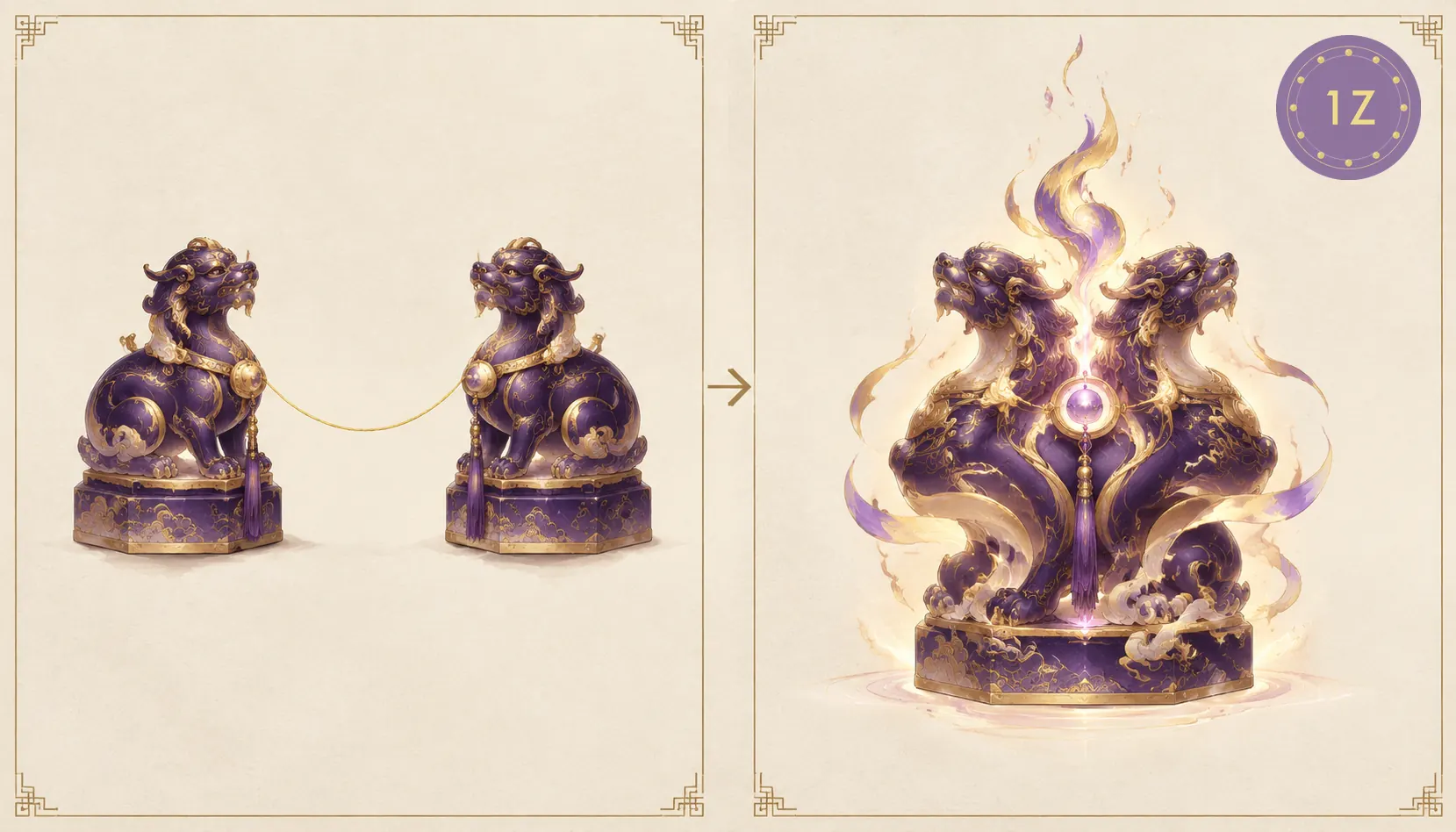
Here is the distinction that separates honest harmony writing from fortune-cookie writing. The bond itself is almost always real: two branches in a six-harmony pair hold a standing alliance, visible in the pairing weight and in how the pair cushions each other, visible across hundreds of charts. The transformation (合化) is a conditional event on top of the bond, the pair actually converting its potential into the named element. Classical practice sets 3 checks before granting it: a gate measured in 15 years of practice and hundreds of charts.
The three checks: the transforming element in season (the month order supporting it); a transparent stem lead (the element showing in the heavens, not just buried); and no strong clash breaking the bond from outside. Without these, the correct reading is a close alliance with structural potential, not a completed conversion. Writing “Chen and You harmonize into Metal” as an unconditional fact skips all three checks, which is why the deterministic tables phrase it as “the Dragon-Rooster bond’s structural potential harmonizes into Metal.”
In practice, the same discipline applies to strength claims. A harmony year is classically “marriage-timing energy present” and “support weather arriving,” never a guaranteed event, and a bond under simultaneous clash pressure reads as support under strain rather than pure cushioning. Based on our analysis of paired readings, the practitioners who respect the conditions layer are the ones whose match reports hold up 10 years later.
Practical takeaway: the bond is the standing alliance; the transformation is the conditional event; never write one as the other.
Harmonies in a Full Chart
| Layer | What it is | When it completes |
|---|---|---|
| The bond (合) | Standing alliance, nearly always real | Present whenever the pair meets |
| The transformation (化) | Conversion into the named element | Season + stem lead + no strong clash |
| The activation | A flowing year touching the pair | Year branch bonds or clashes a natal branch |
Inside a full chart, the six harmonies do three kinds of work. Between two people’s charts, they mark support lines: a day-branch harmony between partners is the classic cushioning read, our BaZi match guide walks it as the Day-to-Day Resonance layer. Within one chart, a harmony linking two of the chart’s own branches merges their agendas, and a flowing year branch harmonizing with a natal branch is one of the three direct marriage-timing activations (the star showing transparent, or the palace moved by bond or clash, per our marriage prediction guide).
The honest boundary, one more time: harmonies are the strongest single-line support the wheel offers, worth its weight across years of readings, and they are still lines, not destinies. A chart with three harmony lines can mismanage them; a chart with none can build support through trines and healthy element flow. If you want the full interaction map, the Chinese zodiac hub holds the year-seat layer, and the compatibility hub scores all 78 pairs.
Practical takeaway: harmonies are support lines with conditions; read them as weather, act on the whole sky.
What are the six harmony combinations in BaZi?
They are six fixed branch pairs: Rat-Ox (子丑), Tiger-Pig (寅亥), Rabbit-Dog (卯戌), Dragon-Rooster (辰酉), Snake-Monkey (巳申), and Horse-Goat (午未). Each joins two mirror-paired seats across the wheel’s horizontal axis, and each carries a transformation potential, toward Earth, Wood, Fire, Metal, Water, and Fire-or-Earth respectively (the last pair is school-dependent). In our 78-pair dataset every harmony pair carries a baseline weight of 94-95, the ceiling band of the pairing scale.
Do six harmony pairs actually transform into their element, or is that a simplification?
No, and this distinction is the heart of honest harmony reading. The bond is the standing alliance, nearly always real; the transformation (合化) is a conditional event that classical practice gates behind three checks: the transforming element in season, a transparent stem lead, and no strong clash breaking the bond. Without the conditions, the correct phrasing is “the bond’s structural potential harmonizes into X,” never an unconditional “these two become X.” Based on our analysis of match reports, conflating bond with transformation is the single most common error in pop compatibility writing.
Which six harmony pair matters most for a given chart, and why is the answer chart-relative?
On the pairing scale they sit together at the top: all 6 pairs carry 94-95, the harmony ceiling, a band spanning just 2 points of the 100-point scale, so no pair outranks another by score. What differentiates them is texture and context: Dragon-Rooster matters most where Metal is structural (a Geng day master’s own element reinforced), Tiger-Pig where nourishment is thin, Snake-Monkey where tempering is the theme. I read the question as asking which bond means most for a given chart, and I answer it chart by chart, and the answer for you is always chart-relative: the strongest harmony is the one that feeds the line your chart actually needs.
How do six harmonies differ from the three harmonies (trines)?
The six harmonies (六合) are pair bonds: two mirror-paired seats folding into one alliance, six pairs covering all twelve branches once each. The three harmonies (三合) are trine triangles: 4 triangles of 3 branches each, 12 branches all told (Shen-Zi-Chen pooling into Water, and three more), pooling the members’ elements into one force. A pair bond is intimacy, one-on-one support; a trine is a faction, three-seat collective momentum, and a two-person meeting within a trine reads as a half-alliance awaiting the third seat. Both are support lines; they differ in geometry, membership, and what it takes to complete them.
Sources
- Earthly branches – Wikipedia: the twelve branches and the six harmony pairings
- Chinese zodiac – Wikipedia: the wheel structure the harmonies fold
- Chinese astrology – Britannica: the classical framework behind bond and transformation readings
Conclusion
Six bonds, one fold each, conditions on top: the six harmonies are the wheel’s strongest single-line support, read honestly. Find your own seat’s key on the Chinese zodiac hub, then check the conditions layer before you lean on the bond.