
The Pomegranate-Wood Rooster
辛酉 (Xin-You) · 石榴木 (Pomegranate-Wood) · Metal Stem
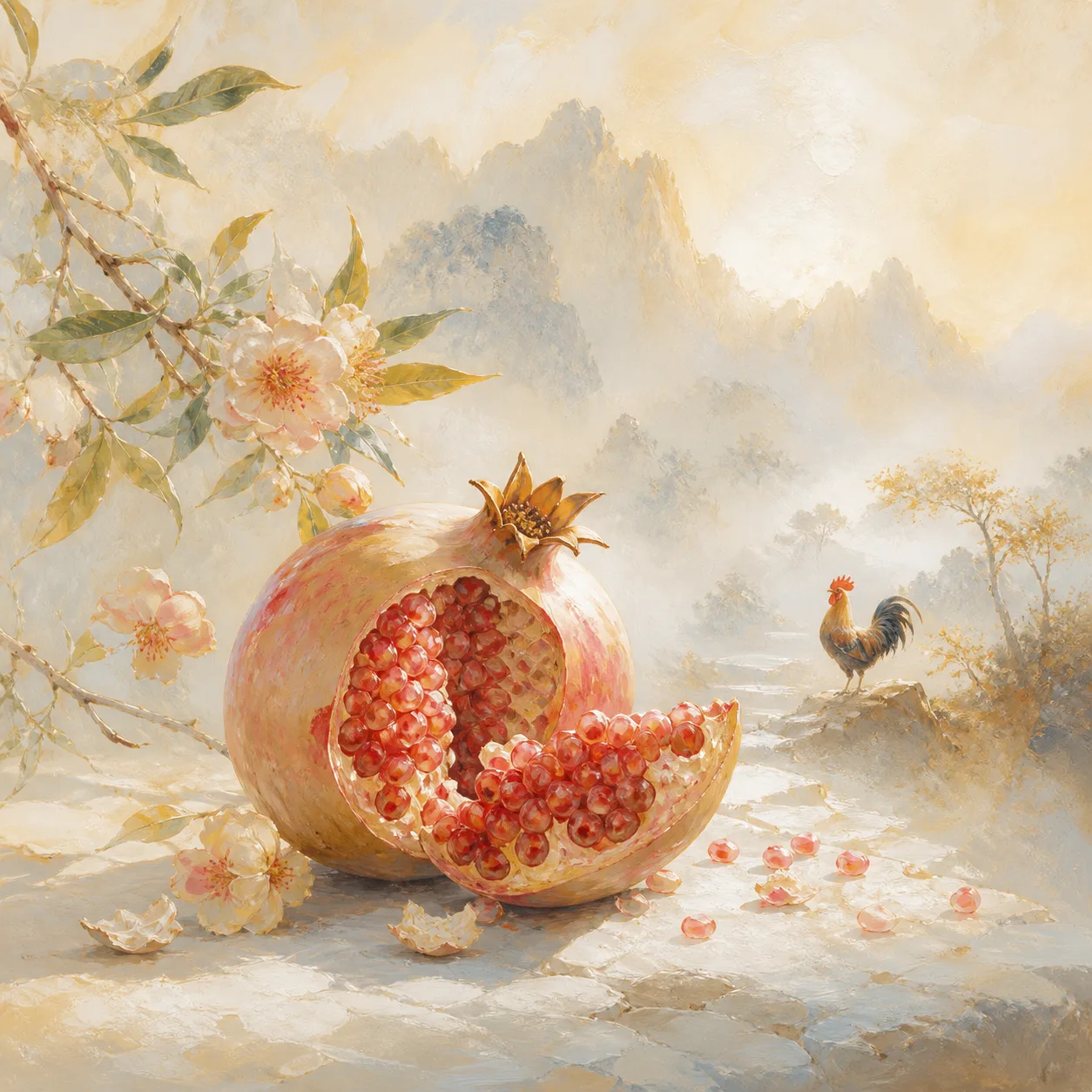
The Pomegranate-Wood Rooster defines those born in 1921 and 1981 under the Xin-You (辛酉) pillar. While mainstream astrology often classifies this year as the Metal Rooster based on its Heavenly Stem (辛 = Metal), its deeper NaYin (纳音) resonance is Pomegranate-Wood (石榴木) — blending metal’s core energy with wood’s expressive quality. This combination tempers the Rooster’s native precision with wood’s growth force, producing abundant creativity, grand ideals, and relentless ambition. Defined by the Pomegranate-Wood image of fertility and fullness, these individuals possess a unique resilience—not merely decorative but deeply rooted, bearing fruit through sustained effort.
A quick map: this is a Metal year by its Heavenly Stem (辛 / Xin), while its NaYin is Pomegranate-Wood (石榴木), a Wood archetype — two parallel systems describing the same pillar, not a contradiction.
Quick Facts
| Years | 1921, 1981 |
| GanZhi | 辛酉 (Xin-You) |
| NaYin | Pomegranate-Wood (石榴木 Shi-Liu-Mu) |
| Stem Element | Metal (辛) |
| NaYin Element | Wood (石榴木) |
| Base Element | Metal |
| Lucky Numbers | 3, 8, 25, 38 |
| Lucky Colors | Green, Teal, Brown |
| Lucky Direction | East, Southeast |
| NaYin Season | Spring |
| Trine Group | Second Trine (Ox, Snake, Rooster) |
| Sexagenary Position | #58 of 60 in the Jia-Zi cycle |
| Lunar Year Dates | 1921: 1921-02-08 to 1922-01-28 1981: 1981-02-05 to 1982-01-25 |
| Six Harmony (六合) | Dragon — Secret Friend |
| Three Harmony (三合) | Ox · Snake · Rooster (Metal Trine) |
| Six Clash (六冲) | Rabbit — Opposing Force |
| Five Element Cycle | Generated by Water → Wood generates Fire → Controlled by Metal |
Rooster Element Variants Compared
| NaYin Variant | Stem Name | GanZhi | Years | Stem Element |
|---|---|---|---|---|
| Sword-Metal Rooster | Water Rooster | 癸酉 | 1933, 1993 | Water |
| Spring-Water Rooster | Wood Rooster | 乙酉 | 1945, 2005 | Wood |
| Mountain-Base-Fire Rooster | Fire Rooster | 丁酉 | 1957, 2017 | Fire |
| Highway-Earth Rooster | Earth Rooster | 己酉 | 1909, 1969, 2029 | Earth |
| Pomegranate-Wood Rooster | Metal Rooster | 辛酉 | 1921, 1981 | Metal |
Like pomegranate wood bending under the weight of its own fruit, this Rooster’s precision yields tangible abundance. Their sharp eye for detail, honed by metal stems, transforms into a gift for curating systems that bear fruit season after season—whether organizing complex logistics or building repeatable business processes. They communicate with a clarity that feels like harvest-ready instruction, and their integrity ensures nothing is wasted. This Rooster doesn’t just observe; they cultivate, making them invaluable in any role requiring exacting standards and long-term yield, such as quality assurance in agriculture or supply chain management.
The same wood that bears so heavily can crack under pressure. This Rooster’s desire for order may become brittle perfectionism, with every overlooked grain feeling like failure. Their honest communication, when overripe, can turn into harsh criticism that prunes relationships too severely. Abundance tempts them to hoard—time, resources, praise—for fear the next season won’t be as fruitful. When the pomegranate wood grows rigid, they risk isolating themselves within their own exacting standards, forgetting that some branches need flexibility to weather storms.
The NaYin: Pomegranate-Wood (石榴木 Shi-Liu-Mu)
In classical Chinese astrology, each of the 60 year-stem combinations carries a specific NaYin (纳音, “assigned tone”) — a poetic elemental melody refining the Five Elements into 30 archetypes. The Pomegranate-Wood (石榴木) NaYin represents a unique expression of the wood element.
Classical Sources
《三命通会》(Comprehensive Treatise on the Three Fates)
By 万民英 (Wan Minying), Ming Dynasty, 1587 — Volume 30, “On NaYin Elements”:
“石榴木者,性辛如五味,花繁而实繁,他木至午而死,至未而墓,惟石榴木至申而生气方生,其性坚贞如金。”
“辛酉,失位之木也,木困于金,须借火以制金,方为有用之材。”
Born in January or February?
There are two systems for determining your zodiac year. Folk tradition uses Lunar New Year (late Jan / early Feb). BaZi astrology uses Lichun (立春, Start of Spring, ~Feb 3–5). If your birthday falls in this boundary period, you might belong to the previous sign (Monkey) under one system but the Pomegranate-Wood Rooster under another. Use our BaZi Calculator to determine your exact pillar based on Lichun.
Core personality traits
Picture a pomegranate tree that has taken root in a copper-rich soil—its branches laden with jewel-like fruit, each seed a tiny universe of potential. This is the image that defines the Pomegranate-Wood Rooster (辛酉, Shíliú Mù). The Rooster’s native metal is already sharp and precise, but here it is grafted onto living wood, creating a creature of startling contradictions. The Sanming Tonghui (三命通会) describes this GanZhi as ‘a tree that has lost its position, wood trapped by metal,’ and indeed, the Pomegranate-Wood Rooster often feels constricted by the very perfectionism that drives them. Their mind is a garden of grand ideas, but the soil is laced with metallic scrutiny—every leaf must be symmetrical, every petal accounted for. This creates a personality that is both visionary and critical, capable of seeing the masterpiece but agonizing over every brushstroke. The wood element lends them a resilience that the ordinary Rooster lacks; like the pomegranate, they bear fruit even in harsh conditions, their idealism flowering despite the chill of reality. Yet the classical text warns that this wood ‘must borrow fire to control metal, only then becoming useful material.’ Without a spark of passion or external inspiration, the Pomegranate-Wood Rooster can become a prisoner of their own standards—a tree so perfectly pruned it forgets to grow. Their pride is not the strutting vanity of the common Rooster, but a quiet, almost tragic dignity: the knowledge that they carry within them a fertility that may never be fully harvested.
Relationships and romance
In love, the Pomegranate-Wood Rooster is a study in controlled passion. Their metal stem demands precision in a partner—they have a checklist as detailed as a jeweler’s appraisal, and they would rather tend their own garden than accept a wilting bloom. But the wood beneath their surface craves depth and growth. They fall not with a flutter of feathers but with the slow, deliberate rooting of a tree. Once committed, they are fiercely loyal, their loyalty a fortress built of both duty and genuine affection. However, their idealistic nature can set them up for disappointment; they may project onto a lover the image of the perfect pomegranate, only to find the fruit has blemishes. Their love language is acts of service and thoughtful gifts—they will remember the smallest preference and craft a gesture that feels both precise and heartfelt. The Dragon (辰, their Liuhe match) is their natural complement, a creature of fire and earth that can warm the Rooster’s wood and help it bloom. With a Dragon, the Rooster learns that perfection is not a prerequisite for beauty. Their vulnerability lies in their pride: if betrayed, they sever the branch cleanly, without regret, but the wound may leave them wary of flowering again.
Career and professional life
The Pomegranate-Wood Rooster’s career path is a negotiation between the metal of precision and the wood of vision. They excel in fields that require both meticulous structure and creative growth—architecture, where every beam must bear weight yet form a soaring space; botanical research, where classification meets discovery; or high-level craftsmanship, such as watchmaking or instrument design. The wood element gives them a long-term perspective rare among Roosters; they are willing to plant seeds that may take years to bear fruit. The Sanming Tonghui’s warning about wood ‘trapped by metal’ manifests as a tendency to over-analyze—they can become so absorbed in perfecting the details that the grand project withers. Their ideal work environment is one that offers both clear frameworks and the freedom to innovate. They shine in roles where they can set their own standards and then exceed them. A career pitfall is their reluctance to delegate; they trust only their own eye, which can lead to burnout and isolated excellence. The Pomegranate-Wood Rooster must learn that a forest is stronger than a single tree, and that collaboration can provide the ‘fire’ that transforms their trapped wood into useful material.
Health and wellbeing
The Pomegranate-Wood Rooster’s constitution is a careful equilibrium of metal and wood. Metal governs the lungs and large intestine, while wood influences the liver and eyes. This pairing often manifests as a tendency toward respiratory sensitivities—allergies, asthma, or dry coughs—especially in environments that lack humidity or emotional warmth. Their skin, too, may be reactive, prone to rashes or eczema when stress builds. The wood element may provoke tightness in the liver channel, resulting in eye fatigue, headaches, or a clenched jaw from bottled-up irritation. Wellness for this Rooster is about nurturing the wood without drowning the metal. Practices that combine structure with flow are ideal: Tai Chi, which disciplines the body while allowing energy to circulate; or Qigong, which harmonizes breath (metal) and movement (wood). They benefit from white foods that moisten the lungs—pear, lily bulb, tofu—and green foods that soothe the liver—leafy greens, wheatgrass. Emotionally, they must guard against the rigidity that comes from over-control. The Pomegranate-Wood Rooster thrives when they allow themselves periods of unstructured creativity, letting the wood grow wild before pruning it back. Regular saunas or steam baths can help release the tension that metal holds in the tissues.
Wealth and finances
The wealth pattern of the Pomegranate-Wood Rooster is like a pomegranate orchard: they invest in the long-term, expecting a harvest that may take seasons to arrive. Their metal stem gives them a sharp eye for value—they are natural analysts who can spot a bargain or a flawed investment with uncanny precision. They prefer tangible assets: real estate, land, fine art, or collectibles that they can see and assess. Their spending is deliberate; they rarely impulse-buy, and they derive satisfaction from a well-negotiated deal. However, the wood element can make them overly optimistic about growth. They may hold onto an investment past its prime, believing it will bear fruit if only they wait a little longer. Their financial pitfall is a form of ‘golden handcuffs’: they can become so focused on building wealth that they forget to enjoy it, hoarding resources like a miserly gardener who never tastes the fruit. The Pomegranate-Wood Rooster needs to learn that wealth is not just about accumulation but about circulation—money, like water, must flow to nourish life. They would benefit from a financial advisor who can provide the ‘fire’ of accountability, helping them prune their portfolio and reinvest in experiences that enrich their spirit.
Personal growth and development
The central lesson for the Pomegranate-Wood Rooster is captured in the Sanming Tonghui’s image: wood trapped by metal must borrow fire to become useful. Their growth edge lies in learning to let go of perfect control and allow passion, spontaneity, and even imperfection to enter their lives. The pomegranate tree is most beautiful when it is heavy with fruit, branches bending under the weight—it does not stand rigid but yields. For this Rooster, a specific practice is to schedule ‘unstructured time’ each week—an hour with no agenda, no goals, just the freedom to follow curiosity. They might take up a messy art like pottery or watercolor, where the medium resists control. In relationships, they can practice saying ‘I don’t know’ or ‘I was wrong,’ small releases of the need to be right. When they embrace the fire of vulnerability and the chaos of creativity, the Pomegranate-Wood Rooster transforms from a perfectionist into a visionary—a tree that not only bears fruit but also offers shade, beauty, and the wild music of wind in its leaves. Their potential is not in being flawless but in being fertile, a source of life and inspiration for all who rest in their branches.
Pomegranate-Wood Rooster Years
| Year | GanZhi | Type | Details |
|---|---|---|---|
| 1921 | 辛酉 | Pomegranate-Wood Rooster | View Profile → |
| 1981 | 辛酉 | Pomegranate-Wood Rooster | View Profile → |
Famous Pomegranate-Wood Roosters
Notable figures born in 1921, 1981.
One of China's highest-paid actresses; Cell Phone, X-Men: Days of Future Past.
Oscar winner, Black Swan, Thor, Harvard-educated.
Captain America in Marvel Cinematic Universe.
Loki in Marvel, The Night Manager.
32 Grammys — most awarded ever; perfectionism and commanding stage presence.
23 Grand Slams; precision, pride, and unmatched work ethic.
A Six Harmony (六合) match — the secret friend combination, naturally aligned in energy and purpose.
Common questions
How does the wood element express through the Rooster in daily life?
The Pomegranate-Wood Rooster (辛酉, 石榴木) blends the Rooster’s precision with wood’s growth-oriented energy. In daily life, they are meticulous planners who thrive on structure but also seek personal development. They often take on projects that require both attention to detail and creativity, such as gardening, writing, or design. Their Pomegranate Wood nature gives them resilience—they can bend without breaking, adapting to challenges while maintaining their core values. They enjoy routines but will innovate within them, making them reliable yet refreshingly original in their habits.
How does the 60-year cycle shape Pomegranate-Wood Rooster recurrence?
The 60-year cycle of the Chinese zodiac determines that a Pomegranate-Wood Rooster (辛酉) appears only once per cycle, with recent years being 1921 and 1981. This rarity makes each Pomegranate-Wood Rooster generation distinct, shaped by the historical context of their birth year. For example, those born in 1921 lived through global shifts, while 1981 Roosters grew up in the digital age. The cycle also influences their elemental balance—since 辛酉 is a Yin Metal stem paired with a Yin Rooster branch, the Pomegranate Wood NaYin tempers the metal, creating a unique blend that only emerges every six decades.
What patterns emerge when studying famous Pomegranate-Wood Rooster people?
Famous Pomegranate-Wood Roosters (辛酉, 石榴木) often display a combination of precision and adaptability. Notable individuals like actress Audrey Hepburn (born 1929, though not 辛酉) don’t apply—strictly 1981 Pomegranate-Wood Roosters include celebrities like Britney Spears and Justin Timberlake. They tend to be perfectionists who reinvent themselves, balancing public scrutiny with personal growth. Their careers often involve performance or creative expression, where their meticulous nature shines. They face challenges with resilience, using their Pomegranate Wood flexibility to recover from setbacks and emerge stronger.
What compatibility dynamics shape Pomegranate-Wood Rooster relationships?
Pomegranate-Wood Roosters (辛酉, 石榴木) are most compatible with Ox, Snake, and Dragon signs, which complement their dedicated and analytical nature. However, they may clash with Rabbit and Dog due to differing priorities. The wood element softens the Rooster’s critical edge, making them more nurturing partners. They seek relationships that offer both stability and growth, often thriving with partners who appreciate their attention to detail and encourage their personal development. Their Pomegranate Wood essence means they can weather storms but need emotional security to flourish.
How does the Pomegranate-Wood Rooster identity differ from other Rooster types?
Unlike other Rooster types, the Pomegranate-Wood Rooster (辛酉, 石榴木) is more introspective and adaptable. The wood element tempers the Rooster’s typical boldness, making them less abrasive and more diplomatic. While Fire Roosters are passionate and Pomegranate-Wood Roosters rigid, Pomegranate-Wood Roosters are flexible planners who value growth over control. Their Pomegranate Wood NaYin signifies resilience and the ability to bear fruit even in harsh conditions, setting them apart as the most nurturing and creatively inclined of all Roosters. They are also more likely to seek harmony in their environment.
How do Pomegranate-Wood Rooster people typically behave in social settings?
In social settings, Pomegranate-Wood Roosters (辛酉, 石榴木) are observant and articulate, often taking on a role of graceful organizer. They are not the loudest in the room but command attention through their poise and insightful comments. They enjoy meaningful conversations and may shy away from superficial small talk. Their wood element makes them approachable and empathetic, but they maintain a certain reserve. They are skilled at reading the room and adapting their behavior, making them excellent hosts or mediators. Their Pomegranate Wood nature gives them a warm yet dignified presence.
How does the wood element influence Rooster’s love language?
The wood element transforms the Rooster’s love language into acts of service and quality time, infused with personal growth. Pomegranate-Wood Roosters (辛酉, 石榴木) express love by helping their partners improve—whether through practical support or encouraging self-development. They value deep conversations and shared activities that build a future together. Their Pomegranate Wood energy makes them loyal but needs reciprocated effort; they flourish when their partner appreciates their meticulous care. They may struggle with expressing emotions verbally but show affection through thoughtful gestures and creating a stable, nurturing home.
How does the Pomegranate-Wood Rooster perform in leadership roles?
Pomegranate-Wood Roosters (辛酉, 石榴木) excel in leadership through a blend of meticulous planning and empathetic guidance. They lead by example, setting high standards while being approachable and fair. Their wood element gives them a growth-oriented mindset, encouraging team development and innovation. They are adept at delegating and fostering collaboration, often creating a harmonious work environment. However, their perfectionism can sometimes slow decision-making. Their Pomegranate Wood resilience helps them navigate crises calmly, making them respected leaders who inspire loyalty and steady progress.
Why is 1921 called Pomegranate-Wood Rooster instead of Metal Rooster?
In mainstream Chinese astrology, 1921 is often called the Metal Rooster because its Heavenly Stem 辛 (Xin) corresponds to Metal. However, the NaYin (纳音) system — a deeper layer of BaZi analysis — assigns this pillar the Pomegranate-Wood (石榴木) resonance. Both names refer to the same year: the Stem name (Metal Rooster) describes its foundational energy, while the NaYin name (Pomegranate-Wood Rooster) reveals its poetic-spiritual quality.
Want Your Personal Reading?
Get your complete BaZi chart with all four pillars, NaYin analysis, and life chapters.
Open Free BaZi Calculator →