
The Spring-Water Rooster
\乙酉 (Yi-You) · 泉中水 (Spring-Water) · Wood Stem
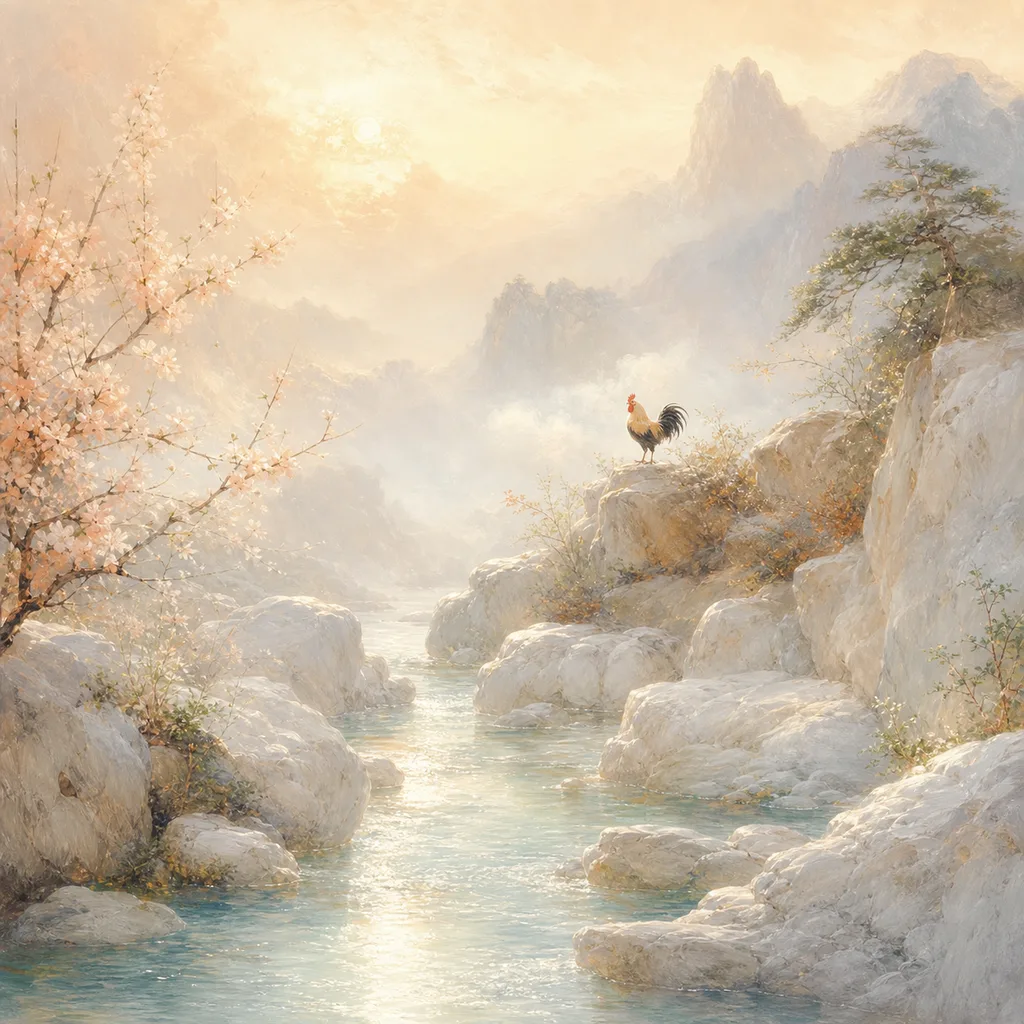
\The Spring-Water Rooster defines those born in 1945 and 2005 under the Yi-You (乙酉) pillar. While mainstream astrology often classifies this year as the Wood Rooster based on its Heavenly Stem (乙 = Wood), its deeper NaYin (纳音) resonance is Spring-Water (泉中水) — blending wood’s core energy with water’s expressive quality. This GanZhi pillar blends Wood Stem and Metal Base, where the NaYin’s Spring-Water tempers the Rooster’s natural rigidity with wisdom, adaptability, and social finesse, yet introduces volatility and indecisiveness. Its defining trait is a quiet, resilient ability to find opportunity amid change, like spring water flowing through rock.
A quick map: this is a Wood year by its Heavenly Stem (乙 / Yi), while its NaYin is Spring-Water (泉中水), a Water archetype — two parallel systems describing the same pillar, not a contradiction.
Quick Facts
\| Years | 1945, 2005 |
| GanZhi | 乙酉 (Yi-You) |
| NaYin | Spring-Water (泉中水 Quan-Zhong-Shui) |
| Stem Element | Wood (乙) |
| NaYin Element | Water (泉中水) |
| Base Element | Metal |
| Lucky Numbers | 1, 6, 13, 49 |
| Lucky Colors | Blue, Black, Silver |
| Lucky Direction | North |
| NaYin Season | Winter |
| Trine Group | Second Trine (Ox, Snake, Rooster) |
| Sexagenary Position | #22 of 60 in the Jia-Zi cycle |
| Lunar Year Dates | 1945: 1945-02-13 to 1946-02-02 2005: 2005-02-09 to 2006-01-29 |
| Six Harmony (六合) | Dragon — Secret Friend |
| Three Harmony (三合) | Ox · Snake · Rooster (Metal Trine) |
| Six Clash (六冲) | Rabbit — Opposing Force |
| Five Element Cycle | Generated by Metal → Water generates Wood → Controlled by Earth |
 \
\Rooster Element Variants Compared
\| NaYin Variant | Stem Name | GanZhi | Years | Stem Element |
|---|---|---|---|---|
| Sword-Metal Rooster | Water Rooster | 癸酉 | 1933, 1993 | Water |
| Spring-Water Rooster | Wood Rooster | 乙酉 | 1945, 2005 | Wood |
| Mountain-Base-Fire Rooster | Fire Rooster | 丁酉 | 1957, 2017 | Fire |
| Highway-Earth Rooster | Earth Rooster | 己酉 | 1909, 1969, 2029 | Earth |
| Pomegranate-Wood Rooster | Metal Rooster | 辛酉 | 1921, 1981 | Metal |
A spring-fed stream, not a flood, gives this Rooster clarity without force. Their precision sharpens when paired with the water’s steady renewal—each observation flows to the next, never stuck on a single detail. This makes them exceptional in auditing or quality control, where they catch errors others miss, then recalibrate without ego. Their edge lies in honest communication that refreshes trust, like water that never tastes stale.
\But the same stillness that clears their mind can turn to rigidity when the spring runs too deep. This Rooster may over-polish a single task, mistaking repetition for renewal, and hesitate to let go of outdated systems. Their honesty, born from water’s transparency, can freeze into bluntness—calling out a flaw without offering the warmth of context. The shadow is a perfectionist who confuses stagnation with stability.
\The NaYin: Spring-Water (泉中水 Quan-Zhong-Shui)
\In classical Chinese astrology, each of the 60 year-stem combinations carries a specific NaYin (纳音, “assigned tone”) — a poetic elemental melody refining the Five Elements into 30 archetypes. The Spring-Water (泉中水) NaYin represents a unique expression of the water element.
\Classical Sources
\《三命通会》(Comprehensive Treatise on the Three Fates)
By 万民英 (Wan Minying), Ming Dynasty, 1587 — Volume 30, “On NaYin Elements”:
“泉中水者,寒泉清冽,取养不穷,八家凿之以同饮,万民资之以生活。此水生于金而出于木,故喜见金为福。”
\“乙酉,自败之水,假众金以相之,亦主吉庆。”
\Born in January or February?
\There are two systems for determining your zodiac year. Folk tradition uses Lunar New Year (late Jan / early Feb). BaZi astrology uses Lichun (立春, Start of Spring, ~Feb 3–5). If your birthday falls in this boundary period, you might belong to the previous sign (Monkey) under one system but the Spring-Water Rooster under another. Use our BaZi Calculator to determine your exact pillar based on Lichun.
\Who they are
\ \The Rooster meets the Spring-Water (泉中水, Quan-Zhong-Shui) and a strange alchemy begins. A creature of precision and display now carries a hidden aquifer within. This is not the boastful barnyard crow, but a voice that resonates from deep underground—clear, cold, and startlingly honest. The metal of the Rooster’s branch (酉) is not blunted by the water; rather, it is polished to a mirror finish. Every feather is a facet, and the water’s stillness allows each reflection to be seen without distortion. Yet there is a paradox: the spring is both a source and a secret. Those born under 乙酉 (Yi-You) often possess a private world of emotion and intuition that their sharp exterior belies.
The Heavenly Stem 乙 (Yi), a slender vine of wood, climbs the Rooster’s metal frame. This creates a tension—wood is cut by metal, but here the wood is supple, wrapping around the blade. This dynamic yields a personality of refined resilience. As the Sanming Tonghui (三命通会) notes, this is “self-defeating water” (自败之水), a water that relies on metal to hold its form. In human terms, the Spring-Water Rooster draws strength from structure—discipline, routine, and clear systems—yet their inner life flows with adaptability and deep feeling. They can be simultaneously the most organized person in the room and the one most attuned to unspoken undercurrents.
Their observation is legendary, but unlike the fire Rooster’s flashy critique, this one watches in silence, gathering data like pebbles in a streambed. They speak only when the current of wisdom is ready. There is a monastic quality to their precision—a devotion to craft that can seem cold until you realize the devotion is born of love for the work itself. The NaYin water grants them emotional depth, but also a tendency toward melancholy, as if they can feel the weight of every stone the spring has ever touched. They are not indecisive, as some might think; rather, they are weighing consequences in a scale that measures not just profit but harmony.
\ \In love and partnership
\ \In love, the Spring-Water Rooster courts like a slow-forming creek, not a tidal wave. They are not given to grand gestures; their romance is in the details—a perfectly brewed tea, a note placed just where you will find it, a schedule adjusted to give you time. Their love language is service wrapped in precision. They choose partners carefully, as if selecting stones to line a garden path. Once committed, they are fiercely loyal, but their loyalty must be earned through shared trust and mutual respect.
The Rooster’s natural mate is the Dragon (辰, Chen), and for the Spring-Water Rooster, this union is especially potent. The Dragon’s expansive energy gives the Rooster’s contained water a place to flow freely. Together, they create a reservoir of possibility. However, this Rooster must guard against emotional withdrawal. When hurt, they retreat into their inner spring, becoming icy and remote. Their partner must learn to read the subtle signs—a slight shift in their meticulous routine, a longer silence—as cries for connection. The NaYin water makes them deeply sensitive, though they will never admit it. They need a love that honors their need for order while gently inviting them to splash in the shallows of spontaneity.
\ \Professional destiny
\ \The Spring-Water Rooster’s career path is not a sprint but a steady percolation. They excel in fields where patience, precision, and deep knowledge accumulate over time. Research, especially in the sciences or humanities, suits them—they can sift through data like water through sediment, finding the gold. Artistic careers that require meticulous craft, such as restoration, calligraphy, or watchmaking, also resonate. The water element lends them a fluid adaptability; they can work in teams without losing their individual edge, often becoming the quiet anchor in a stormy project.
Their work style is methodical, almost ritualistic. They thrive on systems and schedules, but the NaYin water prevents them from becoming rigid. They can pivot when necessary, though they prefer to plan the pivot. A word of warning: the Spring-Water Rooster can become so absorbed in the process that they lose sight of the outcome. They may polish a report to perfection while the deadline passes. They need a colleague or mentor who embodies the Dragon’s fire—someone to remind them that even the clearest spring must eventually reach the sea. The most fitting careers are those that allow them to build something lasting: education, environmental planning, publishing, or any role where they can nurture growth over years.
\ \Physical and mental health
\ \The Spring-Water Rooster’s health is intimately tied to the element of water and the organ systems it governs: the kidneys, bladder, and ears. Water is the deep reservoir of the body, just as a spring feeds the land from hidden sources. They are prone to depletion when overdrawn — lower-back fatigue, ringing ears, or a chill that lingers — and their reserves quietly shape their emotional resilience. The metal of the Rooster branch also corresponds to the lungs and skin, so respiratory care matters too; but it is the water within that must be guarded first: rest, warmth, and deep sleep are this Rooster’s true medicine.
To maintain vitality, they must honor the water’s need to flow. Practices that combine movement with breath are ideal: swimming (of course), tai chi, or qigong. They should avoid environments that are too dry or too sterile—their skin and lungs crave humidity and fresh air. Emotionally, they need to let their feelings surface. The Sanming Tonghui’s image of water “borrowing metal to contain itself” applies here: they need structure (routine, diet, sleep schedule) to hold their emotional water, but they must also allow that water to circulate. A nightly ritual of journaling or a weekly soak in a warm bath can prevent the stagnation that leads to illness. Above all, they must guard against perfectionism-induced stress, which clogs the lungs like silt in a spring.
\ \Money and prosperity
\ \The Spring-Water Rooster approaches wealth as a gardener tends a spring-fed pond: they build slowly, never depleting the source, and they value quality over quantity. They are natural savers, not out of fear but out of a deep sense of sustainability. Their financial moves are deliberate—they research investments with the same care they give a craft project. They are drawn to assets that appreciate over time: real estate, blue-chip stocks, fine art. The NaYin water gives them a knack for finding hidden value, like a spring that surfaces in an unexpected place.
However, their very caution can become a pitfall. They may hold onto money so tightly that they miss opportunities for growth. The wood stem (乙) urges them to invest in growth—education, a business, or even philanthropy—but the Rooster’s metal can be too conservative. They must learn to let some water evaporate to feed the clouds. Another vulnerability: they can be too trusting of systems. A financial advisor who seems meticulous may earn their loyalty, but they must verify every detail themselves. The key is to balance their innate prudence with the wood’s call to expand. A portion of their portfolio should be allocated to ventures that feel like planting seeds—slow, patient, but ultimately abundant.
\ \Evolution and self-mastery
\ \The Spring-Water Rooster’s greatest growth edge is learning to embrace imperfection. Their spring-water clarity shows them every flaw in themselves and their environment, and their Rooster’s nature wants to fix it all. But a spring that is constantly dredged loses its mystery. They must learn to let some silt settle, to allow the water to be murky at times. The Sanming Tonghui’s description of this water as “self-defeating” is a clue: their strength lies not in overcoming but in yielding. They grow not by conquering their weaknesses but by integrating them.
A specific practice: each week, they should deliberately leave one task unfinished, one detail unpolished. Sit with the discomfort. Notice that the world does not end. Over time, this will loosen the grip of perfectionism and allow their natural wisdom to surface. They should also seek a mentor or community that values process over product—a writing group, a craft circle, a spiritual sangha. Here, they can practice being seen as they are, not as they have arranged themselves.
Aspirationally, the Spring-Water Rooster can become a wellspring of quiet influence. They are the person others come to for clarity, for a perspective that cuts through noise. When they balance their precision with acceptance, they transform from a meticulous bird into a living oracle—a spring that nourishes everything around it without ever needing to announce its presence.
\ \Spring-Water Rooster Years
\| Year | GanZhi | Type | Details |
|---|---|---|---|
| 1945 | 乙酉 | Spring-Water Rooster | View Profile → |
| 2005 | 乙酉 | Spring-Water Rooster | View Profile → |
Famous Spring-Water Roosters
\Notable figures born in 1945, 2005.
\\ Comedian, actor, musician, SNL host, Oscar host.\
\ Three-time Rock Hall inductee, Layla, Tears in Heaven.\
Grammy, Tony, and Emmy winner; The Divine Comedy of stage and screen.
A Six Harmony (六合) match — the secret friend combination, naturally aligned in energy and purpose.
People also ask
\ \What opportunities should Spring-Water Roosters seize in 2026?
In 2026, the Fire Horse year, Spring-Water Roosters (乙酉, 天河水) should seize opportunities in creative communication and networking. Their Spring Water energy thrives in collaborative projects, especially those involving writing, teaching, or public speaking. The Fire Horse’s yang fire can be intense, but their water controls fire, giving them calm influence. Career-wise, roles in media, diplomacy, or environmental advocacy align well. Financially, avoid impulsive investments; instead, focus on steady income streams. Relationships may bloom through social events, but they should guard against overcommitment.
How does Spring-Water energy manifest differently from surface Water?
Spring Water (天河水) in 乙酉 is celestial rain or dew, unlike surface water (e.g., ocean or river). It symbolizes purity, renewal, and gentle nourishment from above. For Spring-Water Roosters, this manifests as a refined, intuitive, and adaptable personality—they inspire rather than overwhelm. Unlike surface water’s visibility and force, Spring Water works subtly, seeping into cracks and fostering growth. This energy gives them a knack for timing and diplomacy, but also a tendency to be elusive. They excel in roles requiring finesse, like art or counseling, rather than brute effort.
How does water interact with the Rooster’s fixed element?
The Rooster’s fixed element is Metal (from 酉), and the Water of 乙酉 (天河水) creates a productive cycle: Metal generates Water. This means Spring-Water Roosters naturally channel their sharp, analytical Metal energy into fluid, creative expression. The Water softens Metal’s rigidity, making them more adaptable and empathetic than other Roosters. However, excess Water can weaken Metal, leading to indecision. Balancing both elements—using Metal for structure and Water for flow—enables them to communicate clearly, solve problems innovatively, and maintain emotional resilience.
How do Spring-Water Roosters handle betrayal or heartbreak?
Spring-Water Roosters (乙酉, 天河水) process betrayal with a mix of Metal’s cutting logic and Water’s emotional depth. Initially, they may withdraw to analyze the situation, using their sharp insight to understand motives. Their Spring Water energy helps them cleanse hurt through creative outlets like writing or music. They rarely confront aggressively but instead distance themselves gracefully. Over time, they forgive but don’t forget, integrating the experience into their wisdom. To heal, they need solitude near water or in nature, allowing their 天河水 to flow and restore balance. They emerge stronger, with refined boundaries.
What makes someone a true Spring-Water Rooster?
A true Spring-Water Rooster is anyone born in an 乙酉 year (e.g., 1945, 2005) with the 天河水 (Spring Water) NaYin. This combination gives them a unique blend: the Rooster’s meticulousness and confidence, softened by Water’s intuition and adaptability. They are articulate, charming, and have a natural flair for communication. Unlike other Roosters, they are less boastful and more empathetic, often sensing others’ needs. Their Spring Water energy makes them idealists who seek harmony and personal growth. True Spring-Water Roosters are lifelong learners, using their Metal-Water synergy to inspire and uplift those around them.
Why is 1945 called Spring-Water Rooster instead of Wood Rooster?
In mainstream Chinese astrology, 1945 is often called the Wood Rooster because its Heavenly Stem 乙 (Yi) corresponds to Wood. However, the NaYin (纳音) system — a deeper layer of BaZi analysis — assigns this pillar the Spring-Water (泉中水) resonance. Both names refer to the same year: the Stem name (Wood Rooster) describes its foundational energy, while the NaYin name (Spring-Water Rooster) reveals its poetic-spiritual quality.
Want Your Personal Reading?
\Get your complete BaZi chart with all four pillars, NaYin analysis, and life chapters.
\
Open Free BaZi Calculator →