
The Sword-Metal Rooster
癸酉 (Gui-You) · 剑锋金 (Sword-Metal) · Water Stem
The Sword-Metal Rooster defines those born in 1933 and 1993 under the Gui-You (癸酉) pillar. While mainstream astrology often classifies this year as the Water Rooster based on its Heavenly Stem (癸 = Water), its deeper NaYin (纳音) resonance is Sword-Metal (剑锋金) — blending water’s core energy with metal’s expressive quality. This pillar’s NaYin, “blade edge of a sword,” grants firm will, strong execution, and a sharp sense of justice. Metal amplifies the Rooster’s decisiveness but also rigidity. A supremely sharp instrument that must be wielded with care.
A quick map: this is a Water year by its Heavenly Stem (癸 / Gui), while its NaYin is Sword-Metal (剑锋金), a Metal archetype — two parallel systems describing the same pillar, not a contradiction.
Quick Facts
| Years | 1933, 1993 |
| GanZhi | 癸酉 (Gui-You) |
| NaYin | Sword-Metal (剑锋金 Jian-Feng-Jin) |
| Stem Element | Water (癸) |
| NaYin Element | Metal (剑锋金) |
| Base Element | Metal |
| Lucky Numbers | 7, 8, 21, 36 |
| Lucky Colors | Gold, Silver, White |
| Lucky Direction | West, Northwest |
| NaYin Season | Autumn |
| Trine Group | Second Trine (Ox, Snake, Rooster) |
| Sexagenary Position | #10 of 60 in the Jia-Zi cycle |
| Lunar Year Dates | 1933: 1933-01-26 to 1934-02-14 1993: 1993-01-23 to 1994-02-10 |
| Six Harmony (六合) | Dragon — Secret Friend |
| Three Harmony (三合) | Ox · Snake · Rooster (Metal Trine) |
| Six Clash (六冲) | Rabbit — Opposing Force |
| Five Element Cycle | Generated by Earth → Metal generates Water → Controlled by Fire |
Rooster Element Variants Compared
| NaYin Variant | Stem Name | GanZhi | Years | Stem Element |
|---|---|---|---|---|
| Sword-Metal Rooster | Water Rooster | 癸酉 | 1933, 1993 | Water |
| Spring-Water Rooster | Wood Rooster | 乙酉 | 1945, 2005 | Wood |
| Mountain-Base-Fire Rooster | Fire Rooster | 丁酉 | 1957, 2017 | Fire |
| Highway-Earth Rooster | Earth Rooster | 己酉 | 1909, 1969, 2029 | Earth |
| Pomegranate-Wood Rooster | Metal Rooster | 辛酉 | 1921, 1981 | Metal |
The Sword-Metal Rooster cuts through ambiguity with surgical precision, their observations landing like blade strokes. Where other Roosters merely note details, this one dissects systems to their essential structure, making them unmatched in auditing, quality control, or forensic analysis. In regulatory compliance, they instinctively spot loopholes others miss and enforce standards without hesitation. Their honesty isn’t blunt—it’s a clean incision that commands respect, every word measured and deliberate.
When sharpness becomes rigidity, the Sword-Metal Rooster cuts instead of connects. Their precision can veer into hypercriticism, alienating allies who feel dissected rather than understood. The same edge that makes them incisive can leave relationships bleeding—especially when they insist on perfect order in messy human affairs. In balanced form, they wield respect; off-balance, they isolate themselves atop a pedestal of their own making.
The NaYin: Sword-Metal (剑锋金 Jian-Feng-Jin)
In classical Chinese astrology, each of the 60 year-stem combinations carries a specific NaYin (纳音, “assigned tone”) — a poetic elemental melody refining the Five Elements into 30 archetypes. The Sword-Metal (剑锋金) NaYin represents a unique expression of the metal element.
Classical Sources
《三命通会》(Comprehensive Treatise on the Three Fates)
By 万民英 (Wan Minying), Ming Dynasty, 1587 — Volume 30, “On NaYin Elements”:
“剑锋金者,白帝司权,刚由百炼,红光射于斗牛,白刃凝于霜雪。”
“癸酉,坚成之金,火死于酉,见火无大伤,惟忌丁酉火,就位克之。”
Born in January or February?
There are two systems for determining your zodiac year. Folk tradition uses Lunar New Year (late Jan / early Feb). BaZi astrology uses Lichun (立春, Start of Spring, ~Feb 3–5). If your birthday falls in this boundary period, you might belong to the previous sign (Monkey) under one system but the Sword-Metal Rooster under another. Use our BaZi Calculator to determine your exact pillar based on Lichun.
Personality
The Sword-Metal Rooster is a living scalpel in a world of dull consensus: they see exactly where processes break and people falter. Their challenge in modern teams is learning that not every flaw needs excision—sometimes the sharpest move is to sheath the blade and listen, letting others find their own edge.
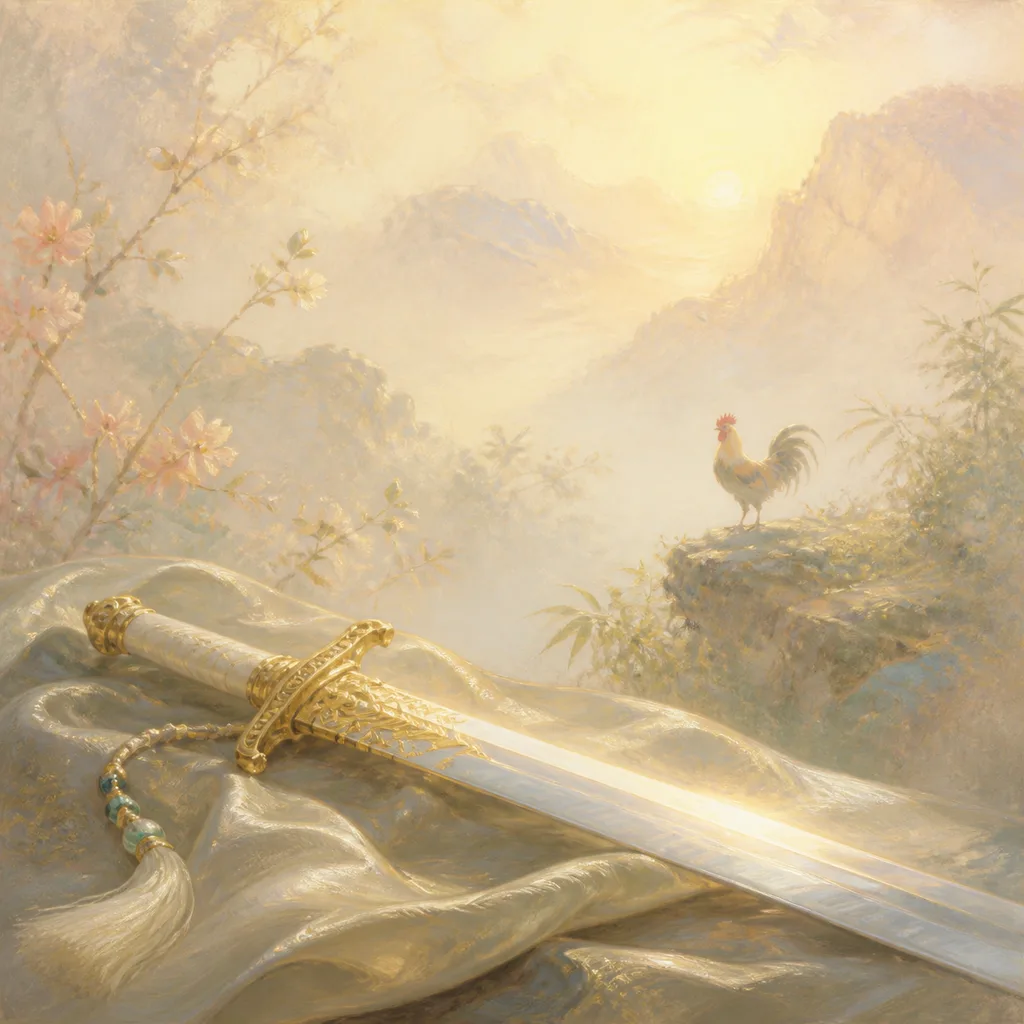
Picture a blade fresh from the forge — its edge catching the first light of dawn, impossibly sharp, yet still bearing the memory of the hammer’s rhythm. That is the Sword-Metal (剑锋金, Jian-Feng-Jin) Rooster. The Rooster is already nature’s perfectionist, a creature of exacting standards and unhurried precision. But the Sword-Metal NaYin does not merely add sharpness; it transforms the Rooster’s meticulousness into a forged, unbending will. This is the GanZhi 癸酉 (Gui-You), where the Heavenly Stem is Water and the Earthly Branch is Rooster’s native Metal. The water tempers the metal, preventing it from becoming brittle, yet the metal remains ever-ready to cut through deception and mediocrity.
The Sanming Tonghui (三命通会) speaks of Sword-Metal as ‘the White Emperor wielding power, tempered through a hundred refinements, its red light shooting into the stars, its white blade congealing like frost and snow.’ This is no ornament; it is a weapon meant for use. As a person, the Sword-Metal Rooster carries an aura of quiet authority. They do not seek attention — their mere presence commands it. Their words are few but chosen with the precision of a swordsman selecting the perfect strike. Yet there is a hidden vulnerability: the water stem gives them emotional depth, a well of feeling that can churn beneath the polished surface. They feel keenly, but they show it rarely, and only to those who have earned their trust.
The interaction between the water stem and the metal branch creates a fascinating paradox. Metal generates Water in the Five Element cycle, so the Rooster’s innate Metal nature nourishes and strengthens the water stem. This makes them even more resolute, more stubborn in their convictions. But water also flows, adapts, and seeks the lowest point. The Sword-Metal Rooster must learn to let their emotions flow without breaking the blade. They are prone to rigidity, to seeing the world in black and white. The classical text notes that ‘Fire dies at You’ — meaning the Rooster branch extinguishes fire, which can make them dismissive of others’ passions or dismissive of their own inner fire. Their challenge is to wield their sharpness without cutting what they love.
Love & relationships
In love, the Sword-Metal Rooster does not flutter and preen like their barnyard kin. They approach romance like a duel — with intense focus, a clear goal, and a reluctance to draw first. Their love language is acts of service and unwavering loyalty, not flowery declarations. They will notice the smallest details about their partner — the way they take their tea, the book they’ve been meaning to read — and act on them without being asked. But this same precision can become a blade. They have high standards, and they can be cutting when those standards are not met. A partner’s carelessness feels like a personal affront to the Rooster’s sense of order.
The water stem softens this edge somewhat, giving them a fluid emotional intelligence. They are excellent listeners, able to mirror their partner’s feelings with empathy. Yet they struggle to express their own vulnerabilities. The Liuhe (六合) match is the Dragon, whose fire can warm the Rooster’s metal and whose expansiveness can loosen their rigidity. The Sanhe (三合) trine of Ox, Snake, and Rooster offers stability and deep understanding. But the Rooster must beware of the Dog (Liuhai, 六害), whose earthy practicality can feel like a chain, and the Rabbit (Liuchong, 六冲), whose gentle evasiveness triggers the Rooster’s need for directness. The Sword-Metal Rooster’s deepest romantic lesson is this: a blade kept forever sheathed will rust. They must learn to risk showing the softer, unguarded side of their nature, even if it feels like dulling their edge.
Career & professional path
The Sword-Metal Rooster’s career is a forge where discipline meets craft. They excel in fields that demand precision, long-term focus, and an unyielding commitment to quality. Think of the surgeon whose hand never trembles, the master watchmaker who can see the invisible, the software architect who builds systems of flawless logic. The NaYin’s ‘blade edge’ quality makes them natural leaders in quality control, auditing, forensic analysis, and any role where a single error is unacceptable. They are also drawn to traditional crafts — bladesmithing, woodworking, calligraphy — where the hand and the mind must work as one.
The water stem adds a dimension of flow and communication. They can excel in diplomacy, law, or journalism, where their sharp analysis cuts through obfuscation. But they must beware of a career vulnerability: their rigidity can make them poor team players. They would rather do the work themselves than delegate to someone who might not meet their standards. This can lead to burnout and isolation. The Sanming Tonghui warns that the Sword-Metal ‘must be wielded well’ — meaning they need a worthy cause or a masterful leader to channel their energy. Without that, they risk becoming a tool that cuts without purpose. Their ideal work environment is one where their authority is respected, their standards are shared, and their contributions are clearly visible. They are not suited to chaotic startups or politics where ambiguity reigns.
Health & wellness
Metal governs the lungs, the large intestine, and the skin in Chinese medicine, and the Sword-Metal Rooster’s health is a mirror of their element. Their vitality depends on the breath — deep, conscious breathing that oxygenates the blood and calms the mind. They are prone to respiratory issues, especially if they suppress their emotions. The metal energy can become stagnant, manifesting as tightness in the chest, dry skin, or constipation. The water stem offers a counterbalance: hydration is key. They should drink warm water throughout the day and avoid excessive cold, which shocks the system.
The NaYin’s ‘sword’ imagery suggests a need for regular ‘sharpening’ — exercise that is both disciplined and rhythmic. Martial arts, fencing, or vigorous walking in nature can keep their energy flowing. They must be particularly careful with their skin, as the Rooster’s branch rules the surface. Harsh chemicals or overexposure to the elements can irritate. The five-element cycle reminds us that earth generates metal, so grounding practices — gardening, cooking with root vegetables, wearing earth tones — can stabilize their sometimes brittle constitution. They thrive on routine, but they must remember that even the sharpest blade can shatter if struck too hard. Rest is not weakness; it is the sheath that preserves the edge.
Wealth & finances
The Sword-Metal Rooster’s relationship with money is one of mastery, not obsession. They see wealth as a tool, like a well-made knife — something to be cared for, used precisely, and never squandered. They are natural savers, not hoarders. They invest in quality over quantity: a single bespoke suit rather than a closet full of fast fashion. Their financial decisions are deliberate, informed by research and a long-term view. They are not gamblers; the blade does not gamble, it calculates.
The NaYin’s ‘sword’ image also hints at a financial pitfall: they can be too rigid in their strategies, refusing to adapt to changing markets. They may hold onto a losing investment out of principle, or refuse to diversify because they trust their own analysis above all. The water stem encourages flow, so they benefit from having multiple income streams — a main career, a side consultancy, and passive investments. They should also beware of spending too much on tools and equipment, mistaking the instrument for the achievement. The greatest wealth for the Sword-Metal Rooster is not in the bank, but in the reputation they build as someone whose word is as sharp and true as their blade.
Growth & self-development
The Sword-Metal Rooster’s greatest growth edge is the very quality that defines them: their sharpness. A blade that is always cutting eventually dulls; a person who is always judging eventually isolates. They must learn the discipline of the sheathed sword — knowing when to hold back, when to let imperfections pass, when to trust another’s hand. The NaYin teaches that the finest swords are not always drawn; their power lies in their potential. For the Rooster, this means practicing active non-judgment. Every day, they can choose to notice something they would normally criticize and instead simply observe it, without reaction.
A specific practice: keep a ‘softness journal.’ Each evening, write down one moment where they chose flexibility over rigidity, or where they let someone else’s imperfection go unchallenged. Over time, this will temper the metal with water, creating a blade that can bend without breaking. The water stem already gives them this capacity; they must consciously develop it. The aspirational image of the Sword-Metal Rooster is not a warrior in battle, but a master craftsman who has forged a life of such precision and grace that their very presence is a work of art. They become the sword that needs never be drawn, because its reputation alone commands respect.
Sword-Metal Rooster Years
| Year | GanZhi | Type | Details |
|---|---|---|---|
| 1933 | 癸酉 | Sword-Metal Rooster | View Profile → |
| 1993 | 癸酉 | Sword-Metal Rooster | View Profile → |
Famous Sword-Metal Roosters
Notable figures born in 1933, 1993.
Two-time Oscar winner, Batman's Alfred, British cinema legend.
Two-time Grammy winner; vocal powerhouse with Tiger-level stage presence.
Godfather of Soul, hardest working man in show business.
A Six Harmony (六合) match — the secret friend combination, naturally aligned in energy and purpose.
Frequently asked questions
Which historical events coincided with Sword-Metal Rooster years?
Sword-Metal Rooster years (癸酉) include 1933 and 1993. In 1933, the Great Depression deepened, Prohibition ended in the U.S., and Adolf Hitler became Chancellor of Germany—a year of sharp, decisive change. 1993 saw the ratification of the Maastricht Treaty forming the European Union, the World Trade Center bombing, and the debut of the World Wide Web. These events mirror the 剑锋金’s piercing, transformative nature.
Which pairings create friction but growth for Sword-Metal Rooster?
The Sword-Metal Rooster (癸酉) finds friction with the Rabbit (卯) and Dog (戌) due to clashing branches, yet growth arises from these tensions. The Rabbit’s gentleness challenges the Rooster’s bluntness, fostering diplomacy. The Dog’s loyalty clashes with the Rooster’s perfectionism, teaching flexibility. The 剑锋金’s sharpness can cut through obstacles when paired with these signs, but requires mutual respect to avoid wounds.
How would you define the Sword-Metal Rooster identity?
The Sword-Metal Rooster (癸酉, 剑锋金) is a precise, sharp-witted individual. The 癸 water softens the Rooster’s fiery nature, while 酉 Metal gives it a cutting edge. Like a sword, they are direct, decisive, and unyielding. They thrive on order and excellence, often appearing aloof but deeply caring. Their identity is one of refined strength—a blend of elegance and toughness, always ready to take charge.
How do Sword-Metal Roosters handle stress and pressure?
Sword-Metal Roosters (癸酉) face stress with laser focus, often doubling down on their tasks. The 剑锋金’s hardness means they may become rigid or critical under pressure, but their 癸 water intelligence helps them adapt. They prefer solitude to recalibrate, using meticulous planning to regain control. However, they risk burnout if they don’t release tension through creative outlets or honest communication.
How do Sword-Metal Rooster people express love and affection?
Sword-Metal Roosters (癸酉) show love through actions rather than words. They are protective and loyal, offering practical support and thoughtful gifts. The 剑锋金’s sharpness can make them appear critical, but their affection is deep and unwavering. They value honesty and expect the same in return. A Sword-Metal Rooster’s love is a steady, sharpened blade—reliable and cutting through pretense.
What professional reputation do Sword-Metal Roosters build over time?
Sword-Metal Roosters (癸酉) earn a reputation for precision, reliability, and leadership. Their 剑锋金 energy makes them excellent surgeons, engineers, or executives who cut through inefficiency. Colleagues see them as sharp, uncompromising, and highly skilled. Over time, they become the go-to person for critical decisions, though their bluntness can intimidate. Their legacy is one of excellence and integrity.
Why is 1933 called Sword-Metal Rooster instead of Water Rooster?
In mainstream Chinese astrology, 1933 is often called the Water Rooster because its Heavenly Stem 癸 (Gui) corresponds to Water. However, the NaYin (纳音) system — a deeper layer of BaZi analysis — assigns this pillar the Sword-Metal (剑锋金) resonance. Both names refer to the same year: the Stem name (Water Rooster) describes its foundational energy, while the NaYin name (Sword-Metal Rooster) reveals its poetic-spiritual quality.
Want Your Personal Reading?
Get your complete BaZi chart with all four pillars, NaYin analysis, and life chapters.
Open Free BaZi Calculator →