
A balanced BaZi chart is not one where the five elements appear in equal numbers, but one where the Day Master’s strength lands near the middle of its range and the generating and controlling lines have somewhere to flow. This article breaks balance into three tests you can run yourself, shows why the month branch outweighs the other three pillars combined, and takes up the part most guides skip: a balanced chart is not automatically a better one.

Key Takeaways
- “Balanced” measures the Day Master’s strength, not the tally of the five elements across the eight characters.
- Three tests decide strength: the month branch (得令), the roots under the Day Master (得地), and the allies among the stems (得势).
- The month branch alone spans five states, 旺 相 休 囚 死, and outweighs the other three pillars combined.
- Balance moves. Each luck pillar runs 10 years, so a weak Day Master can spend one decade leaning on support and the next standing alone. The most common misread is counting elements: an element your chart lacks may be one you should not want.
What Balanced Actually Measures in a BaZi Chart
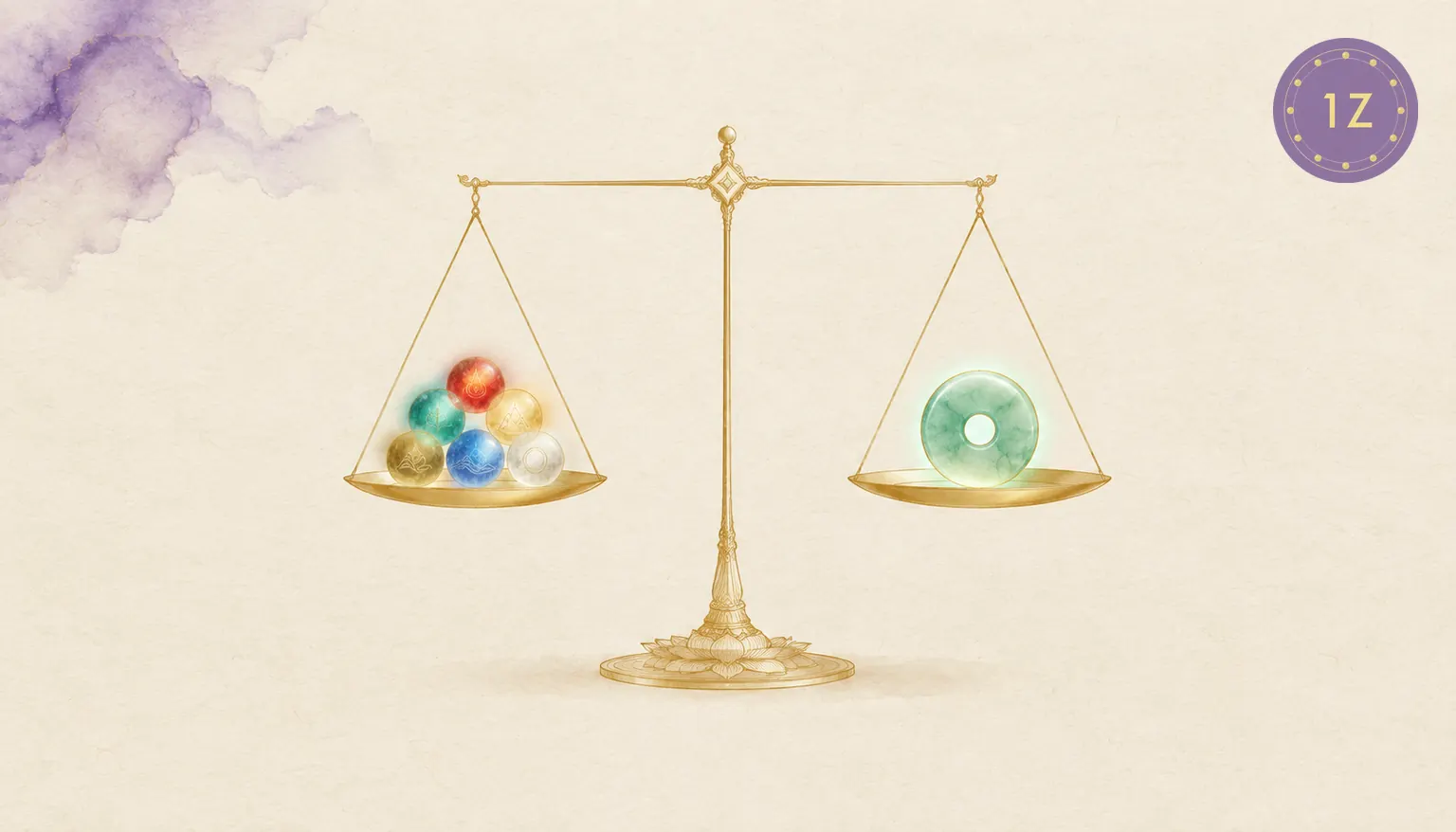
Ask ten people what a balanced chart means and nine will describe a tally: one Wood, one Fire, one Earth, one Metal, one Water, distributed evenly across the Four Pillars of year, month, day, and hour. That picture is tidy and wrong. In BaZi the useful question is never “how many of each element do I have”. It is “how strong is the Day Master, and can the chart’s energy reach the places it needs to go.”
The Day Master is the heavenly stem of your day pillar, and it stands in for you in every reading that follows. Balance describes its position on a strength scale, and three tests set that position. In my experience, balance is a working measurement of the Day Master rather than a score for the chart as a whole.
| Test | What you read | Strong signal | Weak signal |
|---|---|---|---|
| 得令 (month) | Does the month branch support the Day Master’s element? | Month branch sits in the Day Master’s 旺 or 相 set | Month branch sits in its 囚 or 死 set |
| 得地 (roots) | Do the branches hide stems of the Day Master’s element? | Day branch or another branch carries a root stem | No branch hides a stem of its element |
| 得势 (allies) | Do the other stems include peers or the element that generates it? | One or more companion or resource stems appear | Every other stem drains, controls, or spends it |
The three tests are not equally weighted. The month branch comes first because season sets the baseline the other two tests modify. A Day Master that fails the month test can still be strong if the roots and allies are heavy enough. One that passes it can be dragged toward the middle by a decade of luck pillars pulling the other way.
The Month Branch Carries the Heaviest Weight in BaZi
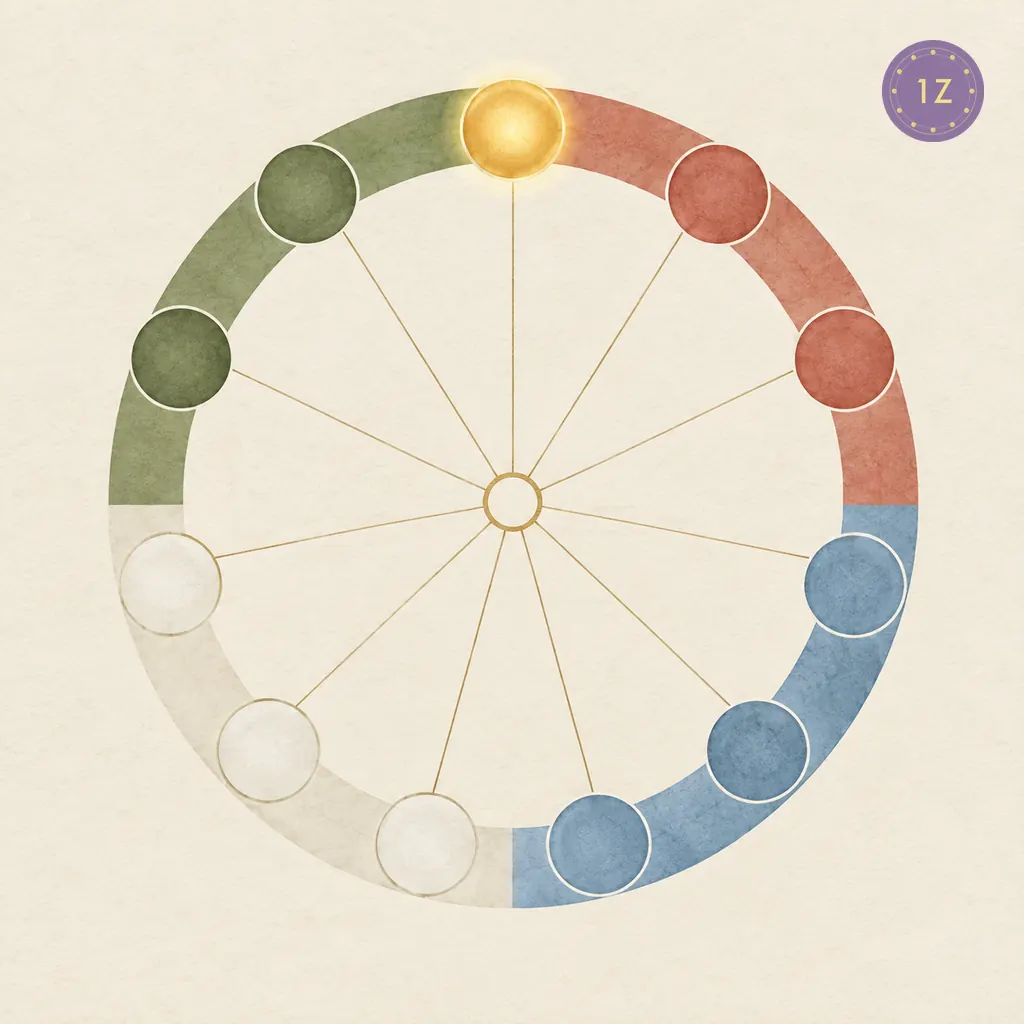
Every branch belongs to a season, and your birth month tells you what the weather was like for your Day Master’s element. BaZi sorts that relationship into five states of the five elements: 旺 (Prosperous), 相 (Supported), 休 (Resting), 囚 (Imprisoned), and 死 (Dead). The first two count as strong, the last two as weak, and 休 sits between them.
| Day Master | Strong (旺 + 相) | Moderate (休) | Weak (囚 + 死) |
|---|---|---|---|
| Wood | Zi, Yin, Mao, Hai | Si, Wu | Chou, Chen, Wei, Shen, You, Xu |
| Fire | Yin, Mao, Si, Wu | Chou, Chen, Wei, Xu | Zi, Shen, You, Hai |
| Earth | Chou, Chen, Si, Wu, Wei, Xu | Shen, You | Zi, Yin, Mao, Hai |
| Metal | Chou, Chen, Wei, Shen, You, Xu | Zi, Hai | Yin, Mao, Si, Wu |
| Water | Zi, Shen, You, Hai | Yin, Mao | Chou, Chen, Si, Wu, Wei, Xu |
Read the Wood row and the mechanism is visible. Wood in a Water month is 相 (Supported): Water generates Wood (the month element generates the Day Master), so the state is Strong, never Neutral. Move to a Fire month and Wood in a Fire month is 休 (Resting): Wood generates Fire (the Day Master’s energy pours into generating the month element), a moderate drain. Land in a Metal month and Wood in a Metal month is 死 (Dead): Metal controls Wood (the month element restrains the Day Master), the weakest configuration.
Two details trip people up here. First, 相 is strong, not neutral: a generating month props the Day Master up rather than leaving it alone. Second, 囚 and 休 are different mechanisms, so a Day Master spending itself to control the month (囚) is not the same animal as one pouring energy into what it generates (休). Month boundaries follow solar terms, not calendar months. The Yin month opens around 4 February at 立春, and the You month around 8 September at 白露, which is why a February birthday can belong to the previous year’s branch.
Our BaZi calculator runs that boundary against Purple Mountain Observatory data, the same observatory whose ephemerides we use for the calendar engine.
Roots and Allies: The Two Legs That Balance the Month
The month sets the baseline, and the other two tests adjust it. Roots are the hidden stems inside the branches, and a branch that hides a stem of your Day Master’s element gives it ground to stand on. Allies are the visible stems in the other three pillars, and two families count: companions, which share its element, and resource, which generates it.
Only three of the 12 branches hold a single stem each: Zi (癸水), Mao (乙木), and You (辛金). That detail matters. A Wood Day Master sitting on Mao has the deepest root available, since Mao holds nothing but 乙木. The same Day Master sitting on You has no root at all, because You holds only 辛金, the element that cuts Wood. Yin hides 甲木 as its main qi alongside 丙火 and 戊土, so that root is real but shared.
| Day branch | Hidden stems | Root for a Wood Day Master | Depth |
|---|---|---|---|
| Mao (卯) | 乙木 | Yes, and the branch holds nothing else | Deepest |
| Yin (寅) | 甲木, 丙火, 戊土 | Yes, as main qi | Solid, shared |
| Hai (亥) | 壬水, 甲木 | Yes, as secondary qi | Present, indirect |
| You (酉) | 辛金 | No | None |
In practice, I weight the month test above this one, then let a heavy root and two visible allies pull a weak Day Master back toward the middle. The reverse happens too when a Day Master that aced the month test meets two controlling stems and no companion.
Why a Balanced BaZi Chart Is Not Automatically a Good One
What most guides miss is where the popular picture breaks down. A chart that sits neatly in the middle sounds like the prize, and the classical literature treats it with more suspicion than that. The reading tradition prizes a chart with an imbalance that has a clean outlet over a tidy chart with nothing to work against, a stance the element cycle explains mechanically: what moves a chart is circulation, and circulation needs a slope to run down.
One case from our files makes the point. A Fire Tiger born in 1986 (丙寅, Fire stem over a Wood branch) spent years stalled in middle management, reading as strong with nothing to spend it on. The turning point was not a remedy but a change of venue: he moved to the non-profit sector, where the output the chart already produced had somewhere to land, and reached executive director within 4 years. Same chart, different outlet.
I would take a lopsided chart with a clear outlet over a tidy one with no pressure in it, every time. This is also where the ten gods earn their keep, because the Ten Gods table tells you which role each element plays for your Day Master before you decide whether an imbalance needs correcting.
Five Strength Patterns, and Where Balanced Sits
Practitioners sort Day Masters into a small number of patterns, and lists of five are common: strong, weak, following, dominant, and balanced. Strong and weak do the work, and they drive the correction logic: a strong Day Master is relieved by output, wealth, or officer lines, while a weak one leans on resource and companion lines.
| Pattern | What the chart looks like | Usual handling |
|---|---|---|
| Strong (身强) | Day Master passes the month test and holds roots or allies | Spend it: output, wealth, or officer lines |
| Weak (身弱) | Day Master fails the month test and lacks roots | Support it: resource and companion lines |
| Balanced (中和) | Sits between the two, with circulation intact | Read the flow; small nudges, not corrections |
| Dominant (专旺) | One element fills the chart and cannot be spent | Follow the element rather than fight it |
| Following (从格) | Day Master has no root and no ally at all | Follow whichever element holds the chart |
Balanced is the middle band of one spectrum, not a species with its own rules. You run the three tests, land somewhere on the line, and there correction becomes optional. The same generating and controlling lines are at work, with less urgency behind them.
Balance Moves: What Luck Pillars Do to the BaZi Scale
The reading above is a snapshot, and BaZi is a film. Each luck pillar governs 10 years and brings its own stem and branch into contact with the natal four, so a Day Master judged weak at birth can meet a decade of resource and companion support and behave like a strong one for those 10 years.
The starting age for that sequence comes from the distance between your birth date and the nearest seasonal boundary, spelled out in our piece on luck pillar starting age. What matters for balance is the implication: the answer to “is my chart balanced” carries a date range unless you name the decade.
A second case from our files shows the mechanism. An Earth Dragon born in 1988 (戊辰, Earth over Earth) went unrecognized for the first 15 years of a working life. The breakthrough arrived in his late thirties, when a favourable luck pillar came through: patents first, then industry leadership. Nothing about the natal chart changed. The decade did.
Four Misreads About BaZi Balance
The errors below share one root: treating balance as a property of the element tally rather than of the Day Master.
| Misread | Why it fails | The correction |
|---|---|---|
| Counting elements, then evening them out | Elements carry different weights depending on the month and the ten god role | Measure the Day Master’s strength first |
| “My chart lacks Water, so add Water” | A missing element is often one the chart should stay light on | Check whether that element helps or hurts the Day Master |
| Treating strength as fixed for life | Each luck pillar runs 10 years and can flip the picture | Read strength per decade |
| Assuming balanced means fortunate | A middle-band chart with no outlet has little to move | Look for circulation before you look for symmetry |
The second row sells products. Charms, colours, and names all assume an absent element is a deficit, and half the time it is the one that would do damage. I have watched people reinforce the line their chart was already fighting, and the reading got worse.
Is a balanced BaZi chart the same thing as a neutral one?
Not quite. Neutral describes a chart with no strong features either way, while balanced describes a measurement: the Day Master sits in the middle band with the generating and controlling lines still connected. A chart can be balanced in that sense and still carry sharp features, such as a clash between two branches. In our files the charts that read as genuinely middling on every axis are the minority, because four pillars drawn from 12 branches and 10 stems tend to produce one pronounced feature. Balanced is a statement about strength, not about character.
Do I need to add the element my chart is missing?
A missing element is not automatically a needed one. Whether an element helps depends on the ten god role it plays for your Day Master, and on which way your strength already leans. If your Day Master is weak, the resource element that generates it and the companion element that matches it are the supportive lines. A missing element from the controlling family is no loss at all. If your Day Master is strong, an absent controlling element may be exactly the gap that leaves the chart with nothing to push against. The honest sequence is to establish strength first, then ask which element serves it, and only then decide whether adding anything is useful.
How do I tell whether my Day Master is strong or weak?
Run the three tests in order. First, check the month branch against the five-state table and see whether your Day Master’s element sits in that element’s strong or weak set; this is the heaviest single input. Second, look for roots, meaning hidden stems of your own element inside any of the four branches, with the day branch counting most. Third, scan the other three heavenly stems for companions and resource lines. Two of three pointing the same way is usually enough to place the Day Master, and our BaZi calculator will run all three against your birth data if you would rather not do it by hand.
Can a balanced chart still meet a hard decade?
Yes, and the reason is structural. Luck pillars change the weather around a stable natal chart, so a balanced Day Master can meet a decade whose branch clashes one of its roots, or whose stem suppresses the resource line it quietly depended on. Balance describes the natal chart’s own centre of gravity. It does not immunize the chart against a decade that removes a support, which is why every strength reading needs the decade attached before it becomes advice.
Conclusion
Take the three tests in order, weight the month above the rest, and remember that the reading carries a date range once luck pillars enter. A balanced chart is not a prize and an uneven one is not a problem. What matters is whether the Day Master has support and an outlet, and you can run all three tests on your own chart with the BaZi calculator.