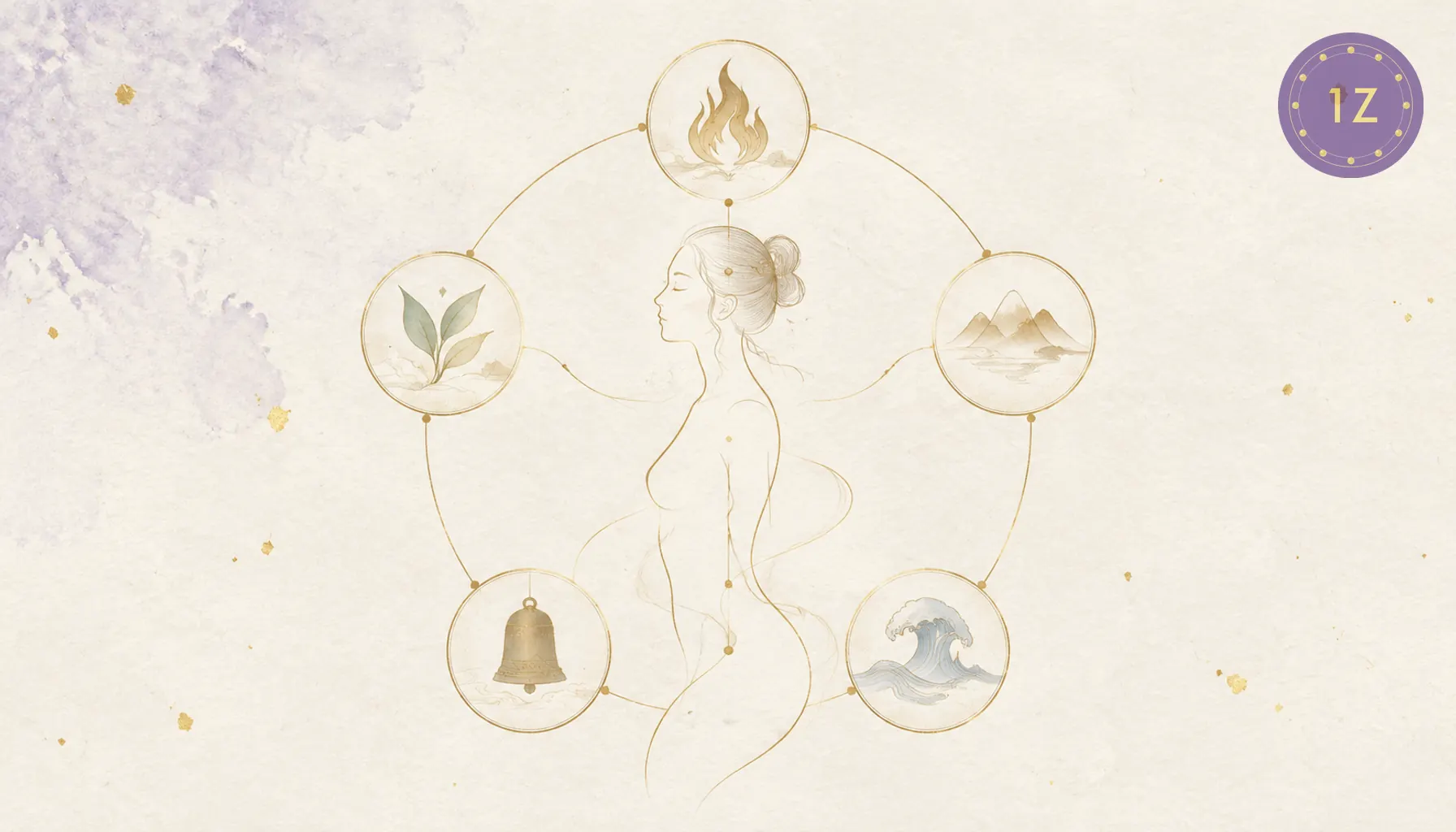

BaZi health analysis is a traditional correspondence reading: it maps the five elements in your birth chart onto the classical organ and season system, and it speaks in tendencies rather than diagnoses. The map itself is fixed and beautiful, and the honest reading stops where medicine begins. Below is the full five-element body map, a plain statement of what a birth chart can and cannot say about health, and a case that shows the framework used the way it was built for.

Key Takeaways
- The classical system maps each element to organ pairs, a season, an emotion, and a flavor: Wood to the liver, Fire to the heart, Earth to the spleen, Metal to the lungs, Water to the kidneys.
- BaZi health reading works on tendencies and correspondences, never on diagnoses; that boundary is the framework’s own rule, not a disclaimer bolted on.
- A birth chart says which elements run strong or thin in the balance, classically read as where ease or strain tends to collect.
- The generation and control cycles explain the traditional logic of support: each element feeds and checks its neighbors.
- Our five elements guide covers the engine; the BaZi calculator computes the chart behind any reading.
What a Birth Chart Health Reading Actually Is
The five-element system (五行, Wuxing) is one of the oldest organizing frameworks in Chinese thought, and the classical medical texts built a correspondence scheme on it: each element pairs with an organ system, a season, an emotion, and a flavor, and the pairs move together through the 12 months of the solar-term year. Classical references on Wuxing document the scheme’s structure and history. In a BaZi birth chart, the same five elements appear as the balance of stems and branches, which is where the two systems meet.
The pattern we see across health-flavored readings is consistent, and the meeting point defines what the reading is. A BaZi health analysis looks at the element balance in a birth chart. It reports the traditional correspondences attached to whatever runs abundant or thin. It is a lens from classical cosmology, not a clinical instrument, and no chart reading replaces a physician, a lab test, or a treatment plan. I put that sentence first in every health-flavored reading I give, because the framework earns trust by knowing its own size.
What the reading can offer is a structured vocabulary for reflection. The tradition asks which season your constitution leans toward, where its cycles suggest ease or effort for you, and what the old texts considered nourishing for each element. Those are contemplation prompts with 2,000 years of footnotes, and our balanced chart guide covers the same balance logic on the chart side.
The Classical Five-Element Organ Map
The correspondences below are the traditional scheme, copied as the texts present it:
| Element | Organ pair (classical) | Season | Emotion | Flavor | Direction |
|---|---|---|---|---|---|
| Wood | Liver / Gallbladder | Spring | Anger | Sour | East |
| Fire | Heart / Small Intestine | Summer | Joy | Bitter | South |
| Earth | Spleen / Stomach | Late Summer | Pensiveness | Sweet | Center |
| Metal | Lungs / Large Intestine | Autumn | Grief | Pungent | West |
| Water | Kidneys / Bladder | Winter | Fear | Salty | North |
In practice, two structural notes help the table settle in. First, the organ pairs follow the cycle order: Wood feeds Fire, Fire feeds Earth, Earth feeds Metal, Metal feeds Water, and Water feeds Wood, so the classical body map and our element cycle guide describe one machine. Second, each element’s season is its ease season in the traditional reading: Wood types and spring, Metal types and autumn, and so on, which is why seasonal language appears so often in classical wellness writing.
What a Birth Chart Can and Cannot Say About Health
The classical framework supports three kinds of statement about a birth chart, and drawing the boundary keeps the reading honest:
| A traditional reading can say | A traditional reading cannot say |
|---|---|
| Which elements run abundant or thin in the chart’s balance | That an organ is healthy, weak, or diseased |
| Which correspondences (season, emotion, flavor) the tradition attaches to those elements | That a food, herb, or routine will treat anything |
| Where the cycles suggest strain or ease tends to collect, as tendency language | When any health event will happen, or that one will |
That said, the tendency language is the whole craft. Take a chart with thin Water. The classical reading describes a constitution that leans toward effort in the season and sphere the tradition attaches to Water, and the old wellness advice for that shape is rest, flow, and stillness rather than more pushing. If your own chart shows that shape, the reading gives you a theme to watch, not a verdict to carry. The same chart tells you nothing about anyone’s kidneys. The tradition never claimed otherwise; the claim belongs to modern keyword articles, not to the classical framework.
A Birth Chart Case From the Files: The Missing Water
A 1961 Metal Ox client, a manufacturing executive, arrived with a health scare at 50 behind him and a schedule that had not changed in 10 years. His chart read as the classical perpetual-motion shape: Earth generating Metal, discipline feeding execution in a loop with no pause built in. Water sat thin to absent in the balance. The traditional reading of a thin-Water chart calls for the qualities Water carries: flow, rest, stillness, reflection.
The client’s own account of what followed is the part I keep in my case files. He took up structured rest, including a weekly swim, and cut his workload by roughly 30%. He reported that his decision quality improved in the same season as the rest did, and the company’s revenue grew during his recovery year. I would file that under the tradition’s own logic rather than under medicine. The chart described a shape that ran without pause, the classical advice for the shape was rest and flow, and the man used the framework as permission to stop. His physicians handled the medical layer entirely; the chart handled the metaphor, and the metaphor was what he would actually act on. You can draw your own boundary the same way: let your chart organize your reflection, and let your doctor organize everything else.
Can BaZi really predict illness?
BaZi cannot really predict illness, and the classical framework does not claim to. What a birth chart offers is a balance description: which of the five elements run abundant, thin, or strained in the traditional correspondence system, with each element mapped classically to organ pairs, seasons, and emotions. Tendency language is the ceiling of the craft, a chart can say where the tradition sees effort collecting, and it cannot say that any organ will fail, when anything will happen, or that a diagnosis follows from a stem-branch pattern. Every serious classical text treats the body map as a cosmological correspondence, not as clinical machinery, and a modern reader who wants medical answers needs a physician, not a chart. The honest use of the map is reflective: it names themes to pay attention to, in the same way a seasonal calendar names themes for a garden.
How is a BaZi health reading different from a medical checkup?
The two practices differ in object, method, and output, and keeping them separate protects both. A medical checkup measures a body. Blood work, imaging, and history produce statements about actual organs, backed by clinical method and falsifiable evidence. A BaZi health reading reads a birth chart: the same birth data always yields the same pillars, and the reading then applies the classical five-element correspondences to the chart’s balance, producing tendency language about where ease or strain classically collects. The chart reading is deterministic about its own arithmetic (the same birth data always yields the same pillars, computed from astronomical solar-term data cross-checked against the Purple Mountain Observatory record) and interpretive about its meaning. The checkup is empirical all the way through, and readings on this site run under Mei Lin Chen’s editorial review besides. In practice the two never compete, because they answer different questions: the physician answers what is, the chart offers a vocabulary for what to reflect on. Anyone managing a real condition should treat the chart as a companion to care, never as a substitute for it.
How should you use the five-element map without turning it into medical advice?
Use the map for its classical purpose: correspondence and reflection, with the boundary named out loud so you know exactly what you are holding. The safe sequence runs in three steps. Read the chart’s element balance, note the traditional organ, season, emotion, and flavor attached to the prominent or thin elements, then translate those correspondences into lifestyle themes the tradition itself suggests: rest and flow for thin Water, rhythm and routine for strained Earth, stillness for excess Fire. Every step stays in tendency language, and every step stops before any claim about organs, treatments, or outcomes. The line to watch for is prescription. The moment a reading says that a food, herb, practice, or supplement will fix something in the body, it has left the traditional framework and entered medical territory, which belongs to professionals. Our framework keeps the map on the reflection side of that line, and readers should keep it there too.
Conclusion
BaZi health analysis is the classical five-element body map read over a birth chart: organ pairs, seasons, emotions, and flavors attached to the elements your pillars carry, reported in tendencies and bounded by its own rule. The map rewards reflection and refuses diagnosis, and that is precisely why it has lasted. To see the element balance the map would read, run your birth data through our free BaZi calculator.
Sources
- Wuxing / Five Elements (Wikipedia): backs the five-element correspondence system and its classical structure.
- Four Pillars of Destiny (Wikipedia): backs the birth-chart framework the reading applies.
- Chinese astrology (Britannica): backs the classical cosmological setting of the five-element system.