
The day pillar in BaZi represents two things at once: its Heavenly Stem is the Day Master, the self, and the Earthly Branch beneath it is the spouse palace, the marriage seat. Classical palace maps also assign this pillar to the middle stretch of life, roughly ages 33-48. This guide takes the day pillar apart job by job, so you can read both halves without overreading either.

Key Takeaways
- The day pillar represents two roles at once: the day stem is the Day Master, and the day branch is the spouse palace
- Palace maps place it in the middle years, roughly 33-48, though age bands vary by school
- Every Ten Gods label is measured from the day stem, which itself stores nothing
- The day branch stores one to three hidden stems, read as partner signals in the day stem’s language
- Only a year whose branch interacts with your day branch disturbs the marriage palace directly
One Pillar, Two Jobs: How the Day Pillar Splits the Birth Chart
Every pillar in a BaZi birth chart pairs one of the 10 Heavenly Stems with one of the 12 Earthly Branches. Polarity rules allow only yang-with-yang and yin-with-yin pairings, so exactly 60 legal combinations exist, and the day pillar steps through all of them across a repeating 60-day cycle: a 365-day year covers six full laps of 60 plus five extra pillars. This daily turnover is why two people born in the same zodiac year usually sit under different day pillars, a rhythm inherited from the ancient sexagenary cycle.
The two halves differ structurally: a Heavenly Stem such as Jia can never appear as a branch and never stores hidden stems, because hidden stems live only inside the 12 Earthly Branches. In a Jia Zi day pillar, the pair numbered 1 of 60, the Zi branch underneath stores a single hidden stem, Gui Water, while the Jia stem on top stores nothing at all.
That asymmetry creates the two jobs. The stem answers for you, supplying the element and the lens every later judgment passes through. The branch answers for the marriage seat, a small room with one to three occupants. One pillar, two departments.
The Day Pillar’s Palace Address in the Birth Chart
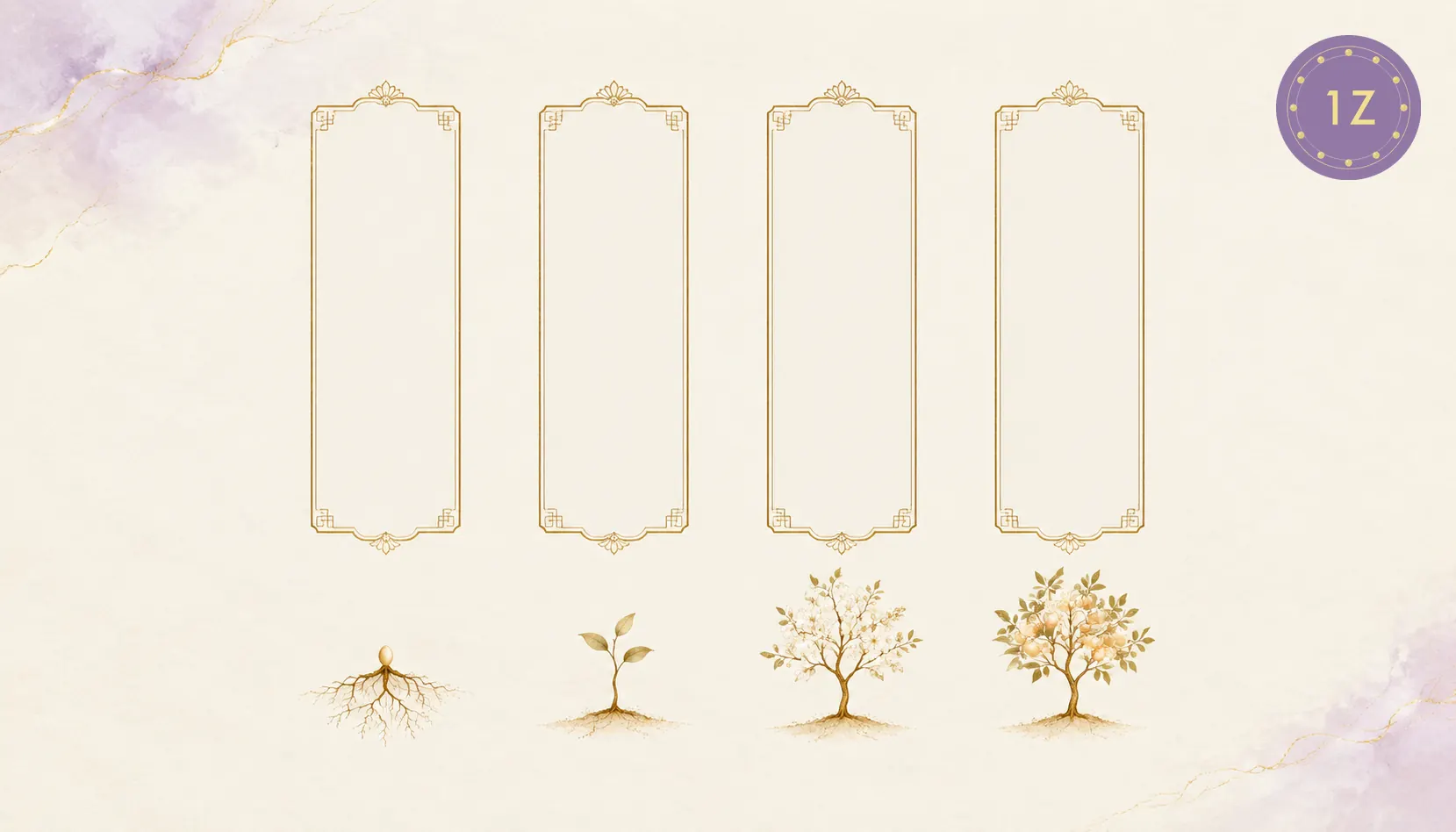
A day pillar never reads alone. Classical texts give each pillar a palace meaning and a stretch of life, and the four pillars framework treats the day column as the chart’s center of gravity. When I lay out a chart for a first reading, this map tells me which pillar you should consult for which question.
| Pillar | Palace meaning | Life stage (classical) | Traditional image |
|---|---|---|---|
| Year | ancestors, extended family, early environment | roughly 1-16 | the root |
| Month | parents, siblings, career foundation | roughly 17-32 | the seedling |
| Day | the self and the spouse palace | roughly 33-48 | the flower |
| Hour | children, later years, private world | 49 and after | the fruit |
The day pillar’s stage covers roughly 33-48, which is why marriage questions lean on this column hardest, and why the tradition calls it the flower of the chart. Two cautions keep the map honest: age bands vary by school, so treat 33-48 as a reading aid rather than a timer, and the pillar keeps working at every age, because the self and the spouse seat do not retire at 48.
Job One: The Day Stem’s Half of the Day Pillar
Anyone whose day stem is Jia, regardless of birth year, reads the whole chart in Jia’s language. Every other stem, and every hidden stem, receives a Ten Gods label measured against that one reference: Wu Earth becomes Indirect Wealth, Xin Metal becomes Direct Officer, Ding Fire becomes Hurting Officer. The vocabulary of 10 possible day stems stays small even when the combinations do not.
What stands out about the day stem is how quietly it rules: it stores nothing itself, yet every judgment is phrased in its terms. In my case files, the clients who argue with a reading are usually arguing with a measuring stick they never chose, a salary or a temperament scored in someone else’s language, and the reading only moves once we swap the reference. The day stem is the chart’s own measuring stick. Our full walkthrough of the 10 day stems lives in the day master guide.
Job Two: The Day Branch’s Half of the Birth Chart
The branch under the day stem is the spouse palace, the marriage seat. Reading it means opening the storage room: main qi first, middle qi second, residual qi last, then each hidden stem is translated into a Ten Gods label relative to the day stem.
A Jia day stem sitting on Zi hears one clear voice. Zi stores a single hidden stem, Gui Water, which Jia reads as Direct Resource, a signal classically read as care and shelter. Two more pillars show how the room fills up:
| Day pillar | Branch stores (main qi first) | Signals in the stem’s language |
|---|---|---|
| Jia Zi | Gui Water | Direct Resource |
| Jia Xu | Wu Earth, Xin Metal, Ding Fire | Indirect Wealth, Direct Officer, Hurting Officer |
| Bing Shen | Geng Metal, Ren Water, Wu Earth | Indirect Wealth, Seven Killings, Eating God |
Across the wheel, three branches hold a single hidden stem (Zi, Mao, You), two hold two (Wu and Hai), and seven hold three. A spouse palace describes tendencies, and no pillar announces that a partner will be a certain type; in my reading the seat describes the room, and the annual branch describes who visits. The deeper seat mechanics sit in our spouse palace guide.
Which Years Touch the Day Pillar
A palace matters when something arrives at its address, and arrivals are annual. The rule that keeps palace readings clean is positional: the spouse palace reacts when a year’s branch interacts with the day branch, and only then; interactions with the month branch belong to the month zone.
The 2026 Bing Wu year supplies the clean example. Wu clashes Zi, a Six Clash pair, so if you carry Zi as your day branch, 2026 is the year your marriage seat comes under direct pressure, an event that recurs once every 12 years and next falls in 2038. If instead your month branch is Zi, the same Wu year pressures the month zone of the palace map, and the marriage seat stays untouched.
In practice, the most common palace mistake I see is a month-branch clash being read as a marriage event. The two clashes share a branch name and nothing else, and a single interaction stays single: one year, one branch, one palace zone.
Reading the Day Pillar in Your Birth Chart: Three Steps
- Find the day pillar: enter the birth date and exact birth time into a calculator and read the third column from the left.
- Read the stem: note its element and polarity, which gives your Day Master, one of 10 possible day stems.
- Read the branch: list its hidden stems main qi first, then translate each into the day stem’s Ten Gods language.
One boundary at step one deserves care: the Zi hour spans 23:00 to 01:00, and schools differ on whether a 23:00-24:00 birth belongs to the ending day or the next. A birth inside that window deserves a check against exact calendar data before the pillar is read.
Births near midnight get that check from exact conversion tables, such as the Hong Kong Observatory calendar data our engine cross-references. Our methodology page documents the calculation chain the columns run through.
Is the day pillar the same as the day master?
The day master is one half of the day pillar. The day pillar is the full pair: a Heavenly Stem on top, an Earthly Branch underneath, plus whatever hidden stems the branch stores. “Day master” points at the stem alone, one of 10 reference elements; “day pillar” points at the whole seat drawn from 60 legal pairings, and each pairing’s nayin is fixed by the classical table. The nayin of the Jia Zi pair is Sea Metal (海中金), a Metal label over a Wood stem and a Water branch, so the same Jia day master wears a different poetic coat depending on the branch beneath it. The precise version: stem for the self, branch for the spouse palace, with the nayin of the pair written over both.
Does the day pillar really stop mattering after age 48?
The 33-48 band is a classical convention, and age bands vary by school, so the map routes questions rather than scheduling events. The Day Master is still measured from the day stem for life, and the ten-year luck pillars keep being read against that same reference, so the day pillar stays load-bearing at every age. Marriage questions still consult the spouse palace at any age, because the seat does not move when the years do. Treat the other bands, roughly 1-16 for the year pillar, 17-32 for the month, and 49 and after for the hour, as signposts for which palace to weigh first.
How do I calculate my day pillar if I was born right before midnight?
A birth near midnight raises one question for the day pillar: which calendar day to use. The Zi hour runs 23:00 to 01:00, and schools differ on whether a 23:00 to 24:00 birth belongs to the ending day or the next one, so a 23:30 birth can produce two legitimate day pillars. Time zone adds a wrinkle: charts use the birthplace’s local standard time, and daylight saving shifts the window. Run both candidate days through a calculator, compare the two day pillars, and note where they differ, which is usually the branch rather than the stem. Our calculator documents the boundary rule it applies on the methodology page.
Conclusion
The day pillar represents the self and the marriage seat in one stroke: a stem that measures everything and stores nothing, a branch that stores the partner’s signals. Enter your birth date and time in our free BaZi calculator and you can read the day pillar’s two jobs for yourself.
Sources
- Four Pillars of Destiny, Wikipedia: backs the four-pillar structure and the Day Master as the chart’s reference point.
- Gregorian-Lunar Calendar Conversion, Hong Kong Observatory: backs exact calendar conversion for day-boundary questions.