
The bazi life palace (命宫, ming gong) is a two-character addition to a birth chart. One Earthly Branch is seated by counting from the birth month and the birth hour; one Heavenly Stem is inherited from the birth year’s stem. This guide walks the classical three-step method, seats six program-checked example palaces, and adds the sister conception palace (胎元, tai yuan).

Key Takeaways
- Three inputs, all already on the chart: the birth month number (1 to 12), the birth hour branch (12 two-hour windows), and the birth year’s stem.
- The classical method seats month one at the Rat and counts backward to the birth month, then counts the birth hour forward to the Rabbit; the text’s own example, a Jia Zi year month-3 birth at the Xu hour (19:00-21:00), seats at Mao with stem Ding (Ding Mao 丁卯).
- The conception palace (胎元) needs only the month pillar: advance its stem one step and its branch three steps, so a Geng Zi month yields Xin Mao (辛卯).
- Our editorial framing counts the pair as characters nine through twelve: overlays that color a reading, never fifth and sixth pillars.
Two Palaces Off the Pillars: What the Life Palace Is
A BaZi chart writes four pillars at birth, eight characters in total, and the life palace adds a ninth and tenth. The palace is not printed by the birth date; it is computed from values the chart already holds, which is why classical texts call the procedure “seating” the palace (安命宫, an ming gong).
The computation takes three inputs. First, the birth month number from 1 to 12, counted in solar-term months where month 1 opens at Li Chun with the Tiger month. Second, the birth hour branch, one of 12 branches on 12 two-hour windows running from the Rat hour, 23:00 to 01:00, to the Pig hour, 21:00 to 23:00; the hour pillar’s own duties live separately. Third, the birth year’s stem.
Practitioners read it as a baseline-disposition seat rather than a second chart. In my experience, beginners lose the count exactly where the counting direction changes, and in my reading the palace sets a baseline tone while the pillars carry the structure.
The Classical Three Steps: How the Life Palace Is Seated
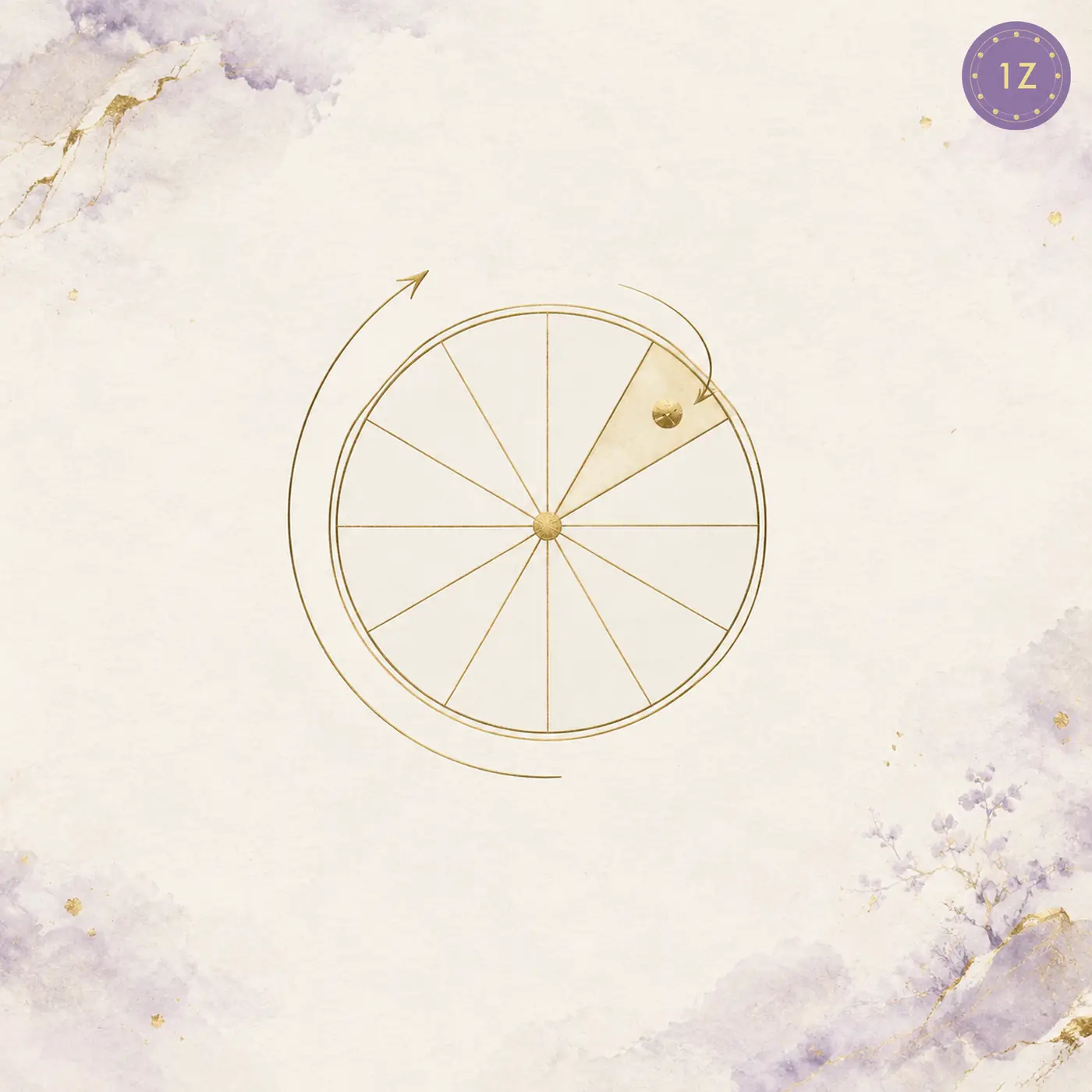
《三命通会》 records the procedure in its juan 2 chapter “On Seating the Life Palace” (论坐命宫), whose worked example is this article’s checkpoint. Three steps seat the branch; the Five Tigers rule seats the stem.
- Seat month one at the Rat, count backward to the birth month. The Rat palace holds month 1, the Pig holds month 2, and the Dog holds month 3, so walk backward one palace per month and stop at the birth month.
- Seat the birth hour at that palace, count forward until the Rabbit. Place the birth hour’s branch on the palace where step 1 stopped, then walk forward one palace and one hour per step; the palace where the Rabbit lands is the life palace branch.
- Seat the stem with the Five Tigers launch lines. Jia or Ji years open the Tiger month at Bing; Yi or Geng at Wu; Bing or Xin at Geng; Ding or Ren at Ren; and Wu or Gui at Jia.
Take a Jia Zi year person born in the third month at the Xu hour. Place the first month on Zi, the second on Hai, the third on Xu, and stop. Then place the Xu hour on Xu, Hai on Hai, Zi on Zi, Chou on Chou, Yin on Yin, Mao on Mao. Where you meet Mao, that is the seat: the life palace sits at Mao.
《三命通会》 juan 2, “On Seating the Life Palace” (论坐命宫), translated from the Wikisource Chinese text
The passage’s next line applies the stem rule: a Jia year opens at Bing, so Mao takes Ding. The classical example’s life palace reads Ding Mao (丁卯). The year 1984 is a real Jia Zi year, so the example is not an abstraction. From that launch seat, stems advance one position per branch to the palace branch; the sibling rule for hour stems lives in the hour stem table. When I seat a palace by hand, I count it twice against that example.
Six Life Palaces Worked, Every Count Checked
The method earns trust through repetition; the table below seats six palaces across five year stems, with the classical text’s own example first. Every row was re-derived by a small program, with the arithmetic behind our methodology page.
| Birth month | Birth hour (window) | Year stem anchor | Life palace |
|---|---|---|---|
| Month 3 (Chen month) | Xu, 19:00-21:00 | Jia (1984, Jia Zi) | Ding Mao (丁卯) |
| Month 1 (Yin month) | Zi, 23:00-01:00 | Jia (1984, Jia Zi) | Ding Mao (丁卯) |
| Month 6 (Wei month) | Wu, 11:00-13:00 | Geng (1980, Geng Shen) | Geng Chen (庚辰) |
| Month 11 (Zi month) | Mao, 05:00-07:00 | Bing (1986, Bing Yin) | Geng Yin (庚寅) |
| Month 8 (You month) | You, 17:00-19:00 | Ren (1992, Ren Shen) | Xin Hai (辛亥) |
| Month 12 (Chou month) | Hai, 21:00-23:00 | Wu (1988, Wu Chen) | Ding Si (丁巳) |
Rows one and two land on the same palace from different inputs: a month-3 birth with a Xu hour and a month-1 birth with a Zi hour both walk the forward count into the Rabbit at the Rabbit’s own seat. Row five shows the walk’s reach: month 8 with a You hour seats the month count at the Snake palace, and the forward walk lands the Rabbit at Hai.
The Conception Palace: Two Moves Back to Conception
The conception palace (胎元, tai yuan) is the life palace’s quieter sibling. Where the life palace takes two inputs, the conception pillar takes exactly one: your month pillar. 《渊海子平》 (Yuan Hai Zi Ping) states the rule in its chapter on erecting the conception (论起胎法): advance the month stem one position and the month branch three positions. The resulting pillar is the conception month’s pillar (受胎之月).
A Geng Zi (庚子) month pillar advances its stem from Geng to Xin and its branch three positions from Zi to Mao, and the conception palace reads Xin Mao (辛卯). That is the primer’s own example, and a live one. The Zi month window that opens on December 7, 2026 belongs to the Bing Wu year and runs as a Geng Zi month, so a birth inside that window carries the Xin Mao conception pillar.
| Month pillar | Conception palace | Where the month pillar occurs |
|---|---|---|
| Geng Zi (庚子) | Xin Mao (辛卯) | Rat month of Bing or Xin years |
| Jia Yin (甲寅) | Yi Si (乙巳) | Tiger month of Wu or Gui years |
| Bing Wu (丙午) | Ding You (丁酉) | Horse month of Ding or Ren years |
Three details keep the rule honest. Moving a stem one position flips its polarity, and moving a branch three positions flips its parity. The pair stays polarity-matched, so every conception pillar is one of the 60 legal stem-branch combinations, and all three rows check out as legal pillars. Advancing three positions is also stepping nine back on the twelve-branch wheel, which we read as one gestation back toward conception; schools vary on the story, never on the two moves.
The pillar is a computed label, never a replacement column. The Tiger month that opened in February 1988 is the real-world instance of the second row’s rule, and advancing it gives the Yi Si conception palace. June 1987 supplies the Horse-month instance. That Bing Wu month computes the Ding You conception palace.
Why Life Palace Results Disagree: One Original Rule, Many House Rules
Search a life palace calculator and the results disagree. Counting tables and subtraction shortcuts circulate in apps and forums, and several cannot reproduce the classical example.
In practice, the checkpoint costs four minutes and a pen. Seat month 3 at the Rat, walk back to Xu, seat the Xu hour there, walk forward, and the Rabbit must land at Mao, giving a Jia year the palace Ding Mao. What most tables skip is precisely this check: one reproducible example, printed in the classical text, that any table either matches or does not. Schools differ on the shortcuts, never on the written procedure this article follows, with the methodology page documenting how our engine’s tables are verified.
What the Two Palaces Color in a Reading
A chart reads its four pillars first, and each pillar’s position carries palace duties. The year pillar covers ancestors and early years; the month pillar, parents and career; the day pillar the self, with the day branch as the spouse palace. The hour pillar, children and later years. The life palace holds no seat in that row; it is an overlay computed from two of the pillars’ own inputs, and its job in a reading is disposition, not architecture.
I have watched the same mistake in consultations: the palace gets promoted into a pillar, and a client arrives asking why their “fifth column” contradicts their day master. It cannot, because the palace is not a column. A Mao-seat palace, for instance, we read as tinting the baseline with the Rabbit branch’s fixed element, Wood, a growth-paced rather than urgent tempo, a trend-language reading because one overlay never outvotes eight carried characters.
The palaces also stay out of scoring. Across our 78-pair dataset, 48 of 78 pairs (62%) carry no classical branch relationship at all. That scoring runs entirely on the branches of two charts’ pillar positions under our methodology, and no life palace enters it.
Disposition and scoring answer different questions. A 1983 Water Pig client spent a decade in a practical career matching her pillars’ visible structure, while feeling an unnamed pull toward counseling and art. At 35 she rebuilt her practice around creative expression. The eight characters did not shout that pull, and a disposition layer like the life palace is exactly where classical reading goes looking for it.
Is the BaZi life palace the same as the Zi Wei Dou Shu Life Palace?
No, and the shared English name hides two different structures. Zi Wei Dou Shu (紫微斗数) is a separate system built on its own star placements. Its Life Palace (命宫) is the first of twelve palaces that include Spouse, Career, Wealth, and Health, all seated by those star rules. The BaZi life palace is a single computed palace seated from the birth month and birth hour, with a stem inherited from the year stem; BaZi adds only this palace plus the conception pillar. The two systems can seat different branches for the same person, so check which method a page used.
Why do some sources give different life palace results?
The 144 possible month-hour pairs collapse onto only 12 palaces, so 12 combinations share every seat and small rule differences flip which seat lands. Some calculators use tables with different starting palaces; at least one classical variant seats the months forward from the Tiger instead of backward from the Rat. The disagreements are testable: 《三命通会》 prints a complete example, a Jia Zi year birth in month 3 at the Xu hour, and the classical procedure seats that palace at Mao with the stem Ding. The seat shifts one palace at each two-hour border, so 20:55 and 21:05 in one month can seat differently. When two sources disagree, ask which original procedure each follows.
How can I find my life palace without knowing my birth hour?
Not exactly: the life palace is seated from the birth month and the birth hour together, so a fixed month with an unknown hour leaves 12 candidate palaces, one for each two-hour window on the branch wheel. A month-3 birth could seat at any of the 12 branches depending on the hour, because each hour moves the seat by one; that range makes guessing worthless. Birth certificates, hospital records, and family recollection of “early morning” or “late evening” narrow the window usefully. A responsible reading marks the palace as unresolved; every statement built on it inherits that uncertainty.
Can a conception pillar ever change my chart, and what nayin does it carry?
The nayin of the conception palace is a label, one of the five elements assigned to the pillar as a unit. The palace itself changes nothing in the chart: it never re-seats a pillar, never touches the day master, and never rewrites the year or hour pillars. The nayin of the primer’s example palace Xin Mao (辛卯) is Pine Wood (松柏木), a Wood-element name, and the years 1951 and 2011 hold the same label as Xin Mao years. Classically the label is read as a background tone under the chart’s earliest layer, and stays interpretive. The deterministic part is only the two moves, stem advanced by one and branch advanced by three. Every school computes those the same way.
Conclusion
The bazi life palace is the chart’s first computed structure: three inputs, three classical steps, and one stem rule shared with the month pillar. Its sister conception palace adds two more from the month pillar alone; together the pair supplies characters nine through twelve, coloring the baseline without ever outvoting the pillars. For your personalized reading, try our free BaZi calculator.
Sources
- San Ming Tong Hui, juan 2 (Wikisource): the classical chapter and its worked Jia Zi year example.
- Four Pillars of Destiny, Wikipedia: frames the pillar system the life palace computes on top of.
- Sexagenary cycle, Wikipedia: backs the ten-stem, twelve-branch wheel and the 60 legal stem-branch pairings.
- Hong Kong Observatory calendar conversion: our engine’s calendar cross-check.