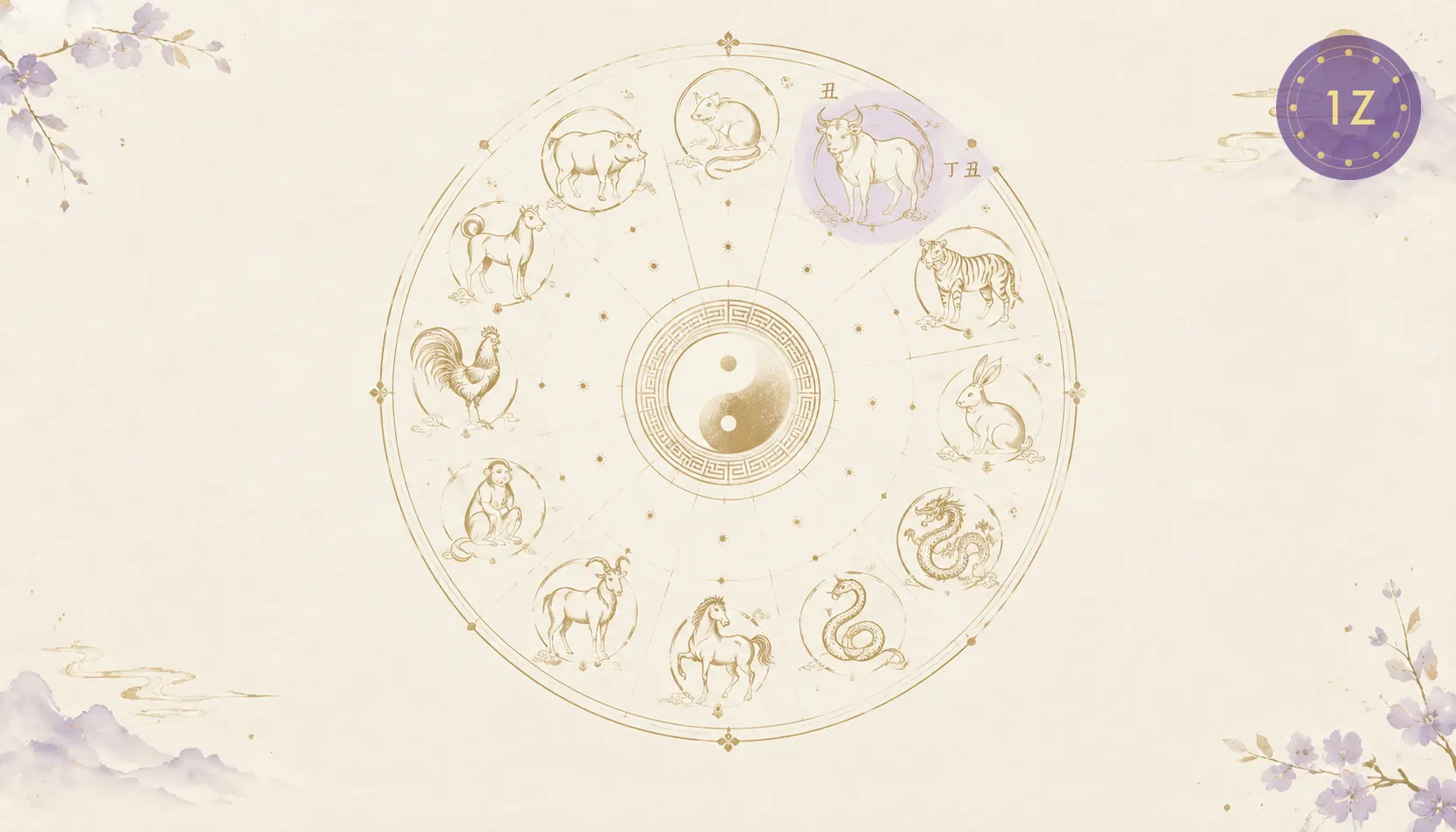

If you were born on a day whose Heavenly Stem is Yi (乙, the second stem) during the Chou double-hour (丑, 01:00 to 03:00), your hour pillar is Ding Chou (丁丑). That answer is not an opinion: it is fixed by a lookup rule over 1,000 years old, the Five Rats Escape (五鼠遁). This article shows the two-step derivation, the full twelve-hour table for Yi days, and the birth-time traps that quietly change which double-hour you actually belong to.

Key Takeaways
- The answer: Yi day + Chou hour = Ding Chou (丁丑). Ding is Yin Fire as the hour stem; Chou is the Ox branch holding three hidden stems.
- The method is the Five Rats Escape (五鼠遁): Yi days start the Rat hour at Bing Zi, and counting forward two branches lands the Chou hour on Ding.
- Chou hour runs 01:00 to 03:00 local solar time, not clock time, and the window belongs to the day you are currently living through, which matters after midnight.
- The hour stem Ding reads as an Eating God (食神) for a Yi Wood Day Master, the pairing of gentle output and quiet craft.
- The Chou branch stores three hidden stems, Ji Earth, Gui Water, and Xin Metal, which is why late-night Ox-hour charts so often read as accumulators.
The Answer First, Then the Reason It Cannot Drift
Ding Chou is the only hour pillar a Yi-day, Chou-hour birth can produce. There is no school variation, no seasonal adjustment, no interpretive wiggle room at this step of charting. The reason is mechanical: the day stem locks the starting point of the hour-stem sequence, and the hour branch is fixed by the clock. When both inputs are known, the output has exactly one legal value.
In my practice, every stem-branch claim gets checked against a deterministic lookup table before it goes out, the same way an accountant re-adds a column. In fifteen years of reading charts, the mistakes I see in other people’s hour pillars almost never come from bad philosophy. They come from copying a table wrong, or from applying the wrong day’s sequence to the hour. The tool catches the first error, and the next section’s two-step logic catches the second.
The Five Rats Escape: Two Steps From Yi to Ding
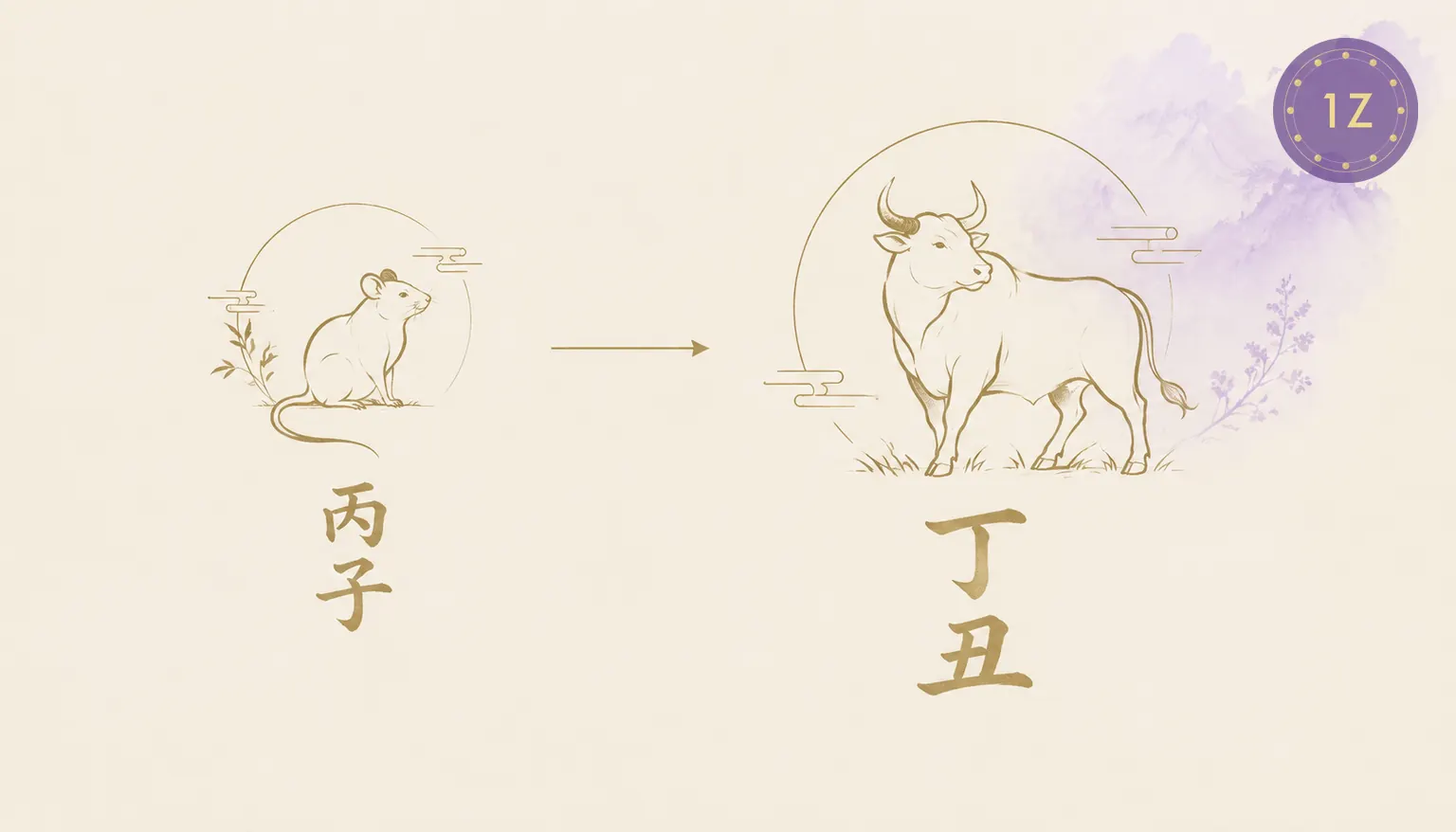
The Five Rats Escape (五鼠遁, Wu Shu Dun) answers one narrow question: given the day stem, what stem sits on each of the twelve hour branches? The name comes from the Rat, the first branch of the twelve. Every derivation begins by fixing the stem on the Rat hour (子时, 23:00 to 01:00), and the rest of the day inherits from it.
Step 1: anchor the Rat hour. The classical mnemonic assigns each day-stem pair its starting Rat-hour stem. For a Yi day the anchor is: Yi and Geng days begin the Rat hour at Bing Zi (丙子). Say it once and the rest follows.
Step 2: count forward in pairs. Stems advance one position per branch, and because stems cycle in ten while branches cycle in twelve, the pairing shifts as you walk the clock from Bing Zi onward until the next hour arrives: Zi (Rat, 23:00-01:00) carries Bing, and Chou (Ox, 01:00-03:00), two positions into the sequence, carries Ding. That is the entire derivation for this article’s question, and the BaZi overview page covers how the other three pillars interact with the hour.
| Day stem pair | Rat hour anchor (23:00-01:00) | Example stem on Chou hour (01:00-03:00) |
|---|---|---|
| Jia / Ji days | Jia Zi (甲子) | Yi Chou (乙丑) |
| Yi / Geng days | Bing Zi (丙子) | Ding Chou (丁丑) |
| Bing / Xin days | Wu Zi (戊子) | Ji Chou (己丑) |
| Ding / Ren days | Geng Zi (庚子) | Xin Chou (辛丑) |
| Wu / Gui days | Ren Zi (壬子) | Gui Chou (癸丑) |
What stands out about the table is the discipline of the climb: each day-stem pair rises exactly two stem positions from its Rat anchor to its Chou hour, because Chou sits two branches after Zi. When a client tells me their hour pillar “feels wrong,” this table is the first thing I re-check with them.
The Full Twelve-Hour Table for a Yi Day
A Yi day walks all twelve hours like this, and the sequence is worth seeing whole because it shows the machinery, not just the answer:
| Double-hour | Window | Hour pillar on a Yi day |
|---|---|---|
| Zi (子) | 23:00-01:00 | Bing Zi (丙子) |
| Chou (丑) | 01:00-03:00 | Ding Chou (丁丑) |
| Yin (寅) | 03:00-05:00 | Wu Yin (戊寅) |
| Mao (卯) | 05:00-07:00 | Ji Mao (己卯) |
| Chen (辰) | 07:00-09:00 | Geng Chen (庚辰) |
| Si (巳) | 09:00-11:00 | Xin Si (辛巳) |
| Wu (午) | 11:00-13:00 | Ren Wu (壬午) |
| Wei (未) | 13:00-15:00 | Gui Wei (癸未) |
| Shen (申) | 15:00-17:00 | Jia Shen (甲申) |
| You (酉) | 17:00-19:00 | Yi You (乙酉) |
| Xu (戌) | 19:00-21:00 | Bing Xu (丙戌) |
| Hai (亥) | 21:00-23:00 | Ding Hai (丁亥) |
The stems cycle through their ten positions while the branches run twelve, so the pattern repeats only after sixty pairings, which is the same sixty-unit rhythm as the year cycle. Reading down the stem column you can watch Bing, Ding, Wu, Ji, Geng, Xin, Ren, Gui, Jia, Yi, Bing, Ding march in strict order, and that strictness is exactly why a verified table beats memory. Every double-hour spans two clock hours, which is where most birth-time errors begin.
What Ding Chou Actually Carries: One Stem, Three Hidden Stems
The pillar is more than its label. On the stem level, Ding (丁) is Yin Fire, and for a Yi Wood Day Master the relation reads as Output, specifically the Eating God (食神): same polarity, gentle expression. In our framework we read the Eating God hour as craft, digestion, and quiet production, the part of a person that refines rather than broadcasts.
On the branch level, Chou (丑, the Ox’s branch) is winter’s end earth. Unlike the single-qi branches it stores three hidden stems, layered by depth: Ji Earth (己) as the main qi, Gui Water (癸) as the middle qi, and Xin Metal (辛) as the remaining qi. Hidden stems live only inside branches, never on stems, and a luck pillar arriving 10 years into its cycle is what usually wakes them. In practice, clients with strong Chou hours tend to describe their second chapters, the decades after fifty, as slow-ripening rather than explosive, which matches the storage reading. One reading from my files makes the point: a 1986 Fire Tiger client, frustrated for years in corporate middle management, moved to a mission-aligned non-profit and made executive director within 4 years, a classic hour-pillar-style late harvest. The Ox page covers the branch’s seasonal character in depth.
As a palace, the hour pillar traditionally governs children, late life, and the aspirations you keep closest, and an honest reading keeps all of that in trend language. Ding Chou does not promise a quiet old age or a particular kind of child; it describes the terrain those chapters will be negotiated on.
Three Traps That Change Your Chou Hour
Trap one: clock time is not solar time. Double-hours were cut from the sun’s position, and modern time zones average that away. Each time zone spans roughly 15 degrees of longitude, and the earth turns 15 degrees per hour, so a city near the zone’s western edge can sit 30 minutes or more behind the clock. That is enough to push a 01:20 birth back across the line into the late Rat hour. For births anywhere near a window edge, adjust to local solar time before assigning the branch.
Trap two: daylight saving time. A birth recorded at 02:10 during a summer clock shift is a 01:10 birth by the standard clock. That single hour can be the difference between Ding Chou and the previous hour entirely. Subtract the 1-hour shift first, then read the window.
Trap three: the midnight seam. The Rat hour is the only double-hour that straddles two calendar days. The convention we follow: the 23:00 to 24:00 stretch is the late Zi hour (夜子时) and still belongs to the day in progress, while 00:00 to 01:00 is the early Zi hour (早子时) of the new day. Chou hour itself never crosses midnight, which makes a genuine 01:00-03:00 birth one of the safest hour calls on the chart. If your recorded time falls anywhere between 23:00 and 01:00, the day stem, not just the hour, may be in play. When a client’s life story and their chart disagree, that seam is where I look first. In my experience the lived record decides it: chart both versions, and the true day stem announces itself within one reading.
Why does the hour stem actually depend on the day stem at all?
The dependency exists because ten stems and twelve branches cannot pair one-to-one. Cycled together they produce only the sixty legal pairings in a fixed order, and an hour pillar must be one of those sixty. If hour stems were assigned independently of the day, the same double-hour on two consecutive days would drift into illegal combinations, Yang stems sitting on Yin branches. The Five Rats Escape ties the hour sequence to the day stem so that every hour pillar on every day is a legitimate member of the sixty-cycle, with each exact pairing recurring exactly once per 60-year cycle and the same rhythm reappearing in month and year pillars.
Does a 00:30 birth count as the Ox hour, or is that a different branch?
No, and this is worth being precise about. 00:30 sits in the early Zi hour (早子时), the 00:00 to 01:00 stretch, so the hour branch is Zi, not Chou, and on a Yi day the hour pillar would be Bing Zi rather than Ding Chou. The Chou window opens exactly at 01:00 and closes at 03:00, and the deeper subtlety is the day: a 00:30 birth belongs to the new calendar day. So before deriving anything, confirm the day stem is genuinely the day you think it is, because births between 23:00 and 01:00 are the one window where both the hour and the day can shift.
Is Ding Chou a good hour pillar to have?
In my experience no hour pillar is good or bad on its label, and any reading that hands you a verdict from two characters is selling certainty. What Ding Chou offers is a shape: an Eating God stem, which reads as gentle, sustained output, resting on a storage branch holding three hidden stems. Charts with that shape tend to ripen late and hold their gains, and the honest phrasing is tendency, not destiny. Whether the shape serves you depends on the Day Master’s strength, the season of the month branch, and what the other three pillars feed into the hour. That is a full-chart judgment, and it is exactly where a two-character label stops being useful.
How do I find my Chou hour if I was born outside China?
Convert to local solar time first, not Beijing time. The double-hours attach to where the sun actually was over your birthplace, so the sequence is: take your recorded local clock time, subtract any daylight saving shift in force, then adjust for your longitude relative to your time zone’s reference meridian, roughly four minutes per degree. A birth recorded at 02:40 in a city sitting 8 degrees west of its zone meridian, in a DST summer, works out to 01:08 solar time, still inside Chou. Without both corrections it would have been misread. Only after that conversion do you read the 01:00-03:00 window.
Sources
- Four Pillars of Destiny – Wikipedia: the four-pillar framework the hour pillar completes
- Ba Zi/Hour Pillar – Wikibooks: the classical stem-by-day hour table this article’s derivations agree with
- Chinese astrology – Britannica: the historical context of the stem-branch calendar
Conclusion
Yi day plus Chou hour is Ding Chou, every time, by the Five Rats Escape: anchor Bing Zi, count two branches forward, read Ding on the Ox. The two tables above let you verify that answer against your own chart in under a minute, and the timezone section tells you whether your recorded clock time even qualifies as Chou. For the full chart context the hour pillar operates in, start with the BaZi pillar overview. To see how your hour stem reads among the ten gods, the pairing table walks every role.