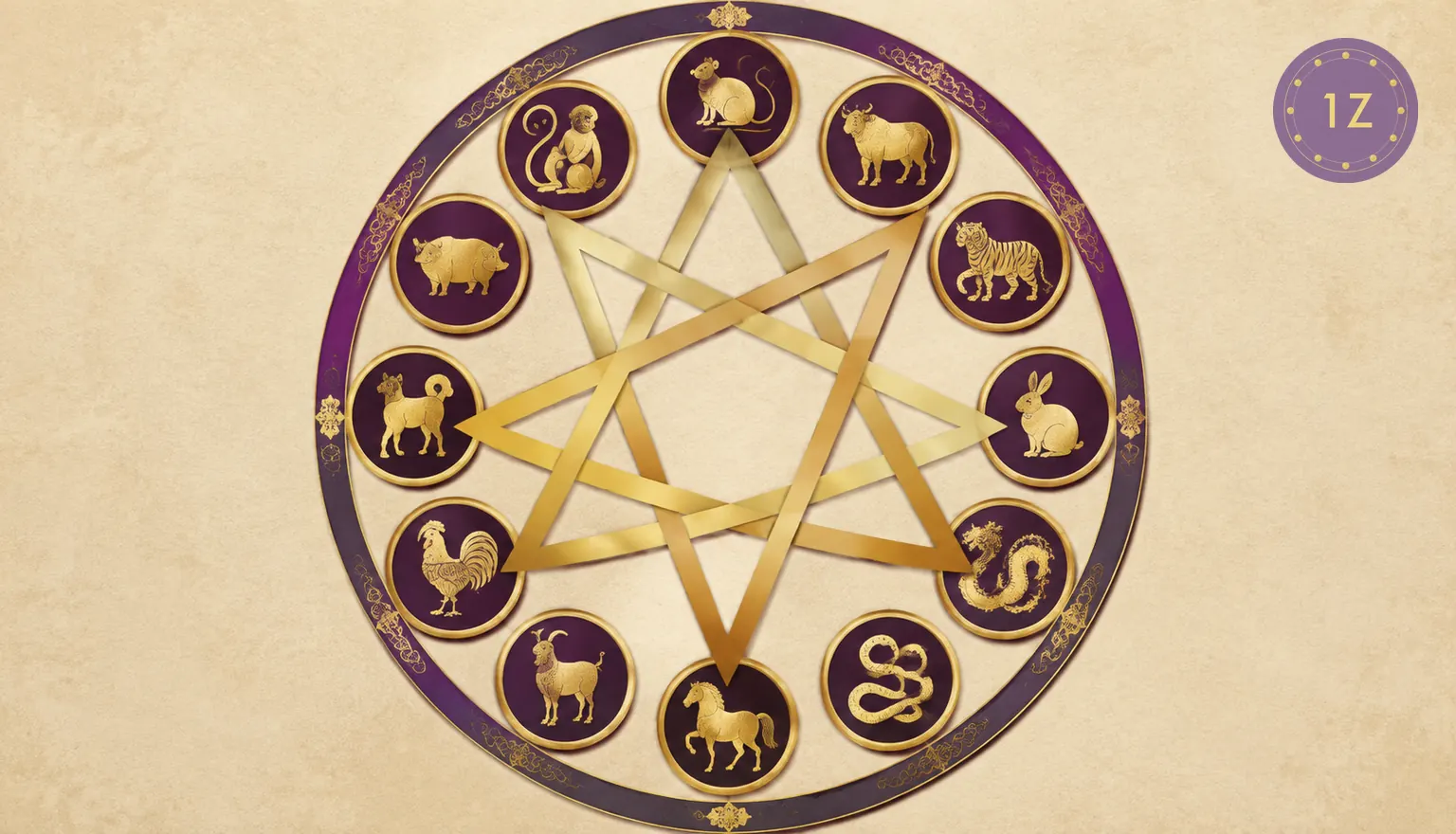

The three harmony trines (三合) are the four fixed triangles of the BaZi branch wheel: Monkey-Rat-Dragon pooling into Water, Tiger-Horse-Dog pooling into Fire, Snake-Rooster-Ox pooling into Metal, and Pig-Rabbit-Goat pooling into Wood. Where a six harmony is a pair bond between two mirror seats, a trine is a faction: three branches that pool their elements into one shared force, the strongest collective structure the wheel offers. This article walks the four groups, the three seats every group is built from, the half-combo question people actually arrive with, and the honest conditions for reading a full trine.

Key Takeaways
- 4 fixed triangles covering the 12 branches once each across the cycle: Monkey-Rat-Dragon (Water 申子辰), Tiger-Horse-Dog (Fire 寅午戌), Snake-Rooster-Ox (Metal 巳酉丑), Pig-Rabbit-Goat (Wood 亥卯未).
- Every trine is three seats with three roles: the growth seat (长生), the peak seat (帝旺), and the vault seat (墓库) that stores the pooled element.
- Two members meeting is a half alliance (半合), real but incomplete, awaiting the third seat.
- Trine pairings carry baseline weights of 88-89 points in our 78-pair dataset (methodology), below the 94-95 of six-harmony pair bonds.
- A full trine in one chart pools enormous single-element force; whether that is an asset depends on what the chart needs.
The Four Groups
The trines follow one structural rule: each triangle links three branches spaced 4 seats apart, and the three together walk one element through its full life arc, birth, peak, and storage. That is why every trine has exactly three named seats, and why the vault seat matters as much as the peak: a force with no vault has nowhere to settle.
| Trine | Branches | Element | Growth seat | Peak seat | Vault seat |
|---|---|---|---|---|---|
| Water frame | Monkey 申, Rat 子, Dragon 辰 | Water | Monkey | Rat | Dragon (water vault) |
| Fire frame | Tiger 寅, Horse 午, Dog 戌 | Fire | Tiger | Horse | Dog (fire vault) |
| Metal frame | Snake 巳, Rooster 酉, Ox 丑 | Metal | Snake | Rooster | Ox (metal vault) |
| Wood frame | Pig 亥, Rabbit 卯, Goat 未 | Wood | Pig | Rabbit | Goat (wood vault) |
Read the table once as geometry (four triangles covering all twelve branches exactly once) and once as process (each group walks its element from birth through peak into storage). The Dog, classically misread as a fire-drainer, is actually the fire vault: its function is housing the forge, not releasing it, which is the single most common trine error in pop writing.
Four triangles, twelve branches, and each group walks one element from birth through peak into storage.
The Three Seats in Reading
The three seats are not equal, and knowing their roles upgrades your reading from “these three get along” to “here is the mechanics of the alliance.” The growth seat is where the element is born, a supply point feeding the group. The peak seat is the element at imperial maximum, the group’s loudest voice. The vault seat stores and stabilizes, the treasury where the pooled force settles between activations.
In a two-person match, the seats decide texture. Inside one faction, the seats pair by role rather than by sameness: a growth seat with the peak seat is supply meeting demand, the classical strong half. A vault seat with either is ballast: slower, steadier, the alliance that endures, and the growth-plus-vault pairing specifically arches toward its absent middle seat (拱, the arching pair). Across factions, two peak-seat natives from different frames (a Rabbit peak and a Horse peak, for instance: no clash, no break, no harm line between them, and Wood feeding Fire on top) meet as two loud voices in reinforcement, and the trine habit of amplitude follows them both. In my experience, and I repeat this in every reading I give, the fastest half-combo misread is treating any two members as interchangeable, when in fact Monkey-Rat (supply to peak) and Rat-Dragon (peak to vault) are different relationships wearing the same badge.
I have one more reading habit to offer from my desk: a vault seat stores, so it activates slowly and holds long. Charts heavy in vault branches read as accumulators, strong reserves held long and opened on trigger, which is why vault-heavy people often describe their best years across a span of 20 years as the ones where something finally opened the storehouse.
Three seats, three functions: supply, volume, storage, and no two pairs inside a trine behave alike.
The Half Combo: What Two Members Make
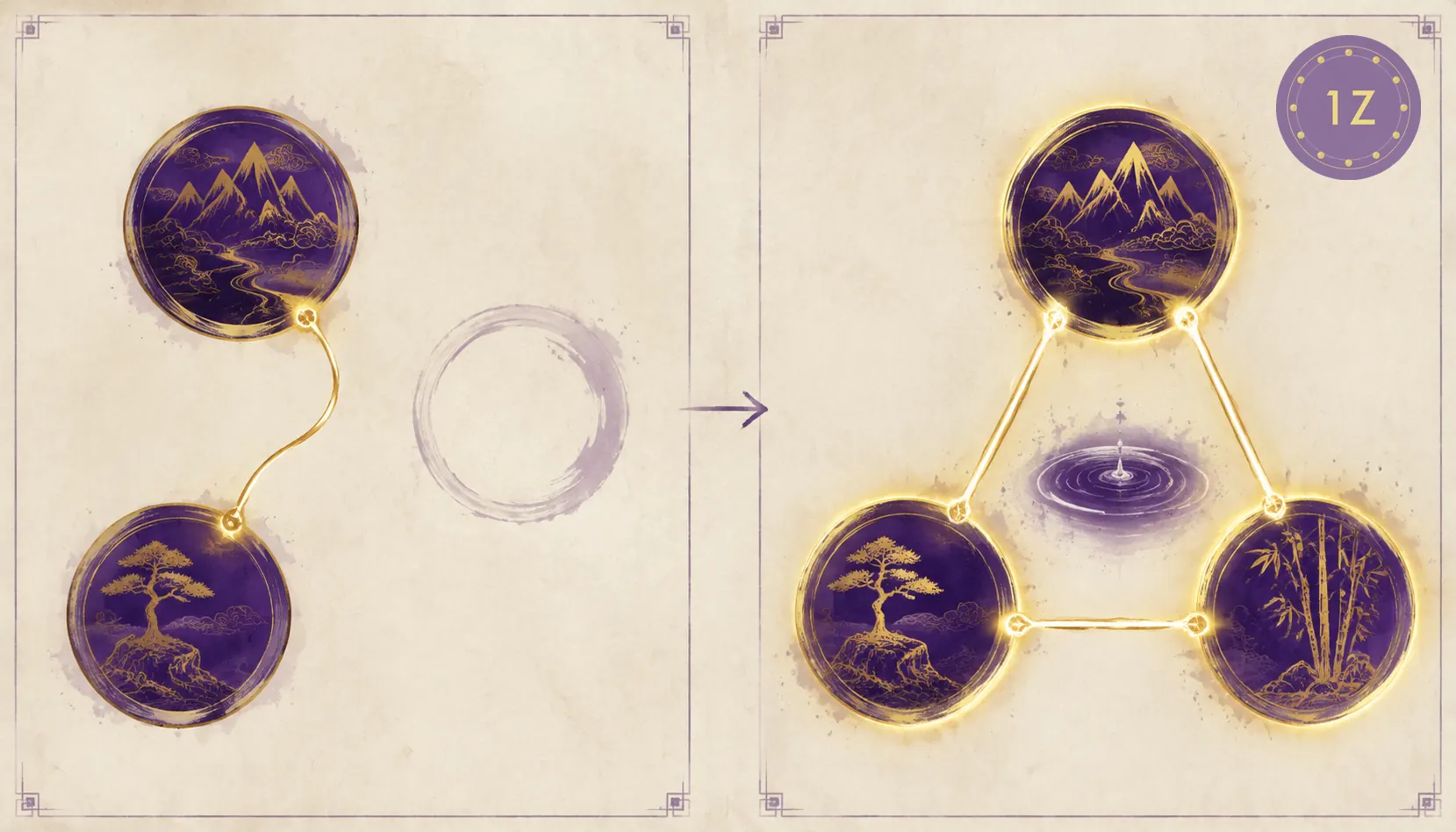
Most people arriving at this keyword hold two members of a trine, not three, so the honest question is what a half combo (半合) actually does. The classical answer: two members of a trine hold a real but incomplete alliance, a chord of the triangle that strengthens noticeably when the third seat arrives by year, by luck pillar, or by partner. The classical strong half is growth-plus-peak (supply feeding the voice); peak-plus-vault pairs the voice with the treasury, the second classical half. The growth-plus-vault pair is traditionally not a half combo at all but an arching pair (拱合): two flanks silently holding the middle seat’s place, a much weaker structure that breaks easily under clash or punishment, and any true half reads stronger in the element’s own season.
Against this, the conditions layer from our six harmony guide applies here too, with a trine-specific shape: a full trine’s pooling carries enough force that classical texts credit a complete, stem-led trine with turning the season’s own weather (回天之力, the power to reverse the sun): with the month order supporting the element and a stem leading transparently, the pooling completes as a true transformation; against a hostile season, the same trine reads as a counter-current, forceful but contested, spending itself against the chart’s climate. A Monkey-Rat-Dragon water frame in a winter chart with a transparent Ren stem reads as the pool actually filled; the same three branches in a dry summer chart read as three allies waiting for rain.
I close with the boundary note I give every client: trine membership never cancels other geometry. Dragon and Dog sit in different trines and also clash diametrically; a chart holding both carries alliance pressure and clash pressure at once, and in our analysis of the 78 zodiac pairings, the honest reading names both rather than averaging them away. Definitions, denominators, and limits sit on the methodology page.
Two members make a real half; three make a pool; and a pool still needs season, a stem, and intact lines to fill.
Trines in a Full Chart and a Match
| Feature | Six Harmony (六合) | Three Harmony Trine (三合) |
|---|---|---|
| Unit | Pair bond, 2 seats | Faction, 3 seats |
| Geometry | Mirror pairs across the axis | Triangle, 4 seats apart |
| Baseline weight | 94-95 | 88-89 |
| Reads for | One-on-one cushioning | Collective pooling via environment |
Inside one chart, a full trine pools enormous single-element force, and the honest frame is conditional: if the chart needs that element, the trine is a gift of supply; if the chart already runs excess, the trine deepens the excess and the reading shifts to spending it. Between two charts, trine members read as natural allies with faction-level support, the layer our BaZi match guide walks as one of the five comparison weights, and trine pairings carry 88-89 in our dataset, strong support though short of the pair bond’s 94-95. The methodology page holds the full definitions and limitations.
What stands out to me, after 15 years of readings, is the third-party dimension a pair bond never has: trine support often arrives through the environment, a year, a workplace, a third person, rather than flowing only between the two. A Monkey-year partner entering a Rat-Dragon half combo completes the faction, which is why classical matchers read trine completion years (a Monkey year such as 2004 or 2016 arriving for a Rat-Dragon pair) as relationship-weather events even when the two people themselves change nothing.
In-chart, a trine is pooled supply to spend; between charts, faction support that often arrives through the year.
What are the three harmony trines in BaZi?
4 fixed triangles: Monkey-Rat-Dragon pooling into Water (申子辰), Tiger-Horse-Dog into Fire (寅午戌), Snake-Rooster-Ox into Metal (巳酉丑), and Pig-Rabbit-Goat into Wood (亥卯未). Each links three branches spaced 4 seats apart, and each walks its element through three named seats: growth, peak, and vault. Together the four triangles cover all twelve branches exactly once, which is why the set is complete at four and every branch belongs to exactly one trine.
Is a half combo actually just a weaker trine, or does it behave differently?
A half combo (半合) is two members of a trine meeting without the third. It is real but incomplete: a genuine chord of the triangle that strengthens when the third seat arrives by flowing year, luck pillar, or partner. The texture depends on which two seats meet, growth-plus-peak is the classical strong half, peak-plus-vault pairs voice with treasury, and growth-plus-vault is the weaker arching pair (拱合) holding the middle seat’s place, and any half reads stronger in the element’s own season. In our experience, half combos are the single most common trine question, because your chart and your pair most likely hold halves, not full triangles.
Which seat in a trine matters most, and can one seat actually override another?
My honest answer, after years of seat questions, is role-relative: the peak seat is the loudest voice, the growth seat is the supply, and the vault is the settlement, and which one “matters” depends on what the chart lacks. A chart thin in the trine’s element benefits most from the growth seat’s supply; a chart strong in the element but scattered benefits from the vault’s consolidation. The Dog in the fire trine illustrates the vault’s misread risk: it houses the forge rather than releasing it, so vault-heavy readings are about accumulation and long storage, not absence of fire.
How do trines differ from six harmonies?
Geometry and unit: a six harmony (六合) is a pair bond between two mirror seats folding the wheel along its horizontal axis, intimate one-on-one support; a trine (三合) is a three-seat faction pooling one element, collective momentum with internal roles. The scores reflect the difference in our 78-pair dataset: six-harmony pairs carry 94-95, the strongest single-line support, while trine pairings carry 88-89, faction-strong but not bond-close. A match with both reads both: the pair bond cushions, the shared faction mobilizes, often through a third party or a year.
Sources
- Earthly branches – Wikipedia: the twelve branches and the trine groupings
- Chinese zodiac – Wikipedia: the wheel structure the triangles divide
- Chinese astrology – Britannica: the classical framework behind pooling and seat roles
Conclusion
Four triangles, three seats each, one pooled element apiece: the trines are the wheel’s faction layer, read honestly as potential until the season fills them. Find your own seat and your faction’s shape on the Chinese zodiac hub, check whether you hold a half or a full, read your vault before you count your fire, and let your own chart tell you which seat you bring to your faction.