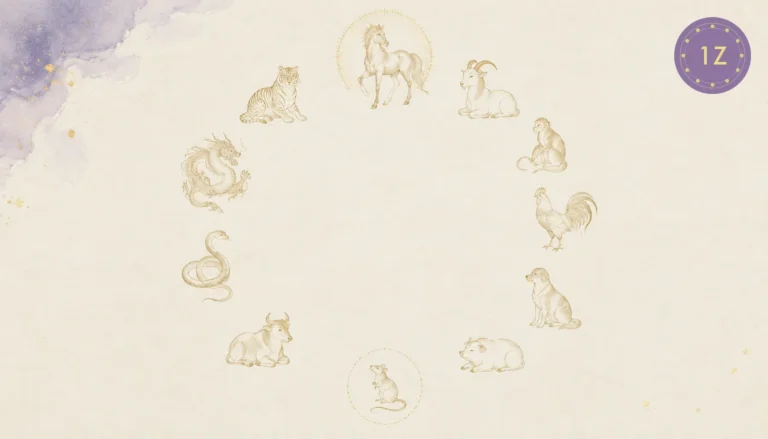


The flying knife (Fei Ren, 飞刃) is the branch that clashes a yang Day Master’s goat blade: Jia Wood’s knife posts at You 酉 (Rooster), Bing Fire’s and Wu Earth’s at Zi 子 (Rat), Geng Metal’s at Mao 卯 (Rabbit), and Ren Water’s at Wu 午 (Horse). The star shares its lookup table with the goat blade, read one row down, keyed to the day stem, never the year animal.

Key Takeaways
- A flying knife is the clash partner of a yang Day Master‘s goat blade, keyed to the day stem, never to the year animal.
- The five stem-keyed entries, four addresses in all: Jia (甲) at You 酉, Bing (丙) and Wu 戊 at Zi 子, Geng (庚) at Mao 卯, Ren (壬) at Wu 午. The five yin stems carry neither star under the mainstream five-yang reading.
- Knife addresses and blade addresses are the same four branches, the Four Cardinals (子午卯酉), swapped across two clash lines, Mao-You and Zi-Wu.
- Every knife address is another stem’s blade: Jia’s knife sits on Geng’s blade, Ren’s knife on Bing’s and Wu Earth’s blade. No branch is only a knife.
- A knife year runs whenever the year branch is your knife address: 2026 (Bing Wu) is the knife year for Ren Water Day Masters, and the next cardinal years are 2029, 2032, and 2035.
- The address marks a palace domain and a direction, not an injury forecast; this site reads stars as layers.
What the Flying Knife Is: A Day-Stem Star Read From the Blade
A flying knife is a named address a chart can carry, filed in the same classical chapter as the blade it shadows: 《San Ming Tong Hui》(《三命通会》), the Ming-era manual that systematized the symbolic-star rosters inside the Four Pillars of Destiny tradition, puts the knife in its Yang Blade chapter (论阳刃). Both hang on one mechanism: the blade marks a yang stem’s Prosperity station (帝旺), the crest of its twelve-stage ladder, and the knife is the branch that clashes it.
The key is the day stem, the Day Master, which rotates through all ten stems in ten days. Two people sharing a birth year can carry different knives, or none at all. Birth-year animals contribute nothing here; the question is about your day pillar, not your zodiac sign.
Fei Ren carries the same 刃 edge character as the blade’s name. What the chapter placement tells me is that classical readers never filed this star apart from the blade; the standalone dramatic career is mostly a translation-era development.
The Flying Knife Table: Five Stems, Four Addresses
Here is the complete lookup, one row per yang Day Master. Find your day stem and read across.
| Day Master | Element | Blade address (帝旺) | Flying knife address | Knife year |
|---|---|---|---|---|
| Jia (甲) | Yang Wood | Mao 卯 (Rabbit) | You 酉 (Rooster) | Rooster year |
| Bing (丙) | Yang Fire | Wu 午 (Horse) | Zi 子 (Rat) | Rat year |
| Wu (戊) | Yang Earth | Wu 午 (Horse) | Zi 子 (Rat) | Rat year |
| Geng (庚) | Yang Metal | You 酉 (Rooster) | Mao 卯 (Rabbit) | Rabbit year |
| Ren (壬) | Yang Water | Zi 子 (Rat) | Wu 午 (Horse) | Horse year |
Five stems produce four addresses, because Bing Fire and Wu Earth share the Horse, the same shared tenancy their blade row shows. Three of the four addresses are single-qi branches holding one hidden stem each: You holds Xin Metal, Zi holds Gui Water, Mao holds Yi Wood. The Horse is the exception, pairing Ding Fire as main qi with Ji Earth in the middle slot. The five yin stems carry no knife under the mainstream five-yang reading, and schools that extend the blade to yin stems move their knife columns along with it.
How to Find Your Flying Knife: Three Steps
The lookup takes three steps; everything you need is the day pillar, the third pillar any BaZi calculator shows.
- Identify your Day Master. Read the heavenly stem on your day pillar; that stem, not your birth-year animal, is the table’s key.
- Read the blade column. Locate your stem’s row and note the blade address, the Prosperity station of your own element.
- Read the knife column. The knife address stands across the blade’s clash line, and the table has already done that crossing; read the address to the right and you are done.
A chart whose day pillar reads Geng Xu (庚戌) carries a Geng Metal Day Master, so the blade posts at You and the knife at Mao 卯, the Rabbit’s branch. A Jia Wood Day Master carries the knife at You regardless of birth year, because the year pillar never enters this table. A Bing Zi (丙子) day pillar already places the knife address inside its own day branch, the interesting case below.
Clients expect step three to be the hard one; it is the only one the table has already finished.
Flying Knife and Goat Blade: One Table, Two Rows
The goat blade and the flying knife run on one register: the same day-stem key, five yang stems, four cardinal addresses. The blade is the Prosperity row; the knife answers a different question, namely which branch clashes the blade.
Read the rows together and the strike-year falls out free: the year branch that clashes your blade is your knife address, so a Horse year does two different things depending on the day stem. For Ren Water Day Masters, 2026 (Bing Wu) is the knife year, the year branch landing on the address that clashes their Zi blade. For Bing Fire and Wu Earth Day Masters, the same Horse is their own blade address arriving, an arrival rather than a strike, since a branch matching a stem’s own address repeats it. When I read a chart, I keep the two rows on one card: blade row for temperament, knife row for the strike-year.
| Day stem | Its flying knife | That address is whose blade |
|---|---|---|
| Jia (甲) | You 酉 | Geng’s blade |
| Bing (丙) | Zi 子 | Ren’s blade |
| Wu (戊) | Zi 子 | Ren’s blade |
| Geng (庚) | Mao 卯 | Jia’s blade |
| Ren (壬) | Wu 午 | Bing’s and Wu Earth’s blade |
The crosswalk shows the mirror: every knife address is some other stem’s blade, so no branch in the roster is only a knife. The General Star keeps the same four addresses by a different axis, the trine; the knife stays on the blade’s axis and differs by row.
Every Flying Knife Address Sits on a Cardinal

The four knife addresses are the Four Cardinals (四正): Zi 子, Wu 午, Mao 卯, You 酉. The cardinal set closes over exactly two of the six clash pairs, Mao-You and Zi-Wu, and the knife table reads that pair of lines as a swap: exchange partners along the two lines and the blade set becomes the knife set, branch for branch.
In years whose branch is not a cardinal, no day stem’s knife year is running. The years 2027 and 2028, Ding Wei and Wu Shen, both sit outside the set. Successive cardinal years land three years apart, each on a different cardinal: 2026 (Bing Wu); 2029 (Ji You); 2032 (Ren Zi); 2035 (Yi Mao). The Horse returns in 2038. Each is a knife year for one or two tenant groups: Jia in 2029, Bing and Wu Earth in 2032, Geng in 2035.
The six clash pairs’ general mechanics live in the clash and combine article; this star needs only the two cardinal lines. The closed loop is calendar arithmetic: four branches in play, successive cardinals three years apart, and the same cardinal returning after twelve.
The Flying Knife in the Four Pillars: Placement, Not Grade
The table yields an address; the chart says whether it is occupied. Where the knife branch sits decides which palace domain the marker colors: the year pillar covering the family field and early years (about ages 1 to 16), the month pillar the parents-and-career palace (about 17 to 32), the day pillar self and marriage (about 33 to 48), the hour pillar children and later years (about 49 onward). An unoccupied address stays a line in the lookup, nothing more.
The Bing Zi pillar above is the clean example: the knife of a Bing Fire Day Master is Zi, so the marker and the marriage palace share one pillar. The boundary stays narrow: the spouse palace is the day branch alone, so a knife in the month branch colors the career palace and cannot be rerouted into marriage. Mainstream chart-grade names key on the month branch, while this table is day-stem keyed, so the knife marks a location and never names a grade. Grade-hunting is overkill here; the lookup is one row.
The knife is, in my reading, a labeled drawer: it says which drawer to open when a year presses the domain, not what you will find inside.
Reading the Flying Knife Without the Dread
The classical gloss collections attach alarming images to this address; the tables themselves attach only a direction. English label lists pile aliases on the name, Flying Blade, Flying Dagger, blood-named kin, until the entry reads like a warning label. The discipline this site holds across every symbolic star applies double here: an address is vocabulary, never a verdict, and the tables stop at placement.
A 1976 Fire Dragon client arrived after years of shadow-work practice, asking why she kept meeting authority figures who clipped her momentum; her file carried a fierce-named star in a prominent month-pillar seat. The reframe that held was the structural one: the star named a pattern of pressure, and pressure has conditions, not verdicts. She later built a mediation practice holding both her legal rigor and her energetic vocabulary.
The star in her file is not the flying knife; the move generalizes to every star whose name outran its mechanism. For calibration, every year pillar and clash pair here cross-checks against the engine our methodology page documents and the Hong Kong Observatory calendar tables.
A frightening name on a one-row lookup has its proportions exactly backwards; I read the table first.
Does a flying knife in BaZi actually predict injury or accidents?
No table in the classical roster converts this address into an event, and the mechanism is narrower than the glosses imply. A knife address is placement; it wakes by clash, and a cardinal has exactly one clash partner, so a knife year requires the year branch to be your knife address, on a twelve-year clock rather than continuously. Lineages weight the family differently: some read the blade’s condition first, the knife as a note in its margin. The reading here is conditional throughout: a knife year is a pacing quarter, a scheduled review of workload, travel, and deferred maintenance. The gap between a direction and a forecast is where this star actually lives.
Is the flying knife the same entry as the blood knife?
No; the distinction is a roster fact before it is a vocabulary fact. The flying knife is keyed to the day stem through the blade table: five yang stems, four cardinal addresses, one row each. The blood knife is a separate roster entry whose derivation is not stated in one voice across classical sources; this site keeps stars with unstable derivations out of its tables rather than printing a lookup that changes by book. What merges the two names in English is imagery, the shared knife character plus translation-era alias lists. The practical test: a source that computes your flying knife from anything other than your day stem’s blade row is computing a different star.
Can a variant school give yin stems a knife of their own?
Under the mainstream convention this article follows, no. The blade table covers the five yang stems (甲丙戊庚壬) only, and the knife row inherits that boundary, so the five yin stems (乙丁己辛癸) carry neither a blade nor a knife. Variant schools assign yin stems a blade by reading the yin stems’ twelve-stage ladder in reverse, which moves every station; a knife column built on such a table moves with it. We recommend naming your convention and never mixing columns across tables: the mainstream blade column and a variant knife column count different ladders.
How do you work with a flying knife year, and how often does one arrive?
A knife year arrives whenever the year branch is your knife address, and each branch returns every twelve years. Ren Water Day Masters meet Horse years on a twelve-year clock: 2026 (Bing Wu); 2038 (Wu Wu 戊午); 2050 (Geng Wu 庚午). Jia Wood Day Masters meet Rooster years on the same twelve-year spacing. The year stem runs its own ten-year lap underneath, so consecutive knife years wear different stems: 2026 Bing Fire, 2038 Wu Earth, 2050 Geng Metal. What to do in one is scheduling, not bracing: a quarter for pacing, workload triage, and deferred maintenance. The mirror group: for the stem whose blade your knife address holds, the same year is a blade arrival, a meeting not a strike.
Conclusion
The flying knife is the goat blade’s second row: five yang day stems, four cardinal addresses, one swap across the Mao-You and Zi-Wu clash lines. Read as a table entry it is arithmetic; read as a calendar, pacing, not prophecy. To see which of the four addresses your own chart holds, feed your birth data into the free 12Zodiacs BaZi calculator.
Sources
- Wikipedia, “Four Pillars of Destiny”: the pillar system housing the symbolic-star roster.
- Wikipedia, “Sexagenary cycle”: the stem-branch wheel the clash pairs and year pillars ride on.
- Hong Kong Observatory calendar conversion: the calendar service our engine uses for year-pillar cross-checks.