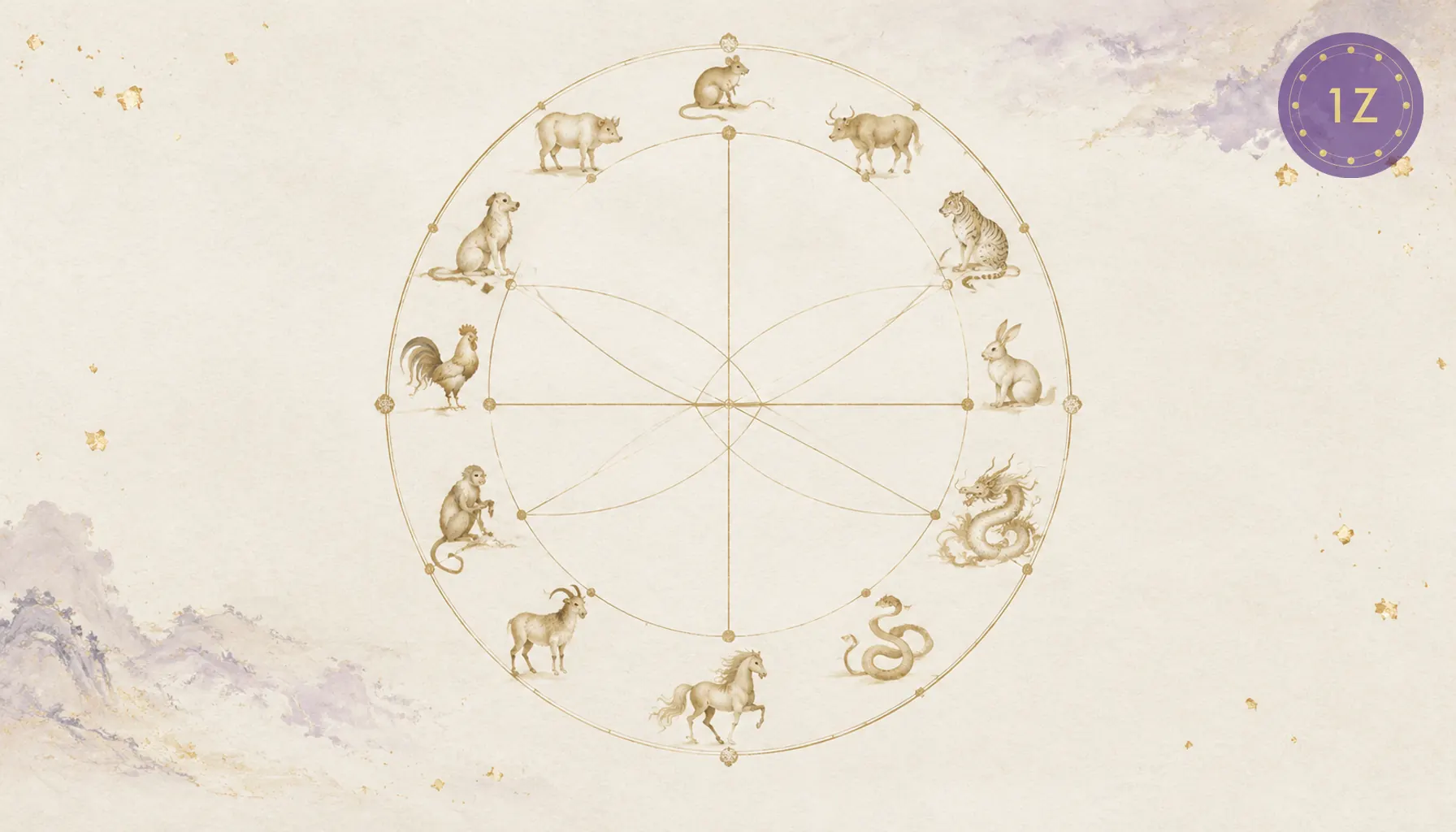

Clash (六冲) and combine (六合) are the BaZi branch wheel’s two strongest relationship lines: six pairs of branches sit in direct opposition, and six pairs hold a mirror bond across the wheel’s horizontal axis. A clash costs 38 points under our 78-pair framework, while a combine runs 94 to 95, and neither number means what beginners expect. This article maps all twelve pairs, explains the geometry behind each family, and shows how to read both without turning a score into a verdict.

Key Takeaways
- The twelve branches form exactly 6 clash pairs and 6 harmony pairs, and every branch participates in one of each.
- A clash pair sits directly opposite on the wheel and sits on the family’s 38-point floor in our 78-pair dataset; every clash pair prices identically, the only zero-variance group.
- A harmony pair mirrors across the horizontal axis and runs 94 to 95, with exactly three pairs tied at the 95-point ceiling.
- The combine’s transform (合化) is a structural potential, not an automatic event: the bond is almost always present, the transform needs conditions.
- Only 48 of 78 pairs (62%) carry no classical bond at all, which makes clash and combine the exceptions rather than the rule.
- To check which pairs your own chart carries, run your four pillars and compare the branches against the tables below.
What Clash and Combine Mean in a Birth Chart
A birth chart places twelve branches across four pillars, and classical reading pays special attention to the pairs those branches form. The Four Pillars framework treats certain branch pairings as structurally charged: the six clash pairs (六冲) oppose across the wheel’s center, and the six harmony pairs (六合) mirror across its horizontal axis. Both families are fixed. No chart invents its own clash or its own bond; the wheel decides, and the reading follows the wheel.
The two families describe different kinds of intensity. A clash is opposition: the two branches face each other from opposite seats, and classical texts read that face-off as friction that surfaces in the open. A combine is attraction: the two branches mirror each other across the axis, and the pair is read as a private channel of support. One pushes apart, one pulls together, and both push with structure rather than mood. If you have ever wondered why two people born in the same animal year get along so differently, the branch pairs each chart carries are one honest reason.
In our framework, that difference in kind shows up in the numbers before it shows up in any story. The scoring under our methodology starts from the branch relationship, adds element adjustments, and lands every clash at the same floor while keeping every bond at the ceiling.
The Six Clash Pairs in a Birth Chart: Opposites Across the Center
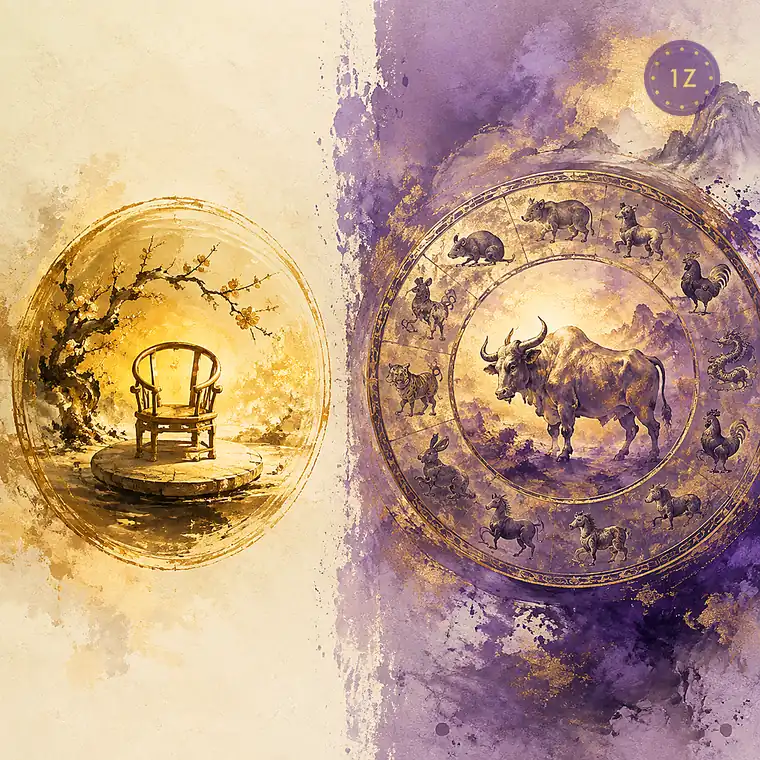
Six pairs of branches face each other from opposite seats: Rat-Horse (子午), Ox-Goat (丑未), Tiger-Monkey (寅申), Rabbit-Rooster (卯酉), Dragon-Dog (辰戌), and Snake-Pig (巳亥). Each of the 12 branches clashes exactly one partner, which is why the wheel holds exactly six clash lines and no more. The Chinese zodiac wheel makes the geometry visible: fold the circle through its center and the opposite seats touch.
| Clash pair | Branches | Score | Element dynamic |
|---|---|---|---|
| Rat-Horse | 子午 | 38 | Water-Fire: fundamental opposition, explosive |
| Ox-Goat | 丑未 | 38 | Earth-Earth: stubbornness, value conflicts |
| Tiger-Monkey | 寅申 | 38 | Wood-Metal: action vs caution, direct conflict |
| Rabbit-Rooster | 卯酉 | 38 | Wood-Metal: aesthetic vs pragmatic |
| Dragon-Dog | 辰戌 | 38 | Earth-Earth: pride vs duty |
| Snake-Pig | 巳亥 | 38 | Fire-Water: intensity vs withdrawal |
Read the table’s score column twice. Every clash pair prices at the same 38-point floor, not approximately there, and that uniformity is itself information: the framework prices the opposition, not the personalities inside it. The floor is the branch-relationship base documented on our methodology page, and element adjustments build on top of it. Nothing in the column changes when the two people change. The element dynamics differ from row to row (Water-Fire fights differently than Earth-Earth), but the structural cost of a face-off stays constant.
The Six Harmony Pairs: Mirror Bonds Across the Axis
The harmony family forms by a different geometry. Classical sources read the six harmony pairs as mirror seats, folded onto each other along the horizontal axis that runs from the Rat-Ox region to the Horse-Goat region. Only two of the six bonds (the Rat-Ox bond and the Horse-Goat bond) sit physically adjacent on the wheel; the other four reach across it as mirror lines, which is why adjacency is the wrong test for a bond and the axis fold is the right one.
| Harmony pair | Branches | Transform (structural potential) | Score |
|---|---|---|---|
| Rat-Ox | 子丑 | tending toward Earth | 94 |
| Tiger-Pig | 寅亥 | tending toward Wood | 95 |
| Rabbit-Dog | 卯戌 | tending toward Fire | 94 |
| Dragon-Rooster | 辰酉 | tending toward Metal | 95 |
| Snake-Monkey | 巳申 | tending toward Water | 94 |
| Horse-Goat | 午未 | tending toward Fire (fire-school reading) | 95 |
The transform column carries a discipline worth stating plainly. Classical texts describe each bond as tending toward an element (寅亥 pulls toward Wood, 辰酉 pulls toward Metal), and the pull is a structural potential rather than an automatic event: a full transform in strict classical terms needs month support, a transparent stem to draw it out, and no strong clash breaking the pair apart. The gap between a bond and a transform is not wording; it is conditions. The bond itself is almost always present, while the transform waits for its season. For the Horse-Goat row, the fire-school reading used here turns the bond toward Fire, while the earth-school reading is also classical, and the difference is a genuine school debate rather than an error to fix. When you read your own chart, check which pillars carry both branches before assuming the transform has anywhere to land.
What the 78-Pair Birth Chart Dataset Says About the Two Families
Across our 78-pair dataset, the two families sit at opposite poles with nothing between. Six Harmony pairs average 94.5 while every Six Clash pair sits on the same 38-point floor, a 56.5-point spread, and the harmony band spans a single point (94 to 95), which means the framework does not rank secret friends against each other. Exactly three pairs tie at the 95-point ceiling: Tiger-Pig, Dragon-Rooster, and Horse-Goat.
The clash side is even starker in its uniformity. Every clash pair prices identically at the 38-point floor, the only relationship group with zero variance, and the medians tell the tiered story: 94 for harmony, 54 for harm, 38 for clash. Harm is the quieter friction family, scoring 52 to 55, and its six pairs (Rat-Goat, Ox-Horse, Tiger-Snake, Rabbit-Dragon, Monkey-Pig, Rooster-Dog) run chronically rather than explosively. I would read the zero variance as structure talking: the framework recognizes the face-off as a fixed cost, then leaves the humans to work out what grows in that soil.
That said, the poles leave a wide middle. 48 of the 78 pairs (62%) carry no classical bond at all, scoring as neutral pairs, and most real relationships live there. Clash and combine are the wheel’s two loudest lines, not its typical ones, and a neutral pair reading is usually the honest starting point for two people who share no famous bond.
Reading a Clash or a Combine Without Over-Reading It
If you’re just starting out, read the two families as two conversation styles rather than good and bad. A clash is a disagreement the wheel built into the structure; a combine is an alliance the wheel built in; neither one decides whether two people handle it well. I have sat across the table from clash pairs who built thriving partnerships, and the cleanest example in our files is a 1960 Metal Rat and a 1966 Fire Horse who ran an import company together for years. Their Rat-Horse clash carries the family’s 38-point floor, and the partnership survived because they assigned completely separated domains: the Rat’s precision never had to share a desk with the Horse’s speed.
I keep one pattern in my case files for the combine side as well: bond strength is not bond outcome. A harmony pair with a 95 can still drift when nobody names the terms of the alliance, and a neutral pair can outperform both families through sheer tempo tolerance. The score describes the structure; the people write the story on top of it. For the friction families beyond this article’s scope, the wheel also carries harm, punishment, and break lines, which our six breaks analysis covers separately.
Is a Six Clash pair the same as a couple that always fights?
A Six Clash pair is not the same thing as a couple that always fights, because the clash is a structural opposition rather than a behavioral pattern. The pair carries a 38-point price in our 78-pair dataset, which rates the face-off between opposite branches: Water against Fire in the Rat-Horse case, Earth against Earth in the Dragon-Dog case, each with its own texture of friction. What the score does not say is how the two people metabolize that friction. The Six Harm family (52 to 55 points) is arguably the harder neighborhood for daily life, since harm is chronic erosion that rarely announces itself, while a clash at least stages its conflict in the open where it can be named. Structure is the fixed part; the fighting, or the absence of it, is the part the two people control.
Can a clash pair work as a business partnership?
A clash pair can work as a business partnership, and our case files show the mechanism. A 1960 Metal Rat and a 1966 Fire Horse built a lasting import company on a Rat-Horse clash (38 points) by assigning completely separated domains, so the wheel’s opposition never had to operate inside the same task. The structural reading explains why separation works: a clash pits two elements against each other, Water against Fire in this case, and the opposition costs least when each side runs its own territory rather than competing for one. If you are building a venture with a clash partner, the same lever is available to you: name the domains early, in writing. Intimate partnerships have less room for that trick because shared households resist domain separation, so the same two people can struggle at home while thriving in commerce, and the score stays 38 either way. The architecture decides what the opposition becomes.
Does a Six Harmony bond really guarantee an easy relationship?
A Six Harmony bond does not really guarantee an easy relationship, and the classical framework itself draws the line that proves it. The bond (合) is a structural attraction that is almost always present between the mirrored branches, but the celebrated transform (合化) into a shared element is a conditional event: strict classical readings require month support, a transparent stem to draw the transform out, and no strong clash breaking the pair. On top of that, the scores contain their own caution: harmony pairs hold 94 to 95 with three pairs tied at the 95 ceiling, which means the framework rates the bond, not the outcome, and a 95 structure still needs the two people to name their terms. Ease is a practice built on good structure. The structure makes the practice cheaper; it does not remove it.
Conclusion
Clash and combine are the wheel’s two loudest lines: six opposites on the 38-point floor, six mirror bonds in the 94-to-95 band, and a fixed geometry behind both. To see which lines your own branches hold, run your chart through our free BaZi calculator.
Sources
- Four Pillars of Destiny (Wikipedia): backs the pillar structure and the branch-relationship layer described above.
- Chinese zodiac (Wikipedia): backs the twelve-branch wheel and the opposition geometry of the clash pairs.
- Chinese astrology (Britannica): backs the classical cosmological setting of branch relationships.