
Yang Water (Ren, 壬) is the ninth of the ten Heavenly Stems in BaZi, the stem the classical texts depict as the great moving water. Your Day Master is Yang Water when your birth day pillar is one of six combinations, Ren Shen through Ren Xu. This page maps the whole current: the ten gods around Ren, its Lu and Blade seats, the twelve-month strength row, the six day pillars, and its Wood-pulling combination.

Key Takeaways
- Yang Water is the Heavenly Stem Ren (壬), the yang half of Water’s pair; Water holds 2 of the 10 stems and 2 of the 12 branches (Hai, Zi).
- The ten gods around a Ren day master sort into five families; Ding reads as Direct Wealth, Wu as Seven Killings, Gui as Rob Wealth.
- Ren’s Lu sits at Hai as its official seat, and its Yang Blade at Zi as its prosperity seat.
- Month strength runs strong for 4 months (Hai, Zi peak; Shen, You supported), draining for 2 (Yin, Mao), weak for 2 (Si, Wu), and weakest for 4 (Chen, Xu, Chou, Wei).
- Exactly 6 of the 60 sexagenary pillars carry Ren as the day stem (numbers 9 to 59).
- Strength is a starting weight, not a verdict; the Favorable Element comes from the full chart.
What Yang Water Means in a Birth Chart
Every BaZi chart sets one stem at the top of the day pillar, and that stem, the Day Master, is the reference point for everything else in the chart. Ren (壬) is the ninth stem of ten, and it carries the Water element in its yang polarity. The element divides into exactly two stems, Ren and Gui (癸), and the yang partner is the one tradition paints large: the river current and the sea swell rather than the raindrop.
That painting is imagery: it belongs to the stem’s depiction layer, not to a measured trait. In my experience, the imagery is where a Ren reading should start, and where it should stop until the chart data arrives.
The stem itself stores nothing; hidden stems live only inside branches, as our hidden stems guide keeps explicit. Ren does surface inside two of the twelve branches: Hai (亥, Pig) holds it as main qi beside Jia Wood, and Shen (申, Monkey) holds it as middle qi beneath Geng Metal. Those two branches are where a Ren day master finds roots. Six of sixty pillars carry Ren on top (roster below).
The Ten Gods Around a Yang Water Day Master
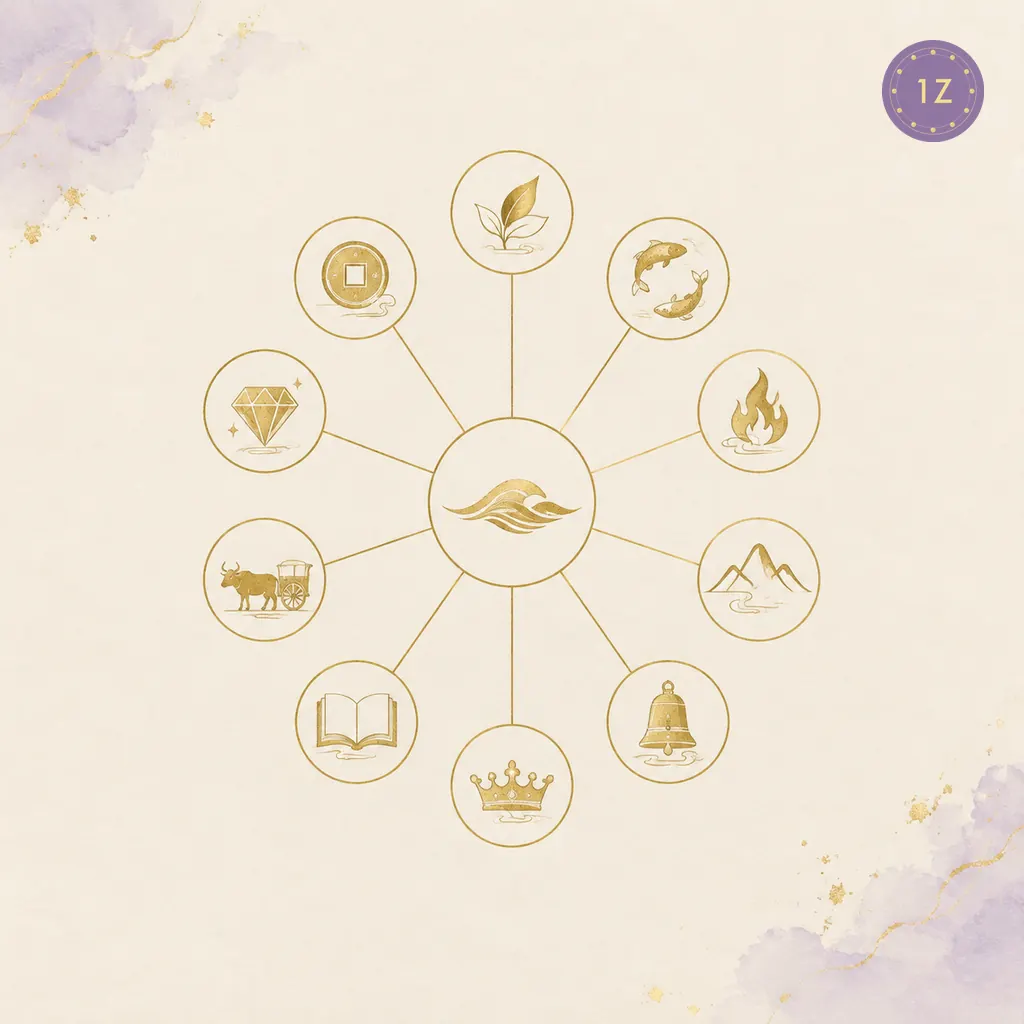
Ten Gods (十神) name the ten roles another stem can play against a fixed Day Master; the mapping is one element relation plus one polarity check. Our ten gods table publishes the general mapping; run against a Ren day master, the ten rows resolve as follows.
| Stem | Element relation to Water | Polarity vs Ren | Ten God |
|---|---|---|---|
| Jia (甲, Yang Wood) | Water generates Wood | same | Eating God (食神) |
| Yi (乙, Yin Wood) | Water generates Wood | opposite | Hurting Officer (伤官) |
| Bing (丙, Yang Fire) | Water controls Fire | same | Indirect Wealth (偏财) |
| Ding (丁, Yin Fire) | Water controls Fire | opposite | Direct Wealth (正财) |
| Wu (戊, Yang Earth) | Earth controls Water | same | Seven Killings (七杀) |
| Ji (己, Yin Earth) | Earth controls Water | opposite | Direct Officer (正官) |
| Geng (庚, Yang Metal) | Metal generates Water | same | Indirect Resource (偏印) |
| Xin (辛, Yin Metal) | Metal generates Water | opposite | Direct Resource (正印) |
| Ren (壬, Yang Water) | same element | same | Friend (比肩) |
| Gui (癸, Yin Water) | same element | opposite | Rob Wealth (劫财) |
Wealth, Officer, and Resource each split a Direct from an Indirect form by polarity: opposite takes the Direct name, so Ding reads as Direct Wealth and Ji as Direct Officer, while same polarity gives Bing as Indirect Wealth, Wu as Seven Killings, and Geng as Indirect Resource. The output and companion pairs keep their own fixed names: Jia is the Eating God, Yi the Hurting Officer, Ren itself the Friend, Gui the Rob Wealth. In practice, I treat this table as a vocabulary check: name what each stem does against Ren, and the chart becomes a set of speaking roles.
The Two Seats of Yang Water: the Lu at Hai, the Blade at Zi
Classical BaZi gives each stem a twelve-stage life cycle across the branches, and the five yang stems count forward. Ren’s row opens its Growth stage at Shen (申), passes Bathing at You and Capping at Xu, and reaches the Official seat (临官) at Hai (亥), the seat tradition calls the Lu (禄). Count the stations: three steps from Growth to the Lu, one more to the Prosperity seat (帝旺) at Zi (子), the seat named the Yang Blade (羊刃) for the five yang stems. The Lu is the stem’s salary seat; the Blade is the peak-volume seat, and since Zi stores Gui, Ren’s Rob Wealth, it carries the classical caution about partners at the till.
Two more named seats complete the row card. On the Scholar Star (文昌), the classical derivation runs: the star marks the Lu, the official seat, of the day stem’s Eating God. Ren’s Eating God is Jia, and Jia’s Lu sits at Yin, hence the seat at Yin. On the Nobleman Star (天乙贵人), the entry reads: for a Ren-stem Day Master, the Yi Gui Noble sits at the Rabbit and Snake branches (Mao-Si). Both are seats on a chart, not personality verdicts.
Month by Month: Where Yang Water Runs Strong
The month branch carries the heaviest single weight in the strength question; a Ren day master’s twelve months split into 2 peak, 2 supported, 2 draining, 2 weak, and 4 weakest. Each window below is a solar-term month (Li Chun opens Yin), never a lunar calendar month.
| Month branch | Solar-term window | State | Band |
|---|---|---|---|
| Hai (亥, Pig) | Li Dong to Da Xue | 旺 (Prosperous) | Strong, peak |
| Zi (子, Rat) | Da Xue to Xiao Han | 旺 (Prosperous) | Strong, peak |
| Shen (申, Monkey) | Li Qiu to Bai Lu | 相 (Supported) | Strong |
| You (酉, Rooster) | Bai Lu to Han Lu | 相 (Supported) | Strong |
| Yin (寅, Tiger) | Li Chun to Jing Zhe | 休 (Resting) | Moderate, draining |
| Mao (卯, Rabbit) | Jing Zhe to Qing Ming | 休 (Resting) | Moderate, draining |
| Si (巳, Snake) | Li Xia to Mang Zhong | 囚 (Imprisoned) | Weak |
| Wu (午, Horse) | Mang Zhong to Xiao Shu | 囚 (Imprisoned) | Weak |
| Chen (辰, Dragon) | Qing Ming to Li Xia | 死 (Dead) | Weak, weakest |
| Xu (戌, Dog) | Han Lu to Li Dong | 死 (Dead) | Weak, weakest |
| Chou (丑, Ox) | Xiao Han to Li Chun | 死 (Dead) | Weak, weakest |
| Wei (未, Goat) | Xiao Shu to Li Qiu | 死 (Dead) | Weak, weakest |
The engine’s canonical explanations run: Water in a Wood month is 休 (Resting): Water generates Wood (the Day Master’s energy pours into generating the month element), a moderate drain. Water in a Fire month is 囚 (Imprisoned): Water controls Fire (the Day Master restrains the month element), which costs effort; restrained, NOT generated. Water in a Earth month is 死 (Dead): Earth controls Water (the month element restrains the Day Master), the weakest configuration.
Spring is not a weak season for Ren: the two Wood months are the draining grade, where output feeds the season. Summer runs weak by restraint, and the four Earth months are weakest by direct control. The month is one pillar arguing with three others; our single-month deep read of Ji Earth under peak Wood shows the same machinery from the month side.
The Six Yang Water Day Pillars
Because the sexagenary cycle pairs yang stems with yang branches only, Ren’s day-pillar options collapse to exactly six of the sixty. Each pairs Ren with one of the six yang branches; hidden stems are listed in weight order, main qi first.
| Day pillar | Sexagenary number | What the branch holds (main qi first) |
|---|---|---|
| Ren Shen (壬申) | 9 of 60 | Geng Metal, then Ren Water, then Wu Earth |
| Ren Wu (壬午) | 19 of 60 | Ding Fire, then Ji Earth |
| Ren Chen (壬辰) | 29 of 60 | Wu Earth, then Yi Wood, then Gui Water (the Water vault) |
| Ren Yin (壬寅) | 39 of 60 | Jia Wood, then Bing Fire, then Wu Earth |
| Ren Zi (壬子) | 49 of 60 | Gui Water, single qi, the Rob Wealth |
| Ren Xu (壬戌) | 59 of 60 | Wu Earth, then Xin Metal, then Ding Fire |
Each pillar carries its own deeper reading elsewhere: year windows, sound-element labels, branch ledgers. The table fixes the structural fact: a Yang Water day master is one of six seats. For most Water natives, the seat under the stem is the first thing that separates two Ren people; the stem alone is only the headline.
Ding Ren: The Combination That Pulls Yang Water Toward Wood
Five pairs of stems combine in the classical system, each a yang stem with its yin partner. Ren owns one of the five: Ding (丁), the yin Fire stem, also Ren’s Direct Wealth in the ten gods table. The pair is classically read as tending toward Wood (合化木): structural potential, not an automatic transformation. The transformation is a conditional event, needing the season’s support, a transparent Wood stem, and no strong clash breaking the frame.
The same pairing leaves a fingerprint on the calendar. In the Five Tigers rule that sets month-pillar stems, every Ding or Ren year opens its first solar-term month at Ren Yin; the computations check out. February 20, 2027, inside a Ding Wei year, computes to a Ren Yin month, and so does March 1, 2022, inside a Ren Yin (壬寅) year; the classical mnemonic 丁壬之岁壬寅头 says exactly this. One boundary keeps this honest: stem combinations live on the stem layer, a different ledger from the 78 branch-pair zodiac scores, with no compatibility number inherited from a stem bond. Our compatibility scoring methodology documents the branch-layer framework; the stem layer here is the one classical texts apply when reading charts, not animal pairs.
What the Yang Water Framework Does Not Tell You
Depiction is not measurement, and the month row is not a destiny. The river-and-sea picture is the classical entry point to the Ren stem, and the chart is the evidence. I would rather hand a client the ten-row table and the six-pillar roster than a paragraph of ocean flattery: the table can be checked, the flattery cannot. A Dead-grade month can still reach workable strength when the other pillars contribute roots, and our balanced chart guide covers balance from both directions.
Any advice about adding an element carries a precondition, because a missing element is not automatically a needed one. The case that made this click involved a client born in a 1960 Metal Rat year (Geng Zi, Metal over the Rat’s water branch), an engineer. His chart ran metal-and-water heavy, and he assumed he needed more of both. The reading found the opposite: the water wanted a channel. The pivot he made in his forty-second year, into hospitality, a service industry that activated his missing Fire, grew into a restaurant business of 12 locations over 8 years. The lesson I keep from that file is to look for the exit before counting the volume.
Is a Yang Water day master really like the ocean?
No, a Yang Water day master is not an ocean, and the gap between the depiction and the person is the difference between imagery and measurement. The Ren stem is classically depicted as the rivers and the sea. The actual chart varies enormously around it: the day branch alone takes six values under a Ren stem, the month branch twelve, and the hour branch twelve more. Two Ren day masters born in different months sit in different strength grades. The six-pillar roster and the twelve-month row do the discriminating; the depiction starts a reading and never finishes one.
Is Yang Water the same as the Rat or the Pig in the zodiac?
They are different layers of the same calendar. The Rat (子) and the Pig (亥) are the two Water branches: the twelve-animal layer that assigns a group signature to a birth year. Yang Water is Ren, one of the two Water stems. The layers intersect without merging: a Ren day master can be born in any of the twelve animal years, and most Rat or Pig year natives are not Ren day masters. A client born in a 1995 Wood Pig year once asked why she read as a Pig when her Western sun sign felt accurate. The year pillar supplies the group baseline, the day stem the individual signature, and both were true at once.
How should you read a Yang Water chart that seems to lack water?
Only after asking whether the chart actually needs support, which is a whole-chart judgment rather than a stem count. For a Ren day master whose chart runs thin, the classical support line is Metal, which generates Water directly, and Ren’s roots sit at Hai (main qi) and Shen (middle qi). For a chart that already runs full, adding water overshoots, and classical attention shifts to the exits: Wood output, Fire wealth, Earth officer. The Favorable Element (喜用神) is computed from the full birth chart, never from one element’s presence or absence.
Conclusion
Yang Water is the Ren stem: ninth of ten, the yang half of Water’s pair, classically depicted as the great moving water, fixed at six of sixty day pillars. The ten gods table names what each stem does against it, the Lu and the Blade grade its strongest seats, and the twelve-month row sets the starting weight. To see which pillars your own chart actually holds, run your birth data through the free BaZi calculator.
Sources
- Heavenly Stems (Wikipedia): backs the ten-stem order, the Ren polarity, and the five-pair combination structure.
- Four Pillars of Destiny (Wikipedia): backs the Day Master concept, the four-pillar structure, and the ten gods framework.
- Purple Mountain Observatory: the official calendar authority whose solar-term data anchors the month windows and pillar computations above.